Author Archives: aaronwest
CCU17: Dressed to Kill (1980)
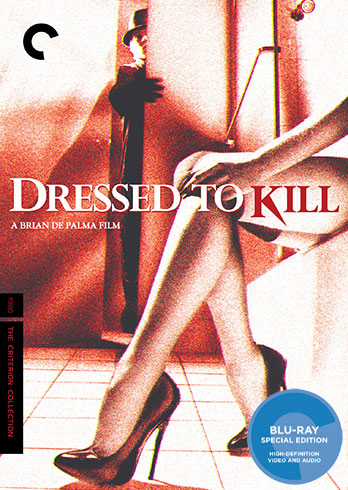
Aaron and Mark talk about Thanksgiving, Black Friday, and Brian De Palma’s 1980 sensual thriller, Dressed to Kill. We go into De Palma and how he’s just a film buff that is able to make movies, plus we investigate the expression of sexuality through therapy, and how De Palma was able to use film language to convey his character’s desires. And of course, we talk about the iconic museum scene.
Or listen here to it here:
Or direct download/listen to the MP3.
Show notes:
Outline:
0:00 – Intro, Housekeeping
19:00 – News
30:20 – Dressed to Kill
Intro
Criterion Fans Show Their Dedication
Get us to 1,000 likes on Facebook
News
Setsuko Hara: Ozu’s Quiet Muse Dies at 95.
Criterion Tribute to Ozu and Hara
Dressed to Kill

Where to Find Us:
Mark Hurne: Twitter | Blog | Letterboxd
Aaron West: Twitter | Blog | Letterboxd
Criterion Close-Up: Facebook | Twitter | Email
Short Cuts 4: 3:10 to Yuma (1957)

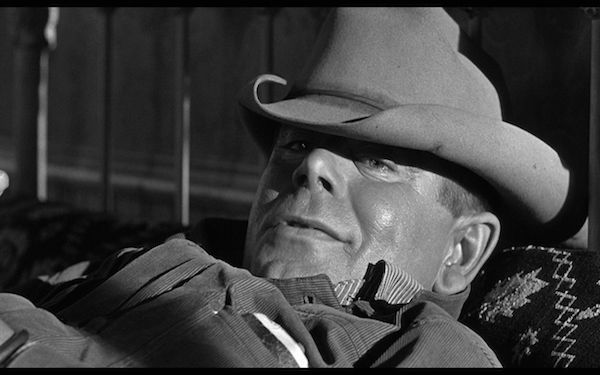
Aaron West discusses the second in the Delmer Daves, Glenn Ford trilogy, which could be considered a “Western Noir” because of the clever shot selection, the use of light and shadow, and the multifaceted characters.
Or listen here to it here:
Or direct download/listen to the MP3.
3:10 to Yuma
Where to Find Us:
Mark Hurne: Twitter | Blog | Letterboxd
Aaron West: Twitter | Blog | Letterboxd
Criterion Close-Up: Facebook | Twitter | Email
CCU16: February 2016 New Releases & The #CriterionBlogathon
Aaron, Mark, Kristina Dijan (Speakeasy) and Ruth Kerr (Silver Screenings) discuss the February 2016 Criterion Collection line-up and then we delve into the Criterion Blogathon, which was an epic experience for all of us. We talk about some of the behind the scenes info, give out prizes, talk about the social media thrills with the #CriterionBlogathon, and give our thanks to all who participated.
Or listen here to it here:
Or direct download/listen to the MP3.
Show notes:
Outline:
0:00 – Intro, Housekeeping
9:20 – News & February Releases
38:40 – Criterion Blogathon
Intro
Kristina – Speakeasy Blog | Twitter
Ruth – Silver Screenings Blog | Twitter
Image of 4 Month, Three Weeks, 2 Days
News
Kristina’s In Cold Blood review
Aaron’s The Apu Trilogy Review
Kitchen Conservations: Gaspar Noé
February 2016 Releases
Criterion Blogathon
Recap, Day One: English Language Films released before 1947
Recap, Day Two: Europe and Mexico
Recap, Day Three: English Language Films, 1947-1980.
Recap, Day Four: Asian Cinema
Recap, Day Five: English Language films, 1981 to present.
Recap, Day Six: Essays and Box Sets.
F For Films – Favorites from the Criterion Blogathon
Grand Prizes:
Research: Cinematic Scribblings
Portrait: Coffee Gone Cold
Originality: Criterion Affection
Humorous: CineMaven’s Essays from the Couch
Where to Find Us:
Mark Hurne: Twitter | Blog | Letterboxd
Aaron West: Twitter | Blog | Letterboxd
Criterion Close-Up: Facebook | Twitter | Email

Criterion Blogathon: Day 6
The last official day of the Blogathon. Thanks to all who participated!


This has been amazing.
Today was the last day of the Criterion Blogathon, a blogging event that celebrates some of the best films in the world.
Films covered include Hollywood classics, art house flicks, foreign films and cult classics. The essays presented over the past six days are inspiring, amusing, challenging and thought-provoking.
The blogathon is dedicated to Criterion, but it’s also an expression of love for the art of filmmaking in all its forms. On behalf of Aaron at Criterion Blues, Kristina at Speakeasy and yours truly, thank you for supporting this incredible blogging experience.
Wait – there’s more! On Sunday, November 22, tune into a special episode of Criterion Close-Up, hosted by Aaron and Mark, with guests Kristina of Speakeasy and yours truly. We’ll be discussing the Criterion Blogathon and debating our favorites. It promises to be a lively discussion!
Below are the final set of posts. But first! We want to hand out some awards.
 Awarded…
View original post 264 more words
Criterion Blogathon: Day 5 Recap
Welcome to the penultimate recap post for this highly successful #CriterionBlogathon. Again, thank you to all the participants — bloggers and readers. The response has been tremendous.
Today’s recap is the third installment of the English language series, from 1981 to present.
Tune in tomorrow for the final day, which will be the biggest. We’ll be covering the big Essays and Boxsets. You can see the full schedule over at Speakeasy.
On Sunday we will be recording a special episode of Criterion Close-Up. Kristina and Ruth will join us as we talk about the week. We’ll be announcing the Grand Prize winners and talking about some of our favorites, so make sure you tune in.
I also want to thank Joshua from F for Films for listing his favorite posts. We love seeing that sort of engagement!
Pop Culture Pundit – The Musical Pulse of Andrew Haigh’s “Weekend.”
Marvel Presents Salo – Beastie Boys Video Anthology
A Scunner Darkly – The Unbearable Lightness of Being

Checkpoint Telsar – Robocop
USA
Superfluous Film Commentary – Paris, Texas (1984)
Checkpoint Telstar RoboCop (1987)
A Scunner Darkly – The Unbearable Lightness of Being (1988)
MovieRob – Do the Right Thing (1989)
Tales from the Border – Mystery Train (1989)
Reel Distracted – Dazed and Confused (1993)
Loud Green Bird – Being John Malkovich (1999)
Marvel Presents Salo – Beastie Boys Video Anthology (2000)
Movie Musings and Podcastings – Mulholland Drive (2001)
Nerdy but Flirty – The Royal Tenenbaums (2001)
MovieRob – The Curious Case of Benjamin Button (2008)
UNITED KINGDOM
Wonders in the Dark – A Room with a View (1985)
Defiant Success – Insignificance (1985)
Journeys in Darkness and Light – Fish Tank (2009)
Pop Culture Pundit – Weekend (2011)
CANADA
Our Planet Burke – Scanners (1981)
Marvel Presents Salo – Videodrome (1983)
THIS JUST IN –
A Shroud of Thoughts – That Hamilton Woman
Silver Scenes – Robinson Crusoe on Mars
Criterion Blogathon: Day 4 Recap
Another great day. We have modern English language films and then the big essays and box sets remaining.
Criterion Blogathon: Day 3 Recap
Day 3 is in the books. Great reading today all around!
It’s already Day 3 of the #CriterionBlogathon!
This is an incredible blogging event, due to the knowledge about – and insightful analysis of – a variety of film subjects. You want to read some of the smartest writing on film? You’ve come to the right blogathon.
Today we’re focusing on English-language films from 1947-1980. You’ll be impressed by the collection of essays below – we guarantee it.
But first, we’d like to hand out today’s awards:
 Awarded to Film Dirt for Eraserhead
 Awarded to Micro-Brewed Reviews for Fiend Without a Face
 Awarded to Cinema Versus for The Brood
 Awarded to Plot and Theme for Macbeth
USA
Speakeasy – In Cold Blood (1967)
Old Hollywood Films – Red River (1948)
Film Ruminations – The Third Man (1949)
Mildred’s Fatburgers – Shock Corridor (1953)
billwhite1951 – All that Heaven Allows (1955)
Mike’s Take on the Movies – Jubal (1956)
That Other Critic – 12 Angry…
View original post 162 more words
Criterion Blogathon: Day 2 Recap

Welcome to the second day of the #CriterionBlogathon! You can read yesterday’s recap over at Kristina’s Speakeasy blog.
Before I get to the entries, I have to address the elephant in the room. The terrorist activities that took place this past Friday in Paris are abhorrent, tragic and maddening. We are saddened, horrified and angry all at once. They have cast a shadow over this Blogathon, as a couple bloggers had to back out because they were personally affected. Others, like Adam over at Hope Lies at 24 Frames Per Second, could not find the words. Please read his post as he addresses the events more directly. He asks the same question that Truffaut asked decades ago, “Is the cinema more important than life?” My answer is no. Absolutely not. However, the cinema has some healing powers. Many of today’s entries are about films that take place in France. This day is dedicated to the people of Paris. We are with you, and we celebrate you. #ParisIsLife!
On a lighter note, some have asked whether Criterion is aware of the Blogathon. The answer, as they published on today’s Criterion Current, is yes.
As they mention, the reason we chose this week was to celebrate two fantastic releases — The Apu Trilogy and In Cold Blood. I published my review of The Apu Trilogy today and highly recommend it. Kristina will be reviewing In Cold Blood, and Ruth will be reviewing Ikiru.
Now, on to Europe … and Mexico too.
FRANCE
The first award goes to ..
Criterion Affection – Children of Paradise (1945) – Michele may have a small word count, but it’s the image that matters. She illustrated a gorgeous picture about her subject!
The Cinematic Frontier – Beauty and the Beast (1946)

CineMaven’s Essays From the Couch – Quai des Orfevres (1947) – Theresa makes us laugh with her comical take on a French classic and her taste in pastries.
Ferdy on Films – Jour de Fete (1949)
Silverbluesnow – The Earrings of Madame de… (1953)
The Stop Button – Diabolique (1955)
Pioneer Pride – Elevator to the Gallows (1957)
Confessions of a Broccoli Addict – Hiroshima Mon Amour (1959)
Film Grimoire – The Testament of Orpheus (1960)
Movie Mania Madness – A Woman is a Woman (1961)
4 Star Films – Au Hasard Balthazar (1966)
Midnight Only – Belle du jour (1967)
4 Star Films – The Young Girls of Rochefort (1967)
filmvulture – Army of Shadows (1969)
Robert Regan Guest at CineMaven’s Essays From the Couch – Love on the Run (1979)
DENMARK
portraitsbyjenni – Babette’s Feast (1987)
GERMANY
Serendipitous Anachronisms – The Threepenny Opera (1931)
SkeletonPete – Vampyr (1932) – Pete wins for mixing up academic research with mining the DVD extras.
The Lonely Critic – The Bitter Tears of Petra Von Kant (1972)
Moon in Gemini – Ali: Fear Eats the Soul (1974)
ITALY
unfocusedframes – Umberto D (1952)
The Jump Cut at Lime Fiesta – Salo, or 120 Days of Sodom (1975) (NSFW!)
SPAIN
Krell Laboratories – Viridiana (1961)
Psychoplasmics – Cronos (1993) – Winner for the great portrait of Guillermo Del Toro.
SWEDEN
Sweet Freedom – The Virgin Spring (1960)
MEXICO
Classic Movie Night – Y tu mamá también (2001)
… and leftover from yesterday:
The Apu Trilogy, Satyajit Ray


This post is part of the Criterion Blogathon hosted by Silver Screenings, Speakeasy and Criterion Blues (yours truly).
The story of the Apu Trilogy, at least in 2015, cannot be told without discussing the exhaustive restoration that The Criterion Collection undertook in order to let a worthy print see the light of day. Below is a short video that summarizes the restoration, but I recommend you watch the longer and more comprehensive piece on the Apur Sansar disc. It shows the tragic condition of the burnt prints, and we hear from the people who were instrumental throughout this painstaking process. This was my second viewing of Pather Panchali and Aparajito, and the print was night and day compared to what I initially saw. Not enough can be said about the tremendous work that Criterion has put into not just the box set, but the visual presentation.
These posts will include spoilers of major events in the trilogy.
PATHER PANCHALI, 1955
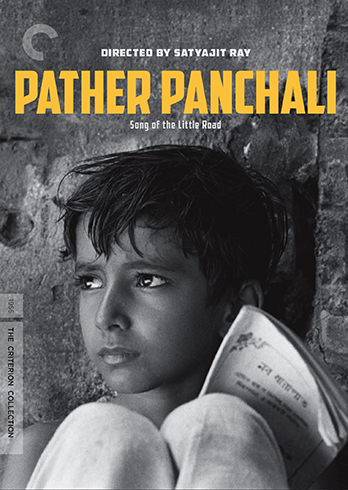
Both Apu’s cinematic story and Satyajit’s career began with Pather Panchali. Many consider it to be the crowning achievement of the series, and it currently sits at number 41 on the BFI Sight & Sound Poll (Apur Sansar is 245 and Aparajito is not on the list.) Ray, influenced by Italian Neo-Realism and Poetic Realism, wanted to portray a different type of India than had been seen before. The fact that we are still talking about the trilogy sixty years later proves that he succeeded beyond his wildest dreams. The debut may not be as fine-tuned as the two that would follow, but it portrays an innocence and simplicity hardly seen before or since.
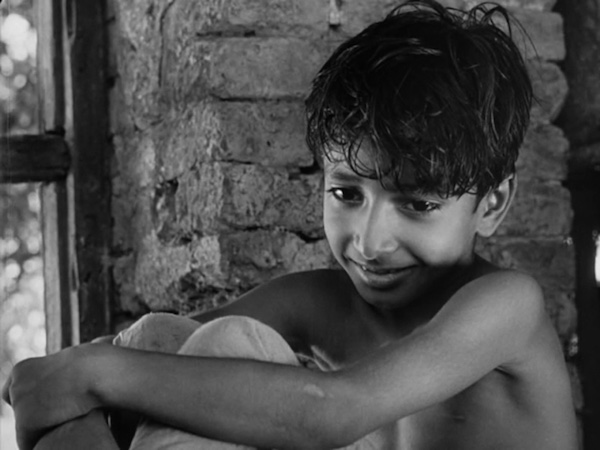
The first major character that we identify with is young Durga, Apu’s older sister, although we first meet her before meeting Apu. She is mischievous, like her younger brother will eventually become, but she is also benevolent. She is a thief, whether she takes beads or fruit, but she has a big heart. She shares food with her aging Auntie. When her younger brother enters the world, she takes him under her wing and shows him that there is a magnificent world lurking beyond their impoverished village.
The Ray family is situated in their rural, ancestral home. It is in a small village, but aside from a select few, we barely get to meet any of their fellow neighbors. It is almost as if the family is in their own little corner of the forest, away from the trappings of society. They are also living in poverty, barely able to subsist during some seemingly insurmountable economic challenges. This may be why Durga steals — not out of an innate need to misbehave — but as a means of survival. We see her watch others eat, and we see the hunger pains on her face. This is a girl that has often gone to bed hungry.
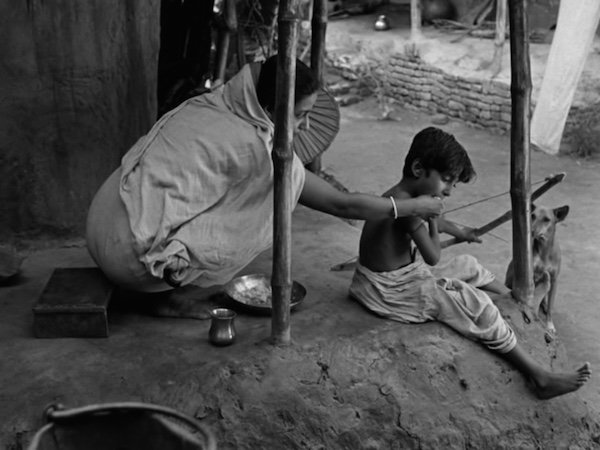
Apu is what you would expect a young boy to be. Despite the same challenges that Durga and the rest of the family face, he has a lust for adventure. He is mischievous and full of energy, playing often and disrupting the peace and quiet of his parents. Early on, after catching him in some misadventure, his mother tells him, “You were not born to survive.” This quick line of dialog would prove fateful and perhaps motivational. Apu was unequivocally born to survive, as we would learn throughout the trilogy.
The Ray parents love their children, but they are faced with difficult decisions as to how to provide for them. Harihar, the father, is not making ends meet in the village and must look elsewhere for work. That ends up being a lengthy journey where he loses touch with his family. Rather than being an absent father, his motivation is out of love. He is trying to find a way to provide for his family, and hoping that the village will provide for them while he is away. Things are trying and much of the film consists of the trio — mother, son and daughter — trying to persevere, hoping for a sign of better things to come.
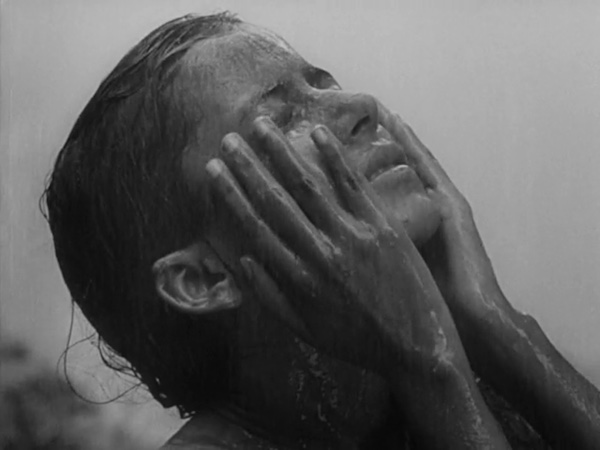
There are emotional highs and lows. As mentioned before, Durga loves to show Apu the wonders of the world. One of the most memorable moments is where he witnesses a train passing, which would be a reoccurring and among the most recognizable motifs of the series. Having not seen a train before, he is overwhelmed with joy as this marvel of technology, this behemoth, passes by in an instant. He runs through a field trying to get a better glimpse, and he seems to be gliding along with the black locomotive.
The lows are tragic. Durga and Apu find themselves in a torrential rainstorm. What begins as Durga playing in the refreshing rain, ends up being miserable discomfort. As a dutiful older sister, she shelters her brother from the rain without thought of herself, and the consequence is tragedy. We experience tragic events throughout the series, yet Ray is not manipulative. There are few anguished death scenes. In fact, many of the deaths happen off-screen. The tragedy is in the reactions, and that is why these films are so affecting. We understand the emptiness of loss, even if we are not as unfortunate as the Ray family. We also understand and respect resilience and fortitude, which are qualities in many of the characters, most notably Apu.
While Pather Panchali is Ray’s inaugural film and perhaps not as technically proficient, he makes use of film language to accompany the dramatic events as they unfold. He uses interesting camera angles, and blocks his actors in locations so that we see more than just traditional close-ups and shot-reverse-shot. The filmmaking allows us to see them in their element, as part of their surroundings, and the plot unfolds realistically and naturally.
APARAJITO, 1956
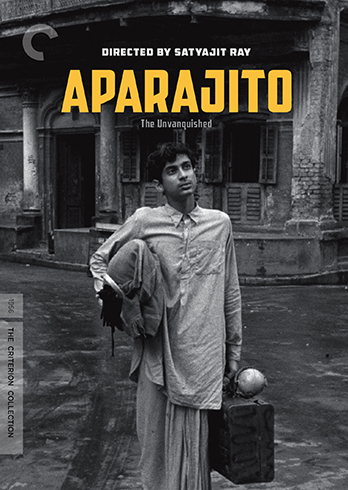
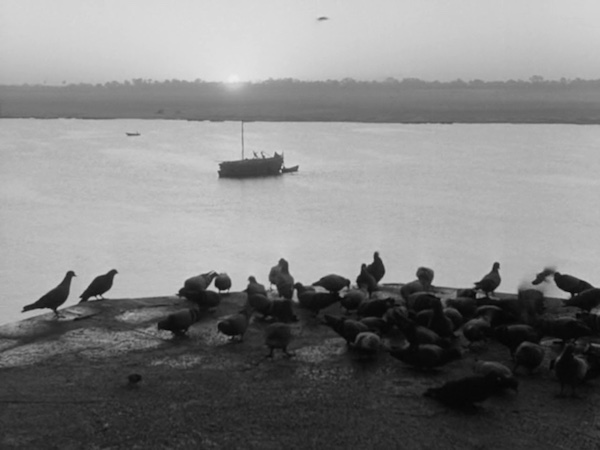
The world of Apu shifts gears after the death of his sister. Prospects look brighter as his father has found sound employment in a large city along the Ganges river. If the railroad were a new world, this is like a new planet. As a young boy, Apu roams along the banks of the Ganges, finding spiritual rituals, physical demonstrations of vitality and strength, and even wildlife in monkeys — which he had been compared to by his mother.
This middle chapter is fragmented, almost as if it is two films, each with a tragedy to overcome. Apu’s personality and future are shaped more by what happens during Aparajito than Pather Panchali, and it functions as an effective connection between the adolescent and the grown man.
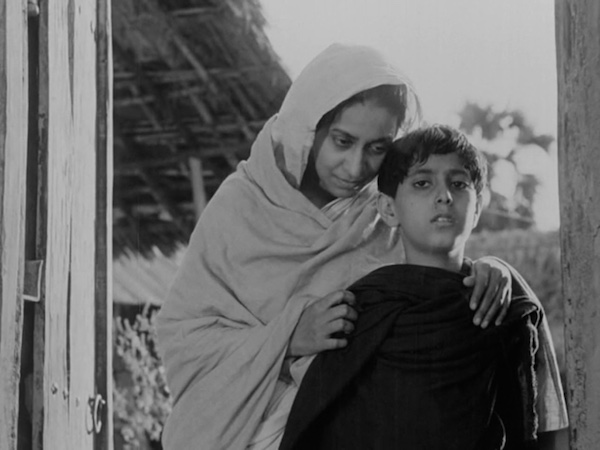

The middle chapter is centrally about Apu, but the most important element is the changing dynamic between mother and son. After they are left alone in the world and forced away from Benares, their relationship evolves. They begin this new life (again) dependent on each other, but as become entrenched, they drift apart.
I haven’t discussed the acting so far, but I’ll say that, in my opinion, the finest performance of the series is Karuna Bannerjee as Apu’s mother. There are many other great performances in the trilogy, such as Chunibala Devi’s take as Auntie in Pather Panchali, or Soumitra Chatterjee as Apu in Apur Sansar, among others, but Bannerjee is the one that has stuck with me the most.
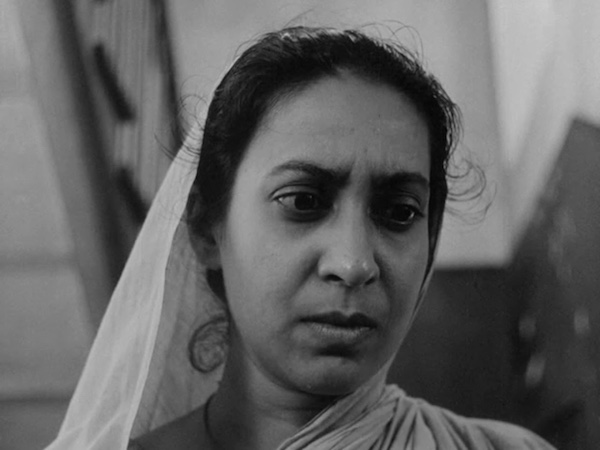
Often her performance does not require dialogue, as brief glimpses at her facial expressions reveal (or betray?) her emptiness. She remains a mother and tries to nurture her child, urging him either on a career as a priest, or begrudgingly as a student. She supports him to the detriment of herself, even though she selfishly despairs. She wants to force him to remain close, against his will, but that is like taming a caged tiger. Apu is a survivor and his youthful ambition is unstoppable. Her reluctant sacrifice and Apu’s apathy makes her the most endearing.
Apu is played by two different actors, as the film encompasses two chapters of his life. Again, the film can be seen as an extension of the beginning and ending. The early Apu is more like his Pather Panchali self, a little older, but still adventurous and mischievous. The Apu that occupies the latter half of the film resembles the character we meet in Apu Sansar. We see an intelligent, literate young adult, who devotes himself to learning and understanding the world. His prized possession is a globe that his school has given him.
The reality is that children grow up and leave their parents behind. I don’t believe that Apu loses the love he holds for his mother, but her loneliness is an impediment to his ambition. He struggles at school, and the constant reminder of her emptiness, usually in the form of letters, is a distraction. When he does visit, he is tentative and not all there. Later he laments that when he is home, he does not get enough studying done. What is left unsaid is that is because he has to fulfill the emotional needs of his lonely mother. It is tragic in an existential way, as is much in the series. Both characters are imperfect, and we understand the motivations for both of them without much judgement. Even though it is tough to see, the film portrays it in a realistic manner that, again, it earns the stirring moments.
Even though in hindsight, Aparajito is seen as a transitional piece, it stands on its own. In fact, when it was finished, Satyajit Ray did not intend to make another sequel. Fortunately for us, he had a change of heart, and wrapped the series up with another masterwork that does provide some resolution.
APUR SANSAR, 1959
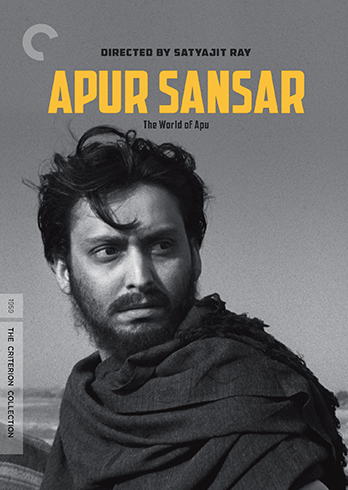
Trains no longer impress Apu. They are now an annoyance. This was established in Aparajito, but is hammered home in the final film. They are a nuisance, a necessarily means of transportation, and even a harbinger of dire things to come. Apu is no longer thrilled with the train. Apu is no longer thrilled with life. His mother was alone in the last film, but now, years later with an impressive education, it is Apu that is alone in his world. However, unlike his mother’s loneliness where she felt abandoned, his is self-imposed. He comes to resent this cruel world.
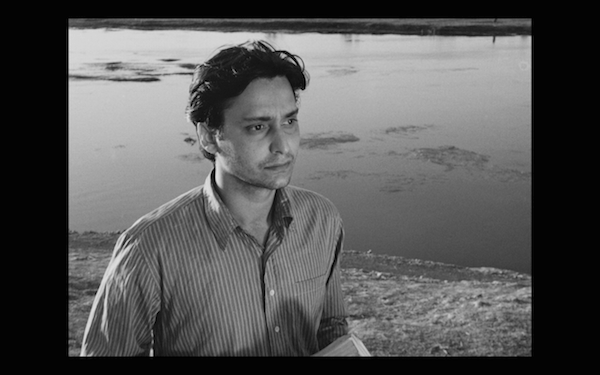
We first encounter Apu as a young intellectual that retained some of the ruthless abandon of his adolescent self. He lives in a small apartment and finds that he is overqualified for suitable employment. Instead he is a hopeless romantic. He plans to eventually write a novel, but for this period of his life, he is content living in the moment and enjoying his freedom.
Apu’s indolent existence is contrasted by his old school buddy, Pulu. Even though they are old school buddies, the seeds of class difference are planted in Aparajito and more pronounced in Apur Sansar. However friendly and loyal to his old friend, Pulu is from an upper class family. He does not have to write a great novel someday. He is more pragmatic, as he will inherit a capitalistic advantage. In this respect, he and his friend diverge in their outlook in life. If not for chance, they may have lost touch and gone separate ways, but they become linked in a familial way by accident.
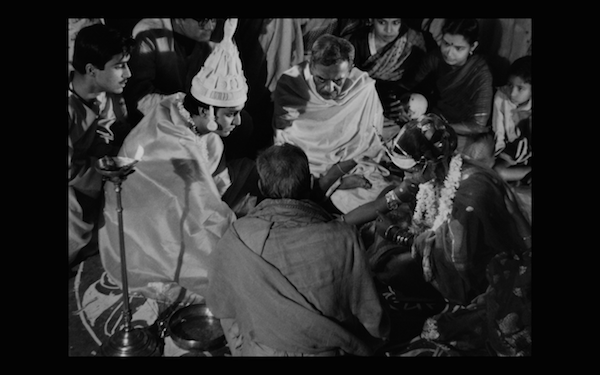
Despite their differences, Pulu sees that Apu is sharp and deserves a chance at life. He is ultimately a good person. Due to a mix-up at a wedding for Pulu’s cousin that Apu attends, the bride is left without a groom. They believe that if she is not married, she will be cursed, and the old friend coaxes Apu to be a stand-in groom. At first he resists, and something comes over him, and he relents. This may be motivated by his romanticism and thirst for experiencing all that life has to offer, or he may simply have been lonely. He becomes married to a person that he has never met before. In an instant, his loneliness is over.
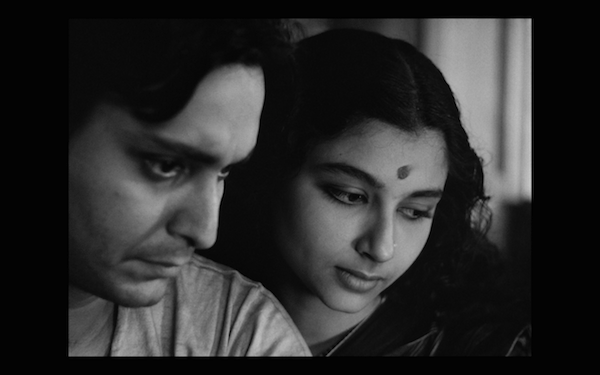
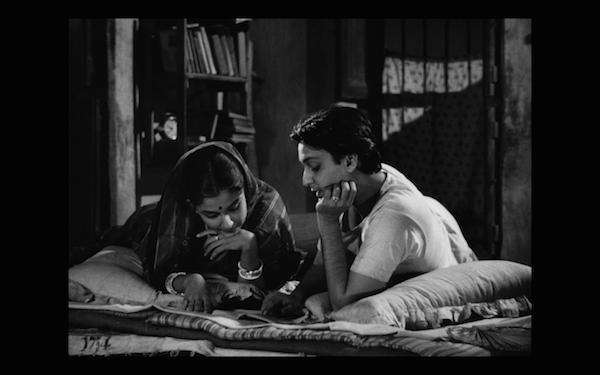
The class differences emerge again when Aparna, coming from a wealthy family, must live with a man with hardly any quality of life to offer. It is a rough transition, but he is a fine match personally, and a genuine and insatiable love overcomes them. The joy that older Apu feels with Aparna is reminiscent of the joy that the younger Apu experienced with the train. This is a new world for him, and despite their lack of means, they make the best of their situation. In this respect, they embody the poverty-stricken innocence from Pather Panchali. She enters this world and feels comfortable.
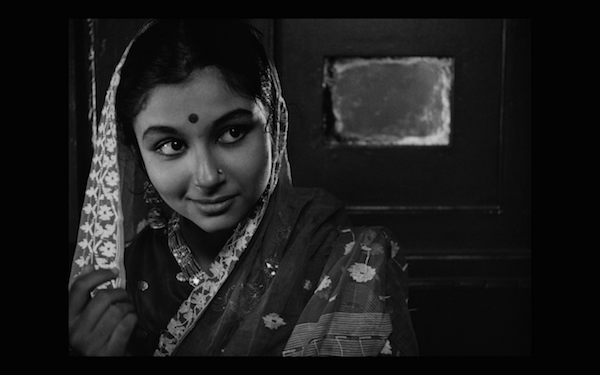
One of the most memorable scenes is where they are riding together in a carriage, professing their love toward each other. The scene is written, acted and shot beautifully, even if it is in shot-reverse-shot style with a hint of darkness. Their love seems childlike and adorable. Unfortunately, at least to this point, glee and joy are not emotions that will remain. Tragedy strikes yet again, and this time is it too difficult for Apu to overcome. He descends into a life of self-pitying, wandering, bitterness.
From a filmic and stylistic standpoint, Apur Sansar ties a bow around the previous two films. There are many motifs, whether visual, mise-en-scene, or character-based that draw from its predecessors. Even though the final film is more overt with some of the symbolism (although not with all), it actually enhances the prior two films. I discovered many elements that helped me appreciate my second viewings of the earlier films. Some of them are notable, such as the mirror shots, the close-ups through a hole cut in cloth, and of course, the duality of the magnificent and dreaded trains. There are others. We can find simple mannerisms of the character in all three films, that become accentuated in Apur Sansar. The stoic disconnection that the character experiences is also a stark contrast to the Apu we had known. Since this is all filmed with convincing neo-realism, the character evolution is convincing and that much more affecting.
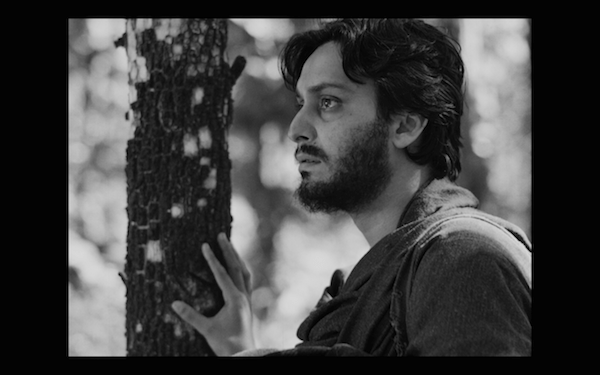
How would the tragedies that Apu experiences transform other people? If I were to wager a guess, many would resemble the older Apu in some respect. I cannot imagine how my world-view would be dismantled if I experienced the same type of despair. The fact that Apu’s plight is about as low as imaginable makes the final payoff all the more powerful. It hurts to see someone in despair, locked away from the world and shut off from its charms — especially someone who was so quick to smile during earlier, dire circumstances.
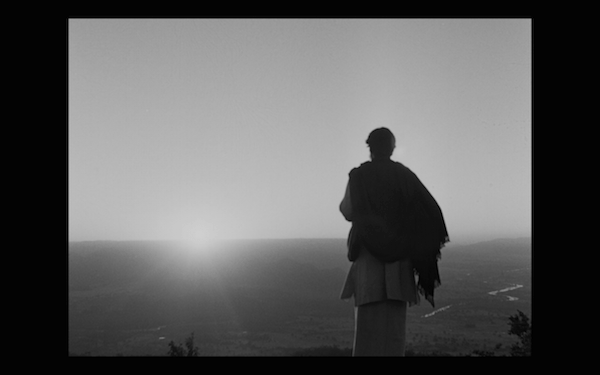
The ending of the trilogy is, in my opinion, one of the most powerful moments in film history. Ray waits until the absolute last minute to give us a glimpse of hope. We barely have time to absorb it until we are to wonder where Apu’s adventures will take him next, but we are given a sense of optimism. Again, this is not a manipulative and sentimental happy ending. We may not be convinced that things are going to be just dandy. Apu will undoubtedly face further challenges in his life. The final moments are so powerful because he has been to the abyss and partially come back. Even if he has not fully entered back into society, he has regained something to cling to that will give his life meaning. Hopefully his fortune will turn and he will not lose something dear to him again, but if so, we are reasonably assured that he has the tools to live a fruitful life. For this reason, the ending, however optimistic, is pure beauty.
The Criterion Collection edition of The Apu Trilogy comes with gorgeous restorations of the three films, a number of supplements, and a nice booklet. I recommend that rather than watching the supplements for each film one at a time, to watch the films first and then go back and watch them disc-by-disc. The supplements speak to a degree about the particular film, but are best experienced having experienced the entire trilogy.
The interviews were informative. They gave a glimpse of the experience of working with a film legend in his early years. We even hear from the man himself, and find that he had an indelible charm and kind authority. In one supplement he reads from an essay, but in such a commanding and hypnotizing voice that it is apparent that film is not the only vehicle in which he told stories.
From the interview with Soumendu Roy and all the actors, we learn of the project’s meager beginnings. It was essentially an independent film, and Pather Panchali had many of them learning on the job (although Mitra and Ray had previously apprenticed with Ray on The River.) Given the obstacles, both financial and logistical, it is a marvel that the project was not only made, but was such high quality that it has endured.
My two favorite supplements are on the Apur Sansar disc. The visual essay with Mamoun Hassan is a comprehensive journey through the production and themes of the trilogy. Finally, the aforementioned restoration documentary by Kogonada is the crowning achievement. Even though it clocks in at under 15 minutes, it unveils what is the true gem of this set — the quality of the films. Without the efforts of all of these individuals, for all of these years, such art would not be seen as it should be. This is certainly the release of the year. However long Criterion operates as a company (hopefully for a long time), this is a release that they will look back at with pride as cinephiles, young and old, discover and rediscover this mesmerizing piece of art.
Thank you, Criterion.
Criterion Blogathon, Day 1
Phenomenal first day. Both the quality of writing and social media interaction exceeded our expectations. So many worth blogs of awards, but so few to give out.


 Criterion Close-Up