Category Archives: Blog
A Tale of Two Blobs
The best way to establish the nature of The Blob is with a song. This little ditty by a young Burt Bacharach is the first impression of the franchise, playing over the opening credits. Unlike the chilling horror scores for filmmakers like Hitchcock, Argento, or Carpenter, The Blob has a theme song that you can dance to, something more in the neighborhood of The Monster Mash. If someone had never been exposed to The Blob before, they might expect a cartoon after hearing the song.
I recommend that while reading this blog entry, you play the above song to get the full media experience. If you read faster than 2 minutes and 41 seconds, then you may want to scroll back up and play it again. The song is catchy and I’d be lying if I said I didn’t listen to it a dozen times or more during this Blogathon process.
This post is part of THE GREAT VILLAIN BLOGATHON, hosted by Speakeasy, Shadows & Satin and Silver Screenings. Click HERE for a list of all entries.
Beware of the blob, it creeps, and leaps and glides and slides across the floor, right through the door, and all around the wall, a splotch, a blotch. Be careful of the blob
The song is a riot, but even the name is on the silly side. What is a Blob anyway? According to the dictionary, it is “a globule of liquid; bubble.” It is far from menacing, and instead is a playful, ridiculous villain, the type that would be right at home with the popcorn sci-fi double features of the 1950s. The reason the film was so successful and the song a hit has less to do with the scares, and more to do with the pop culture phenomenon of a funny little monster that resembles Play-Doh or a well-chewed piece of gum.
I’ve already talked about the 1958 version of The Blob, but the 1988 remake is also worth recognizing as a significant part of the franchise, even if it has a slightly different tone as the original. It has plenty of teenage inadequacy and angst, but is expressed more in the palette of the 1980s. Brian Flagg (Kevin Dillon) is a renegade outsider, wears a leather jacket, has a mullet, and rides a motorcycle. Meg Penny (Shawnee Smith) is a pretty cheerleader who at first wants to date the star of the football team, yet later is thrown into the Blob hysteria with Dillon. Just by the way the characters are drawn, they fit the typical 80s theme of how children fit (or don’t fit) into different social cliques.
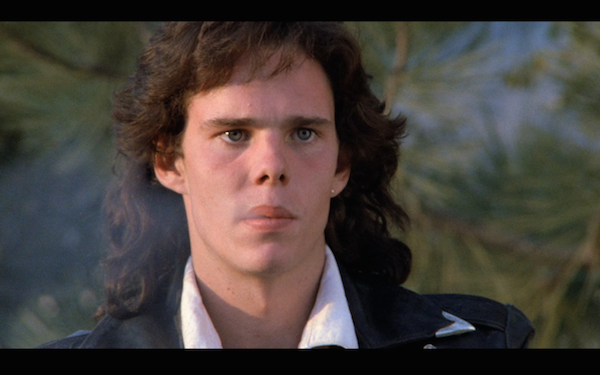
Don’t mess with Kevin Dillon, aka “Johnny Drama” or his mullet.
The remake takes itself more seriously than the original, but it is not without having a little fun at its own expense. For starters, it has the star football player buying condoms at the pharmacy for his hot date with Meg, and later discovers that his date’s dad is the same pharmacist. Doh! Most of the rest of its humor fits with the state of the horror genre in the 1980s. Some of the Blob’s attacks and kills are outlandish and you cannot help but laugh, which is a distinctively different atmosphere as the original, which celebrates and has fun with teenage life.
So let’s talk about the monster itself.
In both movies, it came from outer space. In both movies, it is discovered by a homeless person, who tries to touch the meteorite with a stick, only to get a piece of The Blob on his arm.
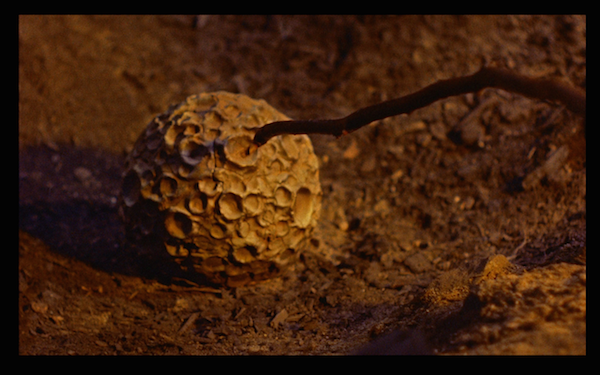
1958 Meteorite and Stick
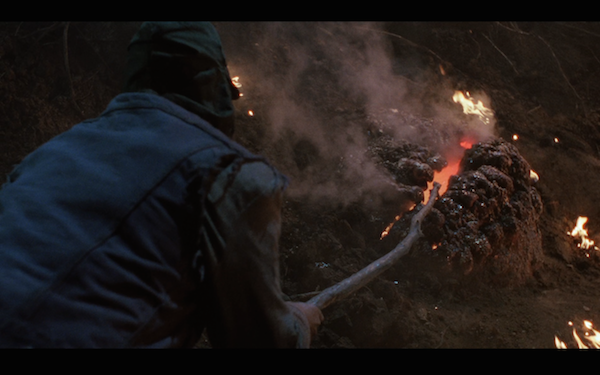
1988 Meteorite and Stick
In the original, he tries to shake it off like one would shake a stuck piece of rubber or glue. It’s just something disgusting that he wants off. This is when The Blob first gets its exposure to human flesh, and immediately wants more. It latches onto his arm and doesn’t let go. In the remake, they don’t waste time with having the homeless guy dance around trying to get a sticky mess off his arm. They instead go right for the gusto. Once The Blob gets a whiff of humanity, it strikes and latches on with lethal precision. Again being playful, the remake cuts to kids eating jell-o.

1958 Homeless Arm
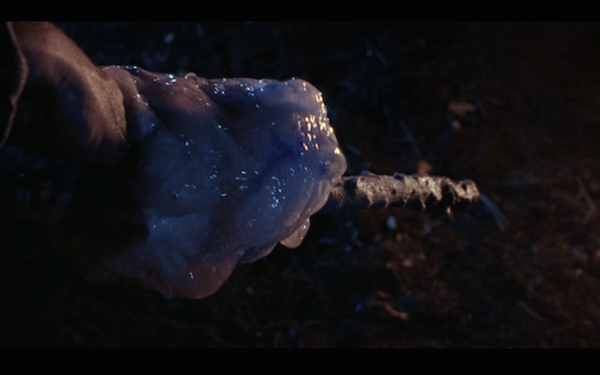
1988 Homeless Arm
The colors of each film are worth discussing. One of the reasons that the original caught on was that it featured an extremely good use of color for the time. You can even tell from the screenshots that the color palette holds up reasonably well today. Of course by the time the 1988 version came along, color was not exactly groundbreaking, so they instead played around with the mise-en-scene. The school colors use pink, so cheerleaders at the football game have pink pom-poms. In one scene the use of color is addressed directly with Meg messing up the laundry and accidentally turning a sweater pink. Maybe that was an epidemic because there are many pink sweaters seen throughout the film. The remake had more flexibility with special effects to highlight the colors of the monster, and sometimes used that to color the frame. A good example of this is the phone booth scene where The Blob and one if it’s captives envelop the booth.
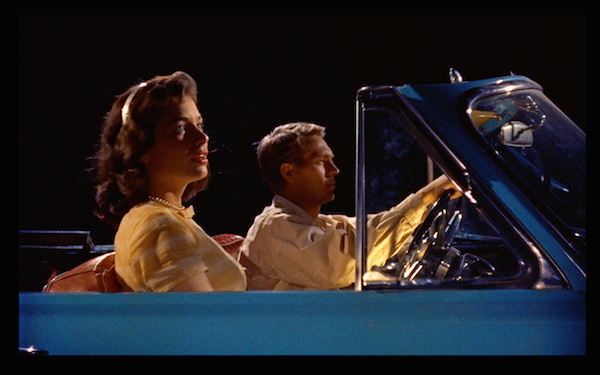
1958. Crisp Colors
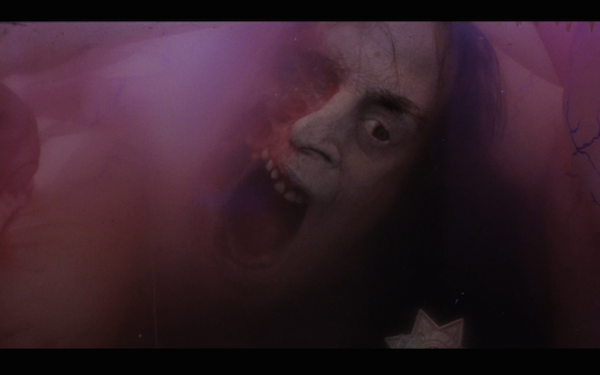
1988. A pink re-imagining of The Scream?
The way they kill may not necessarily be different. The special effects limitations for the 1958 version don’t allow us to see the all the deaths. Besides, for the time frame, anything remotely close to the graphic images in the 1988 version would be shocking and revolting. The old homeless man is found dead in both movies, although far too graphic in the second film for me to even post a screenshot.
Steve and Nancy see the doctor dying, and presumably other people die as well, but most deaths are not on screen. In both films, The Blob can kill by enveloping their victims and we’d assume they suffocate. In the remake, The Blob also has the ability to dissolve their body as if they had been dipped in a vat of acid. That’s interesting because in the 1958 version, the nurse unsuccessfully tries to throw acid on The Blob, which has no effect.
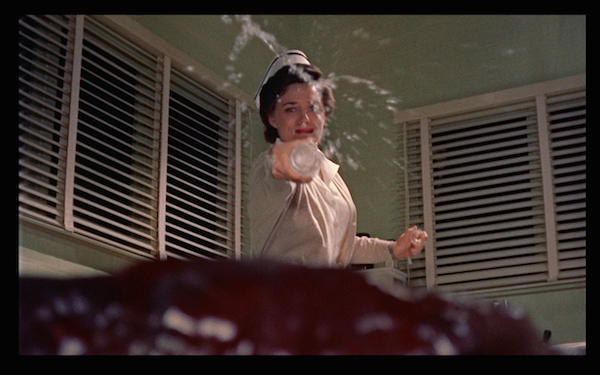
1958. The nurse throwing acid.
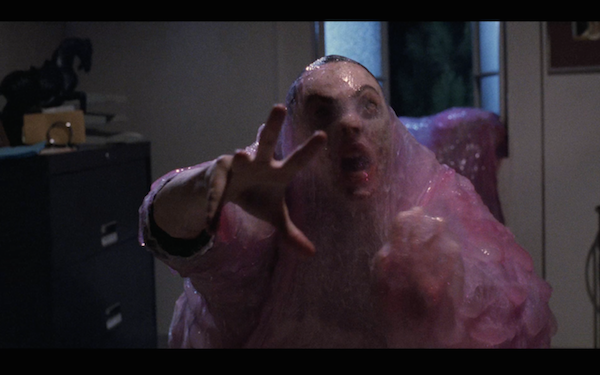
1988. This guy is either about to suffocate or is addicted to Big League Chew.
As for how The Blob gets around, Burt Bacharach mostly had it right, at least for the 1958 version. It creeps, leaps, glides, and slides. Where does it go? Across the floor, through the door, and around the wall.
There are some movement similarities during the early portion of both movies. The Blob grasps at the homeless guy’s arm and gradually spreads to the rest of the body. From there, the 1988 Blob moves at a far more rapid pace. This could be another special effect limitation because we do not see the 1958 Blob move as much. After all, he was basically just a bag of silicone. There are some fun movement parallels between both movies. For instance when Steve and Nancy are in the closet, The Blob oozes under the door. When Brian and Meg are in the walk-in freezer, The Blob oozes similarly toward them.
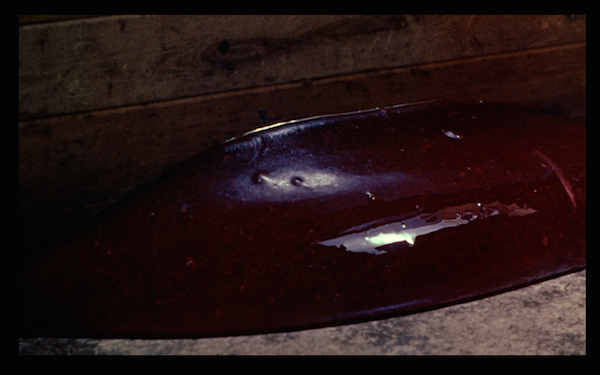
1958. Oozing under the door.
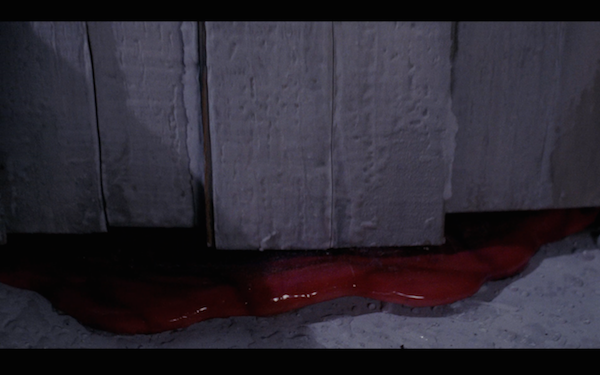
1988. Oozing under the door.
Another fun sequence in both movies is the theater. For 1958, the theater was groundbreaking in a sense. The late movie aspect of 50s teenage culture had not become a presence on film until The Blob, which used it as an exceptional plot device and a way to creatively show off the special effects at their disposal. The remake borrowed the movie theater plot, injecting some children who are seeing a movie that they shouldn’t. Again, it is a comic scenario, with an annoying guy who keeps talking loudly during the movie being the first to get Blobbed. What’s even funnier is that they show the scream in the movie as a reaction to this loudmouth’s quick demise.
The Blob starts in the projection room of both theaters, coming in through the ventilation system, and then makes it into the theater itself, causing mass havoc. The 1988 screen is darker and the visual may not show up well.
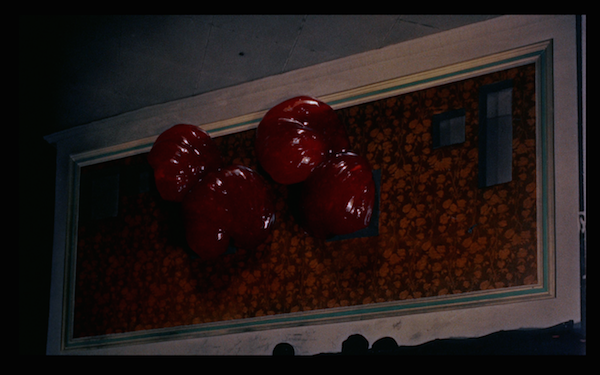
1958. Oozing out of the projection.
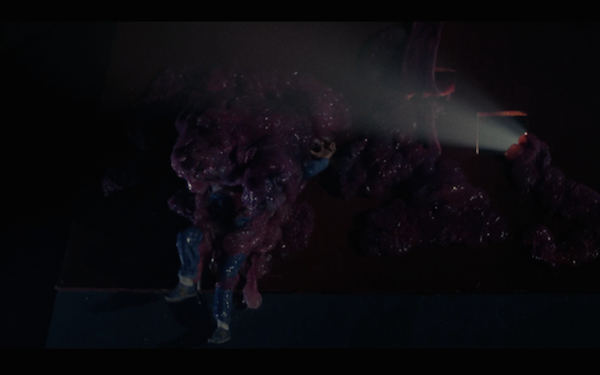
1988. Oozing out of the projection.
You can almost count on your fingers the number of times that The Blob appears in the 1958 version, and the screens that I’ve posted here represent a high percentage of the monster’s appearance. In the 1988 version, he is everywhere. When he appears, they make it a point to have him encompasses a large portion of the screen.
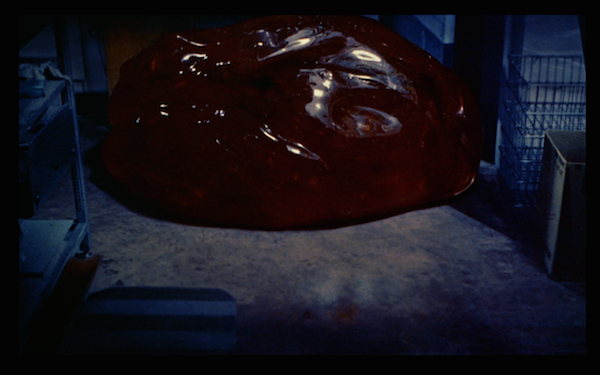
1958 Blob at doctor.
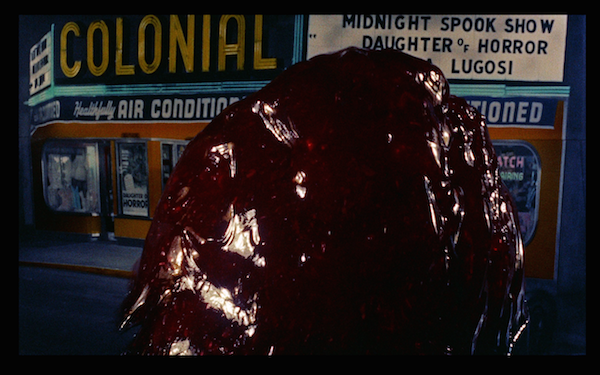
1958. The Blob even goes to the movies.
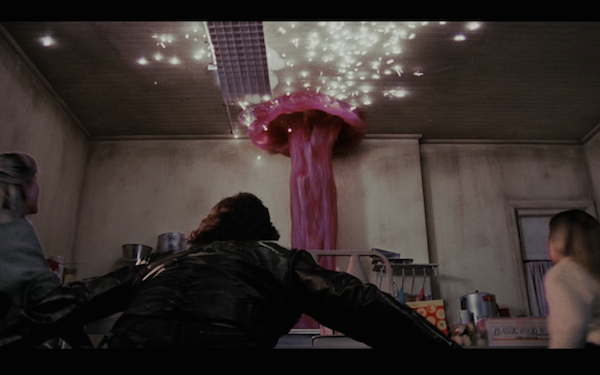
1988. Mushroom Cloud Blob.
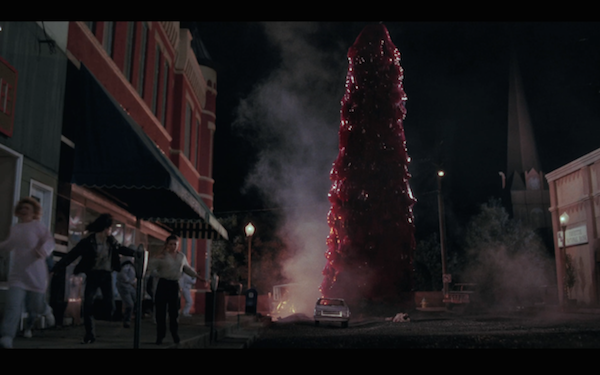
1988. Christmas Tree Blob.
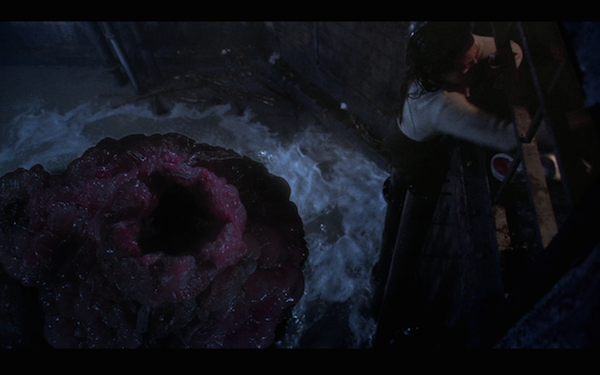
1988. Sewer Blob.
The conclusion is where the versions diverge. They have a similar ending in that The Blob is allergic to coldness. You could argue that the original was poorly written with a convenient deus ex machina ending as they discover this type of “Kryptonite” in the final act. The latter takes a more sophisticated approach, planting the seed of the aversion to coldness about midway in the aforementioned frozen locker scene. When The Blob oozes under the door, it oozes right back when it is exposed to the cool air.
The latter version also has an origin story, scientists that implement a biological containment as if it is a virus, and some far-fetched explanations that I won’t spoil. I’ll be honest that I much prefer the earlier ending, ‘deus ex machina’ or not. It has that same element of teenage innocence that makes the rest of the film so effective, while the latter version suffers from “Summer Movie Syndrome.” If something is expensive, that does not necessarily mean it is better.
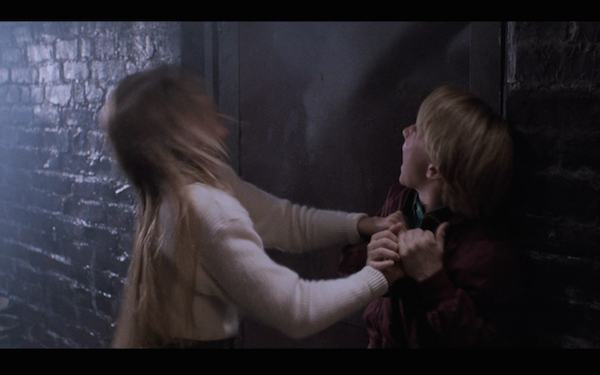
The Blob is so scary that this kid accidentally Birdman’d himself to the door.
So what can we say about The Blob as a villain?
In both versions, he’s a ferocious monster that basically eats people. I’d say that qualifies as a villain. The one thing I’ve purposely omitted from both write-ups until now is the representation of the red scare. In the 1950s, the symbolism of this nondescript menace that nobody understands is almost too obviously a nod toward the Cold War. That was the real fear, and The Blob is one way that allowed people, particularly teenagers, to process the fear. The 1988 version was still in the midst of the Cold War, but the cultural sensitivity was not as pronounced. Instead they use the additional backstory plot as a way of referencing weaponization. Perhaps they wrote this as an homage to the original, to fit it into the Cold War theme that clearly existed. Or maybe it was a product of the times, way of processing Reaganomic escalation. Either way, any text that uses a being to portray a political or societal evil qualifies as a villain in my opinion.
The Kino Kickstarter

Back when I first participated in the Kino Kickstarter for the Pioneers of African-American Cinema, I just dipped my toes in the water. My hope was just to get one Blu-ray for a decent contribution and support a great project in the process.
As the days passed and their participation increased, I became more wrapped up in the project. They added stretch goals to improve the box set, some of which they reached and some that they didn’t. Before I participated, I only owned a single Kino Blu-Ray — Tarkovsky’s The Sacrifice. That’s not because I don’t appreciate their library. It is vast and extremely impressive. I just happen to buy a lot of Criterion, Twilight Time and other discs.
I have to give a shout out to CriterionCast’s Off the Shelf for getting me to dive into deeper waters. I listen to their cast regularly, every Wednesday, the Newsstand once a month, and the others when I have seen the topics (maybe half the time). It was Brian from Rupert Pupkin Speaks and Ryan from CriterionCast that highlighted the value of the $500 package. Not only do you get the African-American set, but you get 25 discs from the Kino Library.
If you do the math, that’s a pretty good deal for Kino discs PLUS it is major support for the project. A few contributions of that caliber could have pushed them through all of their stretch goals. Even though they fell short of the final goal, but I was still pleased with my contribution and disc selection.
The package arrived today.
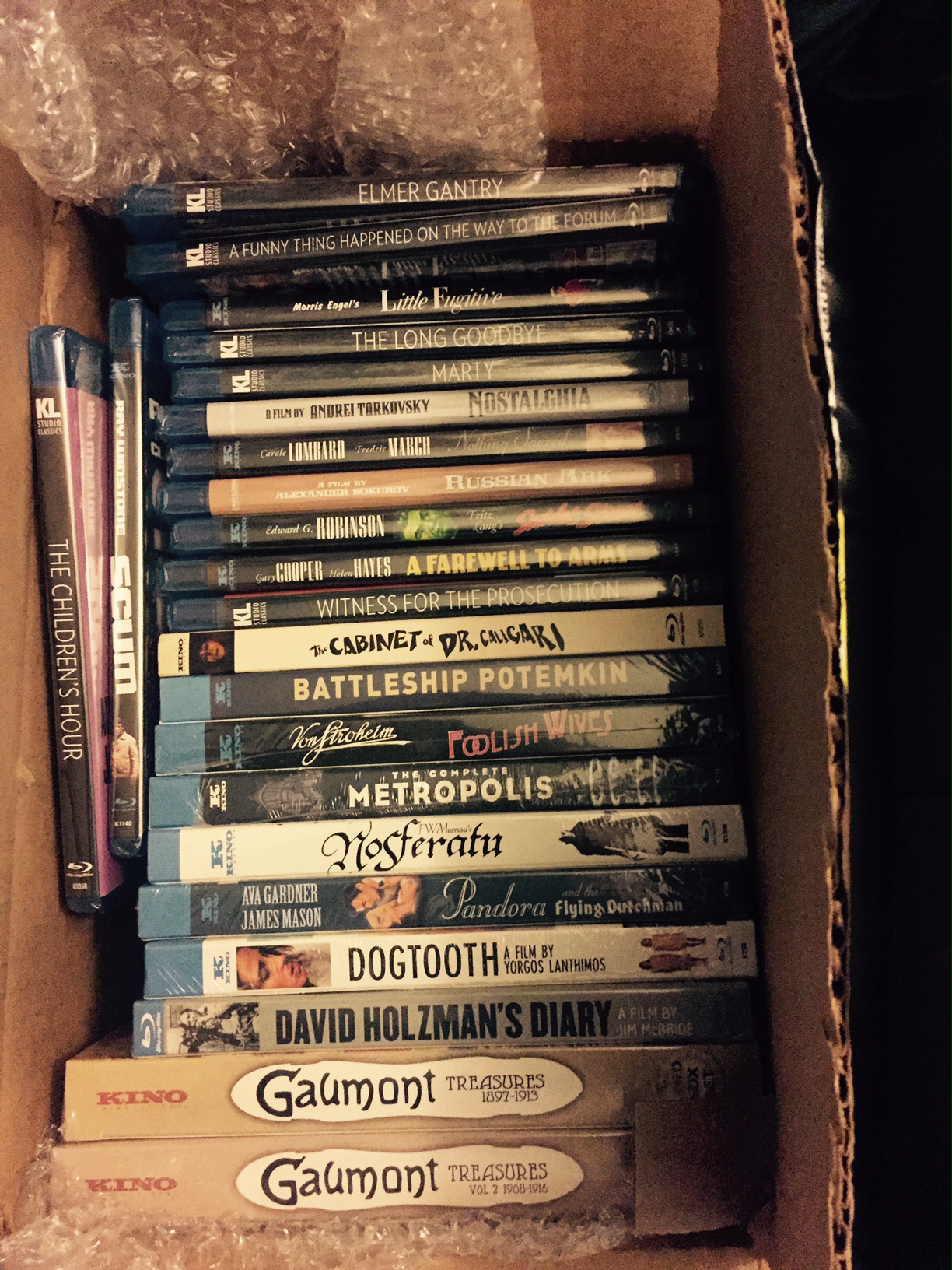
A treasure chest!
It was actually 23 discs because I chose both Gaumont Treasures sets, which count as two.
Here is the complete list:
Scum
Battleship Potemkin
The Cabinet of Dr. Caligari
The Children’s Hour
Elmer Gantry
Foolish Wives
A Funny Thing Happened on the Way to the Forum
Little Fugitive
The Long Goodbye
Marty
Metropolis
Nosferatu
Nostalghia
Nothing Sacred
Pandora and the Flying Dutchman
Russian Ark
A Farewell to Arms
Scarlet Street
Witness for the Prosecution
Gaumont Treasures 1 (DVD)
Gaumont Treasures 2 (DVD)
David Holzman’s Diary
Dogtooth
So how did I do?
Criterion & Blogathons
As I’ve become established with this blog, I’ve gotten acquainted with the Classic Film blogosphere. For the record, I consider this a Classic Film blog. Even though I watch modern films, follow the Oscars and go to theaters on occasion, my passion is for older films. My content here is dictated by the catalog of The Criterion Collection, so occasionally modern films will be thrown into the mix. The people I interact with on Twitter and the other blogs I follow are nearly exclusively into classic film.
I did some rough math the other day and realized that I had blogged about 16% of the entire Blu-Ray collection. That’s not a bad number for only doing this for just under a year. I then calculated roughly the length of time it would take to complete this project while keeping up with releases (estimated 5 per month). At two spine number write-ups per week, that would take me about 7 years. At three titles per week, it would take me about 3 years. That explains somewhat why I’ve been a little more prolific lately. I have free time, but also this is a project I want to complete before I’m old and gray.
The one thing that keeps this fresh is that I can pretty much blog any title of my choosing. I keep up relatively well with new releases (although I am about 4-5 discs behind now), and I use my Lists project to dictate what catalog titles to cover. That gets me part of the way. Sometimes there will be time for me to squeeze in other titles. One way to get some incentive while also becoming a contributing member of the Classic Film community, is by participating in their Blogathons. Not only do I get to interact with other bloggers, but I get ideas on how to approach my posts creatively. It keeps things fresh and keeps me motivated to keep writing.
The first Blogathon adventure is just around the corner. It is the Great Villain Blogathon through Speakeasy, Shadows and Satin, and Silver Screenings.
They just posted the schedule and my post is due on April 15th. As you can see, I chose The Blob as my subject. This gives me the motivation to dive into a title that I haven’t been enthused to cover, The Blob from 1958, while also allowing me to contrast that with The Blob from 1988, which I own from Twilight Time. So it’s a Blobathon, which is a phrase I’ll use. It’ll probably start with a straightforward review of the 1958 version over the weekend, and a Blobathon post on Wednesday that contrasts the villain from both films.
Next month I’m getting involved with Classic Film and TV Cafe’s “My Favorite Classic Movie” Blogathon. I love so many films that it would be impossible for me to pick a favorite classic film. Maybe one day I’ll put some time into developing a big list, but for now, I have many favorites. On the Waterfront is one of those titles that has been sitting near my watching queue. I absolutely love the film and have seen it at least three times, and have already done some studies of it during college, but I have not cracked the Criterion version. Well here’s my chance.

For June, I’ll be diving back in with Speakeasy and Silver Screenings for the Beach Party Blogathon. I had a tough time coming up with a title for this topic. My first idea was for Monsieur Hulot’s Holiday, but I’ve already covered that film in detail. I settled on The Seventh Seal, which is hardly a “Beach Party,” but it does have scenes on the beach. Annette Funicello, meet the Grim Reaper. How about a game of chess?

From here on out, I’ll do my best to join one Blogathon per month, which is probably my limit. I don’t want to overextend myself and burn out. I just want a creative outlet to have fun with.
Zatoichi: The Blind Swordsman. Disc 5

The monumental, phone-book sized boxset of Zatoichi is a treasure, but it’s not something to binge-watch like we do with today’s television series. Instead it is something to treasure at a slower pace. I binge-watched the first three discs, and ultimately got less out of them than these last two discs. We have to remember that these movies came out over a stretch of multiple years, even if some years had 2-3 releases. Compared to other Criterion releases, they are also far lighter, escapist, and formulaic. I’ve found that I appreciate these films much more when I put some time between viewings.
With this disc, I found some of the same old frustrating formula, but I also found some refreshing deviations. One of these films was surprisingly good, and could end up being among my favorite of the series.
ZATOICHI’S VENGEANCE, TOKUZO TANAKA, 1966

The most noticeable difference between this and previous films is the use of color and a more carefully orchestrated style. Most of the Zatoichi films look good, but they do not always use color motifs or much symbolism. This iteration begins with some thieves outnumbering a helpless victim, who we later learn is Tamekichi. Zatoichi fights them off in scene styled with a classy, blue hued template. Later in the film, Zatoichi meets up again with Tamekichi and the blue hue returns, this time using the sky, the water as a way of natural coloring.
Zatoichi later meets another blind man, only this gentleman has been blind from birth. His senses are different than the sword master, and he identifies Zatoichi as an “in betweener” since he was not born blind. This is just another way of setting him as an outcast. Even among blind people, most of whom are born blind, Zatoichi is an outcast. This blind man befriends and mentors Zatoichi, and through his teachings, we see a level of maturity that will carry into the next two films.
Of course the main plot includes a gang of local Yakuza that are harassing someone that Zatoichi meets and respects. They are subject to the whims of the local crooks and get extorted. Zatoichi becomes their protector. There is one scene where the local gang roughs up the hero as he stands up for the family. Beaten and bloody, he thinks about unsheathing his sword, but he stays and takes the punishment. This is some of the maturity that he has reached under the tutelage from his blind elder. Later, when he kills someone in front of the boy, he is reprimanded by his wise mentor.
It is also worth touching on the relationship between Zatoichi and the boy. Midway through the series, they have started introducing children to the storyline. Shintarô Katsu plays off children extremely well, and this usually elevates any story. This is the case here. In one scene the child yells out and places himself in front of Zatoichi during a fierce battle with multiple opponents. Since he relies on his senses and instincts during a sword battle, he could easily and inadvertently kill the child. Not this time. He hears the cries and knows the exact moment in order to restrain himself, and then resume once the boy is out of danger.
As noted above, the ending has a lot more visual style than most, with the blue color palette and some nice silhouetted shots. This is an above average edition.
Film Rating: 7.5/10
ZATOICHI’S PILGRIMAGE, KAZUO IKEHIRO, 1966

Usually when I watch a Zatoichi film, I’m rarely caught off guard. To my surprise, Zatoichi’s Pilgrimage took quite a detour from the typical formula. It continues in the same vein as Vengeance in that the total body count is starting to take a psychological toll. He has a vow of non-violence and embarks on a pilgrimage to reach a level of spiritualism. He prays that he does not kill anyone on his journey. That lasts about five minutes of screen time, but the death is somewhat accidental. Someone attacks him and they have an underwater fight. You can guess the result.
Again, the shooting style is more sophisticated here. They mix up long shots with close-ups. One effective sequence was when they have a long shot with a horse, and then a close-up of Zatoichi’s sandals that cuts to a close-up of the horse’s hooves. Is Zatoichi basically a service animal wherever he goes? Is he duty bound to who he determines to be the good people of the town? It is rare that the film language speaks on such a high character level. Another good example of camera work is later on when Zatoichi is acting as guardian of a household. They have a nice pan from the characters that enter the house to another room where Zatoichi is kneeling in solitude.
One of the strengths in this edition is the focus on character, and not only of Zatoichi, even though they make great strides at fleshing him out – impressive at this stage of the series. The supporting characters are developed well, most notably the female character, the sister of the person that Zatoichi kills against his wishes (and prayers). There is a very touching scene between them that ranks up there as one of the best character moments and performances of the series. He thanks her and gives her money for her burial. You can tell that his compassion is genuine, but he is also romantically drawn to her. She may not reciprocate his advances, but she is grateful, humbled and moved by his honor.
The plot is a bit outside of the formula because virtually everyone in the town is morally inept. The gangsters are always terrible, and they are just as thinly drawn here as in all the others. The lower class villagers that are exploited are just as shady, only in a different way. They refuse to cooperate in the fight against Zatoichi, seeing it as a beneficial situation for them either way. If the Blind Swordsman wins, they will be relieved of their burden. If he loses, they will not be blamed or punished. It is cowardly and immoral behavior.
The final battle scenes are also quite good. In some respects they reminded me of a John Ford finale. The pacing is patient and allows the tension to build. There is not a rush to just have Zatoichi fight a gazillion people at once and kill them all. They use the locations extremely well, and they add the extra element of arrows being shot at Zatoichi. He has to be more tactical and evasive against this unknown threat, which makes this one of the better action sequences in the series.
This was top-notch. I’d say that it is firmly at the top of the series, followed closely by Zatoichi and the Chess Expert. I’m curious to see if this is an anomaly or if this level of quality will continue.
Film Rating: 8.5/10
ZATOICHI’S CANE SWORD, KIMOYOSHI YASUDA, 1967

My expectations were probably a little too high after Zatoichi’s Pilgrimage. They continue to deviate from the formula somewhat, and this time they introduce some supernatural elements that work in some ways and not in others.
One part of the Zatoichi myth that I find perplexing is the gambling. I know that I shouldn’t be complaining about suspending disbelief in a series with a blind guy taking out dozens of opponents in one battle, but the gambling thing really gets me. Zatoichi is almost constantly able to “see” through any cheating that takes place with the organized dice games, and he uses them to his advantage in order to gain riches. They had gotten away from the gambling aspect in the last few films, just as they had gotten away from the lazy, mooching aspect of his character, and I think the series benefited from this change.
Zatoichi encounters an older man who used to be skilled at hand-making swords. When he sees the cane-sword, he recognizes it as a special, mystical blade that enhances the odds for Zatoichi to win in battle. Without the sword or his ability, he would have inevitable lost a battle and his life by now. The only problem is that the sword has nearly reached the end of its usefulness and will break soon. It is predicted to only function for one more kill.
This is a bit much to swallow. After 15 films, we finally learn that he has a magical sword. This seems to be a little too easy for the writers to invent at this point, but of course this is a superhero fantasy tale and you have to roll with it.
On the other hand, the limited use of the sword works in that Zatoichi has no choice but to sheath his sword. We see him fight with a cane or get otherwise creative while saving the sword for when he needs it. Spoiler alert, he will use it and it pays off nicely.
The premise is that Zatoichi shacks up at a hotel as a masseur, which of course is taken advantage of by local gangsters. There is a woman that he connects with, although not as effectively as the last two films. There are some twists and turns that are a little more melodramatic and the plot is more convoluted than usual. On top of that, the running time is longer than most films to date and you can tell. This movie dragged a little bit towards the end. I found that it was bogged down with exposition as they tried to lead to the final conflict, yet there was overall less action than most Zatoichi films.
Film Rating: 6/10
Odds and Ends
I started this project last year as a creative outlet while I recovered from surgery. I’ve taken to it and am pleased that people are reading my stuff. I thought now would be a good time to take stock and let people know where I’m headed.
With the upcoming last part of the Les Blank boxset, I’ll have finished with the 2014 Criterion releases. I’ll finally be releasing my favorites of the year, many of which I have not yet written about for the site even if I’ve seen just about all of them. I’ll also include a list of my favorite write-ups that I’ve done, whether new or old.
From there I’ll start tackling 2015, which I am already behind on. With six releases in February, I have my work cut out for me.
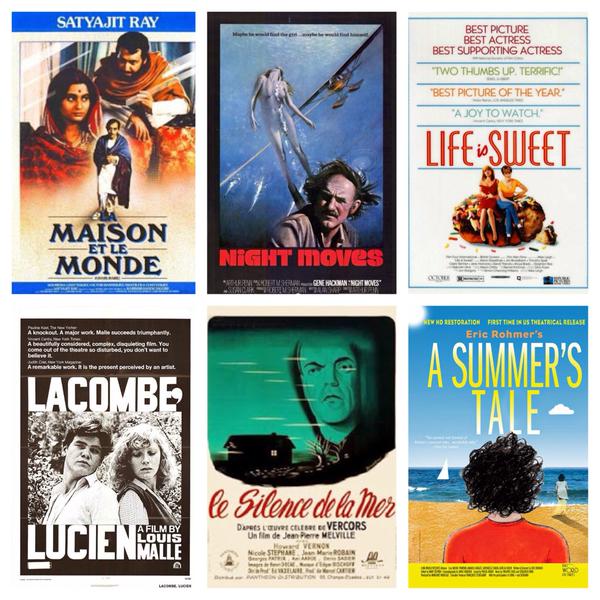
Recently I wrote a guest spot for Brian at Rupert Pupkin Speaks. I’m a fan of his podcast with Ryan at CriterionCast. He’s already given me plenty of ideas about DVDs to purchase and films to discover. It was a pleasure looking back at the past year and thinking of what movies really moved me. I’m proud of the list, even if it is a bit French-centric.
Finally, I launched a Facebook page. Please help me out and go ‘Like’ it. You’ll notice a sidebar where you can navigate recent Facebook postings, very similar to Twitter. Of course links to all new posts will go up there, as will a number of images and news links.
Soon I’ll be launching an Essays section. This is where I’ll post various studies I’ve done through the years. There will be a lot about French film, classical Hollywood, Sunset Blvd, and various others. Most of these were academic and I am no longer in school, but this will not be the last of my essays. I have a number of print sources and am continually interested in pursuing topics to research.
Thanks for following along. I’ll try to keep it interesting. If you have any suggestions, feel free to drop a comment.
Completing My Collection
I started collecting Criterions sometime around the year 2000. I use the term “collector” loosely. I wasn’t thinking of spine numbers or wanting to obtain the entire collection. The films were what drove my purchases. I wanted the films that I loved, which included many from Renoir, Bergman, Kurosawa, and so on. Some of the early purchases were Grand Illusion, Bob le Flambeur, and Le Corbeau, all of which are out of print now. At the height of my DVD collection, I probably owned somewhere in the realm of 50 titles.
At one point, years later, I remember seeing an Amazon listing for the entire Criterion Collection for sale. The list price was $5,000 and it encompassed several years of releases, possibly as many as 300-400 spines (I forget the exact number). When reading the titles, I was drooling, but there was no way in the world I could afford that price tag. However, the seed was planted and ever since I have longed to someday own the entire Criterion Collection.

Le Corbeau: One of my early acquisitions.
Over the years, I continued purchasing Criterions as I found a title that caught my fancy, yet amassing the entire Criterion Collection was still a pipe dream. Over time as I started to get established in a full-time and somewhat lucrative career, I started buying a few more. Criterion meanwhile transitioned from DVD to Blu-Ray, and I embraced the new technology because the home experience was comparable to the big screen experience.
Over the last year, things changed drastically. The catalyst was that my wife became a Jeopardy champion. She won one game and came in second the next day. This was not enough for us to quit our jobs, but it was a nice nest egg. It gave us a financial comfort level. We are both gainfully employed with stable jobs, but we were focused more on paying bills, investing in our future and buying the occasional toy.
After we returned home from our successful trip to California, I asked my wife if I could splurge on some Criterion titles. She said yes. She’s awesome. Let me first establish that this was not her money. It was actually mine (or maybe our?) money that we had set aside for a rainy day. Just knowing that we had the Jeopardy money in our future made us more comfortable with some extra spending.
Collecting all of the Criterion spine numbers at this point is overwhelming even if you can afford it. There are currently 753 spine numbers and counting. It might also be wasteful, as they are consistently upgrading their DVD catalog to Blu-Ray. I’ve already upgraded about 30 titles that I already owned. On top of that, some of the early titles have poor transfers or are lacking special features. One example is the Samurai Trilogy. The original transfer is horrendous and almost unwatchable, whereas the high definition transfer is delightful. The colors make the most out of the Blu-Ray format. For this reason and more, I have decided to collect Blu-Rays only.
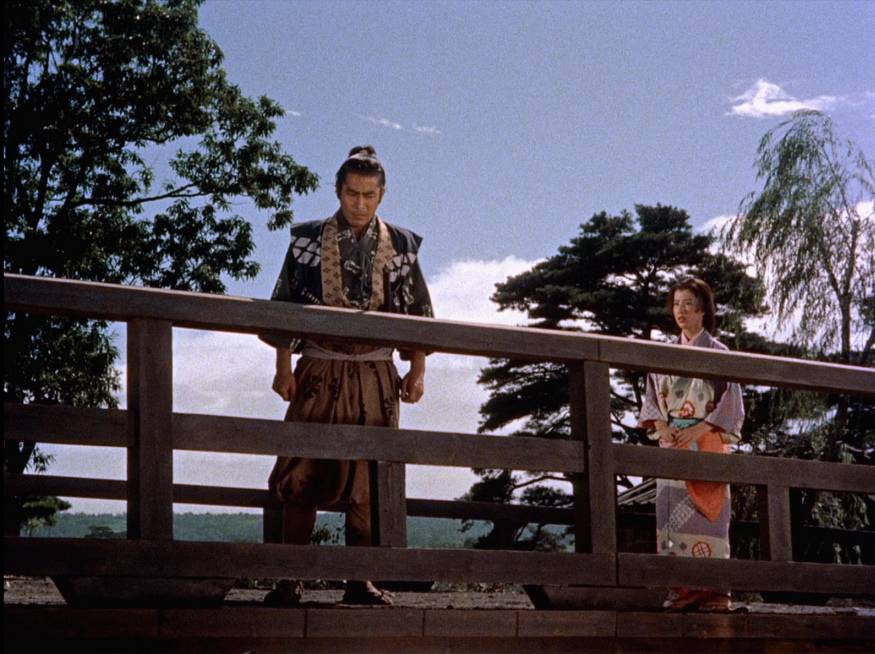
A scene from Samurai I: Mushashi Miyamoto
David at Criterion Reflections made a good point on a recent CriterionCast. A lot of newer collectors will opt for the Blu-Ray only titles, which is understandable given the sheer amount of investment it would take to collect the entire library. Some of those collectors are young or newer to it. That’s not me, but I’m in a somewhat similar position. Unfortunately they miss out on some of the hidden gems, many of which will not be upgraded due to rights issues (like all those StudioCanal titles). Even though my collection consists of almost 95% Blu-Ray, I still like to watch the older titles, especially for my yearly lists. Rather than invest even more into the collection, I prefer to either use Hulu Plus or my local library for the DVD spines. Once they get upgraded, I will buy them.
I’ve been strategic as to when I will make my purchases. I tend to hit the Barnes & Noble and Flash Sales hard, while buying the new releases as they come out. I try to encourage people to give me gift cards for birthdays and Christmas, and I use Amazon credit card points to pick up occasional titles. I’ve now collected the vast majority of the Blu-Rays that are available, and every box set.
There are roughly 30+ un-owned Blu-Ray titles remaining, some of which are out of print, and some of which I dislike. My goal is to own them all anyway. In fact, that is now my New Year’s Resolution. This year I plan to complete my Collection, including the expensive out-of-print (The Third Man) and crappy (The Big Chill) titles.
Watching them is another story entirely. Since I’m already an art film-buff, I’ve probably seen more than half of the titles, but for this project, I want to revisit them with total immersion, which includes watching all of the special features and occasionally doing additional research.
Perhaps in a couple years when more titles have been upgraded, I’ll start procuring the older, more obscure titles that are unlikely to be revisited. Let’s face it that Criterion is a business, and some titles sell better than others. For now, I’m considering my collection complete once I have all of the Blu-Ray spines.
La Résistance et La Religion
In 5-days, I’ll be going under the knife for hip arthroscopy. That will be followed by a lengthy recovery period with no weight bearing. The couch will become my best friend.
With three classes remaining until my degree, I had to make arrangements to continue taking classes. With a 4-6 week period of no weight bearing, the last thing I want to do is spend two evenings a week hobbling from class to class on crutches. Even with a handicapped sticker, you cannot avoid a lot of walking on campus.
I reached out to a few professors to seek alternatives. One of them volunteered to independent study this semester. This was tremendous. This has always an option, but since it takes a lot of time for the overworked faculty, it is difficult to find someone to agree to it. I cannot thank this instructor enough.
The best part is he left it up to me to choose a topic. He’s an expert on warfare, specifically WWI and WWII, plus he is a film buff. I gave him a few options, including some I thought would be easier on him. One of those options was to do something related to film during WWII, which was what I was hoping for. He agreed to that one. It may be a little more work on his end, but it sounds like it’ll be a little more interesting than what he usually encounters.
We worked to fine tune the topic. With WWII film, it is too easy to cast your net too wide. My first proposal was far too ambitious. He had me narrow it down to a single nationality and an aspect of one war. And he ruled out American films, simply because there are far too many WWII films, during and after. I chose post-war French cinema regarding the German Occupation of France.
I’ve already narrowed down a dozen or so films, which is probably the upper limit of what I’ll cover. It is heavy on Melville and Malle, with some other big names littered in. I’ve cracked a book on the Resistance, and once I make headway with that, I’ll start delving into the movies and working out a thesis. This blog should be a good way to vocalize my thoughts as I digest film to film. The first three selections are Army of Shadows, The Sorrow and the Pity, and Leon Morin, Priest.
The other class is also film related. It is an online religion through film class. The focus is on religion, and rather than focusing on deeper, classical films, the professor has chosen more recent, mainstream selections. The theme of the class is to look through these films to find religious ideas. Some will be more overt (O’ Brother Where Art Thou, Tree of Life), while others will be subtle (The Social Network). The films will not all be necessarily good. The universally reviled Jack and Jill, for instance, is on the syllabus to explore Judaism. And there are some that I would’t ordinarily see, like P.S. I Love You.
Why a New Blog?
Those of you who know me from my cycling blog, SteepClimbs.com, know that I’ve been nursing an injury on and off for over a year. That’s put a damper on my activity, and with still no diagnosis at present, there looks to be plenty of downtime in the immediate future.
I have a lot to say. And I need a creative outlet.
I’ve been writing in some capacity since I was a child. The creative releases would come in bursts, and rarely amounted to much. I would write short stories as a child, all of which were lost. That’s probably a good thing, as they were probably terrible.
After starting a technology company in my 20s, I settled on writing more. There began my love affair with the world wide web, and ended with my selling a company and working as Content Manager for a media company in North Hollywood, California.
As that company was going under amid the new decade’s dot-com bust, I got a book deal and advance. That was quite a story of its own, which I may tackle later.
As I started my new career as an Underwriter, I started writing again. This time it was about film, and lasted a few years until shortly after moving away from a major film market.
The cycling blog is not going away anytime soon, as fitness is a passion of mine, but there simply isn’t too much for me to talk about, and I have a lot more free time now.
So I launched a new blog. Here I’ll talk about all sorts of things that simply would not be interesting to readers of SteepClimbs. This one is also going to be much smaller without nearly the amount of readers. I’ll publicize it a little bit, but it’ll be mine, for the most part. If people find this interesting, then that’s great, but this is not a vanity project.
Topics will be wide ranging. This is a blog for whatever fits my interests at any given moment outside of health and wellness.
Right now my passion is again for film and media. I’m finishing up a history degree, and reading a lot of books. I’m also a news and political buff.
The tagline is “Musings About Popular Culture & History.” That sounds about right for now. My guess is that I’ll write most about film. I was once a film studies minor until the college slimmed down that department, and I had to change to an English cognate. Film has been my first love for most of my adult life, and usually of the non-mainstream artistic variety.
We’ll see where this takes me.


 Criterion Close-Up