My Winnipeg, Guy Maddin, 2007

People can be extremely protective about the definition of a documentary. There are some purist that insist that the only real documentaries are cinema vérité, where the camera is a mere fly on the wall and the directors do absolutely nothing to obstruct real life from happening. Of course people have been testing that definition for nearly 100 years. Robert Flaherty is famous for casting actors and staging the action, yet his documentaries like Nanook of the North and Man of Aran are seen as revolutionary.
While many have stayed true to the essence of the documentary, the envelope has continually been pushed over the years. Errol Morris broke a major rule by actually reconstructing real events for The Thin Blue Line. Today the definition of a documentary has been stretched even further. With My Winnipeg, Guy Maddin did not so much as push the envelope, but tore it up into little pieces, ate it up, and regurgitated it. And it is magnificent.
First, let me get a disclaimer out of the way. Guy Maddin is not for everyone. I had seen two of his films previously, The Heart of the World and The Saddest Music in the World. In both I recognized the talented craft of a filmmaker who had studied his film history, especially black and white silent film. These films were a mixture of silent film with David Lynch. I preferred “Heart” over “Saddest”, respected both and loved neither. They were intriguing experiments and not much more. Despite the accolades, I skipped My Winnipeg until now.

Winnipeg!
Another disclaimer, I love documentary and could care less about the purity. I love Flaherty, especially Morris, Steve James, Berlinger & Sinofsky (R.I.P.), and everyone in between. If someone wants to experiment with form in order to make a point, whether for the purpose of art or revealing a truth, then I say go for it. One of my favorite documentaries of the last several years is Exit Through the Gift Shop, which may be a complete farce. It has some truths, because it talks about graffiti artists whose work exists, but we ultimately do not know what is truthful. We may be the subjects just as much as those on screen. The same could be said with Guy Maddin’s documentary.
My Winnipeg is both a love letter and hate letter to Maddin’s home town. Ultimately it is a little bit of both. He loves the uniqueness, the absurdity, yet hates the cold, the monotony, and how it reminds him of the symbolism of his childhood, such as the furs, the forks, and the lap. Don’t worry if that last sentence doesn’t make sense. It doesn’t make too much sense in the film either.
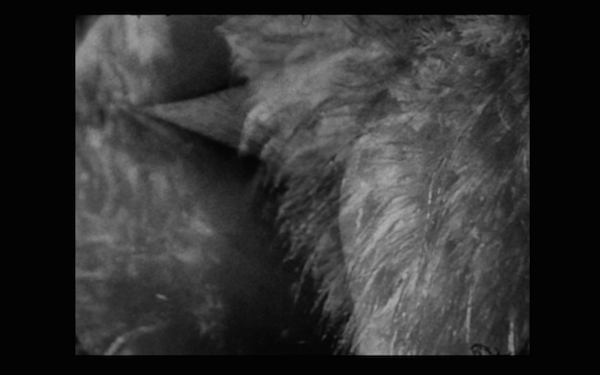
Fur dissolving into Lap
The film is rooted in Maddin’s own life. He recreates his childhood using actors to play his mother, his dead brother, and even his dog. They stage much of it at his recreated childhood home at 800 Ellis. Since his father died, they pretend that his body was exhumed and buried in the living room.
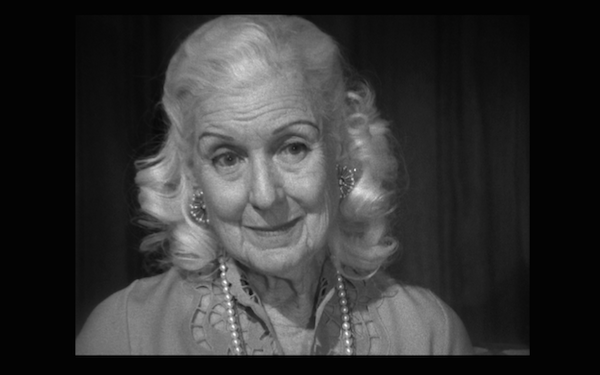
Mother
Maddin provides the narration, which begins with him riding a train through Winnipeg, and the voice is his own reflection of the city. As he narrates in his monotone voice, he intersperses archival footage, maps, quick shots of furs, laps and forks, with scenes of him trying to stay awake on the train. In this manner, the style is similar to the other Maddin films, with nods to silent films (weird title cards), quick dissolves between different types of footage, grainy film, shaky camera work, and the scenes cut back and forth from the train to his home, to the stories of his childhood and of the city. This is not like any other documentary.
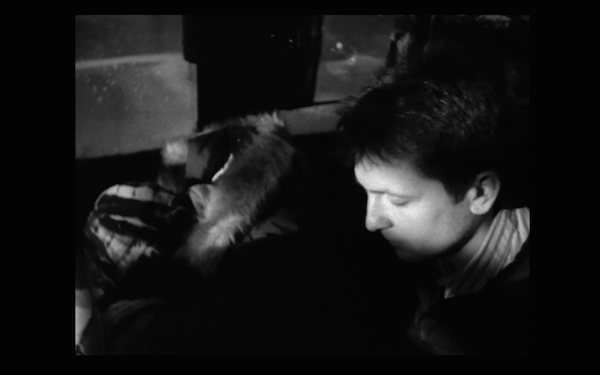
Sleepy on Train
It is immediately apparent that Maddin is playing with the truth, not just of his own life, but the entire city. He states some facts, one of which is that Winnipeg has 10x the sleepwalking rate of any other city. Of course that cannot be true. How is it even measurable? Yet this “fact” plays into his train-riding reflections of the city that in many respects resembles a dream world. He also claims that Winnipeg is the coldest city in North America. This is partially true depending on how you measure. It is the coldest large city. There are a few towns in Nunavut that would blow Winnipeg doors off. Maddin’s intention, however, it is not presenting an absolutely factual representation of the city. How much fun would that be anyway?
As he ventures away from his own history, he looks deeper into the city. “Winnipeg!” he says, as he introduces another absurdity, like not being allowed to keep any old signage. All the old signage is kept in the signage graveyard. He talks about a TV show called Ledgeman, where every episode has someone standing at the edge of a ledge, and every show ends with a suicide. Is that real? You can easily Google it to find out. If not real, then what is Maddin trying to say about his city? The TV show is not real, and I think this is part of the hate letter to his city, the fact that people would be entertained by people leaving their city in one of the most gruesome ways imaginable.

The partially demolished MTS Centre
There are other tidbits of “facts,” some more absurd than the last. He talks about the MTS Centre, or the MT Centre with the S flickering on and off so that it really says “empty center.” This was the hockey arena, but has become a betrayal because Winnipeg’s market could not sustain an NHL hockey team, so it was demolished yet stilled fielded a team called “The Black Tuesdays” that consisted of former players aged 70 or older, who played hockey amid the wreckage, sometimes with the wrecking ball actively destroying the arena. Maddin also claims that he was born and raised in the Centre. He was nursed in the wives room, and loaned out to visiting teams as a stick boy.
Some of the above paragraph is true, some embellished, and some outright lies.

Finally we get to the horses, the lovely and beautiful horses. I am not going to delve into this story because it is such a terrific scene and needs to be seen without description. This scene also has a little bit of truth, a little bit of embellishment, and of course, some lies.
Some events seem to be absurdist revisionist history, but are absolutely true. That’s part of what is gorgeous about this documentary. Not only is it engaging and fascinating, but it is a mystery. One could spend hours trying to fact check the documentary, and some probably have, and still could not tell the entire truth from the lies.
There is one telling line near the beginning of the film. “Everything that happens in Winnipeg is a euphemism.” Of course this is not literally true. Plenty of true things happen every day. Perhaps everything that happens in My Winnipeg is a euphemism.
Sometimes strange is truthier than fiction. I loved this movie.
Film Rating: 9/10
Supplements:
Cine-Essays: These are a series of short essays that Maddin refers to as little “points” that when finished point by point, will encompass Winnipeg. The topics are puberty, colours, elms, and cold. They are, very much like the film, indescribable and inexplicable, but just as much fun.
Guy Maddin and Robert Enright – This is a 52 minute conversation from 2014. He talks about the evolution of the project, and of course, about the factuality of the piece.
The documentary was commissions by Michael Burns for the Documentary Channel. Maddin was fascinated by trains and wanted to use this as the basis to show that Winnipeg is the “frozen hellhole” that we know it is.
He describes the mythologizing as “embedding the stories in emulsion.” It has been called Auto-Fantasia. The debate whether something is really documentary was mostly settled. He cites Herzog who presented “ecstatic truth.” Truth uninhibited is different than truth exaggerated, and that’s how he feels about My Winnipeg.
Even history is flawed because it is the victor’s viewpoint. If they look at the other side, it gets romanticized.
He cites influences, notably Chris Marker, although he does not want to compare himself to Marker. He was also inspired by Fellini’s I Vitelloni. He also references Detour because he cast leading lady Ann Savage as his mother. He does not make the connection, but one could connect the unreliable narrator of Detour with Maddin himself in My Winnipeg. He may be the least reliable narrator in any film.
Of course he does talk about which parts are real and fake, yet in a playful manner. He jokes that he would always get asked the same questions at festivals and screenings, so he challenged himself to always give a different answer. He does tell of some things that were real and embellished, but you can tell that he is answering carefully and could be giving different answers. Even as an interview subject, he is not the most reliable narrator.

If Day. Is it true?
”My Winnipeg:” Live in Toronto – This bit shows a screening at the Royal Cinema in Toronto with Maddin providing live narration. He felt nervous. He was told it is normal to feel terrible before and great during. He was surprised how he got big laughter during certain scenes.
Short Films:
Spanky: To the Pier and Back (2008)
This is a film about his dog Spanky, the same one he used as a replacement in the film for his childhood dog. Sadly, this turned out to be his last walk with the dog, as he died shortly afterword. What’s odd is that Maddin calls it an artless film, but I have to call him out on that statement. This is the most interesting dog walk to a pier and back that I’ve seen. Like his feature films, he uses a lot of quick cuts, and frenetic, sweeping camera motions. 8/10
Sinclair, 2010
This is a film that would be incomprehensible without the intro. Maddin was angry about some political, racist issues in Canada. Bryan Sinclair was an Indian, but had a treatable condition and was in the hospital, only to be found dead later. This film is the perspective of Sinclair in the waiting room. 5/10
Only Dream Things, 2012
This was developed for the Winnipeg Art Creative. He recreated the bedroom where he lived and used sounds that he remembers. The movie was dreamlike, with the typical Maddin style, only in color. The dreams themselves are more vivid, alternates between foggy dream state. In a way this film reminded me of someone who goes crazy with Photoshop filters or Instagram. 3/10
The Hall Runner, 2014 – This was one he was hoping to make into a feature but he did not get it off the ground. The film follows hall runner rugs with Maddin narrating. 5/10
Louis Riel for Dinner, 2014
Riel was a politician, and one of the founders of Manitoba. This was an animated short in which Louis Riel was a duck that could not be eaten. This one cannot be described and must be seen, and is probably my favorite short on the disc. 8/10
This was a treasure trove of riches and a nice, recent discovery for me. I expect this will be one of my favorite releases by the end of the year.
Criterion Rating: 9.5/10
In the Realm of the Senses, Nagisa Oshima, 1976

In the Realm of the Senses is shocking, vile, gruesome and absurd, all of which were intentional. It meant to provoke us (and Japan) away from our mundane social norms, like a lot of 1970s filmmakers were doing across the globe. With the Japanese fierce censorship code, this film is even more shocking, and it reveals something about their moral code given that it still has not been shown in its uncut entirety today.

Kichi and Sada
However disturbing, it is essentially a film about love. To most people, including myself, this type of love would be revolting and unfathomable. The woman has an unquenchable sexual thirst, while the man serves as a vehicle for her insatiable desire. As their relationship progresses, the ordinary becomes boring and she continues to ratchet up their activities. This makes for a more controversial and shocking film as it goes along, but it is fitting in how the plot develops and resolves.
When I first watched it, I found it shocking and amusing. That was also intended. Scenes such as when children throw snowballs at an older man’s genitalia add very little to the plot, and serve only to further provoke. The older man in question is only pertinent because he recognizes Sada, the lead character, as a former prostitute, although that could have been handled differently.
The sexual acts get more amusing, whereas the climax (no pun intended) and resolution are outlandish and way over the top. I was surprised to learn later that this was a true story. This one needed some time to settle and appreciate, and thanks to a good number of Criterion supplements, I received plenty of context and analysis.

Even though the description of the film would sound like pornography (and in a way, it is), the difference is that this was created and produced by professionals and has an artistry that lessens the stimulation. The set designs and photography are gorgeous, and even though the characters are doing unsettling things with their bodies, they are framed by an auteur. One such example is during the wedding scene. The man who had previously conducted the ceremony is doing some sort of celebratory dance. The camera pans upward so that he and his dance are the focus of the shot. It settles there for a time as he continues dancing, and then pans down to his feet where an orgy is taking place among the entire wedding party. Again, it is meant to shock and not titillate.
From here on out, I have to discuss the ending. Please stop reading here if you are spoiler averse.

Kichi Falling Asleep
As domestic, routine sexual activity becomes boring, Sada veers into sado-masochism territory. This is introduced through her earning her living as a prostitute, and encouraging her client to slap her repeatedly. She enjoys this so much that she brings it into her own bedroom. This leads even further, and she eventually gets fixated on choking. She likes the sensation when he is being choked during the sexual act. Even this eventually becomes mundane, and they have to go even further.
To understand Kichi’s behavior and final sacrifice, you have to understand a little bit about Japanese culture. They have a certain fascination with it, and they think of it as courageous to sacrifice one’s life for another. The most obvious examples of this ideology are the kamikazes in World War II. We also decorate our heroes, but in Japan it is different. It is truly honorable to die by one’s own desire.

The Final Sacrifice
When Kichi tells Sada that next time she should not stop with the choking, he is committing his final sacrifice. This is him letting go, giving everything he has in order to please who he loves, because there is nothing else within him that can satisfy her any longer. From a Japanese perspective, it is an honorable, if unconventional, way to die.
The ending is foreshadowed throughout the film. She has been characterized to have a violent streak, and had even threatened to cut off his manhood earlier in the film. There are scenes where she uses sharp objects, such as the time she holds a knife in her mouth, or the fantasy she has of cutting up Kichi’s ex-wife. Once she realizes that Kichi is gone, she simply takes what she feels belongs to her, his manhood. Again, this is shocking and grotesque, but in the context of their relationship, it is another act of love. She is taking her favorite part of his, and what’s left is her intense loneliness.
Film Rating: 8/10
Supplements:
Commentary: – This was a fantastic commentary from film scholar Tony Rayns, which was not expected. He begins by disclaiming that he will not be commenting on the sexual acts themselves, and he takes an academic approach to the film that was enlightening and refreshing.
He reveals that the popularity of artistic sex films in America prompted the project to start. Japanese had many sex films, but that’s not what they were going for. This was a true story, and the filmed version a lot more similar to the reveal events. Not every scene was true, of course, but the broad strokes of the plot were real.
They were a working class couple, not very educated, and they continue an erotic tradition that goes back centuries until Edo period. It stopped around Meiji period, where outside morals infringed on them. Because of this, In the Realm of the Senses is in part a political film, but that is difficult for Americans to tell unless they have a good sense of Japanese history.
Oshima drew on the trial transcript and the Sada story that was told after she was released from jail and published later. Oshima had made other provocative films, but this was his first from the female perspective. Of course it would not have made much sense to tell this story from a male point of view..
The sexual pleasure on film is all from Sada, and not from Kichi. He is never shown or heard actually in an orgasmic state. Even in the scene where his pleasure is shown in physical form, he does not moan or shudder. It is shown from her perspective and she takes the pleasure in his discharge, not him.
The true story is that after Kichi dies, the story becomes popular and people side with Sada. That is strange given what we’ve seen on film, but it is not too abnormal given Japanese culture. He gave his life for her.
Interviews:
Oshima and His Actors – This was a 1976 interview with the lead actors and Oshima for Belgian TV in 1976. Fuji does not actually speak in this interview, and Oshima does the majority of the talking, He says this was the first hard-core pornographic film in Japan. The other ‘pink’ films, as he calls them, were tame in comparison.
Eiko Matsuda, who plays Sada, speaks briefly and seems uncomfortable. She had an inferiority complex when she heard about the film. It helped her work through it, and so she feels it was her destiny.
Tatsuya Fuji – The lead actor was interviewed for Criterion in 2008.
French title was “Empire of the Senses” which is a better fit. He felt that his relationship was very much a dual, two-person empire, and their desires are their own. They should not be judged.
He said not many actresses could have taken such a role, not just because of the ability, but also the courage. Eiko had worked in underground theater and had a different perspective than most actresses.
Oshima created a relaxed and gentle atmosphere on set. He was very polite and let the actors be. Usually the set would be cleared for the sex scenes with just the actors and Oshima present.
He talks about how the sense of dying in Japan is different. They see life as a “a fleeting dream.”
Recalling the Dream – Even though this segment is under the Interview category, it is more of a documentary. It is a 40-minute segment that talks with a number of people who were involved with the film from behind the camera.
French distributor Dauman had imported Oshima’s Death by Hanging. He then moved from distribution to production, and it was Dauman that wanted an erotic film. Oshima was a leftist and it was thought that he would use sexual imagery as a political statement, but it turned out to be a conventional love story, albeit with political overtones.
They got around French legalities because they were technically French sets. All the film and negatives went to France. It was not developed in Japan during or after filming. It had been developed in Japan, the lab would be charged with indecency. It was unusual for the crew to not see dailies or any footage during the shoot. They just had to trust that Oshima was getting what he needed.
When the filmmakers and crew returned from France after the initial release, customs and police waiting for them. They had to screen the print to customs because it was a customs bond, which was the only time the film was ever screened uncensored in Japan. It was an audience of 50 people. For the Japanese release, they put a black bar on the entire lower part of the frame to censor the sexual activities.
Police wanted to go after Oshima for something and couldn’t. Instead they went after the script. The result was that Oshima apologized for stimulating the judge, police and authorities in the hearing. It sounds today like he was being sarcastic, but that was actually part of the deal.
Censorship is more liberal in Japan now, but they still cannot show the uncensored film. The biggest victory was being able to show the castrated penis uncensored.
Deleted Footage – Most of the scenes were simply extensions of existing scenes and were not too necessary. For instance, they extend a scene with her playing music at the inn to hide that they are having sex. The most notable deleted footage was that of the non-fatal choking scene and just after Kichi’s death. That scene is extended with Sada acting frantically and looking around, presumably to make sure nobody was around. They probably shortened that scene to make it seem more like love and less like a crime.
Criterion Rating: 8.5/10
Les Blank: Always For Pleasure. Final Thoughts.

Over the last month or so, I have tackled the terrific Criterion box set, Les Blank: Always for Pleasure. It consists of fourteen main features, countless supplements, and various other short films. It is a treasure of riches, as Blank takes us through Cajun country, up to Northern California, across the country to the Blue Ridge Mountains, up north to New England, back to California, Louisiana, and ending with a spiritual celebration in New York City. In the process we experience various different cultures, foods, music, and vibrant characters that are so far fetched that they cannot be made up. Les Blank’s world is about as far from the mainstream as possible, but it is about living life to the fullest, enjoying the simple things, and respecting traditions.
How can I summarize such a journey? I really cannot, as I’ve already written nearly 10,000 words as I rode along. You can read them here:
As a recap, I’ll look at the different types of topics that Les Blank explored, and how his vision was unique compared to so many others.
Music

Today it seems like most musicians and bands with a fan base have their own documentary. They are relatively easy to put together thanks to DIY independent film avenues and crowdfunding like Kickstarter. The larger the band, the larger the production, and the sales are nearly guaranteed. Most of these documentaries fall into one of two categories: the career narrative and the concert film. While some can be extremely good, such as somewhat recent documentaries on Rush, Metallica and Big Star, but they follow the same formula. They talk about the band’s origins, their success, breakup, and aftermath. They show concert footage and talking head interviews with anyone and everyone they can find. Many of these are inspired by VH1’s Behind the Music more than filmmakers like Les Blank or D.A. Pennebaker, and that’s a shame.
In many ways, Les Blank was a pioneer of the music documentary, and in other ways he was completely isolated from the genre, on his own island. He started with Dizzy Gillespie (which is not on the disc), and from there, he found some blues artists in Texas and Louisiana. He ventured further away from the Deep South, and covered artists that would not be found at the top of a music chart or featured on MTV. He wasn’t interested in only the musician, but also the way that they lived, the place and culture that molded them, and, perhaps most importantly, the affect they had on others. The one common thread among all of his musical documentaries is people could dance to the music. The people who experienced and enjoyed the music were just as essential to the documentary as the musician and the music.
Les Blank’s music work predated MTV, VH1, and Kickstarter, although it eventually caught up and he worked concurrently with the transformation of audio to video. He undoubtedly saw the musical documentaries from Pennebaker, Scorsese, Demme, and others, and you would think those would influence his style. Nope. From the first documentary on the disc, The Blues According to Lightnin’ Hopkins in 1968 to the final documentary, Sworn to the Drum, very little had changed. He had as much interest in how and where Hopkins grew up as he did Francisco Aguabella. He could not travel to Cuba to understand Aguabella, but if it were politically possible, he unquestionably would have. It is no coincidence that both of these documentaries are just about a half an hour long, feature the artist’s music as the soundtrack, show people dancing to the music, and explores the roots and ideologies that make them express themselves through sound.
Food

Again, Les Blank was a pioneer when it came to documentaries about food. Unlike with music documentaries, food via the mass media found a home almost exclusively on television. Blank probably had more influence than he gets credit for, since it was the Cajun cuisine that became a large part of cooking television. One of his subjects, Paul Prudhomme, even had his own short-lived series on Public TV during the nineties. Other personalities like Emeril Lagasse and Justin Wilson also became Cajun celebrity chefs. As Blank demonstrated, Cajun cuisine is delectable, and until the 1990s, was virtually unexplored as a mass consumer cuisine. Today you can get Cajun food everywhere, but not the type of food that Les Blank’s subjects cooked.
Food was such a central subject with his documentaries, that it comes as a surprise that only two of the films on the disc were specifically about cuisine. He explored garlic with Garlic Is as Good as Ten Mothers and Cajun in Yum, Yum, Yum! A Taste of Cajun and Creole Cooking. Despite it not being the sole subject, food is a large part of most of his documentaries. For musicians, he wants to know what they eat in addition to where they live. When he looks at cultures like Cajun or Polish-American, he spends a lot of time with their foods of choice. Even with Tommy Jarrell in Sprout Wings and Fly, he has a scene at the dinner table where they serve traditional southern food.
Les Blank loved food and it showed. In the supplements, we learned that he would run around movie theaters with aromatic dishes prior to a screening to add another layer of immersion to the experience. Can you imagine watching a movie about New Orleans while smelling red beans and rice? What about Ten Mothers while sniffing the strong scent of garlic? Even though I watched all of these movies without the hint of an aroma, I felt like I could taste and smell all of the food. And it was good …
Life

Even though each documentary had a subject, Les Blank’s films were just about the way people lived. Whether they were laborers in the middle of Texas, hippies in California, or country folk living in the mountains, we got to see what they did, how they behaved, and we heard their thoughts and ideas on life. As I reflect on this boxset, I think back to the early documentaries where he shows gorgeous landscapes, stunning sunsets, or just people wandering to and fro. People fascinated Blank, and that fascination was not restricted to his subject. He was enthralled by people running in a field just as much as he was a crazy actor arguing with a director (from Burden of Dreams about Herzog and Kinski, which was not on the set), or an old musician talking about playing baseball in the fields as a kid.
Food and music were just two examples of the many outlets people found to enjoy life. The Maestro dedicated his life to painting hundreds or perhaps thousands of pieces, not for economic benefit, but for his own passion. Blank loved to show people that were proud of something, whether it was a distinctive physical imperfection like a gap between two front teeth, or people who tried to compete with each other by wearing the best costumes at Mardi Gras. He showed people having a good time however they could. It doesn’t matter whether people were poor and lived in small Texan towns, or if they were doctors and lawyers that wanted to dance polka for a week, there was a smile on their face. If a nagging tooth gets in the way, then just pull it out and enjoy life.
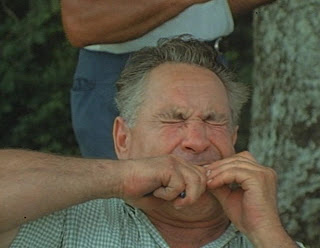
Thanks Les Blank for showing us your world.
Box Set Rating: 9/10
Les Blank, Always For Pleasure. Part Four.
GAP-TOOTHED WOMEN, LES BLANK, 1987

Again, we have a Les Blank topic that comes completely out of left field. Who would dream of filming a movie about something as minute as a slight wedge in between someone’s mouth? Les Blank was that man, and based on what other topics he approached, he must have been unusually attracted to women with the dental distinction.
The big question is whether there is some mystique to gap-teethed women. Are they sexier than girls with a block of bright and shiny whites? That’s probably in the eye of the beholder, just like some people with find various imperfections attractive.
Blank takes the topic further and uses it explore the concept of beauty and self-image. He opens with a girl who bites into an apple with her gap-teeth, and proudly leaves her ‘signature’ in the piece of fruit. Chaucer is referenced aplenty, and sometimes in the manner that he adored gap-toothed women. The Wife of Bath had gapped teeth, and she also had five husbands and countless other lovers. Her affliction did not leave her for wanting. Others have studied the term and traced “gap” back to the word “gat,” which meant lecherous, casting not the most favorable shadow on Mrs. Bath.
Some women are self conscious about their gaps. A lot of dentists consider it a flaw and aggressively will try to convince women to close them (or maybe they just want the business). They are more common in other words, such as Indian, where one lady says “half of India has gap teeth.” That could be due to a lack of dentistry as well as any cultural preference.
To balance out those with image problems, there are plenty of famous individuals that are considered beautiful. Lauren Hutton made a living out of her gap-tooth, and appeared in the movie doing street interviews. Madonna, also gap-toothed, is likely also proud. At last check, she still had the gap, but she did not choose to appear in the movie. Hutton’s message is to accept one’s own imperfections and turn them into your own uniqueness. Others take it further, such as one lady who screams for “Gap Pride!”
Blank gets some points for pursuing a topic that most could not even conceive of, and using it to explore the incomprehensible topic of women’s self-image and male attraction. Well done, Les.
Film Rating: – 8/10
Supplements:
Mind the Gap – This piece shows his office, cluttered with stuff he loves. Includes gap-toothed women, garlic, and red headed women and was going to make a movie about the latter. Susan Kell talks about his fascination of Chaucer, and the wife of Bath.
They had a Casting call advertisement and had the phone ringing non-stop. Who knew there were so many people with gap-teeth and eager to show the word? Te gist was that most women were excited about celebrating what had been seen as a flaw. They unsuccessfully tried to get Madonna. They also tried for Whoopi Goldberg, who was local to Berkeley and not as famous. She probably would have done the film, but her career blew up during the filming and she was no longer available.
YUM, YUM YUM! A TASTE OF CAJUN AND CREOLE COOKING, LES BLANK, 1990

Les Blank has some great titles, and this one fits the subject the best. I would say the vast majority of his documentaries have some element of food, even if it is not the primary topic. He just loves food.
This time he returns to Cajun country to focus exclusively on the cuisine. We meet up again with an older Marc Savoy, who we first met on Spend it All. He throws a bunch of ingredients in a pot that are then cooked over a country wooden fire. It is called “Goo Courtboullion,” which means absolutely nothing to me, but looks like the most delicious thing anyone could taste.
The guys out in the wilderness haven’t heard of Paul Prudhomme, which turns out to be a good time for a transition, and they then show him signing books in New Orleans in the next scene. He is the owner and celebrity chef of K-Paul’s Louisiana Kitchen. What’s interesting about Prudhomme is that this is ages before the Food Network, Top Chef, The Cooking Channel, and the concept of celebrity chefs. Prudhomme was one of the originals, and he along with others (Justin Wilson, Emeril Lagassee) popularized Cajun cuisine in the kitchen. When one watches this documentary — and perhaps many TV executives had — it is easy to understand why.
They cook a variety of dishes, with a focus on whole foods and nothing manufactured. One lady dismisses garlic powder, saying, “that’s the new stuff they got. No good.” Blank, ever the garlic aficionado, would most definitely agree.
Many more dishes are made, including a variety of Etoufees, each looking more delicious than the last. I seriously challenge anyone to watch this 30-minute documentary and not eat something during or immediately after.
Marc Savoy reappears to presciently comment on Louisiana cooking from outsiders. He ordered Cajun fish at Disneyland. The fish itself was fine, but they covered it in a black pepper that made it inedible. He actually took the fish to go, removed the pepper and ate it. I wonder what he would make of all the Cajun restaurants that have sprouted up all over the country? Would he take their finest dishes, eat a bite and then customize the rest later in his hotel room? My guess is yes.
The best quote is:
“What’s better than a bowl of gumbo?”
“Two bowls.”
Film Rating: 8.5/10
Supplements:
Marc and Les – When recruiting Savoy’s participation, they called him up and said “come on over, making gumbo.” Marc credits Les for meeting his wife Anne, which was sort of a half-truth because he met her at a festival that he wouldn’t had attended if not for Les. Les would remain friends with a lot of his subjects. Savoy was no exception.
THE MAESTRO: KING OF THE COWBOY ARTISTS, LES BLANK, 1994
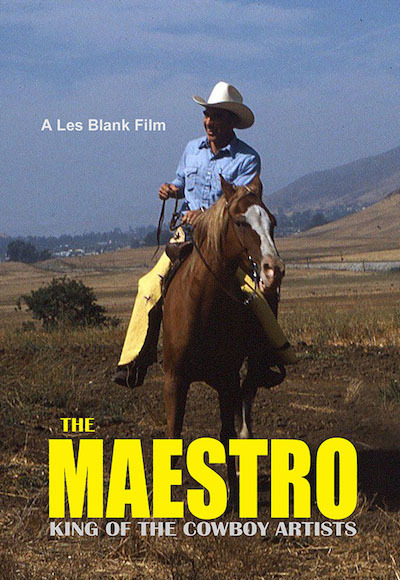
The overall theme of “Cowboy Artist” Gerry Gaxiola is that he does not paint for money. Like with Anton Newcombe, made famous by Ondi Timoner’s Dig!, he is not for sale. The continual reminder for Gaxiola in the film and the features is that for him, art is a religion and not a business.
What’s odd about Gaxiola is that the grew up in San Luis Obispo. Even though he grew up in a ranch, southern California does not exactly scream cowboy country. He speaks without a southern accent and his values are more common in Berkeley, where we resides, than say, Texas or anywhere else in the deep south. Yet he travels with a Cowboy getup, complete with the hat, boots, and even utility belts that he creates himself to holster his “guns,” which would be paintbrushes. Is he an artist or a gimmick? If you ask him, the answer would indubitably be artist, but Les Blank’s portrayal leaves the question on the fence.
He began having a Maestro Day, which would be a daily celebration where he would invite crowds to see him perform. He would do some artistic endeavors, like a “Quick Draw” where he would paint at warp speed. The rest was more performance, including singing and dancing. He would get the crowd involved, awarding best-dressed cowboy. There would be treats, and it sounds like a fun day for the family. Despite the success of Maestro Day, he quit it after 13 years because he was moving more in the direction of entertainer than artist and that is not how he wanted to be seen.
The man was not without talents. I’m not art expert, but I could tell that he was well versed in painting a picture, constructing buildings (like his own art studio), clothing (all of his boots), and various other items that could be used in art. He could paint, use ceramics, and sculpt.
The problem was that he never got the respect of the art community. He thinks that is because he chose not to sell his paintings, and the community respects economy over talent. Whether that is true is not clear. Perhaps they saw him as a gimmick just like many would at Maestro Day. He challenges successfully recognized artists such as Andy Warhol and the Christos, all to no avail. Warhol passed away, and the Maestro thinks that given time, he would have given in. From what I know of Warhol, I sincerely doubt the Maestro would have been paid any mind.
He appears to be able to live thanks to an inheritance of some sort, and so he self-importantly lives the Van Gogh life, constantly reminding us of that. Even though Van Gogh had a benefactor in Theo, he lived in misery and desperation. The Maestro, with his massive arsenal, choice studio, and slick Cadillac lives with a smile on his face.
Film Rating: 6.5/10
The Maestro Rides Again, 2005
In this follow-up work, the Maestro shows more of his work, including his first set of boots, a piece of luggage that has the state of California and all its counties. He paints a series of famous landmarks, which for the documentary his subject is the Mission of San Gabriel. He wanted to paint the first McDonalds in Downey, but does a “drive by” painting because it is too dangerous a neighborhood for him to stand all day.
This time his inspiration is Howard Finster, famous artist who rendered many REM covers and was proficient with folk art cutouts. The Maestro makes his own version of cut outs, with popular figures like Chet Baker, Miles Davis, Howard Finster and unpopular figures like George W Bush, who the Maestro dubs “Inferior Man.” He is not a conservative cowboy. That much is clear.
Cinephiles should appreciate his artistic series on a number of films, such as a painting about Fitzcarraldo, although the painting makes it look to be more about Blank’s documentary about the project, Burden of Dreams since both Kinski and Herzog are in the frame. He also painted other Les Blank images, such as the polka film with Blank in the audience. He was clearly a Blank fan, but was that because of his respect for the man’s craft or to serve his own ego since he was a Blank subject. 5/10
The Maestro – Interview with Gaxiola in 2014. He thinks Blank hit the ‘high spots’ and the cowboy stuff and not as much the artist. He thinks the film portrayed him without any depth, and again laments that he thought of himself as a Van Gogh, but the art establishment did not want that. He said the process was frustrating because the filming took 10 years and Les Blank was not a guy with a plan. He just filmed. Blank pretends he’s not interested until you start doing something, and then he would turn on cameras.
He seems to regret the Cowboy caricature, and he especially complains when people call him out for “dressing” as a Cowboy, because it makes him feel like a phony. My question is, does he rustle cows?
He is not altogether proud of the film and complains some, but then catches himself and tries to sound grateful. He is happy that the “Art is a religion and not a business” was the principle theme and has on.
Art for Art’s Sake – This is a brief feature about the process of putting the film together. Chris Simon saw an ad about Maestro Day, decided to go and had a great time. During the show, Maestro mentions Burden of Dreams. Wow! He and Les were like two peas in a pod. Lots of films took five or more years, mostly to let the material develop, but also editing. Maestro is an example of one that took a long time.
They discuss the Christos incident, which I found very interesting. Blank was not happy with this situation because he thought Gaxiola wanted to deface Christo’s art by spraying paint on it with his gun as part of his challenge. They argued about it, and compromised by having Blank shoot the challenge as if Maestro is shooting the umbrellas, but he does not. There is even a disclaimer that “No Umbrellas Were Harmed in This Film.”
SWORN TO THE DRUM: A TRIBUTE TO FRANCISCO AGUABELLA, LES BLANK, 1995

It is fitting that the final documentary on the box set is of a musician, and more fitting that it’s of a fringe, obscure and culturally immigrated genre. Francisco Aguabella is a Cuban percussionist who plays Latin Jazz and Santeria music. He emigrated Cuba in 1957. Even though he never made his way back to the homeland, he has stuck to his roots and helped bring his culture and Afro-Cuban to the states.
This is not the type of drumming that people would think of after seeing Whiplash. It is almost in a different universe. When you see it being played onstage, it is doesn’t appear to be as impressive. Aguabella is one of many percussionists, and he seems to be doing less actual drumming, but he is actually the mastermind that determines the beat. He translates via his big drum to the other drummers and creates a conversation with the other drummers. The sum of the entire process is magic, and nobody would argue that drums are not an important, if not the most important, factor in Afro-Cuban music.
There is plenty of exposition about the music origins, Francisco’s personal history, and the way the music works. The cultural history is fascinating even if they race through it, but it is the images that are the most powerful. There are certain key images that are unforgettable, like when Aguabella is playing at a religious ceremony and the camera freezes at the moment when someone becomes “possessed” by the music.
The colors that are painted on his face represent different Gods. He us a devout Religious person, and that can be seen through his playing. Carlos Santana says that when they are playing, the walls begin to sweat. People are always dancing, sometimes energetically, sometimes hypnotically. Like a lot of the music that Blank portrays, it inspires people to move.
Film Rating: 9/10
A Master Percussionist – This feature has more background info on Aguabella. He was a master Jazz drummer, but could also play Santeria. Back then he was one of few that could play in the states, although now many can play due to the popularization here. Latin Jazz was his love, but he was at his most powerful during the Santeria ceremony. It was just powerful.
They didn’t film him talking about his origins in Cuba before the revolution, where he would carry huge bags of sugar. After revolution, he was afraid if he left he couldn’t come back. He was a remarkable man.
La Ciénaga, Lucrecia Martel, 2001

La Ciénaga is a bleak and perplexing piece of filmmaking about two sets of adults, two sets of kids, and a lot of laziness, racism, alcoholism and backstabbing in between. The upper class adults have few redeeming qualities and rely on their children and maid for menial tasks, yet they treat the children with suspicion and the maids with outright scorn and accusations of theft.
The movie begins with a number of adults on the upper end of middle age, all lounging near a filthy pool, drinking a stark red concoction that makes them more expressionless as they get more inebriated. The scrape of their pool chairs is grating, as they move the metal into a position that makes them more comfortable, but they are immune to the jarring sound. They are virtually zombies, just letting the day pass by them. A thunderstorm is on the horizon, yet they still remain motionless. Suddenly, Mecha, the matriarch of the host family, stumbles with a glass in her hand, and lacerates her chest and breasts. The underage children are responsible for transporting Mecha to the doctor because nobody else is sober enough to drive.
Meanwhile, the children explore the tropical areas with gun in hand, looking to have a little fun. They encounter a cow that is stuck in the mud, obviously suffering. At first pass, they consider killing it to put it out of its mercy. They decide against it the first time, and on a later visitation when the cow has not improved, they end his existence. Animals and references to animals are constants in the film. One child relates a story that was told to her about dogs that ate cats, but when the dog was cut apart to see if the cats were inside, they discovered an African rat. Even in ordinary scenes around the house, the sight of wildlife is constant, from having a dog in the frame to backing it bark in the background. We even see a random turtle crawl across the frame in a later, brief scene. The point is clear, that we are supposed to compare these miserable individuals who merely exist, behavior and sometimes the misfortune of animals.
Meanwhile, someone in the city has witnessed an image of the Virgin Mary on a water tower. There is continual news coverage about this wonder, with people describing what she saw or what friends of theirs had seen, but few people on camera having actually seen the Virgin. One of those interviewed on camera says that the Virgin’s appearance implies that hard times are coming, foreshadowing some events that will transpire to the family later. These sequences recall another famous cinematic Virgin Mary appearance in Fellini’s La Dolce Vita, which is ultimately dismissed as little more than media frenzy. The same is true here, but it is a mechanism to advance and close the story.

The only real energy comes from the children. They are the only ones that have normal human urges. For example, there is one scene where the two young women ask a boy to try on a shirt so they can see how it would look on someone else. It is obvious from their expressions and how they watch him change clothes that they simply want to see his bare chest. They participate in dance outings, and even if one of these results in a fight between two boys, including the one who changed in the store, they are an active and agile bunch. Towards the end, the children play collectively in the water amid an explosion of water probably from some broken water source. It violently sprays water into the stream, and they emerge from it with smiles on their faces. When the children are out, they are the opposite of stagnation. When they are at home, they are mostly bored, pensive, and tired, not so different than their parents who never leave the house.
With Mecha recovering from her lacerations, she is bed-ridden and miserable. She sees an advertisement for a mini-fridge, and later we see that she has the fridge, which allows for easier consumption of her mind-numbing drinks. At one point she sees her husband sleeping and mutters, “what a pig you turned out to be” with complete disdain. He has no real defense, as he is as helpless and lifeless as her, and is in a constant trance-like state. She later asks him to move into another room and leave her alone. By this point, they are a marriage of convenience, with only their laziness and alcoholism in common. What she despises in him, she could easily despise in herself.
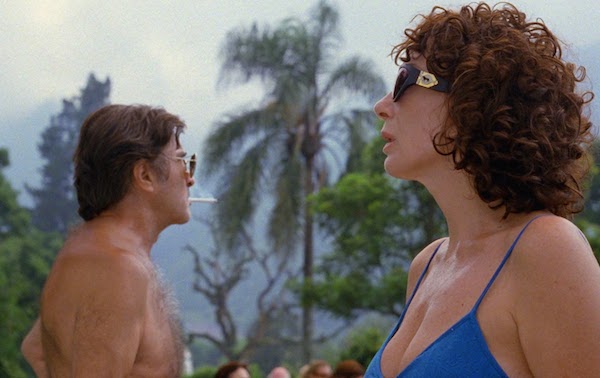
Given their lack of admirable qualities, they project the worst habits on the Indians who serve them. These people, including the maid, are of a lower class, but they are portrayed as having a better work ethic and a stronger sense of self. Yet the upper class Argentines call them idiots, rag on them for eating bad fish and for treating animals poorly. The daughter is caught between her flawed mother and the Indians. When her friends discard some muddy fish saying that only Indians will eat it, she reclaims it and assumedly eats it later. She also tries to comfort the housekeeper after being lambasted for her race. She represents progression and compassion, given the circumstances she’ll encounter, could later turn into her mother.
A tragedy occurs at the very end, one that probably could have been avoided and I will not go into it here. Punctuating the bleakness of the film and combining the primary and subplot is another visitation to the Virgin Mary site, hoping to see something or get a message. She sees nothing and questions its validity. Even though the movie starts on a pessimistic note, it ends much darker.
Film Rating: 7/10
Supplements:
Lucrecia Martel, Seven Notes on Cinema – This feature gets us inside the creative mind of Martel and uses La Ciénaga and some of her other work in order to show her methods and philosophy towards film. She shares seven aspects of cinema that she employs in order to contrast a realistic and unrealistic vision. For La Ciénaga, the keys are sound and immersion. She uses grating sounds, like the animals and the pool chairs for instance. As for immersion, she uses steadicam and shoots close to the actor’s perspectives. Sometimes the camera is in so close that it feels like it is within another character. She also shares that she is not Catholic, whereas many in her town are, and that is probably why the Virgin Mary was used as a plot device.
Andres de Tellas – Tellas is a Writer, Director, and Buenos Aires International Festival of Cinema Co-Founder. He has a wealth of knowledge about Argentinian cinema, and I found his insights into their cinematic culture fascinating since I know virtually nothing about their cinema. The films are often based on politics due to the series of 20th century dictatorships. A notable film after they had freedom of expression was The Official Story (1985), which gained some world renown. What followed was mostly message movies, and the following generation (including Martel) went against that type and created a New Wave of Argentinian cinema. While the cinema is not as overtly political, it has to be read with the political backgrounds in mind. After all, the elder actors of La Ciénaga were repressed under the dictatorships. Some, like Graciela Borges, participated in the prior Argentinian New Wave before the political turmoil. La Ciénagac can be read as a straight family drama, or as the actions of people who have been repressed.
Martel works in the spirit of Jorge Luis Borges, who says that nationality comes naturally and exists in your expression. However she may try to avoid it, her Argentinian upbringing is ever present in her cinema. She is aware of filmmaking history, especially Argentine, and possibly she was making a reference to Fellini, or maybe just using Catholicism as a theme of false hope for people who had been repressed.
Criterion Rating: 7/10
Something Wild, Jonathan Demme, 1986

“It’s better to be a live dog than a dead lion.”
What does that mean? To Charlie Driggs (Jeff Daniels), it means quite a lot. He is a NYC corporate VP, living the high life with a nice house in the suburbs, a cheerful wife, two kids, and doggone it, he’s just a swell guy. Or is he? Enter Lulu.
Lulu, real name Audrey (Melanie Griffith) lives on the wild side, and somehow catches Driggs in the act of rebellion. He leaves a restaurant without paying. It could have been a simple mistake, or it could have been his own way of non-conformity, of living wildly despite his privileged status. From there the fun ensues. Lulu and Charlie take off on an adventure of their own. He blows off his professional responsibilities, and they find a unique bond in their opposing values and lifestyles. Lulu wears a short, dark wig, somewhere in between a brunette Madonna and 80s goth, with different colored bracelets that cover her arms and neck, while Charlie wears a bland blue business suit with a yellow tie.
The first third is part romp and part road movie. This contrast of cultures is unsettling and welcoming, as Charlie and Lulu see how the other half lives. They may joke and criticize each other’s worldviews and clothing choices, but they make for an odd, yet somewhat refreshing match. Meanwhile, the film is shot with attention to color and detail, a lot of greens, background graffiti art, and popular radio songs
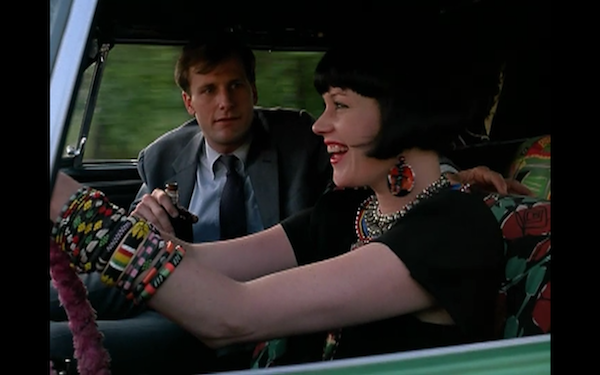
Lulu and Charlie
After using Charlie to masquerade as her fake husband to impress her mother, Audrey takes him to her high school graduation to impress her old friends. Here is the tonal shift in the movie. She changes her appearance to look a little more like somewhere between traditional, classy Madonna and Grace Kelly. At the party, they meet one man from Charlie’s world and one from Audrey’s, while The Feelies (a somewhat underground post-punk group) plays cover songs for the dance. Charlie encounters Larry from his office accounting, and Audrey embarrasses him during the exchange, while Audrey meets Ray, who turns out to be a former flame with even more of a wild streak.
This is where it’s worth exploring what the movie is saying about corporate culture. Remember, this is fresh in the middle of the Reaganomic 1980s, where youngsters were expressing themselves in colorful, cheerful ways, and the status quo of the suburban and corporate lifestyle was seen as square. This defines the two main characters to a tee. Lulu is beyond hip, the kind of girl that 1980s girls adored and wanted to emulate, while Charlie was the schmuck whose life was seen as mundane and boring. Real life and culture was passing him by.
When Larry the Accountant learns that Charlie is having an affair with Audrey, who even in her prom getup, is far hipper than his pregnant wife Peggy. He smiles at Charlie and says, “I didn’t think you had it in you.” In a look, you can tell he idolizes his office VP and in part envies him. The wife, however, is not of the same mind and wants to get away.
Audrey is a tough nut to crack. At times she seems endearing and playful with Charlie, while other times she is malicious and humiliating. When she tells Larry about their tryst, that is a breach of trust and also a lie. She says they are expecting a baby. In this way she is trying to shatter the image of the corporate schmuck, and she succeeds in the eyes of Larry, if not to herself.
Despite the earlier moment of rebellion at the restaurant, Charlie comes off as an upstanding and moralistic guy. He does not want to get in trouble with his expense accounts, which Lulu takes advantage of, and he even condemns foul language in a later scene. He is even monogamous to his fake marriage with Audrey, when his “real” marriage is revealed to have been over for next to a year. He is an ambiguous figure, ultimately good, but with a little wickedness that probably fills an emotional hole within him. Audrey is swiss cheese when it comes to emotional holes, but together. they can let themselves go and even dance like dorks, without caring how they look.
Ray (Ray Liotta) is a different breed entirely. He is unquestionably part of the criminal element, and the audience sees through his charade even if Charlie buys right in. He manipulates Charlie into participating in a store robbery, and that’s where the road trip becomes something more dire and serious. Maybe Charlie could have fit into Lulu’s world, but Ray’s world is somewhere he could never live. He would get eaten alive, and in a sense, he does. However tonally different, the last chapter is engaging in a different way, mostly thanks to Liotta’s performance, and it unwinds toward its inevitable conclusion.
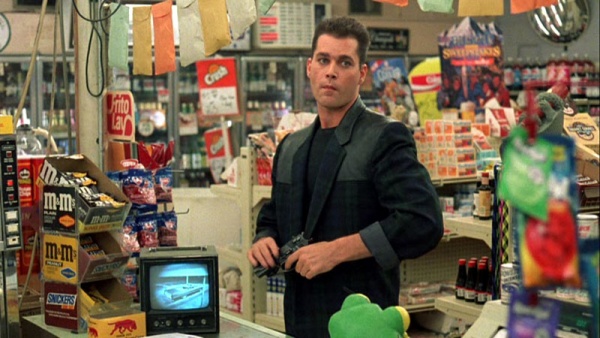
Something Wild has some elements of an art film and some as a road genre film, but it is unmistakably an 80s film. The soundtrack ranges from New Wave, poppy one-hit wonders, dark goth, and just to put the cherry on top, even includes some old school rap outside of a gas station. While some of the 80s nostalgia is fun to experience (or re-experience for someone who lived through the generation), it’s almost trapped by the time period, and that leaves it dated. In addition, while the finale is thrilling, the actual ending seems unrealistic and tacked on. It almost seems like something to appease a movie executive (however unlikely given Demme’s later comments).
Instead it is a mixed bag, all over the place tonally with some highs, lows, and like a lot of the 80s culture, something to be consumed and left behind.
Film Rating: 5.5/10
Supplements:
Jonathan Demme Interview – He had worked on Swing Shift, which he felt was destroyed by studio and he wanted to get out. Even though he had directed other projects before, as an auteur, he considers Something Wild to be his debut. He made it with Orion who was one of the few studios to give creative freedom in that period.
His comments on casting were particularly interesting. He had Melanie Griffith in mind because of Body Double and Night Moves. His first choice for Charlie was Kevin Kline, and then someone recommended Jeff Daniels after his performance in The Purple Rose of Cairo. The extreme “nice guy” element was not as highlighted in the script. Jeff brought a lot of that. Ray Liotta had not acted in a film before and was recommended by a troupe performer. Demme was “scared” of Ray during the audition, and found him to be the perfect fit for his character. He wishes he could take credit, but pretty much everything in the movie was all Ray. I will hand it to him that the casting was the strongest aspect of the movie, and Ray Liotta gave the best performance.
He talks a lot about the soundtrack, including The Feelies (who he loves, proving again is eclectic and good taste in music). They did a lot of big covers, like David Bowie’s Fame, which would be expensive today, but not back then. He used the music to match the tone, with the fun, outrageous poppy stuff in the beginning with Charlie and Lulu, and darker music during the Ray sequences. The finale reverts back to the lighter fare.
E Max Frye Interview – Frye was the screenwriter and this was first studio film. The idea came from him just seeing someone looking wild with piercings sitting at a bar, who later meets someone with a suitcase. He lived in the East Village where there was a lot of graffiti art, colors, and that helped with the template. Spoiler alert: it looks a lot different now. He was going for contrast between a hipster girl, businessman, and criminal.
He had re-written the ending a number of times and didn’t find much that worked. That’s understandable as that is one of the weaker areas of the film.
Criterion Rating: 5/10
The Palm Beach Story, Preston Sturges, 1942

One of the many things I like about Preston Sturges is that he’s all over the place. It is not that he completely defies the Classic Hollywood conventional formula, but that he is not confined to it, and he plays with expectations. Even in the screwball comedy genre, he’s a bit of a loose cannon and less predictable. The Palm Beach Story is even more out there than others, like the soon to be upgraded Sullivan’s Travels (which, to be fair, is not exactly conventional either).
While the overall journey does not sound too far fetched – they start in New York, take a train to Jacksonville, and then boat to Palm Beach – it is the detours along the way that make this truly a Sturges picture. Tom (Joel McRea) and Gerry (Claudette Colbert) are the true leads and get the most screen time, but they share it with plenty other colorful characters. It is not the Capraesque manner of portraying two primary characters with some dimension and flattening all the others around him, such as in It Happened One Night, also with Colbert. He uses the supporting characters to give texture and flair.
All of the characters are a lot of fun, whether they are major or minor, but I am going to touch on the best of the supporters.

The Quail & Ale Club
My favorite batch of supporting characters is the band of drunken hunters that take Gerry under their wing and give her access to their train car. They are introduced one-by-one, all with ridiculous names, but not to the extent that they could all be totally made up, just far from the norm. When they get on the train and start drinking, they are a delight. Two fellows start a competition where they will shoot crackers in the cabin, which a racially insensitive stereotypical African-American porter (unfortunately, this was common to the era) would reluctantly throw the crackers up in the air. At first one drunken gentleman seems to think they are merely miming the shot, which itself is a little silly since there could be no way to prove which is a hit. The reality is even more outrageous. The man loads a live round into the chamber, and succeeds in hitting the cracker, shooting out the train window in the process. They do it again, and eventually the entire Ale & Quail Hunting Club are shooting toward the train window, destroying the entire cabin. Rather than deal with drunks with guns, the conductor simply detaches their car and goes on without them.
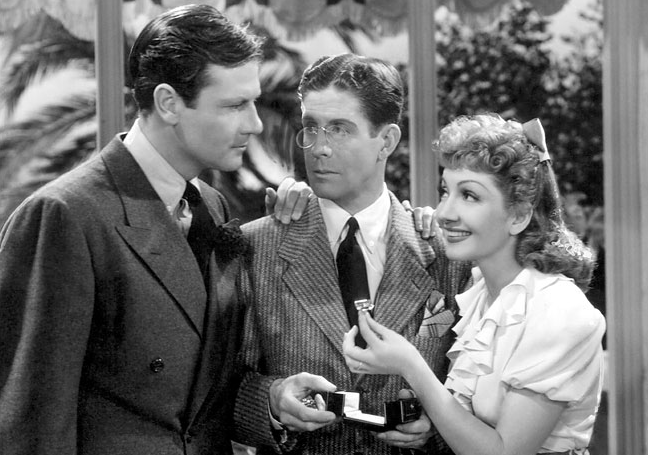
Tom, Hackensacker, Gerry
The next two characters are the ultra-rich descendants of the Hackensacker family (an obvious mockery of the Rockenfellers). John D enjoys the idea of paying for whatever Gerry needs along the way, which includes a wardrobe since hers was on the Ale & Quail car. He even meticulously writes down each amount, although we learn later that the total bill means next to nothing to him. He could own the store without blinking. His sister, Prince Centimilla (Mary Astor) is later introduced, and they are both humorous in their pursuit of married couple that are playing as brother and sister. The best comic relief is Toto, who bears more than a passing resemblance to Carlo from My Man Godfrey as the jilted sponge who passive aggressively allows himself to be cuckolded for a free meal ticket.
The most outlandish part of the feature is the ending. I won’t reveal the specifics, but it is a form of a deus ex machine (sort of), which comes completely out of left field. There are some films that I see this type of ending as sloppy and lazy, but here it is completely appropriate with the zaniness that has taken place during this romp to South Florida.
Film Rating: 8/10
Supplements:
James Harvey – This is a critical analysis from Harvey, a film scholar. He talks about Sturges origins with screenplays and B movies, and how he made his way up the ladder with Paramount.
Sturges came from a rich upbringing, which explains why he focuses often on the upper classes and lampoons them with such precision. His adopted was Solomon Sturges, who had acquired a great deal of wealth in the stock market. Despite not being his real father, the two were very close.
As I noted above, Struges’ comedy was too far out to be appreciated by the mainstream. The Lady Eve was a big hit, but Palm Beach and Sullivan were failures. Despite another big hit with The Miracle of Morgan’s Creek (which I would LOVE to see on Criterion someday), Paramount let him go and aside from a couple successes, his career mostly went on the downturn. He became a favorite of French critics like Andre Bazin, who liked him and hated Capra, so his work has been rediscovered and celebrated in part thanks to them.
Bill Hader – This is an odd choice for an interview since Hader is not necessarily a film scholar, but he clearly has an appreciation for classic comedy and he is unquestionably an authority on modern comedy. He spends most of his interview with a Sturges script book, just reading some of the dialog and cracking up at it. The words read as funny as they sound spoken, and sometimes even funnier. He remarks that a number of comics and filmmakers were inspired by Sturges.
Safeguarding Military Information, 1941 – This is a short propaganda film made during the war to prevent people from unwittingly spilling military secrets in public and possibly compromising the safety of our military. It plays out as one would expect from a propaganda film, whether American, German or Russian. One segment had Eddie Bracken, who would star in two major 1944 features for Sturges, the aforementioned Morgan’s Creek and Hail the Conquering Hero.
Criterion Rating: 7.5/10
Top 20 of 1996
The 90s were generally good years for film, but I was surprised by how tremendous this year was. The resurgence of indie Americans was in full swing; Dogme 95 was in motion (although the Von Trier film on this list isn’t really Dogme); and there was still quite a bit of foreign cinema going strong. This list also has two of the best and most influential documentaries of the decade.
One addition that might surprise some people is James and the Giant Peach. Many people wrote it off as a standard Roald Dahl animated children’s tale. This was in the era where Pixar was getting all the accolades and other animated films were being overlooked. I discovered it later and consider it to be a gem. I’ve watched it several times and appreciate it more each time. I implore people to check it out if they haven’t seen it.

This year was so strong that a lot of wonderful movies had to be cut, and that always hurts. Some of my last cuts were Citizen Ruth, Drifting Clouds, Flirting with Disaster, Sling Blade, Pusher, and The People vs. Larry Flynt.
1. Breaking the Waves
2. Secrets & Lies
3. Fargo
4. Paradise Lost
5. James and the Giant Peach
6. Trainspotting
7. When We Were Kings
8. La Promesse
9. A Summer’s Tale
10. Mars Attacks!
11. Bottle Rocket
12. Big Night
13. Lone Star
14. Irma Vep
15. The English Patient
16. A Moment of Innocence
17. My Sex Life … Or How I Got Into an Argument
18. Ridicule
19. Hard Eight
20. Shall We Dance.

The Bitter Tears of Petra Von Kant, Rainer Werner Fassbinder, 1972

Like many of Fassbinder’s films, he features strong, female characters in the leads and supporting parts. In this film, the cast is predominately female, and is among the most feminine of his works. That does not mean that it is feminist. One could argue that it has some feminist attributes, and it can also be seen as anti-feminist since the portrayals of women are mostly negative. It can also be seen as a class contrast, with Petra (Margit Carstensen) representing the bourgeois, Karin (Hanna Schygulla) representing the poor and uncultured, and Marlene (Irm Hermann) representing the working class.
The entire movie takes place in Petra’s apartment. Often films that are shot in a single location can be drab and tiresome, but there is enough visual ingenuity, both with the camerawork and the mise-en-scene, to keep every scene fresh. The performances are all tremendous, particularly Carstensen who was working with a great deal of dialog.
Petra represents the horror that success can have on a person. She is conceited, brazen, thin-skinned, and she asserts her power over defenseless people. Marlene, her assistant, is the object of many cruel and disdainful eruptions. Petra thinks of her as less of a person. At one point she tells Karin that “Marlene has been with me for three years. She sees everything, hears everything. Pay no attention to her.” Petra does not bother to hide her secrets from the help, but we will find out later that this person is not the invisible bystander that Petra considers her.

Petra and Karin
Petra’s cousin (Sidonie von Grasenabb) introduces Karin as a young model. Petra takes to her, seeing someone with a beauty that she can possibly mentor and control. Petra’s riches come from a life of fashion, and she could make a person’s career. She asks Karin to visit her later, and the girl timidly agrees, knowing that this could lead to a brighter future. When she shows up later, she is dressed to the nines, with a gold outfit and a wide collar around her neck. Petra is dressed in an ostentatious and grossly flamboyant outfit with circular beads decorating her breasts. The outrageous wardrobes are contrasted with the Classical European paintings on the walls. Some of these include nakedness, male and female, and they are prominently placed within the frame. Fassbinder was not bashful with nudity, whether his own or others, and he clearly used these paintings as a way of injecting an uncomfortable sexuality into the mise-en-scene.
Petra is intrigued by the young lady, although seems more interested in bragging about her own experiences. There are mirrors everywhere, and as she talks, she narcissistically watches herself. It is when Karin reveals a horrible tragedy that happened to her parents when Petra really takes to her. It is at this vulnerable moment that Petra sees Karin as someone fragile that she can control, who can fill the void of loneliness that is consuming her. Karin becomes a kept woman and a romantic relationship begins between the two.
In the second act, the tables have turned. Karin is the one who has the power. Petra is helpless to get her affection, much less her attention. Karin cannot be bothered, reads a magazine on the bed and demands that Petra get her a drink. She is playing the role of the spoiled child, and Petra is trapped as her enabler. Earlier she had bragged that “everyone is replaceable,” referring to Karin and Marlene, but to her, that is a flat out lie. She is psychologically tethered to both of them.

Marlene, ever so silent.
Marlene is the anchor for this movie, beautifully played by Irm Hermann in a mostly silent role. She doesn’t need to speak to convey her thoughts. She says plenty with her face, as she reacts to what is happening in Petra’s life, which often does not have anything to do with her. Some of the best shots in the film are when Petra and Karin or whomever are talking about some nonsense, and the camera pans over to Marlene and zooms in for a close-up, showing her utter and absolute disdain for her employer. Her hatred is obvious to the audience, but Petra is oblivious. She is just another plaything, like the dolls and mannequins that she collects. Only this one does her bidding without ever questioning her authority. At least not yet.

Despair
When she is left. Petra is completely isolated and in despair. She sits on a white carpet that looks like a cloud. The European, nude painting is still behind her in the frame, fully exposed just like her heartbreak. Has she died and gone to heaven? The shot implies as much, and a major part of her, her power, has died. She feels completely abandoned, but there are still some people remaining in her life. Her daughter Gabby appears with family, and Petra’s behavior is similar to what we’ve seen with Karin and Marlene. She is out of control, lashes out at one moment and tries to apologize the next. She calls them fake, “dishonest little rats.” After her fury passes, she is told that she will pay for her actions, that there will be consequences. There are. I will not reveal them in this write-up, but I will say that Petra’s conclusion is in the typical Fassbinder style.
Film Rating: 8.5/10
Supplements:
Outsiders: – These are four interviews with actresses from the film: Margit Carstensen (Petra), Hanna Schygulla (Karin), Eva Mattes (Gabby), and Katrin Schaake (cousin Sidonie). This 2014 segment edits their answers together so that they stay within the topic of the film. Most of them felt like outsiders to Fassbinder’s stable of actors, which is strange because they were all cast in many of his films, especially Carstensen, who played many lead roles. Most talked about how they were treated on the set by Fassbinder, and how he would play games to create conflict amongst each other. Some were reluctant to reveal much, while others are more forthcoming. The overall sentiment was that Fassbinder was difficult to work with. The only exception was Eva. He was gentle with her and did not play the same sort of games as with the other actors.
What is surprising is the production time. The filming was lightning fast, 10 days. Carsternsen had an easier time because she had played the same role in the theater and knew the lines, but the other actresses had difficulties. As they put it, Margit was perfect everytime.
The story was autobiographical based on a relationship of Fassbinder’s. It is interesting that he chose women to play the roles, but he often did portray his own life through women, which may have been an element of his homosexuality. Fassbinder felt that whoever had the strength in the relationship loved the person less, and that was what he was trying to convey with this film.
Michael Ballhaus – Ballhause was the Director of Photography. This was his third film with Fassbinder, who had dismissed him as a TV DP. In the other segment, the other ladies had very kind things to say about Ballhause, although those were probably contrasted with Fassbinder. He said that this project was challenging because they shot quickly and he had one room to work with. He had to figure out good angles to keep it interesting, which I would say he accomplished. Fassbinder told him that he was a big fan of Douglas Sirk and wanted this to look as visually rich as a Hollywood film. They would argue and at one point there was a blow-up. At one time Ballhause said “I am not a machine. If you don’t like it, then hire someone else.” They eventually made up, and worked on many other projects together. Ballhause liked working with Fassbinder because he was a good visual director.
Beautiful Destruction – This is a feature from Jane Shattuc, author of Television, Tabloids, and Tears: Fassbinder and Popular Culture.. She talks about how dark his work was, although it was beautiful visually. He had a bleak portrait of humanity, and that was reflected in his work.
Fassbinder started with a theatre troupe, and as we know, he maintained that collective for much of his film career. Many of the issues playing out in film were also part of their personal lives.
She says that the mise-en-scene was very important in this movie. The changing in appearances of Petra reflects how she feels about herself. She starts in the operatic dress, then to red hair, and finally in a white nightgown, showing her true humanity. The set, clothing and shooting change as the character changes.
Role Play: Women on Fassbinder – This was 1992 German TV documentary with many of the women who worked on his films. This was quite a bleak documentary. It was far from a puff piece. The actresses were frank about how far on the edge they were during the Fassbinder age, and how cruel he was to them. Yet he was also successful and gave them continual work if they could endure it. For the most part, he was not friendly with actors save for rare occasions. When Margit Carstensen speaks of her history with Fassbinder, her tone and look are as if she is revealing a traumatic and monumental time of her life. This is not the type of remembrance you’ll see of many directors.
The people that worked for Werner often thought about leaving and starting fresh somewhere. Margit attempted this and distanced herself from his inner circle, which made him angry. She tried to leave one time during the filming of Chinese Roulette and said: “You leave and you’re out of the film.”
Even though he was difficult, he portrayed women beautifully, and most of the women conclude that it was due to his effeminate nature and homosexuality, although none of them really understood it or him. We know that he was bi-sexual and would engage in relationships with actresses, such as Irm, but even she was confused during the relationship.
They all say he was a brilliant filmmaker. He had the capacity to love, but his addiction and dependence got in his way. He had a series of disappointing relationships. Often he would test his lovers and be disappointed. His standard of love was too high for anyone to really achieve. In many ways this tale is a tragedy because Fassbinder, however brilliant, was tortured, never found love, and died due to indulging too much.
Criterion Rating: 9/10
Odds and Ends
I started this project last year as a creative outlet while I recovered from surgery. I’ve taken to it and am pleased that people are reading my stuff. I thought now would be a good time to take stock and let people know where I’m headed.
With the upcoming last part of the Les Blank boxset, I’ll have finished with the 2014 Criterion releases. I’ll finally be releasing my favorites of the year, many of which I have not yet written about for the site even if I’ve seen just about all of them. I’ll also include a list of my favorite write-ups that I’ve done, whether new or old.
From there I’ll start tackling 2015, which I am already behind on. With six releases in February, I have my work cut out for me.
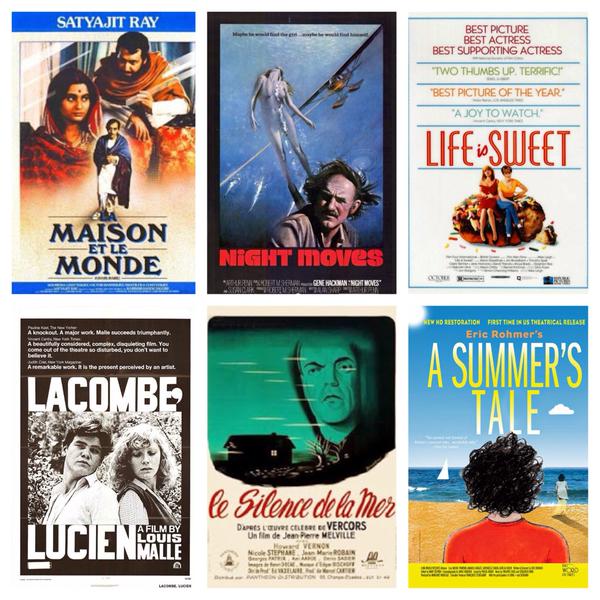
Recently I wrote a guest spot for Brian at Rupert Pupkin Speaks. I’m a fan of his podcast with Ryan at CriterionCast. He’s already given me plenty of ideas about DVDs to purchase and films to discover. It was a pleasure looking back at the past year and thinking of what movies really moved me. I’m proud of the list, even if it is a bit French-centric.
Finally, I launched a Facebook page. Please help me out and go ‘Like’ it. You’ll notice a sidebar where you can navigate recent Facebook postings, very similar to Twitter. Of course links to all new posts will go up there, as will a number of images and news links.
Soon I’ll be launching an Essays section. This is where I’ll post various studies I’ve done through the years. There will be a lot about French film, classical Hollywood, Sunset Blvd, and various others. Most of these were academic and I am no longer in school, but this will not be the last of my essays. I have a number of print sources and am continually interested in pursuing topics to research.
Thanks for following along. I’ll try to keep it interesting. If you have any suggestions, feel free to drop a comment.


 Criterion Close-Up