Criterion: Bottle Rocket, Wes Anderson, 1996

It would be unfair to only talk about Bottle Rocket as Wes Anderson’s first film, and how it planted the template from which his future style would grow. It technically was his first film and certain stylistic and performance elements would reoccur, but it feels to be more substantial than a first feature. Wes Anderson and the Wilson brothers were learning, certainly, but the real first feature was the short film a few years earlier. That was their low-budget, independent way of figuring things out, and that’s what gave them the attention and confidence to be trusted with a larger production. Bottle Rocket cost nearly $8 million dollars and had some influential and experienced people involved, notably producers James L. Brooks, Polly Platt, and actor James Caan.
It is fair to compare this alongside Anderson’s other works, and in my opinion, it rates rather highly. Anderson says in the ‘making of’ documentary that people usually have one of two responses to the movie – they either love or hate it. There isn’t much in between. I’m in the love it camp, and have been since I first saw it many years ago. I’ve already talked about my respectful ambivalence toward’s Wes Anderson in my Fantastic Mr. Fox write-up (all of the rest which will eventually be revisited), but it is worth repeating that the style of all of his films can be divisive. Sure, he’s a critical darling, and deservedly so, but some people find his quirky indie style to be unappealing. That has been me to a certain degree, but not with Bottle Rocket.
I think it is among his best films, somewhere around Fantastic Mr Fox, Rushmore and Grand Budapest Hotel.. On some days I might call it my favorite Wes Anderson.
Why do I like it so much? First off, Anderson is a phenomenal filmmaker, and this is apparent from throughout the feature debut, and to a certain degree with the short film. Of all his films, I think Dignan is the best-drawn character, and I will delve into him further in a moment. Even though the film is eccentric, compared to many of Anderson’s other works, it is more realistic. Sometimes in his later films he will take the quirkiness too far, such as with The Royal Tenenbaums, The Life Aquatic and Darjeeling Limited, and they appear to be more of a fantasy world than reality. Bottle Rocket and also Rushmore are grounded in a lower class, youthful and naive reality, with two (three if you count Bob) lost souls trying to scrap together a place in this world.
Another strength of Bottle Rocket is the romantic element, which I think Anderson has only come close to replicating with Rushmore. The fact that Anthony falls for a hotel housekeeper speaks to his desperation and to his benevolence. Most housekeepers are invisible, even to the lower classes. It speaks for Anthony’s character that not only he recognizes her, but he pursues her in the kindest, gentlest way possible, yet is genuinely infatuated.
One of my favorite scenes in all of Anderson’s movies is the pool scene where the romance is effectuated. The scene is beautifully lit and the pool is a gorgeous shade of blue. The camera angles are not linear, but not disruptive either. The way the scene is shot lends to the awkwardness and uncertainty of the characters, and the satisfaction for both of them once they finally act on their feelings. The scene ends appropriately with Dignan interrupting them.
Dignan is the type of character that is easy to love and feel sorry for at the same time. He is ignorant, naïve, and not very self aware, but he is also charismatic and confident. He has qualities that everyone has to a certain degree, yet they are accentuated. He is like a more eccentric and less intelligent Max from Rushmore. He will say what he means and sometimes trample on others, but he will instantly back down when it comes to a confrontation. His most endearing characteristic is his optimism and glass half-full outlook on life. I will not spoil the ending, but the fact that he utters the line “We did it” triumphantly to Anthony and Bob, just sums up everything about him. He gives another great line while in the midst of a heist – “They’ll never catch me because I’m fucking innocent.” He gets the best lines in the movie, as he should, because he’s …. well, he’s just Dignan.
Film Rating: 9/10
Supplements:
Commentary with Wes Anderson and Owen Wilson – They can barely remember the movie because they made it so long ago, but they still share a number of good stories. They weren’t sure whether they would cast the Wilson brothers because they had little acting experience and wouldn’t give the project much panache. The producers were the ones who convinced them. Jim Brooks thought Luke had a Montgomery Clift feel.
It was interesting that they cut roughly 20-minutes of an action sequence. This was Bob’s pot plant being discovered by police and them running away, much of which is in the deleted scenes. The odd part is that the remainder of the movie has very little action save for the very end, yet they cut the scene that had a lot of action because it simply didn’t fit.
They talk about the disastrous test screenings, and how they thought their film was funny, but discovered later that “there was not a big laugh in the movie.” They remembered one incredibly positive comment card out of 500 from that first screening where most people walked out. Anderson coincidentally met the person who wrote the card later and he recognized her because he cherished that card and kept it.
The Making of Bottle Rocket – This is mostly a series of interviews from the participants, since not much footage exists from the actual shooting. Anderson and the Wilsons talk about how young they were and how little they knew, but others say they were more professional and confident on the set. Andrew Wilson, for instance, says that they play possum because they knew exactly what they were doing. Interestingly enough, they were making $700 a week and $100 per diem during the production. They were kids and had never earned this type of money before, so a lot of people accused them of milking the production time to keep getting paid. The jury is still out whether that was the case, but they at least established the slow pace at which they would develop films. Anderson has never been in a major hurry, and that has helped his films retain a sense of quality.
Bottle Rocket, 1994 – This is the short 13-minute film that was recognized at Sundance. There are many similarities to the movie, such as the stealing of the earrings, playing pinball, the book store heist, and many more. For a student film, they do a good job and I can understand why people saw enough promise to give them a feature. It also looks inexpensive. For instance, they don’t show the bookstore robbery. They just show the actors talking about it later.
Deleted scenes – You can see the amateurism of the filmmaking from the deleted scenes far more than anything else, and they were smart to delete them. They would have slowed the movie down with irrelevancy. The pot chase was a fun scene, but most others were just distractions.
Photos and Storyboards – The photos were from Laura Wilson and encompassed the feature and the short. These stills are more for the die hard fans.
Shafrazi Lectures, No. 1: Bottle Rocket – For a critical commentary, this one was disorganized and inarticulate. He says some things about the characters, but mostly looks at random scenes and comments on them. Most of his comments are not very insightful, such “I love that,” for one or “I don’t like that” for another.
Murita Cycles, 1978 – This is Barry Braverman’s documentary about his father Murray. Braverman was a collaborator and friend of the filmmakers and this early work inspired them. You can tell that they modeled some of their characters from Murray. He is quirky and soft-spoken, and reminds me of some of the Bill Murray characters in later films. He is sort of a hoarder entrepreneur, yet is unafraid of getting himself dirty. Like a lot of Anderson characters, he is endearing and refreshing despite his flaws.
Criterion Rating: 9/10
Criterion: Time Bandits, Terry Gilliam, 1981

Time Bandits came at a curious time in the career of Terry Gilliam. It could be considered a crossroads. He had cut his teeth animating for Monty Python, which eventually led to him co-directing Monty Python and the Holy Grail with Terry Jones. From there he moved towards imaginative fantasy worlds like Jabberwocky, where he was still finding his craft. Time Bandits was yet another step forward into exploring a fantastical world, while still clinging to his Python roots and trying to achieve a mass appeal. What resulted was a blending of the Python comedy, the Gilliam fantasy, and another stepping stone towards the career of a unique auteur.
Gilliam uses a child’s perspective to establish the fantasy, contrasted with the crass commercialism of the adults – Kevin’s parents – and a yearning toward the adventures of yesteryear. While he is dreaming of historical and fantasy worlds, his parents are dreaming of an appliance that prepares their food just a little quicker. Meanwhile, they sit on furniture that still has the plastic covering seemingly to keep it from becoming worn and old.
The mise-en-scene of Kevin’s bedroom is a template for the entire remainder of the film. The pictures represent locations where Kevin and his Time Bandits will later travel, while the toys will similarly reappear as objects in later scenes. This is a clever and creative way of planting a gun in the first act to have it reappear in the third. Gilliam places everything in the first act, which begs the question as to whether the events take place in reality or whether they are in the dreams of a child’s mind.
The fact that Kevin’s travel companions are dwarves help anchor the camera to a child’s perspective, so that virtually everything in the movie is shot from below. All of the adults (save for Napoleon) tower over the camera. This also suggests the mystery between this being a child’s imaginary world or whether the bandits and their perspective are real.
John Cleese and Michael Palin are the link with Gilliam’s Monty Python roots. While they are funny in Time Bandits and steal every scene they are in, they restrain Gilliam’s artistry and imagination. It is no coincidence that his best work would come when he was ultimately divorced from the Python aesthetic. We laugh when Cleese steals the rich bounty from the bandits only to give it away to the poor, or when he turns a blind eye to those poor being punched for no apparent reason. We also laugh when Michael Palin tries to hide an ailment from his beloved Shelley Duvall, whether it is in the forest or on the Titanic.
When the Python actors are not on the screen, the film becomes less of a comedy and more of a deeper examination of the spirituality of this world. In this sense, Time Bandits is two different movies. It is in part a Pythonesque comedy and in part an artistic examination of commercialism, the concept of good versus evil, and at it’s core, a coming of age story. Given that it is so many things and is partially effective at each, I feel that it falls short of its potential, yet remains wholly entertaining.
Film Rating: 6.5/10
Supplements:
Commentary: – Gilliam discusses his experiences with the film in a decent commentary. I did not realize that this began as a children’s film while he was struggling to make Brazil. I can see that ambition in Time Bandits, and for that reason I’m glad he used a mainstream canvas to stretch his creative legs, and that experience probably helped Brazil become a great film. It is interesting that he used Python actors and dwarf actors from Star Wars, yet was inspired by Visconti in terms of production value. This is readily apparent by the terrific historical set pieces, which stand on their own for any genre of film.
There are other participants in the commentary. Child actor Craig Warnock played Kevin and shares some of his fond memories of the experience, since he was young during the filming, he does not have the sharpest memory of how everything came together. He share some interesting stories, such as how he got the part, which of course would be difficult to forget.
Also participating in the commentary are Michael Palin, John Cleese, and David Warner. Palin helped write the movie. He was initially going to only write the dialogue, but he ended up contributing to the plot as well. And he casted and wrote his own part. It was a short shoot for John Cleese and he did not know entirely what the movie was about, but he enjoyed his scene. Warner enjoyed playing the evil genius, which was a sort of comic villain that he had not played before.
“Creating the Worlds of Time Bandits” – This piece is about the set and costume design. Like many good Criterion features, it points out things that are easy to miss when first viewing the film. One thing I missed was that the bandit characters had relics from history as part of their costumes. Talks about different locations – Ancient Greece was Southern Morocco. The Napoleon scenes were filmed in Wales. There were other scenes shot in Kent, and a lot on the studio. The Titanic was shot in a studio by just creating a deck, but it worked well. The sinking was from A Night to Remember.
Terry Gilliam and Peter von Baugh – This is a conversation between the director and film scholar from 1998. Gilliam talks about films he loves as a kid, like epic films (Ben Hur), which can be seen in his personal and Monty Python works. Talks about using movies as escapes, which makes sense since his major works – even the most artistic — really are about escaping into a sort of fantasy world. He did not know art cinema as a child, but adored people like Jerry Lewis. Of course he would eventually discover art films. At one point in the interview he references La Jetee, which of course he would remake into 12 Monkeys.
Shelley Duvall – Interview with Tom Snyder in 1981 on his Tomorrow show. He introduces her as a big star, which she really was at the time, but her film career derailed afterward and she worked more on children’s projects (Fairy Tale Theater). She talks about how smart Monty Python guys are, which is true as they are all Oxford scholars, and many of their post Python works have been academic. This was a short, promotional segment where they showed a clip.
Criterion Rating: 7.5/10
1935 List
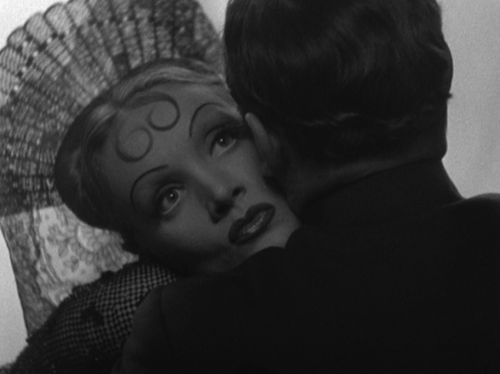
Phew. What a tough year! Thanks to Josef Von Sternberg, I have a solid #1 title and also another title towards the end of the list. There are some excellent films from the year, both in America and abroad, but there were a lot to navigate through to get to this list. This was the period where Hollywood started producing a lot of literary epics because they did well overseas, notably Dickens’ A Tale of Two Cities and David Copperfield, both of which are good and deserve a place on the list. Sternberg also tackled a literary classic with Crime and Punishment, which is not on par with the rest of his work, but still worthy of being on the list.
There are some good French films, but perhaps because of the happenings with the National Front, this year is lacking compared to 1934 and especially 1936. There are some good American comedies and musicals, including Berkeley’s Gold Diggers of 1935, which has some tremendous musical set pieces, especially considering the year.
There are two notable omissions. Top Hat would probably make most people’s lists, but I have some sort of aversion to Fred Astaire and Ginger Rogers. The biggest omission is Riefenstahl’s Triumph of the Will. I’ve seen it and studied it, and realize that it truly is a great documentary, one of the best ever made. That said, I cannot bring myself to list it and would rather watch paint dry than see it again. I can go into a movie like Birth of a Nation and appreciate it as art even if I do not agree with the message, but I struggle with the Nazi documentary. Yes, that is a Tati Short at #20. I have it rated higher than the better known documentary, and make no apologies.
1. The Devil is a Woman
2. Toni
3. Bride of Frankenstein
4. Mutiny on the Bounty
5. A Night at the Opera
6. The 39 Steps
7. Carnival in Flanders
8. A Tale of Two Cities
9. The Ruggles at Red Gap
10. The Good Fairy
11. Man on the Flying Trapeze
12. Gold Diggers of 1935
13. David Copperfield
14. Captain Blood
15. Steamboat ‘Round the Bend
16. The Clairvoyant
17. The Lives of a Bengal Lancer
18. Crime and Punishment
19. The Informer
20. Gai Dimanche
Criterion: The Complete Jacques Tati

It is both fortunate and tragic that we can package an innovative filmmaker’s life work into a 7-disc box set. The tragedy is that he was not able to share more of his artistic vision, either due to financial or creative issues. You would be hard pressed to find another auteur who matches the quality of the heart of his output from 1953 until 1967 with Monsieur Hulot’s Holiday, Mon Oncle, and PlayTime. The last film of the trilogy, which is arguably the best, essentially ended his creative freedom and harnessed his talents. His career ended with a whimper, and his final projects never made their way out of development.
On the other hand, despite the lack of production, it is quite a journey to wade through all of the creative works from someone of Tati’s caliber. The Jacques Demy box set that came out earlier this year similarly captured the essence of his career, but not the entire narrative. There were notable omissions, some of which would be a good fit for Criterion (Model Shop), while others wouldn’t (Parking). For Tati, even the lesser films are Criterion-worthy, as they highlight his talents and his style in various ways. He had financial problems after PlayTime, but that did not force him to compromise his artistic integrity in order to make a fast buck.
Tati began his career as a music hall performer and a mime, and in many ways, he remained as such throughout his career. The oddball characters of of François the Mailman or the popular Monsieur Hulot showcased his physical talents and comic ability. Since his characters were mostly mute, he was a mime without the makeup, a music hall performer without the music (at least not the same type of music). And he could always make us laugh.
People fascinated Tati. He used his films as a way of observing the habits of ordinary people, however odd and nonsensical, and how they transformed during the period of economic prosperity and American innovation following the war. He was always an observer, and his film style made us observers as well, rewarding us for our attention to details, with hidden gags buried layers below the surface or in the background of the frame. He challenged us to be curious like him.
Tati denied that he was critical of modern architecture. He constantly claimed to be impressed by it, but not always by the people who inhabited it. A large part of his work satires the preposterous lengths that people go in order to improve their lives, whereas deep down they are merely trying to impress others. Hulot as a character and Tati as a person were less than impressed by these displays. To them, having the latest gadget, or the most immaculately manicured landscaping, or an appliance that has an inexplicable additional feature were pointless. He wanted to get to the core of humanity, get people away from the hustle and bustle of the city. This sometimes meant meandering around a small town where garbage lies in the middle of the street, or transforming a ludicrously designed restaurant into a relaxing bistro where companionship and revelry were most important.
These little treasures from the old France were being lost, little by little, but there was beauty still to be found among all the chaos. Few scenes illustrate this point better than PlayTime when Barbara opens Hulot’s gift en route to Orly airport, to uncover a lovely flower arrangement, which not-so-coincidentally resembles the streetlights that guide their way back home.
The box set is a delight, and ranks at the top of the Criterion sets that I’ve explored to this date.
Criterion Rating: 10/10
Jour de Fete
Monsieur Hulot’s Holiday
Mon Oncle
PlayTime
Trafic
Parade
Tati Shorts
Criterion: Tati Shorts, Jacques Tati

When accepting the Honorary César award in 1977, Tati urged the film industry to support short filmmakers, even if they had to sacrifice a small percentage of their profits. It is through shorts that filmmakers are allowed to get creative and take risks. He points out that without shorts, the careers of people like Keaton, Chaplin, Fellini and Rene Clement would not have flourished. The same is true of himself, even if he humbly left his own name out. Through his short films, we see the evolution of his style that would materialize in his six feature films over fifty years, three of which are arguably masterpieces. This disc has all of the films shorts with his involvement, either as actor, writer, director or even father.
On Demande Une Brute, 1934 – This was written by and starred Tati, but written by Charles Barrois. It is pure slapstick comedy, that is not so much Tatiesque. He claims in one of the supplements that the first film was not very good, but he learned from it. I don’t agree with his assessment, as I think it works as a comedy, even if it doesn’t resemble what would become a Tati comedy. Tati played a naïve youngster, caught in a tough position having to accept a wrestling match with a menacing champion. Plenty of shenanigans ensure, including a major plot point that involved an umbrella, perhaps foreshadowing things to come. 7/10
Gai Dimanche, 1935 – Tati co-directed this short with Jacques Berr, co-starred and co-wrote with Enrico Sprocani (circus clown that went by name of Rhum). This is a better effort than his first film, even if the direction is amateurish and there is some poor framing. I’m a little more forgiving because I know the filmmakers were young and learning their craft. The results on screen are more in line with what Tati would later do, including using long-shots and creative sound effects in order to enhance the humor. There’s even a scene with a malfunctioning sign, which is nearly mimicked in Jour de Fete, and signs would be a recurring motif in all of his future work. 7.5/10
Soigne Ton Gaughe, 1936 – This was directed by René Clément, only his second credited project, and starred Tati. Even though Clément was not yet the accomplished director he would become, it is apparent in this early work that he had potential early on. Even though Tati did not write the story, it played to his tastes and his strengths. He starts out as a bicyclist that resembles Francois from Jour de Fete. He does a boxing routine when he thinks nobody is looking that is much like a performance he gave 40 years later in Parade. Tati again proves himself to be a capable comic actor, and the shot selection and framing are the best of these early works. 8/10
L’Ecole Des Facteurs, 1946 – This is the first sole directorial credit for Tati, and anyone who has seen Jour da Fete can tell. This is the first introduction to Francois the Postman, and is essentially a truncated version of what would become Tati’s feature length debut. Many of the shots look identical to the feature, and it they were not the same shots, then I have to give Tati kudos for recreating them so efficiently. The story begins with the bicycle school, where Francois and two other postmen learn the proper way to ride and hand for certain types of letters. There’s also the famous bike riding itself scene, which ends with it parked comfortable at the café. While it lacks the charm and character development of the feature film, it is quick to get to the point and highlights some of the better gags. 8/10
Cours du Soir, 1967 – This was made on the set of PlayTime, directed by Nicolas Ribowski, starring Tati who dresses in Hulot clothing. But this character is not Hulot! He is teaching an evening class about an unknown subject. If anything, the class is to become Hulot. He starts by doing impressions of different sorts of smokers, then segues to sports impersonations and other pantomimes. Finally they have to practice stumbling on a step and then running into a column, which of course Tati can do masterfully. The students cannot quite manage, and they perform nonsensical calculations (using shoe size?) to figure it out. Even though this is a showcase for Tati’s talents, the humor is not as effective. We’ve seen him do many of these same routines in other places without making up an absurd classroom scenario. 4.5/10
Degustation Maison, 1977 – This was Tati’s daughter, Sophie Tatischeff ‘s directorial debut. Tati was not directly involved, but most likely gave his daughter a great deal of assistance. The short film has some Tatiesque elements, and is filmed in Saint-Severe, the same location as Jour de Fete. The premise has locals frequenting a bakery and having an insatiable demand for tartlets. Most of the short just watches them interact, which is the type of observation that her father favored. The joke is that the café is like a bar. As they eat the tartlets, they get looser and eventually appear drunk and get cut off. While the short was one-note and the joke is not very funny, it was a decent debut. 5.5/10
Forza Bastia, 1978/2002. This is a film that Tati began and did not finish. His daughter Sophie wrapped it up over two decades later. This is very much unlike any other Tati film. It is a pure documentary, which I don’t believe he had previously attempted. This is about a football match between Eindhoven and home team Bastia. Not so surprisingly, Tati is more interested in the behavior of the participants rather than the actual match. He films the town as they represent and celebrate their team in the days leading up to the match, waving flags and honking horns through congested traffic. Even during the match, he captures more footage of the fans in the crowd and curiosities on the field, such as the groundskeepers creatively trying to make the soggy field playable. He shoots some of the match, but very little, and the results are anti-climactic. Instead he accomplishes what he most likely intended, which was to capture the culture surrounding the match. This is my favorite of his shorts. 8.5/10
Supplements:
Professor Goudet Lessons – Stéphane Goudet is all over this box-set as the preeminent Tati scholar, so it is only fitting that he conclude the disc with a half hour lecture that concludes the themes and methods of the filmmaker.
One of the more common recipients of Tati’s ridicule is the education system. He made fun of schools, which we see more in his short films rather than his features. He is primarily interested in leisure, especially sports and holidays, and these do become prominent themes of his features. Constant targets are those who take themselves too seriously at anything.
The basis of Tati’s cinema is observation. He likes to show us people looking, and subsequently, he challenges us to observe as well. It is curious as to why he made so few films in such a long timespan. At first it was because he needed time to observe humanity, to pick up on personal nuances and trends that he could ridicule. He says that PlayTime was the only film that the French didn’t like because they didn’t know how to watch it.
For someone that is consistently compared to silent filmmakers, sound is a major attribute of his films. He likes objects or people to have one sound to characterize their function, which he often manipulates in order to highlight ridiculousness or humor.
David Lynch, Olivier Assayas, Michel Gondry, Patrice Leconte and Wes Anderson all contribute snippets to this lecture.
Tati Story – This is a brief bio of the life of Tati through his works. Begins with his silent period, then feature films, and shows many examples from the short films on this disc. For someone with such a limited output of work, his reach and genius was limitless.
Criterion Rating: 8/10
Criterion: Parade, Jacques Tati, 1974

I wrapped up my discussion of Trafic by quoting Tati from an interview about why he made so few films. His answer was that he did not want to make something that failed to meet his standards. His quote was that, “in life, you only have so many ideas.” Parade is most certainly one of his big ideas. It is ultimately his lifelong idea, a culmination of all his years working in the entertainment industry, beginning in the music hall, continuing with his mime training, and to a lesser extent, his experience in films. This is Tati the showman, which was ultimately what he was all his life, even if that side of him was disguised in his most popular works because the real Tati was somewhere within the character of Hulot.
By that same token, ideas for a variety show on TV and a feature film are drastically different. Parade stands apart from all of Tati’s cinematic output because (and apologies to Jafar Panahi), this is not a film. This is a TV show that was later converted to film. As a TV, show it would be quality entertainment. As a stage show, it would be an experience one would never forget. As a film, it is a decent and fleeting experience. As a Tati film, it is the outlier, the movie that does not belong and cannot be measured or even categorized with all of his previous efforts. For that reason, Parade is a disappointment.
The show is a form of a circus with Tati as the host. There are acts of juggling, balloons, magic, animals, and musicians (especially during the latter third of the film). The acts that take place when Tati is not on the stage are at times enjoyable, at others trite and uninspired.
It is when Tati is on screen that the film shines. He does a few pantomimes. My favorite was his attempt at boxing. His act is coordinated with the drummer to register the punches and the end of the round. It is short, but absolutely hilarious. Other acts are also good. The soccer goalie is a joy, whereas the tennis match is a riot, especially when he performs his mime in slow motion and captures the anguish of the tennis player on every shot to comedic effect.
The audience participates in the escapades. During the tennis match, they look left and right using the sound effect of the ball as their cue. At times it is clear that they are plants, such as when an audience member does a magic act that upstages the amateur on stage who fails at his act. There is also a husband and wife couple in the audience during the mule sequence. The husband is tempted to walk onto the stage and try his hand at the mule, but his wife gets in the way. When he finally gets away from her and onto the stage, he manages to ride the mule. He follows it up with a couple pratfalls and we catch on that the joke is on us. He was part of the entertainment. There is another family with two small children who are given a great deal of reaction shots during the entirety of the film with no explanation as to why, but they come back into “play” at the end of the film. It was probably a blast for the children, but as a film finale, it was unsatisfying.
It begs to wonder why Tati brought this to screen in the first place. The simplest explanation is the lure of money. He had been critical of the idea of ‘selling out’ to get a paycheck, but after two failures in PlayTime and Traffic, he may have had no choice. He may have needed the cash. On the other hand, he is clearly proud of his background as a pantomime and entertainer, and what better way to exhibit such hidden talents than on a TV screen? Given that he shot it in video (and it shows), it also begs to wonder whether this is something he wanted to stand on the same footing as his artistic films. Whatever his reasoning, it is a disappointment that this is the final appearance on film for such a cinematic genius.
Film Rating: 3/10
Supplements:
In the Ring – This is Stéphane Goudet’s critical analysis. He has provided a lot of the better content on this box set. His commentary is useful here in pointing out some of the background of the production, such as the fact that this was the first French movie filmed on video that was shown in theaters. He points out that the cinematographer was Gunnar Fischer, the same DP who filmed many of Ingmar Bergman’s classics (The Seventh Seal, Wild Strawberries, Smiles of a Summer Night). The filming style is different than Tati’s other works, not just because it is filmed on video, but it also has close-ups and zooms, which capture the action of the performance. Of course Tati’s traditional long shots would not work with this type of production.
He provides some background on what Tati brought to his performance. Many of the acts were developed 40 years earlier as he was a developing pantomime and comedic actor. Goudet is fond of this work because it shows that side of Tati, and he dismisses the argument from a Tati biographer that this was a tragic mistake. Goudet feels like this is an extension of Tati’s earlier work. I disagree with Goudet, as is clear in my write-up above.
“In the Footsteps of Monsieur Hulot” – This documentary is one of the better special features of the set. It was directed by his daughter Sophie Tatischeff, and separated into two parts. The first part is about Tati’s early life, how he developed his comic sensibilities, and through the filming and exhibition of Mon Oncle. It shows a lot of 1930s footage of Tati doing his mime acts in the music hall as a young man, and these are a treasure to see. There are interviews of Tati, and he discusses his move into short films, the first of which he considers to be terrible, but he learned from it, and eventually made features. He wrote Jour de Fete while in the war, stationed at Saint-Severe, and promised to return to film there. He kept his promise and that launched his film career. The whole town participated. He based Hulot on someone he had met in the military, someone good natured and goofy. From there, as we know, he made Monsieur Hulot’s Holiday and Mon Oncle, the latter of which launched him to international stardom.
Part two follows the remainder of his career. He tours the world for Mon Oncle. He wins at Cannes and an Academy Award. He gets to meet the star of his choice after winning the Oscar, and chooses Buster Keaton, and eventually spends time with Keaton, Harold Lloyd, Mack Sennett, and Stan Laurel. From there they cover PlayTime, with the construction and destruction of “Tativille,” and the economic failure of Tati. Traffic is glossed over, but Parade is cherished by Tati. He made it in Sweden because he felt they had supported him in his career, even during the bad times. It ends with him giving a parting quote: “If I’ve managed to bring a little smile to people’s everyday lives, in the end [ … ] I think I did well in choosing this marvelous means of expression.” You did well, Jacques.
“An Homage to Jacques Tati” – This is a 1982 episode of the French TV show Magazine. Artist and set designer Jacques Lagrange pays tribute to his friend. He talks about how he created the Arpel house from a sketch, and they received letters of outrage from architects, all of which they cherished. He talks about the process by which they would write their gags, which was carefully thought out and visualized.
Even if the film itself is not up to the quality of the rest of Tati’s work, the disc is worth watching for the supplements, especially Tatischeff’s feature length documentary.
Criterion Rating: 6/10
Criterion: Trafic, Jacques Tati, 1971
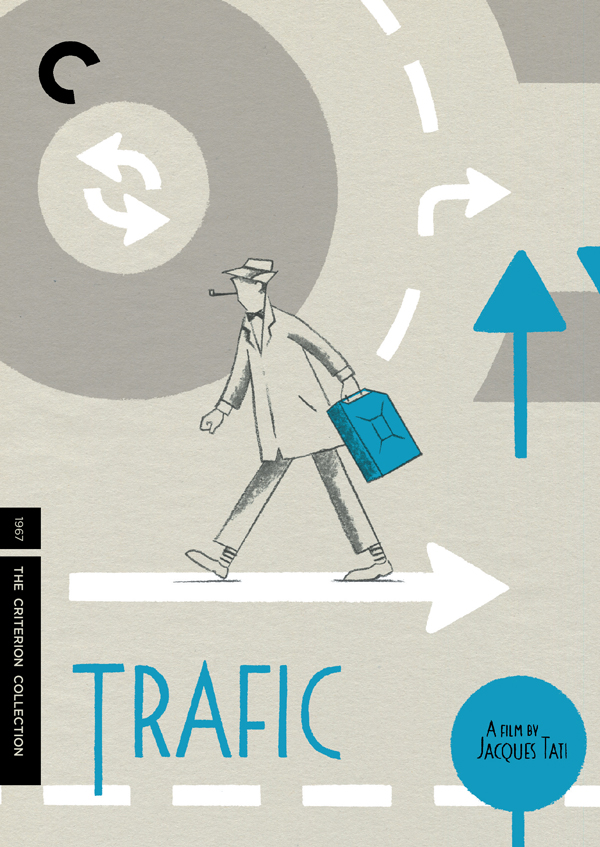
As workers and mechanics are preparing to send their model car off to Amsterdam for a car show, we hear them whistle a number of familiar tunes. We hear snippets from Monsieur Hulot’s Holiday, Mon Oncle, and probably various others if you listen carefully. The trace of Hulot’s presence is immediately evident, even if we do not see him for a few minutes.
The shock of Hulot’s introduction in Traffic is that he is employed. Previously, he was nearly unemployable. In Mon Oncle, he bombed an interview and got fired from a job for incompetence, and in PlayTime, he could not even navigate the modern world to get time in the same room with a potential employer. Even in Jour de Fete, where Tati’s Francois could be seen as a prelude to Hulot, he has a job and is absolutely terrible at it.
In the years after PlayTime, Hulot has clearly had a change in ideals. Not only is he employed at an auto company, but he is an actual designer. The car that he ends up designing would be admired by the Arpels from Mon Oncle or by the invention expositioners in PlayTime. It is an entirely modern camper, a way of getting outdoors and enjoying life, but with a lot of clever, innovative and sometimes useless features that are the exact type of thing that baffled Hulot previously.
The fact that he obtained the job and designed something modern and silly is a mystery, but that’s not at the heart of the story. He and his team are responsible for transporting his model camper car to an auto show in Amsterdam. As can be expected, a lot of hijinks occur along the way that slow down and threaten to half the trip entirely.
In some ways Traffic is similar to the previous three films. They are mostly in long shot without close-ups, with sight gags that are easy to miss the first time through, not too much dialogue from the main characters, plenty of background noise, a mixture of languages, and of course, Monsieur Hulot is at the center of it all. Despite these similarities, this does not feel like the same type of Tati film. Perhaps it is unfair to compare it to the previous trio, which are arguable masterpieces, but everything seems a little more watered down this time out. The jokes are not quite as inventive. There are big laughs, such as when Hulot hangs upside down while trying to fix some ivy, but it feels like it has been done already. Previously Tati had been pushing his art a little further each time, and that resulted in PlayTime, his finest film. Traffic feels like a creative step back.
That is not to say this is a bad movie. Lesser Tati is still enjoyable and worth watching, and there are plenty of quality scenes. The traffic accident scene ranks up with the best of Tati’s scenes across his entire filmography. There are other lighter touches, such as the windshield wipers reflecting the look and personality of the drivers, and the mass of umbrellas at the end, that are full of the Tatiesque charm. Yet, for all of those, there are other scenes that don’t quite work. I could have done without the anonymous nose-picking in cars, which is too easy and not nearly as intelligent as most of Tati’s humor. There is also the cruel practical joke that makes Maria mistake her dog for dead, when the doppelganger is a mop with a button nose and far from realistic. Tati was probably trying to connect the children’s pranks from Mon Oncle, but those were organic and fun, whereas the dog prank is tired and transparent.
The ending is up to par with the rest of his work. When Maria is on the boat in the water, we see her appreciate the beauty of her surroundings, which is consistent with Tati’s typical arc of anti-technology and humanizing his characters. When they get away from the hustle and bustle, they find themselves refreshed and their personality changes for the better. Like with PlayTime, they go in circles rather than squares, only in Traffic they embrace quiet and solitude as opposed to the everlasting automobile congestion.
The end is bittersweet. Even though this film is not quite up to par with the remainder of Tati’s work, it is the final film for an endearing character. The outcome for Hulot is no surprise, but we’d like to know what awaits him next. We’ll miss him. It is not easy to say goodbye to Monsieur Hulot. Adieu, my friend!
Film Rating: 6.5
Supplements:
“Jacques Tati in Monsieur Hulot’s Work” – This is a 1976 program from the British show Omnibus. It begins at the beach house of Monsieur Hulot’s Holiday. Most of the special consists of interviews with Tati about his craft and his films, jumping backward and forward throughout his work. The one thing I have learned from this set is that Tati is not the greatest interview, which is perhaps because of the language barrier, but more likely because he is protective, defensive and not too revealing about his art. Nevertheless, he does say some interesting things about his work. Tati says he is not criticizing modernity, but is defending people who feel they have to change. This makes sense with Traffic because Hulot tried to assimilate into this new, high-tech society, only to fall on his face yet again. My favorite part of this special was his comparing himself with the old masters, specifically Chaplin. His comedy is passive rather than Chaplin’s active. He talks about the wreath and tire part from Monsieur Hulot’s Holiday, and how differently Chaplin would have orchestrated the gag.
People ask him why he made so few films over the years, but he liked to do them in his own way with creative freedom, without making something that doesn’t live up to his style. He adds that “in life, you only have so many ideas.”
With only one major supplement and a film that doesn’t measure up to Tati’s filmography, this disc is the most disappointing, yet still worth a watch.
Criterion Rating: 5/10
Criterion: It Happened One Night, Frank Capra, 1934

In the interest of full disclosure, I’ll come clean that I’m not a Capra fanatic. That’s not to say that I don’t have tremendous respectful for him as a talented and influential filmmaker, and I like most of his films, even if I do not love them. My first exposure to him came during my younger cineaste years, when I was being reared on the edgy indies of the 90s and the new auteurs of the 00s. Compared to Todd Haynes or Tarantino, the “Capraesque” pictures of the classic Hollywood era seemed rather plain and mundane. Again, I thought they were good pictures, but they laid everything on a little too thick. There was too much ideology in Mr. Smith Goes to Hollywood, too much populism in Meet John Doe, and too much sentimentality in It’s a Wonderful Life.
When I first saw It Happened One Night, I had an anti-Capra bias. Just like with those other films, I did not hate his breakthrough comedy, but I did not love it either. I was ambivalent. That was easily 15 and possibly 20 years ago. I gave it another shot earlier this year, and came out with a newfound appreciation, yet still was not completely enamored. This Criterion disc gives me another chance for a re-visitation, and like their best releases, a new contextualization. Having a lot more knowledge about film history doesn’t hurt either. On this third viewing, the film grew on me quite a bit more.
First, in the context of his library, this film is not as “Capraesque” as I had originally remembered. Beginning with Mr. Deeds Goes to Town, his signature style really started to take shape, and was cemented as he continued to work. This film is actually unlike a lot of Capra’s later work, in that it’s more spontaneous, faster paced, and has a lot more of an edge.
It’s worth pointing out that this is a pre-code film. That said, it is a relatively benign pre-code film. The code would begin just a few months later. The writing may have been on the wall, but Capra did not indulge too much. When he did, it served the plot, such as the hilarious mannerisms of speech of Mr. Shapeley. At it’s core, the film is about sex, yet Capra danced around the subject in ways that undoubtedly inspired post-code filmmakers. The ‘Walls of Jericho’ way of dividing the hotel room is the perfect way to have a man and woman sleep together in a non-threatening way. It also became a suitable metaphor for the unspoken subject throughout the film. Some of the dialogue, the undressing scene, and the payoff of the ‘Walls of Jericho’ metaphor would probably have been altered in a post-code world, but it was indirect enough that it could have been a workable canvas to present sex in film.
There are three elements that make this simply a fun movie: Clark Gable, Mr. Shapeley, and “The Daring Young Man on the Flying Trapeze.” Gable was a delight, and played opposite the stone-faced Colbert with precision. The confident, charming and funny way he delivered his lines during their banter really sold the hostile courtship. He interacted with other characters in the same way, such as his boss, the detectives that try to search his hotel, and last but not least, Mr. Shapely. One of the funniest scenes of the movie, in my opinion, was the way in which Gable manipulates the misogynist character of Shapeley. Even though the character was funny, he deserved comeuppance, and the manner in which he was dispatched was one of the comedic high points. The song they sing on the bus does very little for the plot. It is more of a diversion than anything, but it conveys the relaxed, jovial atmosphere, where the courtship and the ‘One Night’ would eventually take place.
Film Rating: 8/10
Supplements:
Frank Capra, Jr. Remembers – Frank, Sr’s son remembers and discusses a lot of the details about the film. Of course he was born in 1934, so he did not remember anything firsthand, but he probably was exposed to a lot more about the film as a Capra than most others involved. He talked about the situation with Claudette Colbert, how she was about to leave for vacation and would only take the project if they doubled her pay and finished in four weeks. They agreed and literally had to begin production the next day. She was complaining all the time, and told friends that “I’ve just finished the worst picture of my life.” He says that Capra and Gable had a lot of fun making the picture. It shows.
Screwball Comedy? – Conversation between critics Molly Haskell and Phillip Lopate. It Happened One Night is sometimes called first screwball, but that is not altogether accurate. It is only loosely a screwball in the first place, at least in the way that future films would be considered. It was not as fast talking as Howard Hawks’ films, including Twentieth Century that came out that same year. The conversation moves on from looking at it from a screwball perspective and becomes a straightforward critical analysis, although they would often return to view the themes from a screwball point of view.
Fultah Fisher’s Boarding House, 1921 – This is the first Capra film. While his amateurism is on display, some of his skill is also clear. It works well visually, and he blends the title cards into the action effectively. The action scenes were effective, but the title cards were excessive and made the short film tough to follow.
Frank Capra’s American Dream, 1997 – This feature length documentary about Capra’s life was a treat. This and many of the other supplements make the disc far more than just the film. This is a tribute to the entire legacy of the filmmaker. Ron Howard narrates as they follow his origins as a child immigrant, the hard work that gave him opportunities in life, and of course his career in Hollywood. What was surprising was that after the huge success of It Happened One Night, Capra fell into a deep depression due to his success and guilt towards those suffering in the depression. This is where his career took a turn and he worked towards making films that the common man could appreciate. While this is often a criticism of the “Capraesque” method of filmmaking, it is also a justification for it. People in the depression were suffering. Movies were a low-cost escape for them. Capra gave them hope and inspiration, and considering the time, it does not matter how realistic his worlds were. Through this journey, I gained respect and appreciation for the man and his methods, even if I do not always adore his movies.
AFI Salute to Frank Capra – This was the 10th life achievement award in 1982. It plays as an hour-long awards ceremony. Jimmy Stewart hosts the show, beginning with a short feature about Capra’s childhood story up to his breakout in silent pictures. Many other celebrities speak, including Bette Davis and Peter Falk, who worked with him in Pocketful of Miracles. Claudette Colbert came out and was respectful, which is ironic since she had such a miserable time on the picture. Lionel Stander, from Mr. Deeds Goes to Town, said a few words, as did many stars who were influenced by Capra. These included Bob Hope, Jack Lemmon, Burgess Meredith, Fred MacMurray, Steve Martin, many more. It ended with Capra giving his acceptance speech, and truly enjoying the moment.
Criterion Rating: 9/10
Criterion: Playtime, Jacques Tati, 1967

One of the recurrent statements found in the PlayTime supplements is that you have to see it more than once to truly appreciate. Due to the continual long shots, the wide frame, and the crowded amount of characters, there are many gags or comic touches in the background that will be missed. I first saw PlayTime years ago, as my first exposure to Tati, and I fell in love with it right away. This marked my third viewing, and as expected, I found plenty that I had missed during previous viewings, and I adored the film even more.
PlayTime is the culmination of Tati’s artistic and comedic exploits over the previous twenty years, which shockingly only resulted in three feature films. In this time he developed his ‘silent yet noisy’ comedy film, inspired by the giants of silent film, all the while making artistic statements about the modernization of society after the war. While PlayTime is just as hilarious as Mon Oncle or Monsieur Hulot’s Holiday, it is grander on every level. It has more comedy, a more direct and pointed message, and is a more ambitious and impressive production.
Tati poured everything into this project, his time, fortune, property, and his credit, leaving him in shambles. Although it is a shame that the film ultimately was a failure and he suffered devestating consequences as a result, at least we were able to see on the screen exactly the type of film that he aspired to make. He even said that he had no regrets because of the final product.
The targets in PlayTime can be isolated and listed as modern architecture, tourism, invention, privacy, taste, or many, many others, but that takes away from the primary message he is trying to convey. Like much of his work, it returns to tradition versus modernity, just like the dogs that contrast with the humans in Mon Oncle, the revelry and lack of boundaries that the partiers experience when they finally get to ‘play’ is the message of PlayTime. Why be so serious and distracted by the trappings of modern society? It does not matter whether you can buy a pair of glasses that allows someone to apply makeup without taking them off, or buildings made of glass so clear that one cannot distinguish what is inside or outside. They are all ludicrous, tasteless, and take away from the essence of humanity, which I think Tati is able to illuminate at the end film.

The first half of film shows various characters, including American tourists, Monsieur Hulot, businessmen, and others frequenting a number of sleek and modernized locations. There are some instances where true French landmarks, such as the Eiffel Tower, Arc de Triomphe and Sacre Couer are reflected from opening doors, but those momentary images are all that we see of the beauty of Paris. Instead, most of the people spend their time at an expo with ridiculous inventions, most of which are impractical and some worthless (like a broom with lights or a silent door). We know that the tourists see some of France, because buses take them to Montmarte or Montparnasse, and they return with baubles and mementos, but they always return to these lifeless and nondescript buildings.
The latter half of the film takes place almost entirely in a restaurant and nightclub called the Royal Garden. It has been undergoing construction until literally the very last minute before customers arrive, and we soon find out that the restaurant is not quite ready to function. That does not stop people from flooding in. For awhile a doorman does what he can to keep the riffraff out, until Hulot destroys the glass door, allowing everyone entrance. Some are humorously guided there by the light fixture at the entrance, that turns them in a circle and points them into the restaurant. The restaurant is an absolute disaster until, yet again, Hulot’s clumsiness does more destruction. This time he destroys the framework of the architecture, and in it’s wake, leaves a more traditional looking bistro. This is where PlayTime begins, where he encounters a number of different characters, some of whom are locals and others tourists, but it does not matter. They all have quite a time by breaking the rules set forward by modernity.
What Tati is saying really comes into form through the last few images. He takes a liking to one of the American tourists, Barbara, and gets her a parting gift that she opens on the bus ride to the airport. It is a flower arrangement that resembles the street lights that enlighten the trip to Orly, reminding us that beauty can be found in the most unsuspected and curious places, but it is not some type of artificiality and disconnection to be manufactured, packaged and sold. As the cars continue towards the airport and day turns to night, the beautiful imagine remains in the unlikeliest of places.
Film Rating: 10/10
Supplements:
Terry Jones Introduction: He first saw it on a 70 mm screen, which I can only dream of. He could see all the detail in the long shots, and understood why there were not many close-ups. It was the most expensive French film of all time, a failure, but a ‘tour de force’ of filmmaking. Jones calls it the “most ambitious expression of Tati’s genius.”
Selected Scene Commentaries:
There are three commentaries. Historian Philip Kemp looks at roughly 45 minutes of footage and points out how the plot structure is that a number of straight lines in the beginning of the movie become curves towards the end. The statement is abstract, but he is able to demonstrate it by the on-screen behavior.
He talks about how PlayTime was a failure and bankrupted Tati and his family. He goes into the details of how Tati and the family put up so much of their own property and inheritance to finance the film, but it was a financial disaster and wasn’t screened in USA until much later.
Stephane Goudet looks at the beginning scenes in the office and expo, and then the later scenes with the “shopwindow” apartments. Even though the office setting appears intent on creating a more organized and efficient environment, it does the opposite. The spatial proximity of the cubes provides distance and disconnection. The apartments show no boundary between private and public life, and resemble the class conceit previous exhibited by the Arpels. It is no surprise that this scene was originally written for Mon Oncle.
Jerome Deschamps, a Theater Director, looks at the early scenes in the office. One scene in particular, which happens to be one of my favorites, is Mr. Giffard’s long walk down the corridor, coming from the background while Hulot and the secretary wait on the left in the foreground. They can hear his footsteps, but cannot see the long walk like the audience can. The scene takes a long time to unveil, but is worth it. Deschamps then looks at the scene in the waiting room, where Hulot encounters and is fascinated by Mr. Lacs, and then misses Giffard because he is staring out of the window.
“Tativille” – This is an interview on the set of playtime from 1967 British TV. It was built on a hilltop outside of Paris. Tati escorts us through the set, which is barren and deserted, even more so than in the film. It shows how he choreographs actors, especially during restaurant scene. They are all amateurs and Tati orchestrates their actions a person at a time. The crew talks to the American wives from the nearby base, who really have no idea what type of film they are in, but they are enjoying the experience all the same.
“Beyond Playtime” – This is a short 2002 documentary from Goudet. There are more tours through Tativille, with background about the process. It took two years of filming, where a gigantic set was built from scratch, and it cost 15 million euros. Sadly, the set was later destroyed. Tati affectionately says “Playtime will always be my last film.”
“Like Home” – 2013 Visual essay from Goudet.
Talks about the criticism that Playtime has a lack of structure, but gives the same ‘straight lines turn to curves’ argument. He goes through many of the themes and points out gags that are easy to miss. Finally, he talks about how the film ends with a sense of poetry. Tati said that “I want the movie to begin when you leave the theater.”
Sylvette Baudrot – Interview about the behind-the-scenes process with Baudrot, She talks about a gag that they were not able to pull off, which was an attempt to make the streetlights appear to be watering pots that are hydrating the tourists in the buses as they pass. Instead that premise is used in the restaurant where it appears the waiter pours Champagne onto the ladies hats. She talks about how Tati was an ultra perfectionist with timing, color, and just about everything else. They used cutouts of the Paris buildings that we would see through the windows, as well as cutouts of people as extras and side columns on the building. These were expensive, but in some cases it was cheaper than the alternative, like hiring 100 more extras. One terrific touch that she shared was how funny Tati could be when he acted out the parts to the actors, which included the ladies. Because of his early career as a mime and experience as an actor, he was able to show them virtually everything.
Criterion Rating – 10/10
Criterion: Ride in the Whirlwind, Monte Hellman, 1966

While Ride in the Whirlwind sbould be compared with the film that preceded it, The Shooting, it is not a carbon copy. It shares many elements in common with the companion film. The most obvious is the cast members of Jack Nicholson and Millie Perkins, but there were also many of the same locations, the same crew, and even the same horses.
Despite these similarities, the differences are more distinctive. First and foremost, the style is different. If these two pictures are considered “acid” westerns, then The Shooting is far more “acidic.” Whirlwind is actually quite linear in comparison. Rather than being oblique with major plot elements left to the viewer’s imagination, this time the narrative is clear and direct. There are four different groups of characters with conflicting motivations, and we get the general idea of what they are about. The first group are outlaws; another is a group of cattle-hands trying to pass through; the third group are the vigilantes, and the final group is a farming family in the wilderness.
The premise is that the cattle-hand protagonists end up in the wrong place at the wrong time. They encounter the outlaws, who unsuccessfully try to pass themselves off as cattle-hands. After an awkward meeting between the two groups, they camp out and find themselves under fire from the vigilantes before they can depart. They are completely innocent, but in the eyes of those with the guns, they are guilty by association.
Only two of the three cattle-hands survive the initial shootout, played by Cameron Mitchell and Jack Nicholson, and they make it out of the camp on the same horse. From here begins the existential dilemma on who is and isn’t an outlaw. Who is good and who is moral?
After escaping out of the valley, they encounter the farming family. They assure them that they are good people, not outlaws, but they have to do certain things in order to escape from their accusers. One thing they need to do is take the farmer’s horse, which is theft. They try to justify it because otherwise they will hang for something they didn’t do, but theft is theft. In the farmer’s eyes, they are taking his horses and that is unjust. They are intruding on the family, eating their food, making them uncomfortable and putting them in harm’s way. As the story unfolds, the ‘innocents’ commit other acts that blur the lines further. Every man that turns towards the immoral has to follow a series of actions. While we side with the main characters that we believe are good people, it is perfectly justifiable that they would be seen as evil under the circumstances.
Nicholson and Perkins play completely different characters than in the previous film. Nicholson’s character is unlike most of what he would play in his later, illustrious career. He is softer spoken, kinder and gentler. He tries to endear himself towards Perkins, whereas most outlaws would not care one bit. He plays the character well, but in an understated, muted fashion. There is no chewing scenery here.
Perkins played a sort of Femme Fatale in The Shooting, but here she plays a meek, naïve and inexperienced young farm girl. She is not nearly as savvy or manipulative. In the special features, Perkins says she tried to play the girl as if she was imitating one of her chickens. That makes sense, as the girl is physically and socially awkward, and does not know how to behave around people outside her family.
It is clear that even when the duo has the family hostage, that Hellman wants us to like them. They remain kind and respectful, and plead that they are not evil people. They even play checkers to pass the time. They can be as nice as they want, but the existential crisis remains. They are in control of the situation, holding people against their will and forcing them to keep their presence quiet. The circumstances of how they ended up in that situation are immaterial. There are there, and in the eyes of the victims, they are just as criminal as the stage robbers.
Even though both of these films were shot inexpensively, they get the most out of the small budget. Visually, both films look far better than other independents from the era, even if The Shooting has more showy shots. Whirlwind is more straightforward, mostly because that is what the plot calls for. There are more characters and more events to unfold, which require shorter shots with more cuts. There are a few exceptions where the camera is allowed to breathe, such as the visually striking scene when the pair are climbing to get out of the valley. Another impressive shot is the final scene. It may be the prototypical cliché shot of a character riding off into the sunset, but it adds some panache. Rather than just watching him ride off, he is enveloped into the misty clouds, or the whirlwind as the title implies. It looks good visually, but it also fits the film thematically. The world has changed for this character, and we know that even though he survives, it will not be a pleasant existence. He has come full circle and is what he hated.
Film Rating: 6.5/10
Supplements:
Commentary: Again, we had the same participants from The Shooting and they had a similar dynamic. The film historians would comment based on their own knowledge and experience, while peppering Hellman with questions about the production and background.
One interesting aspect of this commentary was the level of Nicholson’s involvement. He was not the star that we know today, and he wrote and acted in the film. We don’t think of him as a writer, and it says something that the character he wrote for himself was so far from the type he would play throughout his career. For the screenplay, Nicholson researched stakeouts at the library, and this particular story was based on a real shootout that took place over three days.
It was impressive hearing Hellman discuss how the cabin burning took place. It looks spectacular on the screen, yet they had to contain the fires so they could continue shooting without destroying the set. Had to show multiple stages of the fire, and of course, it ended with the set destroyed. It was risky to try to pull off with the limited budget, but it worked amazingly well on screen.
This was a productive year for Hellman. He had made two Philippines movies prior to this, so with these two westerns, he had made 4 movies in 12 months. That is a third of his career output in one year, which is saying something.
House of Corman – This was a conversation between Roger Corman and Monte Hellman. It’s a very chummy talk. One thing that they do not bring up, that Hellman revealed in the commentary, was that Corman did not want to make the films once he saw the screenplays. He didn’t think they could be commercially successful. Instead they talk about Corman’s decision to make two westerns, and his influence on American filmmakers by that time. His influence was considerable, and Hellman was one of his protégés that would not have the same career otherwise.
The Diary of Millie Perkins – In The Shooting, she put dirt on her face to cover discrete makeup. She wanted some sort of unique look, so the mud became her makeup. She talked about her horseback riding, which she handled quite well, a lot better than the other actors. She had an interesting relationship with Jack during the time, and they are still friends. They bonded.
Whips and Jingles – This is a Will Hutchins interview. He talks about running up hill with chalk. He was in decent shape, but not an easy run and had to call a medic. One thing that comes up often in all these features is Jack and Monte arguing about budget, but they had to pay out of their pockets if they ran over. He accidentally stumbled into a Parisian theater in 1969 and was surprised to see The Shooting and RTW playing. He had no idea it had been released anywhere.
Blind Harry – This was a short discussion between Hellman and Harry Dean Stanton. Jack said don’t do anything, play yourself, just act. That’s interesting because he’s been accused of doing that on a couple occasions. Harry was head of the gang so he didn’t have to do anything. This was a major influence on his future approach to acting.
The True Death of Leland Drum – Hellman talks to B.J. Merholz and John Hackett, actors in Ride in the Whirlwind. They were amateurs, which Hellman makes the point is not a dirty word. They talk about the horse wrangling, which is a recurring theme in all of these supplements because a high percentage of the budget went towards horse wrangling due to the teamsters union.
Heart of Lightness – Hellman speaks with Assistant Director Gary Kurtz. They talk about all the rain early in The Shooting that caused production delays. The crew was small, with one or two in the art department, one horse wrangler, two cameramen, two sound men, and one on wardrobe. Again, it is quite a final product for such a slim production.
The Last Cowboy – They talk to Calvin Johnson, the horse ranger that worked on the films. He had worked on westerns since he was 10 years old. They revisit the locations. Pahreah was one of the towns where they shot, which is long gone now. Talks about shooting at the “staircase” near Bryce Canyon where they had the final scene in The Shooting. The locations were just gorgeous.
An American Legend – This was my favorite supplement on the disc. It is a critical piece by Kim Morgan on the career of Warren Oates. Much of it is a career retrospective, but she also discusses the “it” factor that made him such a renowned actor. She says it starts with the face. He was a type of “gorgeous ugly,” as she puts it, recounting his attractive, grizzled look. The Shooting was his first leading role, which began a Hellman collaboration over a few films. He was thought of as a character actor, which is unfair, probably because his lead films were in smaller, grittier films from Hellman and Peckinpah. He died too young. Who knows what the future auteurs of the 90s and 00s could have done with him?
Even though there are far better movies in the Collection, this disc is loaded with two quality films and a ton of features. One of the notable absences on the features is anything from Jack, although he has been in retirement lately and may not have been up for it.
Criterion Rating: 9/10


 Criterion Close-Up