Criterion: Shoah
SHOAH, CLAUDE LANZMANN, 1985

Roger Ebert famously refused to rank or categorize Shoah with other films, whether they were narrative or documentary, because it simply could not be compared with other films. It stands on its own. As a history buff, I hold similar feelings. This is as much an historical document as it is a documentary about the holocaust. That said, it also turned out to be a groundbreaking documentary with a distinct style that influenced other films. The documentaries of Ken Burns and Werner Herzog owe a debt to Shoah, as do many others. It turned out to be a certain benchmark of documentary filmmaking, and it still stands near the top.
The right time to create an all-encompassing, reflective, history of the holocaust was exactly when Lanzmann set forth on his lengthy project, in the early-70s, which we spent an exhaustive 12-years working on until it was finally finished and released in 1985. The timing was ideal for two reasons.
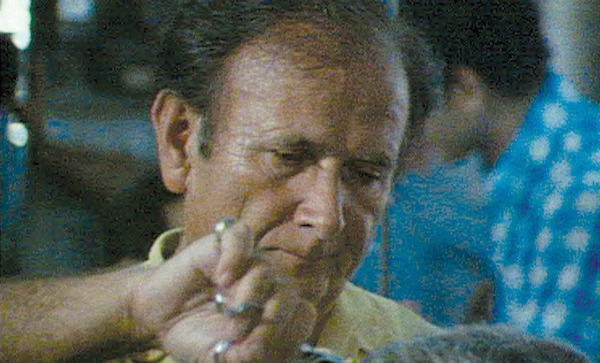
The first is obvious, because many of the major players were still alive. The second is because there had been a time to reflect. Many of the stories that were told during Shoah could not have told 20 years prior. It was simply too close to the tragedy of the actual events. People could not have delved so deep into a painful past without having time to process and reflect on it, time to move on. This is the case with the barber, talking about how he had to participate in the ruse to lure unsuspecting Hebrews to the gas chambers, when he encounters people he knew. These are excruciating memories, and he can almost not tell the story. The same is the case with a lot of these people. These are wounds that cannot be re-opened when they are fresh.
Additionally, people were able to come to terms with the impact of the holocaust. Even after the war, people didn’t really know what to make of it. The fact that a nation would nearly successfully exterminate an entire race is simply unfathomable. Some that were closer to the actual events had to deal with their own guilt of being caught up in the wave of anti-semitism, even if they didn’t participate in the holocaust nor would have wished it to happen. Lanzmann captures this sentiment when he interviews Polish towns near the extermination camps. They were aware that the Jews were going away and had feelings about it, but in many respects the full impact was kept at arms length. One witness, when asked about her feelings towards the Jews during that time, boldly points out that she does not feel pain when someone else cuts their finger. Ouch!
And then there’s Lanzmann. Without his obsession in getting the countless hours and hours of interviews, or deciding to finally travel to Poland to see and film the camps themselves, to painstakingly and patiently search for financing what must have been a tough sell. His obsession was the key in making this film what it is, and his presence is felt in nearly every frame, as his curiosity and interviewing technique is how the layers are peeled that reveal the process of how the Jews were exterminated.
Shoah is not an easy film to watch. Not by a long shot. There’s the 9+ hour length, making it impossible to watch in a single sitting, and the unwieldy translated subtitles, which make you wait for the translation from Polish/Hebrew/Yiddish to French before you see the subtitle. It is a film that has to be split up and requires patience. And then there’s the actual content. Lanzmann asks the penetrating questions about how the Jew-killing machine actually worked, and the answers arrive in graphic detail. Hearing stories about the death panic, the screaming, the cruel teasing by the German soldiers, and many others, are among the darkest you’ll ever hear. Some of the most difficult portions are the clandestine interviews with German Nazi’s who proudly unveil the killing ritual step-by-step. This is a film that will leave you shuddering many times, in disbelief that such acts could have actually happened.
However difficult and sobering, it is a worthwhile tribute to the events and to the departed. The visual film language complements the troubling stories. They are not manipulative, but respectful. The cinematography is muted, with a lot of blues and greens, with slow moving cameras that tour the camp sites, or the slow-moving trains as they approach the camps that we know mean the end for thousands, but the people who actually traveled to their ends were completely unaware. Even though it is unimaginable what these people endured during their last days, weeks and months, we can almost put ourselves in their shoes, if only for a second, thanks to Lanzmann putting us there with his many tracking shots shown as the stories are told.
Shoah may be one of the most heart-wrenching and difficult movies to watch, but it is also one of the most important and one of the deepest. It requires some investment to dedicate the time to view, and the patience with the dialogue, but it is a film that almost has to be seen. However dark, disturbing and at times grotesque, by the end, it is a thing of beauty to capture such a tragic era of world history.
With all due respect to Ebert, Shoah is a film that can be ranked against others. It ranks as one of the greatest documentaries ever made and is a monumental historical achievement.
Movie Rating: 9.5/10
Special Features:
The Criterion boxset has three discs, two for the film and one of the supplements, the latter of which could comprise about half of the actual film.
There are three more documentaries, all from Shoah outtakes:
A Visitor from the Living – This documentary is about a Swiss Red Cross official who toured what turned out to be a façade of a camp. The Germans had anticipated his visit and put together a show of better conditions, but that’s all it was, a show. He made his report and they later exterminated all who he encountered. The interview is compelling because the interviewee now knows about the horrors of the holocaust, and talks about sensing how things were out of order, but his report was glowing. They dance around how he looked the other way until the very end, when Lanzmann uncharacteristically calls him out for either not being honest in the interview, or not being honest in the report.
Sobibór, October 14, 1943, 4 p.m. – This is one of the rare uplifting tales on the entire disc. It is the story of a young man who had previously escaped concentration camps eight times only to eventually be recaptured. He eventually ends up in Sobidor, which was an extermination camp where hundreds of thousands were processed. He took part in an uprising and describes it in detail, as it began at 4pm exactly, and would not have happened if Germans were not so punctual. Even though this is a sit down interview and there is a language barrier that requires two translations, this is an adventure of freedom that is told to Lanzmann.
The Karski Report– I realize that Jan Karski is an influential figure that reported on the travesties going on in the ghetto, but I had trouble getting through this one. He also was one of the weaker parts of Shoah, partly because his story was a digression from the majority of the film (the ghettos versus the extermination camps), and also because of his manner of speaking in English that makes him hard to understand. I did not complete this documentary.
Two Interviews:
Both of these are fascinating. The shorter one is Lanzmann talking about A Visitor from the Living and Sobibór, October 14, 1943, 4 p.m., which is brief and interesting to hear why these stories were omitted from Shoah and why he made certain decisions in bringing them to their own films. The cream of the supplements was an hour long discussion between Lanzmann and Serge Toubiana, which gives a lot of background information on the making of the film and what Lanzmann was trying to accomplish. It was random that he was given this project, and if he had known what it would eventually entail, he might not have gone through with it. We’re lucky that he did.
There is also a segment with Caroline Champetier, who was an assistant camera person, and filmmaker Arnaud Desplechin, who has written about Shoah and has a respectable body of work of his own.
Criterion Rating: 10/10
Criterion: The Big Chill
THE BIG CHILL, LAWRENCE KASDAN, 1983

I first saw The Big Chill ages ago, when I was much younger and had a different perception of the world. I thought it was okay, recognizing that it was an above average film for the time, but wasn’t something I could relate to. At my age now, I should be able to relate to the material more, being in my early middle ages and having reunited with many old friends over the last several years. Sometimes a Criterion release will change my mind about a film, and I’m always willing to go in with an open mind.
My perception may have changed, but so has my appreciation for good cinema. I’ve seen at least a thousand films since that first viewing, and having seen so many good ensemble movies, this one felt lackluster by comparison. I actually liked it far less than the first time, when I was a teenager, and that is partly because I have experienced other, better films, but also because I have lived enough to have an understanding of genuine nostalgia and emotion.
In one of the special features, someone mentioned that one of the producers said “I had no idea this was a comedy.” I actually felt the same way, and didn’t realize that it was intended to be a comedy until hearing this from the filmmakers. There was not a funny note. Sure, there were some playful moments, and the way they incorporated the big dance scene was fun. My guess is they intended Meg Tilly and Jeff Goldblum to be comedic relief, but they completely fell flat.
They also try too hard to make things seem important. The emotional character moments are not earned and don’t seem genuine. Sure, it is difficult to develop such a large ensemble where there’s not a leading man, but it has been done before. From the same era, there’s The Breakfast Club and Hannah and Her Sisters. More recently, there’s The World’s End, which is a real reunion comedy with emotional moments. The big difference between The Big Chill and these other films is that Chill goes out of it’s way to try to create profound, insightful character moments, yet with completely undeveloped characters. These other films develop the characters around the story and let the emotional moments come from there.
What is most interesting about this project is that the large ensemble became pretty well known, and most of them are actively working today. Some are famous, and most are now proven, experienced, quality actors. You can tell that they were just beginning to develop their chops, and maybe with better material and direction, they could have pulled it off. The potential was there, which makes it all the more disappointing to revisit and witness its failure.
Movie Rating: 3/10
Special Features:
Lawrence Kasdan Interview: I’m not sure what it was, but Kasdan does not come off as very bright in this interview. Maybe it is his speaking cadence. He talks about working within the Hollywood system to create good movies, and seems a bit arrogant by talking up his work, which to me has been mostly mediocre. He talks about some films that inspired him, and compares this one to Rules of the Game. I hope he wasn’t serious.
1998 Documentary: This also didn’t work for me, and I think I might have enjoyed it more if I liked the movie. Most of it was about people talking about their characters, the production, with a lot of clips. I actually didn’t finish this one.
TIFF Reunion Panel 2013: This was better, but that’s because the actors have now become successful, and it is interesting hearing them recall their experiences and the wonderful times they had.
Deleted Scenes: Pass. If they weren’t good enough to make the movie, then I’d rather not see them.
Criterion Rating: 4/10
Criterion: Faces
FACES, JOHN CASSAVETES, 1968

There are a lot of faces in John Cassavetes’ second film, Faces. His camera is not afraid of getting close, sometimes so close that it almost feels like you can see inside the faces inside the characters heads, and behind the façade they exhibit while they are out cavorting. The extreme close-ups are unnerving, the jump-cuts jarring, but altogether, it feels as polished as ever. The story is of a broken marriage, but it is told in an unconventional matter where, of all things, the characters spend much of their time laughing, telling bad jokes, singing, and living it up.
What is Cassavetes trying to say here? Is it that behind every happy face, there is a sad one underneath? Is he saying that laughter is a way of hiding the pain? I cannot claim to have these answers, and probably neither did Cassavetes. Writing this with the benefit of hindsight, we know that he was an alcohol and that’s what led to his eventual passing. He certainly had a lot of loud, raucous nights filled with laughter, but that laughter inevitably ends, and he certainly endured his share of hardship.
He wrote a good script and wanted to do something a little different with it, and some of what happened on screen was probably a direct result of the lack of a budget. Since they were shooting in 16mm, they had to get creative, and had to play with conventions. What he had played around with in Shadows, he nearly perfected in Faces. He made the characters seem like they were real people, with real issues and problems. The fake laughter was and wasn’t acting, as the characters themselves were acting out a scene that was not exactly true to their world – that they were all playing a part in the downfall of a relationship.
And I cannot say enough about the acting. There were two Oscar nominations, for Seymour Cassel and Lynn Carlin, but I think that Gena Rowlands and John Marley brought everything they could to the roles. Even Fred Draper, playing a character with his own name, was terrific at being the schlub who eventually becomes the third wheel, with his transparent attempts to stay within the party being refused. Another terrific performance was given by Joanne Moore Jordan as Louise Draper, who plays a jilted woman trying to take solace in a younger man, Chet, who has eyes for another. The entire ensemble was the best of the few Cassavetes films I’ve seen thus far.
Movie Rating: 8/10
Special Features:
Alternate Opening: The original cut had been over 180 minutes, and has not survived to this day. Apparently Cassavetes buried it after he cut down the film to the theatrical length. This new opening was found later and mixes things around. It begins with the bad joke banter between the Forsts, wbich comes later in the theatrical version. It also fleshes out some of the earlier scenes, including the bar at which Freddie and Richard meet Jeannie and how they end up at her apartment. It doesn’t add much to the movie, but you see that some of what was originally shot and was later cut around was originally a little more developed.
Cinéastes de notre temps: An episode of the French program was has footage of Cassavetes talking about the filmmaking progress before the release of the film, and giving a formal interview after the release. Usually I really enjoy these TV pieces, but this one went a little long and didn’t reveal much about the movie.
Making “Faces”: This was a lot better. It was nearly a feature length documentary about the process by which Faces was made, and had a lot of interesting tidbits from the actors. One thing that struck me was how Cassavates did not direct the actors. He would let them know when they weren’t on their game, but aside from that, they owned the role.
Lighting Faces: This was very technical and probably can only be truly appreciated by those who understand the finer details of cinematography. I admired some of what was revealed about how they used natural lighting, or made the film stock fit the mood of the scene, but much of it was robotic to me.
Criterion Rating: 8.5/10
1995 List

1995 was an unusual year. My best-of list probably looks a lot different than many others because I’m not as crazy about some revered films (Se7en) and I like others less than other people (Heat, Babe). My list has a couple of relatively obscure titles that are worth seeking out, specifically The White Balloon and Zero Kelvin. I was also surprised by the lack of American indies near the top. The industry was transitioning during the year and trying to keep up with the post-Pulp Fiction market. There were a few gems, but most rounded out the latter part of my list.
1. Before Sunrise
2. La Haine
3. To Die For
4. Underground
5. Toy Story
6. Leaving Las Vegas
7. The White Balloon
8. Casino
9. Sense and Sensibility
10. La Cérémonie
11. Whisper of the Heart
12. Safe
13. Clueless
14. Twelve Monkeys
15. Zero Kelvin
16. Living in Oblivion
17. Heat
18. Kicking and Screaming
19. Welcome to the Dollhouse
20. In the Mouth of Madness
Criterion: Shadows, John Cassavetes
SHADOWS, JOHN CASSAVETES, 1959

As I watched John Cassavetes’ first film, I was struck immediately by how different it was from the films of the era, and how much in common it had with the French New Wave films that were just about to burst onto the scene. I have no idea whether Cassavetes had any inkling of Cahiers du Cinema or any of the young filmmakers who were concurrently putting on their first projects, but I think it is reasonable to say that they arrived at a similar place by taking the same route – the influences of the post-WWII films, particularly from the Americans.
Many have argued that because of the code and the routine during the last vestiges of the studio system, that innovation was falling by the wayside. The film world was ready to be shaken up and it most certainly was in the years to come, mostly by the French, but also by the advent of the American indie that Cassavetes could arguably have begun. The young American filmmakers to follow would be influenced by the New Wave in a huge part, but also by Cassavetes films, if to a lesser degree.
That’s not to say that Shadows is exactly like all the New Wave films, but neither were they like each other. Few people would lump Elevator to the Gallows, The 400 Blows and Breathless together as part of the same style. The point was they came from fresh, young perspectives, which was exactly what Cassavetes brought. Nothing like his portrayal of racial relations or the Beat Generation would be found in a studio film, and that was why it was revolutionary for American film. On top of that, it gave Cassavetes a filmmaking foothold to put together the type of independent dramas over the next two decades that he would become known for, even if they were different stylistically from his debut.
Shadows is not a great film. It is barely a good film. The post-script proudly proclaims that it was improvised (which wasn’t entirely true), and the actors were mostly novices, and the rust shows. The lack of polish is part of its charm. Some of the scenes were stilted, wooden and disjointed, like the African-American musicians talking about their business and the embarrassment of introducing a girl group. Other scenes seemed more natural and fluid, like the courtship and consummation between Ben and Lelia.
Even though it is hit or miss, it is valuable for capturing a scene that wasn’t always represented. There aren’t a lot of movies about the Beat Generation. It is in many ways a document of the culture, even if not a realistic representation of what it was really like.
Movie Rating: 6/10
Special Features:
This Blu-Ray disc features A Constant Forge, a whopping 3 hour and 20 minute documentary about Cassavetes and his process. Wow! From what I have read, the documentary is watchable, if not spectacular. I’m passing on it for now and may revisit after I’ve explored more of Cassavetes’ filmography.
The remaining features are minor. There is a brief interview with Lelia Goldoni, where she describes how she became involved with Cassavetes’ workshop and the atmosphere of his teachings. She talks about her experiences with the films and the improvisation or lack thereof. There is also some silent footage from the workshop and some stills, which gives a distant taste of what it might have been life.
Criterion Rating: TBD (once I watch the long documentary)
Criterion: Sweet Smell of Success
SWEET SMELL OF SUCCESS, ALEXANDER MACKENDRICK, 1957

Sweet Smell of Success is one of many in a long line of New York City masterpieces. It captures not only the high traffic sprawl, but also the culture and especially the seedy underbelly. In this case the sludge is the press, and is based on the life of Walter Winchell, one of the earliest and most influential gossip reporters. He had a massive following, seemingly limitless power, and according to many, was completely unscrupulous, unethical, and would use people and spit them out, building and destroying lives and careers.
Burt Lancaster and Tony Curtis star in this vehicle, with Lancaster as the Winchell-inspired reporter named J.J. Hunsecker, and Curtis plays Sidney Falco, the smarmy press agent that thinks of little other than climbing the ladder to success. He is at the columnist’s mercy, since being locked out of the column would mean the end for him. In order to curry favor, he goes the extra mile by trying to split up the relationship of Hunsecker’s sister with a local musician. He is blackballed in the papers until he succeeds in the division, and none of his actions can trace back to Hunsecker.
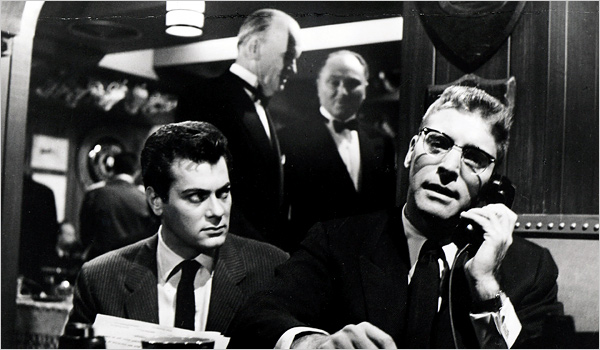
There was a lot of talent behind this picture. Alexander Mackendrick was an unrecognized genius, known for making a handful of successful pictures for Ealing Studios. This was his first American film, and even though he was not equipped to handle the Hollywood-style kill-or-be-killed environment, he managed to pull off an amazing film. His success would not last as he would be fired from his next product. The writing was based on stories by Ernest Lehman, which were thinly veiled to be about Winchell, and the best parts of the screenplay were penned by playwright Clifford Odets. The rapid fire and biting dialog that occurs between the two larger-than-life characters was mostly the product of Odets and his constant rewriting. The result was a tightly-written and quickly-paced pictures, especially since it is mostly dialog driven. On top of all this talent, was James Wong Howe, cinematographer extraordinaire, who through Mackendrick’s vision, captured New York City like no other.
Appropriately for the subject, the style and tone resembles a film noir, only without the typical stereotypes of the genre. There are no private detectives or unsolved murders at the core of the story. Compared with the noirs of the era, the plot is actually quite mundane, mostly about the rivalry and dependency between the two men, and what deceptive machinations they will undertake to accomplish their goals. The film looks, sounds, and flows beautifully.
The only weak point, and this is a minor one, is that it is such an indictment of the changing newspaper industry, most notably Winchell, that it seems heavy handed at times. Winchell, for all his faults, was not as calculating and overbearing as Lancaster’s Hunsecker. If he were, he would have never achieved such a powerful position in the industry. On the other hand, his confrontational characterization made for some terrific character drama. If he were a weaker character, the climax might not be as impactful.
Movie Rating: 9.5/10
Special Features:
This disc has a treasure of features, almost too many. There were two that were exceptional. The 40-minute documentary, [i]Mackendrick: The Man Who Walked Away[/i], was fascinating, chronicling how the director went from the top of the British film system to an American director, to completely out of a career and into academia. His life is an example of how Hollywood was not all that indifferent from the cutthroat newspaper world that he so eloquently portrayed in his first American film.
Another terrific feature on the disc was an interview with Neal Gabler, a film critic and historian who had written a book about Winchell. His commentary was mostly about Winchell’s history and legacy, and how his life was portrayed on the screen in what was a major character indictment. The character of Hunsecker was protective of his sister, but in real life, Winchell was protective of his daughter and outcasted one of her suitors, which is what the movie was based on.
There are other features, including a lengthy interview given by successful Hollywood filmmaker James Mangold, who studied under and was mentored by Mackendrick.
On top of that, the commentary by James Naremore has a wealth of information about the film, the time, and the production. There are many interesting details pointed out. One that struck me was how this film pushed back against the production code by ignoring its reservations and going forward as scripted anyway. He also points out that this is one of the first films that references the McCarthyism trend in the press of calling out communists, and that much of those behind the film had leftist leanings and an anti-HUAC agenda. This is peppered throughout the film, and it is used as the smoking gun that shoots the narrative into the third act, which is the leaked item suggesting that Dallas is a pot-smoking communist elitist.
This disc has some fine features and I didn’t even go into the packaging, which is also terrific. This is also a must for Blu-Ray owners and anyone with an interest in film history towards the end of the studio system.
Criterion Rating: 10/10
Criterion: The Young Girls of Rochefort
THE YOUNG GIRLS OF ROCHEFORT, JACQUES DEMY, 1967

Recently with a group of film buffs, we’ve had some conversations about Blind Spots. These are the films, genres, directors, themes, or whatever attributes that just rub you the wrong way and turn you off from a film. My blind spot are many of the American musicals from Classical Hollywood. I’ve tried and just cannot get into them. Part of it is the overdose of style over substance, and I think they often spend too much time and space distracting from what makes films good (plot, character, conflict). For instance, why spend 5-minutes on a song saying one thing about a character when you can reveal plenty more with actions against other characters?
Basically I like musicals where a character is a musician and that says something about him (Once), or where the art of the musical is a major part of the narrative (All That Jazz), or pretty much anything directed by Ernst Lubitsch. There are other conventional musicals I like, such as Singing in the Rain, Meet Me In St. Louis, and some I hate, like An American In Paris and My Fair Lady. I know, it’s not too defensible and I realize that. Despite my personal tastes, I understand that the American musical was a major institution, created by enormously talented people, and they deserve their place in the lists of the best of American film.
The Umbrellas of Cherbourg is an exception to this Blind Spot because it is revolutionary, and breaks from the formulas that I dislike. The music actually adds to the characters, all of whom are deeply drawn and identifiable.
I was wary of The Young Girls of Rochefort because I knew this was more in the style of the musicals that rub me the wrong way, especially An American in Paris. Fortunately I found that, while Rochefort is nowhere close to as groundbreaking as Umbrellas, there was enough there to make me appreciate the film. The characters were not as deep and their encounters more fleeting, but the film is made exceptionally well and manages to transcend what is not my favorite formula.
There are a number of characters with various objects of affection that dance around each other (literally and figuratively), with their perfect matches seemingly just barely outside of the picture. First, there are the carnies, who are basically interested in a good time and act more as distractions to the real romantic interests. There is the sailor who has devised his ‘feminine ideal’ and even painted her, which coincidentally looks like Catherine Deneuve’s demoiselle character. Meanwhile, the twin sister, played by Francois Dorleac (who tragically died the year this was released) encounters and brushes off Gene Kelly, who is a fit for her artistically and creatively, since they are both musicians. Finally, there is a shopkeeper with the unfortunate last name of Dame, who used to be involved with the demoiselle’s mother, who operates a frites stand and has no idea that he is even nearby.
The Umbrellas of Cherboug managed to have a deep message and a light presentation, and I thought that might be the way that Rochefort would go as well. Since the sailor and the demoiselle kept barely missing each other, was Demy saying that the feminine ideal is unobtainable? Even to the end I wondered what he was saying here.
[Spoiler]
As we learn in the final scene, the circus that is en route to Paris picks up the sailor as a hitchhiker, so we assume that he will meet his feminine ideal. It isn’t tightly wrapped up, but the message is clear. It is strengthened by the statement by her ex-lover who lies and tells her that this love interest is in Paris, which is “too small for your passion” and that she will find him. So, overall, there isn’t much of a message here. It is more about the journey of finding someone, at least for the demoiselles, or not finding someone for the carnies, who will go from place to place and stay lonely, although they don’t seem bothered by this.
[/spoiler]
Movie Rating: 7/10
Special Features:
The big one here is Agnes Varda’s The Young Girls Turn 25 documentary, which revisits the town of Rochefort 25 years later. It shows how the city has been revitalized, how the locals remember the project, and how it has become a permanent part of their culture. One local proudly carries around the VHS cassette of the movie everywhere she goes (hopefully upgraded to Blu-Ray by now).
It is a little more than an hour-long, but is a lot different than the standard documentary special feature. This is a Varda film, and rather than just rehashing a lot of tidbits of information from the film shoot (which it does to some respect), it takes a journey. In this case it is much of the crew, stars, and extras all coming together to celebrate the anniversary of the film. Much of it is jubilant, although some is somber. The scenes where they dedicate streets to Jacques Demy and Francois Dorleac were especially touching, the latter of which had Catherine Deneuve breaking a bottle to christen her sister’s street, barely able to hide the emotions of her loss through large sunglasses.
There are other quaint, fly-on-the-wall types of features. There’s another French TV special with Legrand and Demy working out the music of the film and answering some questions. The song was the one that the carnies sing, and it was a treat seeing them work out the timing, the ending, and how it would transition to the next scene.
There were also a couple features surrounding the costume designs and set designs, which were mostly about Rochefort, but also touched on Umbrellas. I enjoyed hearing about how the costume designer collaborated with her husband who was the art director to match clothing. Rochefort wasn’t as flamboyantly colored, but it certainly had a look. They paid a lot of attention to little details, such as coloring 1,000 total shutters on random buildings.
Criterion Rating: 8.5/10
Criterion: The Life and Death of Colonel Blimp
THE LIFE AND DEATH OF COLONEL BLIMP, POWELL AND PRESSBURGER, 1943

“BUT THE WAR BEGINS AT MIDNIGHT!!’ frustratingly exclaims General Wynne-Candy, known to the film audience as Colonel Blimp. There are a lot of points to the Powell and Pressburger epic, and the most potent and appropriate is that in the era of the Great War, wars do not begin or end at a certain designated time. They begin when they begin and end when they end.
The Life and Death of Colonel Blimp is an unparalleled masterpiece. It is far and away from most historical epics, but in a completely different way. You cannot really compare it to something from David Lean. It is no Lawrence of Arabia; nor is it anything that could have come from the vision of a Cecil B. Demille or anything that starred Charlton Heston. It is unquestionably a Powell & Pressburger film, and it captures the lofty rise and thudding fall of the British ideal of civilization. It encompasses the Boer War, two World Wars, the rise of Naziism, and a lot of hunting expeditions that would yield mounted animal heads on an upper class British wall.
I remember taking a history class on the two World Wars, and we talked a lot about the actions that led to them, and how effectively war had changed. WWI was a war of attrition and ended with a harsh peace for the Germans. WWII was something entirely new, total war, and it was exceedingly difficult for the British ‘Blimps’ who used to run the entire world to come to terms with. In that class, we had the benefit of decades of academic study and hindsight, but Powell & Pressburger arrived at the same prescient conclusion right in the thick of it. And they were absolutely right. You could not fight a gentleman’s war in that era or any era since. That was the lesson that was so difficult for Candy and the Blimps to discover, but it was the right one. The enemy was not notified of the starting date and time of D-Day, or things might have ended quite differently.
It is almost unimaginable that any other actors would play the three leads in this film. Roger Livesey carried the swagger, the charm, and the pomposity of Blimp from his foolhardy youth to his rotund and thick-headed old age. Deborah Kerr plays three roles, and each one is the object of his affection, essentially the motivation for everything he does. However, it is the performance of Anton Walbrook, and the way his friendship unfolds with Candy, that is the emotional core. He has lived the highs and lows of the wars, whereas Candy has been comfortable hunting trophies, drinking sherry and hunting trophies all his life. My two favorite scenes in the film are Walbrook monologues – the one he delivers to the alien board when trying to return to England, and the one he delivers to Candy as they engage in a timely political debate after the General is sacked.

One of the strengths of the film is that the partnership between Candy and Theo are familiar territory given the partnership with the British director Michael Powell and the Hungarian ‘alien’ writer Emeric Pressburger, an unlikely pairing that would produce some of the most magnificent works of their time. You can see both of their voices in the characters, and they are wonderful.
I cannot say enough good things about this movie. It is one that I adore and thanks to such a wonderful restoration, is one that I will revisit many other times in my life.
Movie Rating: 10/10
Special Features:
Martin Scorsese gives a passionate introduction. He has been obsessed by Powell and Pressburger for many years, and cites them as influences for much of his work. He references the duel in Colonel Blimp, which doesn’t actually happen on screen, but is one of the best shots in the film as the camera flies away from the building into the snowy wonderland. He used that same technique in Raging Bull. Sometimes it is not necessary to show the conflict, but instead the magnitude and reactions of the outcome.
The commentary is given by Scorsese and Michael Powell. The beginning portion is mostly Scorsese, and he talks a lot about the use of color, the technical matters of the production and the staging. Michael Powell was quite old when he recorded his portion. His speech staggers some and is at times unintelligible, but his presence is comfortable. He tells small stories about the production, points out the many Deborah Kerr hats that he is proud of, and shares a lot of what came from him and what came from Pressburger. It is like watching home video with a grandfather you love.
The 2000 documentary [i]A Profile of “The Life and Death of Colonel Blimp”[/i] is also excellent. It talks a lot about the background and controversy of the film, and you hear from a lot of British directors who were directly influenced by it, including Stephen Fry and a young Kevin MacDonald.
The restoration demonstration is again mind-blowing. The original print had a lot of mold and resulted in many green waves flowing across the screen. Plus the color plates and aged poorly and resulted in a disorienting view. The before and after swipes of the restoration are truly impressive. Given the condition and age of the original print, this is one of the most impressive restorations that I’ve seen.
And this just scratches the surface. There is also an interview with Thelma Powell, production stills, and the original Colonel Blimp cartoons that inspired the film. If you are going to choose a handful of Criterion Blu-Rays to own, this would be near the top of a short list.
Criterion Rating: 10/10
Criterion: The Umbrellas of Cherbourg, 1964
THE UMBRELLAS OF CHERBOURG, JACQUES DEMY, 1964

After the opening credit sequence, the film begins in a garage, with Guy finishing up his work. There are not many images that are more masculine than a group of male auto mechanics fraternizing. Think of the crew from Drive a Crooked Road as they hoot and holler at the women passing by. This is a different auto shop, and the masculinity is quashed the moment they open their mouth. This is not a musical with regular actors occasionally breaking out into song. This is a movie where every line is sung, and not in the manner of a Mick Jagger or Tom Jones. The men sing with high pitched voices, in falsetto, in an instant shattering the stereotype of the masculine image.
While Demy was undoubtedly influenced by American musicals, what he created was truly original and groundbreaking. From the concept that every line of dialogue is sung to the sharp, loud and bright background colors that match the actor’s wardrobes, he broke through convention with a blowtorch.
Even now, some 50 years later, the world that Demy created takes some getting used to. I’ll admit that for me, giving it a second try with this Blu-Ray disc, it was not easy to get absorbed into this movie, but once there, I didn’t want to leave. The next 90 minutes fly by, as you become invested in the relationship between Guy and Geneviève, and whether it will survive his departure to the Algerian war.
Even though the movie’s presentation is the embodiment of consumptive lightness, the overall theme is rather complicated and not altogether pleasant. It is the choice between passion and practicality, something that most adults have to face at some point in their lives, and something that was the theme to what could be considered the film’s prequel, Lola. Roland daydreams and yearns for passion, but is ultimately scorned and chooses a responsible, practical life. Lola has plenty of temptations that might make immediate sense, including the potential coupling with Roland, but she waits for her original passion, and that choice pays off.
In The Umbrellas of Cherboug, Roland has changed entirely and is the face of practicality, whereas Geneviève is a shopkeeper’s daughter that is madly in love with someone from a lower class, Guy, who works in a garage of all places. This relationship could work, although it would not be without challenges, which is something that both parental figures realize and try to convey to the love-struck lead characters.
Because we have been trained by Hollywood that true love always survives despite all obstacles, the ending of Umbrellas is bittersweet and difficult to absorb.
[Spoiler]
Even though they both have their doubts, they have made their bed and have to sleep in it. Guy is at peace with the decision he has made, and that is exemplified by how he happily plays with his son in the film’s final shot. Geneviève’s appears to be consumed with regret, even if she’s the one driving the Mercedes, wearing expensive clothing, and looking as upper class as her recently passed mother wanted for her. Together, they would have made for a more passionate pairing, but they would have faced struggles in life that might have hurt them in the long run. Did they make the correct choice? That depends on your perspective. However, the choice was made and time has passed, so they have to live with it.
[/Spoiler]
Some people have problems with the ending, but I think it is one of the film’s strengths. This is a movie about love, sure, and you become invested in the two main characters, but it is also about life and the choices we make.
Movie Rating: 8/10
Special Features:
This disc is full of extras, making it appropriately the most loaded yet in the box-set.
The Once Upon a Time documentary was fixating, nearly as good as the movie itself. It has many archived interviews with Demy, Legrand, Varda, Deneuve, and it peels away the layers that went on behind the scenes. As some would expect, the voices were not the actor’s, but they did sing as they acted in order to get the affectations correctly (and apparently they all sang awfully). I thought it was fascinating how tough the movie was to sell to distributes, seeing how successful and iconic it is in hindsight. Yet since it broke boundaries, I can see why people were reluctant.
There is a short interview with Demy and Legrand for French TV. These pieces are always of interest to me because the French media can ask direct, difficult questions. I thought the questions they posed to Legrand about how he compares with Bach and Beethoven, and whether those classical composers would have made film scores was pointed, but a very good question. They were basically asking whether he had compromised his own integrity in order to create film music. I thought he handled the questions with aplomb, and rightfully did not elevate his own talent to the world’s best composers ever.
Film Scholar Rodney Hill gives a 20+ minute interview that I thought worked effectively well. He gives a bit of a retrospective and contextual basis for Umbrellas, and makes the thematic connection with Lola. He talks about many of the difficult realities with the movie, and how it was a product of the Algerian war, which had just ended when the film was released and was fresh on the minds of the masses of people who saw the film.
Just like the previous two discs, there was a short piece on the restoration. They repeated some points from the previous two, but I liked how they showed the RGB print composition and color correction. In some ways, they have used controversial Turner-like methods to adjust the color, but they are doing so to get as close to Demy’s artistic vision as possible.
Criterion Rating: 10/10
This is the disc that makes buying the box-set worth it. Umbrellas is a landmark in French and World cinema, and Criterion has held up to their reputation of putting everything they can into their biggest and best releases.
Criterion: Insomnia, 1997
INSOMNIA, ERIK SKJOLDBJAERG, 1997

Before I delve into the review, please forgive me for a little bit of gushing. This Blu-Ray transfer looks fantastic. The light blue and stark, shining white hue jump really bounce off the screen. The crucial foggy scene where an accident occurs is breathtaking with this transfer. I know of some people that were mixed on the original yet liked the Christopher Nolan remake. My advice is to give this another look on Blu-Ray. Because of the better transfer, the film language is more prominent and speaks better to the characters and their motivations.
Jonas, played flawlessly by Stellan Skarsgård, is a Swedish homicide detective who is called to investigate a murder up in northern Norway. The town is north of the arctic circle, dubbed the “Land of the Midnight Sun,” where for a few months in the summer the sun will remain shining throughout the day and night.
Jonas is far from a sympathetic character. In fact, he’s the opposite. He is not quote an anti-hero, because his actions are so despicable that it’s near impossible to root for him. In one scene he shoots a dog point blank just to dig in and peer into its bloody carcass. The most pivotal scene is after planting some evidence as bait, they chase the likely killer into the shack where the murder occurred, but find that the suspect has escaped through an underground tunnel that leads to the coastline, where a dense, blue fog waits for them. The pursuers split up in. One gets shot in the leg, while the other takes a shot at Jonas. His vision blurred, he sees a shadow of who he believes is his man, and takes a shot. Moments later, he discovers that he killed a fellow officer. Rather than report the crime, he covers it up and tries to pin it on the killer at large, which just adds to the depravity of the character.
Meanwhile, Jonas cannot adjust to the continuous, bright conditions. He tries to duct tape sheets to the windows, yet there is one penetrating beam of light always staring back at him. The hotel room lighting was truly spectacular in setting up the tone of the tortured character. Is he evil because of this hell in which he is living in, or is it a hell because he is evil?
The pulp mystery-novel type of plotting has a couple of problems, but it is secondary to the visual filmmaking and tremendous performances, most notably when Jonas meets the killer and finds common ground. In a way, they are in this together, and Jonas acts accordingly.
As the film progresses, and Jonas’ state degrades, Skarsgård just gets better. He looks like a man delirious, broken, worn down by the punishing sun. His gaze goes blank at times, his head held downward. He makes many pauses, trying to reconcile this dream-like world he is living in. Of course I’ve seen the actor in many tremendous performances such as Breaking the Waves and Dogville, but I believe this is his masterwork, and he single-handedly elevates what would otherwise be mediocre material.
Because of Christopher Nolan’s successful remake, it cannot helped but to make comparisons. Visually both are top-notch filmmaking, and the Nolan version has a better ensemble, is better written, and captures some of the moral ambiguities in the original. It has a half hour running time and adds more exposition to the story, which does help payoff with the conflicts near the end. That said, sometimes less is more, and I’d say the predecessor is better than the higher profile reproduction.
Movie Rating: 8.5
Special Features:
There is a 20-minute conversation between Skarsgård and writer/director Erik Skjoldbjærg. They discussed the process of putting the film together. The lead character was originally going to be Norweigan, but was changed to Swedish after casting the lead actor. One thing that was telling was that Skarsgård admits that he didn’t like the script when he first read it, which led to an uncomfortable pause from the director. It is understandable since this was a first feature, and the actor would be taking a major risk. Skarsgård adds that it was the rich character that drew him to the role. He made the right decision.
There are two short-films, both student films of Skjoldbjærg’s, which I decided to pass on. While I adore Insomnia, the director doesn’t have enough of an impressive body of work that makes me want to explore his originals, unlike someone like Jacques Demy. Maybe one day.
I wish they had added a commentary, whether academic or with the Director and Actors. Since the lead is Swedish and the country Norweigan, there are numerous mentions of the language gap that are probably lost to me and most Western viewers. I’d also like to hear more about the shot selection and some of the behind-the-scenes work.
Criterion Rating: 9/10


 Criterion Close-Up