Blog Archives
Criterion: Jimi Plays Monterey, D.A. Pennebaker, 1986

Jimi Hendrix was like a being from another planet. He showed up, transformed culture and music as we know it, and then he quickly said goodbye, leaving us to marvel at him nearly half a century later. His performance at Monterey was still relatively early in his three album career, but it was a monumental moment. He had already been immensely popular, but this was when he truly arrived, and he frankly blew people away.
The documentary is introduced with high-speed graffiti artist painting a picture of Jimi in his element while “Can You See Me?” plays in the background. He begins with a beige base as the first layer, where we can barely make out the primary features of Jimi’s face. From there he applies other paints and more layers. When he gets to the red, he sprays it seemingly randomly, but it becomes Jimi’s trademark bandana. When he is finished with his creation, the song is over and the poster boy for late 60s guitar psychedelia is clearly fashioned on the wall.
The exposition is brief, which is fine. The core element of this documentary is the performance. John Phillips narrates the origins of Jimi’s career, including beginning playing in clubs with R&B acts, being discovered and eventually managed by The Animals, who brought him to London and changed many different worlds, including Jimi’s. As Phillips puts it, Jimi “went like a fireball once he hit London.” The Experience was formed and the rest is history.
The obligatory setlist:
Saville Theater, 1967
Sgt. Pepper’s Lonely Hearts Club Band
Wild Thing
Monterey Pop Festival, 1967
Killing Floor
Foxy Lady
Like a Rolling Stone
Rock Me Baby
Hey Joe
The Wind Cries Mary
Wild Thing
People did not know what to make of him. There are alternating shots of Jimi shredding, nonchalantly playing complicated riffs on his guitar, while making unnatural sounds on his Stratocaster. There are occasional shots of the crowd. Many are simply floored. They had never seen anything like this. Others are exuberant, moving to the music.
Even when he talked, he sounded like he was from another world. “Dig, man .. “ as he liked to say, “laying around and picked up these two cats” as he points toward Mitch Mitchell and Noel Redding, his Experience bandmates.
He played covers, old blues standards, and a handful of his own hit songs. This was before he had much of a body of work, like my favorite Axis: Bold as Love, which he would record next, and Electric Ladyland in 1968. One great thing about Hendrix is that his own material was not required. Covers would be staples in his live shows until the very end, because he somehow transformed them into Jimi Hendrix songs.
He was ever the showman and pulled out all the stops during his Monterey performance. During “Hey Joe”, he plays a solo while picking with his teeth, and it sounds no different than the brilliant solos he played with his hands. Later he plays another solo with the guitar behind his head, and again, it sounds perfectly fine. He effortlessly swivels and moves his guitar around, yet never misses a beat. He actually makes such complicated playing seem easy as he is completely relaxed while playing (probably thanks to chemicals).
It is the final song where things finally go bonkers. Before he covers The Troggs’ “Wild Thing” he combines the American and English national anthems into something unrecognizable and otherworldly. He uses the tremolo and feedback to create sounds. At times they sound like the driving of a car; at others they sound like a space ship.

“Wild Thing” is a relatively simple song. Even I can play the primary riff and it would be flattering to say that I’m even a beginner. Jimi takes the simple and makes it complex, and frankly just destroys the song. Between the verses, he continues to use his weapon to make sonic and beautiful sounds. Towards the end of the song, he destroys his guitar, with it still plugged in. Even in destruction, it manages to sound like he is “playing.” Finally, it burns in flames, still transmitting sound.
Backstage before the show, he and Pete Townsend had a debate as to who would go on first. It apparently became contentious and they had to flip a coin. When it was settled, The Who would go on first, but that just inspired Jimi to push his performance to another level. That he did. As his guitar was burning on stage with the crowd going out of their collective minds, I’m sure he was thinking, “Pete, take that.”
Film Rating: 9.5/10
Supplements
Commentary with Charles Shaar Murray –
He calls Jimi’s performance one of the epochal single performances in 60s rock and roll. Jimi was great because he had roots in real rhythm and blues, whereas the Englishman just had the records. Nobody had done the type of things that Jimi did with guitars. Stratocasters were not designed with this type of playing in mind. Nobody envisioned this.
What was amazing is that this performance and the heights he reached in his career were a mere year before he had left the USA for London. He was an avid drug user, and was on acid for this performance, and that inevitably helped with his creativity and innovation with sounds and feedback.
It is interesting that he played Bob Dylan songs. Dylan was an influence in many ways. Not only did he write some of the best songs of the era, but he had no voice and still managed to sing with success. Jimi was self-conscious about his own voice, which was hardly the strong choir-like voice of R&B, and probably would not have tried singing his own material if it were not for Dylan. He paid tribute by playing the folk hero’s songs, yet like all other covers, he played them in the Jimi way. He played “Like a Rolling Stone” with the same chords that he played “Wild Thing,” and Dylan’s lead guitarist was in the audience and bore witness to how the song transformed in Hendrix’s capable hands.
His genius is that he plays so casually. On “Rock Me Baby,” he was playing keyboard, horn and guitar riffs all on his guitar, while singing. If you looked at his playing, you would barely notice. He made the complicated seem mundane. His guitar would get out of tune from his playing, but he was able to gradually bend the strings back into tune while playing. Nobody else could do that.
Additional Audio Excerpts – There is plenty of biographical information, including details about his rise to success and arriving at Monterey. This is an audio recording of 45 minutes.
Interview with Pete Townsend – “Jimi was out of his brain, on acid, and wouldn’t discuss the question” of who went on first. They were both going to introduce pyrotechnics for the first time, so part of the argument was who would do it first. Townsend’s perspective was that he didn’t feel like following Jimi because Jimi was far more talented. Jimi’s team did not see it that way, as it was more of him wanting to be the first to do something special.
Criterion: The Night Porter, Liliana Cavani, 1974

I knew going in that The Night Porter was controversial. What I didn’t expect was for it to be so perplexing, confusing and illogical. It is certainly artistic, brave and creative filmmaking, but it is also needlessly provocative, tasteless, and in some ways insulting. I’m not referring to the nude or sexual scenes, most of which are tame given the Italian cinematic landscape of the time (see any early 1970s Pasolini film for an example). What is unsettling is the way two people deal with their tragic memories of captor and prisoner.
From a filmmaking perspective, Cavani is right there with her art house Italian peers from the era. The film looks tremendous, especially in this restored Blu-Ray version. She uses crooked angles for many of her shots, which adds to the disturbing nature of the narrative as it unfolds. She shoots in a darker hue, with lots of muted blues, greys and blacks, which looks great, yet is consistent with the mood of the primary characters.
Most of the early film consists of a back-and-forth between the war years and a Vienna hotel, where one of the Nazi camp leaders, Max, works as a night porter. He encounters one of his prisoners, Lucia, who recognizes him and that triggers some terrible memories.
The flashbacks are of the harsh realities of the war. There is one scene where Germans are taking shots at kids on a swing set, disturbing because it combines a playful, jovial activity with atrocity and murder. There is another scene where a large group of prisoners are stripped naked in a room and examined by the Nazis. This is not an erotic scene, but instead one of abject humiliation, not just of Lucia, but all of her imprisoned companions.
The best and most effective scene comes about a third into the film, and is a strong example of contrasting horror with beauty. Both Max and Lucia are attending a performance of Mozart’s The Magic Flute. They see each other in the audience, and again the memories are triggered. The wonderful, uplifting music continues in the background as we see a woman’s dormitory, crowded with cots a few feet away from each other. Lucia is lying in one cot as a German soldier is raping another woman within earshot. There are other powerful flashbacks, such as an instance where her captor inserts two fingers into her mouth, simulating fellatio. She looks fearful and apprehensive as this happens, still with the joyful music playing in the background. When we see her in the audience of the performance, her face is solemn and she looks distracted. This is not a pleasant memory to re-live.
From there the plot takes a left turn into the perplexing territory that I noted above. There are a group of former Nazis that Max belongs to. Most of them are proud of their deeds, yet Max feels shame. They know of the “witness” to their crimes and agree that she needs to be eradicated. The audience would expect Max to act according to the orders of his peers, but he defies them. Soon enough we will discover why.

Charlotte Rampling gives a tremendous performance!
This is where I have problems with the film. Max and Lucia are in love. He calls her “my little girl,” confesses his love, and they rekindle their romantic and sexual relationship in the hotel. Lucia reciprocates the love, yet there are still grossly disturbing flashbacks, like her singing a song bare-breasted for the German soldiers, and receiving a severed human head as her reward. This is what is baffling. The Stockholm Syndrome is a real thing and may have happened to a certain extent during the war, but being a captor of the Nazis is not the same as Patty Hearst being captured by the SLA.
Together they rebel against the Nazi conspirators that want to silence Lucia. He wants to save her, while she does not want to expose him. They want to live together even if circumstances, society, and their wartime past makes that an impossibility. They become the prisoners, and the post-war society is their captors.
Even though this turn defies logic, I am willing to forgive it to a certain degree because Cavani is using the horrors of war and imprisonment to make an artistic point about post-war society. She goes out of her way to reveal Max’s shame for his actions, and how he is protecting his “little girl” as a sort of penance, while Lucia is masochistically re-living a version of the worst years of her life in order to support him. They suffer in the hotel room because of their isolation and inability to escape. They starve, just like the prisoners during the war were starved. This could be read as society being imprisoned in 1958 by not being able to come to terms with the terror, with some who participated in the torture quietly being prideful of their actions, and the sufferers still haunted and unable to deal with the transformed world.
In this last paragraph I am going to spoil the ending, so please stop reading here if you have not seen the film.
Lucia had no option to leave her captivity during the war. The Germans, including Max, would not allow it. In 1958, he even chains her to the room, which is unnecessary since she is committed to remaining with him. Together, they have limited options. If she goes to the authorities, Max will be discovered and punished. Max has no options that do not involve killing Lucia, since she is the witness. Their only avenue is to leave willingly, famished, with barely enough energy to move one leg in front of the other. Their ending is inevitable and tragic, as they are shot in cold blood as they try to cross the bridge. We can tell from their body language that they have accepted this ending as inevitable. In some respects, this is also Cavani attempting a form of closure. The captor and the prisoner are gone, however tragic, but life goes on. The world needs to accept what was terrible and move on.
Film Rating: 7/10
Supplements
Introduction to Women of the Resistance – Cavani introduces the film and says that The Night Porter originated with this documentary project for TV. She had watched a lot of western footage between 1940-1945, but could not get any footage from the Eastern Block. She says it is the only resistance documentary that focuses on women.
Women of the Resistance, 1965
Much of the documentary consists of archival footage and interviews with women who were directly involved. The images are not sharp, but that probably has more to do with the TV format rather than any restoration issues.
As with anything about the war, this is difficult and not altogether pleasant to watch, but it is rewarding. There are difficult issues that the women discuss, and one simply refused to discuss her own situation because it was too difficult.
The film begins with letters that imprisoned women write to their family hours before they are to die. All of the letters are powerful. One example: “Don’t think of me as being any different from any soldier on the battlefield.”
The resistance began in France and united all against the anti-fascist parties. Many were killed in the resistance, men and women. The women that participated were sometimes in service roles, but they also served as effective partisan fighters. Just like with the men, they suffered harsh treatment and persecution if they did not go along with the fascist regimes. Of the female resisters, 623 were shot while 3,000 were deported to Germany. The captured women were beaten, had their hair pulled out, starved, and suffered countless other tortures. One lady tried to make earplugs out of her clothing in order to not hear the screaming. They did not work so she tried to kill herself.
There are many topics in the documentary that would form the narrative of The Night Porter. While many of the subjects did not describe the sexual torture on camera, Cavani likely heard many such stories and chose not to broadcast them. Starvation of course becomes a theme, as Lucia and Max are unable to obtain food, not even from their neighbors, yet they live in a free society and have money. In the documentary, the ladies talk about how they were starved and many would die from hunger. One way they were tortured was by being tantalized by delicious food that they would not be allowed to eat. This comes into play in The Night Porter with the jam that Lucia eats ravenously. She sees it on the counter and cannot contain herself. The only difference is that in this captivity, she is allowed to eat what is in the room, but nothing else.
Most of the stories are tragic and painful, but there is an undercurrent of gratitude towards women who served and satisfaction from the participants. After the war, these women are remembered for their service and bravery. One person states that the women were sometimes sent in with the front lines because they simply had more courage than the men. All women that survived are proud of their experience and their service, even if the memories are filled with sorrow. Most importantly there is still a sense of duty to be watchful and wary of the potential of fascism and racism to come back. We know from history that it does not happen again, at least not anywhere close to the extent that it happened in the war.
Film Rating: 7.5/10
Liliana Cavani 2014 interview – She knew right away that she wanted Rampling or Mia Farrow to star in the lead role. She made the right choice as Rampling was brilliant. She did not want the female character to be Jewish because she did not want it to be about race or the Holocaust. Instead, Lucia was the “daughter of a socialist.” She had to make the movie as a tragedy because of the era. It was not possible to make a happy film about this topic.
She speaks about the controversy surrounding the film. Catholics came out against the film, although they were not bothered by the torture or misogyny. They were simply against the sex.
Criterion Rating: 7.5/10
Criterion: Tootsie, Sidney Pollack, 1982

At one time in my life, I spent a year living in North Hollywood. It was almost like living on a different planet. Even though the northern side of Laurel Canyon and Mulholland Drive is more suburban sprawl, it is indirectly linked with the film industry. Most of the people I worked with had some aspiration of working in Hollywood. Many had written scripts; others had dabbled into acting, while others were more interested in the technical side of things. When we went to lunch, the waiters and waitresses were gorgeous. We didn’t have to guess which ones arrived with the hope of becoming stars.
Most of the people I met didn’t make it in the business. Most won’t. It is a cutthroat industry and there simply aren’t enough jobs out there for the people who want for them. If people had dedicated their lives and failed, I could see them doing something absurd or even unscrupulous as a result of such desperation.
That sort of desperation is where Tootsie comes in. It takes place in New York, which makes it even more complicated. There is a film industry, but there is also Broadway and television work, and ultimately fewer high paying jobs for a full-time actor. In the case of Michael Dorsey, he was brought up as a New York “actor’s actor.” He had undeniable credibility and some ambition, but was suffering because of his inability to make compromises. When the truth hits him, when he hits the bottom of his career, he arrives at the ultimate compromise and both a comical and absurd way of “selling out.” He becomes a woman.
Even though Tootsie is a mainstream comedy with a ridiculous premise, it touches on a number of realities. The fact that actors face such an uphill battle when it comes to career choice is a minor reality. It is more the reality of gender roles and inequality that drives this movie and is the source of the comedy. It also speaks to the reality of the times. It came out on the heels of the women’s liberation movement. Society had progressed by that time and there was more equality in the workplace, but it was (and to a certain degree still is) a man’s world – and that’s not only in the entertainment industry. Tootsie turns the idea of inequality on its head. It is the man that has to change gender roles in order to further his stagnating career. As a woman, he has a sense of security.
Tootsie could not be made today, at least not in the way it was made in the 1980s. In some ways it would be too tame today, since transsexualism is becoming more commonplace. As I write this, a show about a transsexual-themed show just won a Golden Globe award. We also live in a more politically correct world. The idea of someone being objectified is not as prevalent today thanks to countless sexual harassment lawsuits. It probably does happen, but a boss would have a hard time getting away with calling a female employee Tootsie, pinching her bottom, or placing her in a situation where she has to kiss someone against her will. Things are different today. While Tootsie was an effective comedy in the 80s, it is funny today in a nostalgic and dated sense. It is like we are watching an older world being poked and prodded.
In some ways, Tootsie is an anti-feminist movie. Dorsey is a scoundrel of a man, someone who will use the same line on three women at a party, and will use privileged information under the guise of Dorothy to try to get a woman into the sack. He is morally weak, and the fact that he uses womanhood to jumpstart his career is in itself chauvinistic. He is depriving other capable women from the same opportunity, one of which is a friend of his who he casually sleeps with while he longs for another woman.
The character arc of Dorsey makes him become feminist to a certain degree, at least as much as someone from his beginning mindset could in the early 1980s. He realizes that women have challenges and that not everything is a bed of roses. They are objectified, ridiculed, and they are not expected to retaliate. He gives advice to Julie (Jessica Lange) to stand up to her ill-behaved boyfriend (whose actions aren’t dissimilar from Dorsey’s), yet she fails to stand up for herself. Julie doesn’t have a backbone, yet Sandy (Teri Garr) has just as forceful a personality as Dorsey, but she is lied to, cheated on, and treated with complete disrespect.
As a film, Tootsie is decent. The filmmaking is not particularly inspired and they rely a great deal on montages. The soundtrack, most notably the annoyingly catchy “It Might Be You” song is also dated. It is elevated by a brave gender-bending performance from Dustin Hoffman, some terrific improvising from Bill Murray, and a witty script.
Film Rating: 6.5/10
Supplements:
Commentary: This one took place in 1991 with Sidney Pollock for the original laserdisc. This was in the infancy of audio commentaries and it shows, although we learn some new and interesting things about the production.
The script had believability problems from the beginning. They had to establish that Dorsey had the chops to pull off acting as a woman. They spent the beginning of the movie and the first of many montages as exposition to establish his credibility as an actor.
The first shot of Hoffman as Tootsie was a risk because it is a jump in time. They had some logical problems because they did not show expositional shots of the mental and physical process of his deciding to become a woman. He simply appears in costume. Later they would show a montage with him doing the makeup and transitioning from a man to a woman. I think it was more effective the way Pollock shot it. It is a great, abrupt and funny entrance for Dorothy Michaels.
Interviews:
Dustin Hoffman – He was self-critical. He was fighting with Pollock on the set. One thing he wanted was a more farcical scene in the bedroom with Lange, but there were many other fights. He talks about how people generally get casts as character actors unless they are lucky enough to get famous. The Graduate got some reviews that said Dustin was ugly. He says that what defines a good piece of work is it doesn’t date. He feels The Graduate and Tootsie do not date. I agree with the former, but not the latter.
Phil Rosenthal, Everyone Loves Raymond creator – The “guy in a dress” is oldest gag in world, going back to Ancient Greece, but Tootsie works because he sets up the scenario in a modern world that a man would go to that length. Tootsie is a sitcom, believable people in incredible situations. They chose a soap opera because it is believable that an actor can get that role, can get stuck in that role, and can have a live, televised scenario. He says the movie is not a lesson in feminism, but Dorsey becoming a better man.
Dorothy Michaels and Gene Shalit – This was a silly and unused interview from the movie. It invents a theatrical background for Dorothy, who has mixed feelings about being in a soap but has to make some money. “Do you feel that you are Emily?” “I feel that I am Dorothy Michaels playing that part.” She even asks Shalit out.
The Making of Tootsie, 2002 –It shows Pollock & Hoffman fighting about the creative elements, which Dustin alludes to in his interview. They both acknowledge that the fighting was productive. Pollock talks about how stressful the business can be. This was his 13th film and they get harder and create more anxiety.
A Better Man: The Making of Tootsie, 2007 – This is a longer documentary and uses much of the footage from 2002. The idea began with a story of a tennis player that was unranked and then changed into a woman and became ranked. Murray stated the backbone of the movie: “about someone who becomes a better man by imitating a woman.” That premise was what got Pollock to do the movie.
Pollock did not want to act in the film, and he even talks about how difficult it was in the commentary. Dustin really wanted him in the part. He sent Pollock daily roses to convince him to act: “Please be my agent” – signed Dorothy.
Development delays eliminated the rehearsal time and caused some problems on set. This may have benefited the film as there were lots of exchanged ideas on set, some of which created animosity between Pollock and Hoffman, but sometimes they would laugh too.
Lange was not a comedic actress and did not have the capability of playing comedic. According to Garr, Lange simply wasn’t funny. So she played it straight and it worked. Bill Murray saved for last three weeks of shooting because “they wanted something in the can” first. Murray’s behavior was unpredictable, and at point on set he thrashed his room.
Deleted scenes – Like with most deleted scenes, you can understand why they were cut. The best scene here was when Sandy (Garr) intrudes on Hoffman and he plays sick. He uses oven mitts to cover his nail polish and she finds a garter that he cannot explain.
Wardrobe / Makeup tests – These were for Hal Ashby, who was initially going to direct. This test had Hoffman wearing a nurses uniform and speaking in character, but without the voice he would use in the film. There was also silent footage of him walking in costume.
Criterion Rating: 7/10
Criterion: Safe, Todd Haynes, 1995

Safe is not your everyday 90s independent film. About the only thing it has in common with the most celebrated films from the era is the miniscule budget. That is not meant as a slight against what was an innovative film movement, but merely a way of setting Todd Haynes’ project apart. It is the outlier of the movement, and like many outliers before it, has come to be recognized over time.
Let’s face it, Safe is bleak. It is about the degradation of everything in a human being’s life. Carol goes from a materialistic housewife, albeit an unhappy one, to a state of constant suffering that necessitates a rejection of the modern world. We feel for Carol with every cough, every sneeze, and especially every time she vomits.
However depressing, it is also a beautiful world. We can thank Todd Haynes and Alex Nepomniaschy for creating such a visually stunning world without spending much money. Haynes’ shot construction and Nepomniaschy’s lighting complement each other. Haynes likes to fill the shot with a lot of empty space, which gives a good DP plenty of room to light in a way that draws our attention to the focal point of the scene. One such example is when Carol frantically pulls into a parking garage in the midst of a couching fit. The sequence ends with a long shot of her car in the garage. We hear her coughing, but all we see is the car, alone and detached in the distance. The lighting does not draw attention to itself because it creates the illusion of the unflattering and dull light of a parking garage, but in this sequence, it captures a visual beauty that portrays a sickness.
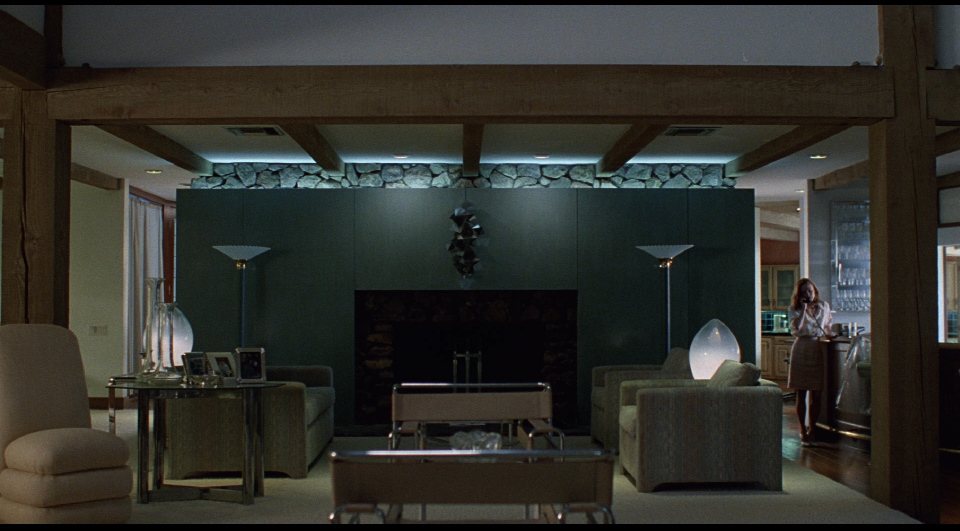
Living room scene
Because of budget restraints, Haynes uses a lot of long takes, but that really works for this type of film. Another remarkably framed scene is early on in the house. The scene begins with a long shot of the living room. Carol is on the phone in a tiny corner of the frame, yet it is dominated by the ostentatious display of their interior decorating. The point Haynes is making is that Carol is consumed by the materialism of this world of the 20th century. As the shot continues, she moves closer to the camera, which tracks slowly backward outside of the room to reveal a doorframe. Carol makes her way to the door and when the shot ends, she is framed inside it as if she is a woman in a box. The film language highlights the central theme, and foreshadows how the plot will unravel.
Safe is one of those films that you can pause at just about any shot and find the still image visually striking. In that sense, it reminds me of an Orson Welles film (not that I am comparing these two filmmakers), because his movies also had the quality of working as still images. Not too many of Haynes’ 90s contemporaries have that same aesthetic. Filmmakers like Tarantino, Sayles, Soderberg and others that found independent success in the early 90s were more concerned with creating a mood, often one of grittiness, and were not consumed by visual imagery. Those that would come later in the decade, like Paul Thomas Anderson and Wes Anderson were more interested in framing and shot construction, and were very likely inspired by Haynes’ Safe
It is no secret that the message of the movie is that of AIDs. The autoimmune disorder of Carol being ‘allergic’ to the 20th century is simply a façade for the real illness that was permeating the world of the filmmakers. This message is clear from watching it more than once, and Haynes and Vachon speak of their intent openly. They wanted to make a film about AIDs. In case there’s any doubt, it is erased by Carol’s final image where she clearly has Kaposi’s sarcoma on her forehead.
In hindsight, the AIDs epidemic is compelling. We live in an era where the disease is still not cured, but at least is in control. People are not dying from it like they were in the 1980s, at least not in this country. I could discuss this film and talk about nothing other than AIDs, but I’m going to pass on that temptation. It has been discussed plenty enough already, and I think there is more to reveal behind even the AIDs reading of the film, much of which Haynes intended even if he did not say so explicitly.
A bulletin board advertisement asks: “Are you allergic to the 20th century?” This is the turning point of the movie. Previously Carol has been mostly in denial about her illness, even if it is clear from her symptoms that it exists, regardless what her doctor says. When she reads this ad, it is as if a light bulb is turned on in her mind. She IS allergic to the 20th century. As she further explores this program and others, that belief is reinforced. It is not just the culture of materialism and the social mores that she has trouble fitting in with, but her body is explicitly rejecting the chemicals of the modern world.
The movie transitions from inaction to action, as Carol sets herself on a course to remedy her illness. We know where that will eventually take us, but the process reveals a lot about the world in which Carol, Haynes, Vachon, and Julianne Moore lived.
Eventually she lands in a retreat, which resembles a 12-step program facility. If you’ve known anyone in the program, you will know that it can work to curb addiction, but it also has a rhetoric and jargon that goes along with it. There is one scene where Carol is speaking with her friend Linda in a café. Previously in the movie, she was pensive and nervous when speaking in public, even if it was just with a close friend. Now she has a script to read from. She has bought into the program and is one of its strongest advocates. In this sense, her anti-chemical refuge resembles a cult. This is her Jonestown (without the Kool Aid).

Dr. Dunning
Dr. Dunning is the Wrenwood program leader, and he is quite the curious figure. He seems like a charming enough person. He speaks well and proves to be a good leader. Is he a good person? That’s not so clear. When he is not speaking to the crowd, he seems to be more concerned whether people are buying into the program, whether they are rejecting the outside world. In a candid conversation with Carol, he reveals as much. In one speech he speaks of keeping one’s mind open, and then later, he tells his people to shut it tight. He even goes so far as to say that he has stopped reading the news or watching television because he cannot bear to see what is happening to the world.
This transition in his message can parallel many totalitarian leaders. While Haynes is using AIDs and other autoimmune disorders as his main thrust, he is rejecting the groupthink that encompassed a lot of social movements during the day. To a lesser extent, this can be construed as rehabilitation programs, but I think the ultimate recipient of the scorn, and the one that he would not admit to, is Scientology. There are even many references to becoming ‘clear’ of chemicals, which is the essence of the Scientology message. During the 1990s when this movie was put together, the church was not as powerful in Hollywood as it was now. John Travolta and Tom Cruise had not yet signed on, but it did have a strong presence. And it was not the only type of post-modern, trendy social movement. There were many like it. Haynes is warning us not to blindly trust demagogues who would suggest that we close our eyes and shut out the world.

Julianne Moore
Of course I cannot talk about this movie without discussing Julianne Moore, in what was unequivocally her breakout performance. Today we know her as one of the top actresses of her generation, but back then, she was an up-and-comer that had just had her start working with artistic auteurs in Short Cuts. Moore has had quite a career, and has given two of her best performances to Todd Haynes (the other is Far From Heaven, which I would LOVE to see on Criterion). In my opinion, this is the best performance of her career. Her great acting is especially on display when she is acting sick, but I found her strongest in the first act when she is pretending not to be sick for fear of social or marital ostracization. Her face is often expressionless with a hint of fear, her speech soft and nervous. She seems to be on the brink of falling apart at any moment, yet somehow she manages to hold it in. That makes the times where she does break down even more powerful. Even with Haynes’ remarkable direction, it is hard to imagine the staying power of Safe without Julianne Moore.
Film Rating: 8/10
Supplements:
Commentary: – This commentary was recorded with Haynes, Moore and Vachon in 2001. This was probably around the time they were filming Far From Heaven together, perhaps after it wrapped and they were in the same place at the same time. Oddly enough, Julianne had never seen the final cut of Safe before.
Haynes reveals that a lot of scenes were shot at his grandfather’s place. After all, despite how the film looks, they had to save money. The opening shot where they drive up is on way to their house. Much of Carol and Greg’s house was shot in his grandfather’s house, like the kitchen and living room. Even the furniture company is their office. Throughout the commentary, he reveals that a lot of the extras were people that worked in the film in some capacity. They simply didn’t have a lot of money to pay people for small roles.
Moore tried to speak without using vocal cords too much, so she would breath her dialog. This gave a hint of fragility and sickness, and really enhanced her performance. They shot out of order and Moore had to lose a lot of weight for the ending scenes, which is remarkable given that she is in just about every shot.
There is a scene where Moore covers her face in Xander Berkeley’s shoulder and starts a coughing attack. She then vomits. You would think that the vomit was planted there, but no, that came from her. They highlight her process for that in the commentary. Most actresses would not attempt such a thing, but Moore gave everything to this role.
A lot of the shooting was during and after the big 1993 earthquake. That derailed a lot of their exterior shooting plans. The scenes in Wrenwood were shot in the Simi Valley, which was near the epicenter. There was an earthquake aftershock tremor that interrupts her final speech where she stumbles. It was probably a huge ordeal working around such a calamity with a shoestring budget. It is amazing that the film came out so good.
The Suicide, 1978 – This is a Todd Haynes short film, made when he was a child. For his age, he was already a talented filmmaker. The premise is a child is attempting suicide in a bathroom, and it flashes back to school confrontations and other problems that motivated the decision. It looks very because it was not shot on expensive film stock, and it is clearly amateur, but it shows a filmmaking and editing prowess.
Todd Haynes and Julianne Moore – This is a 2014 conversation between the two where they reflect on their career together that began with Safe. She aggressively wanted the part and auditioned in a T-shirt. They show the audition tape. The art in Safe, according to Haynes, is inverted. It followed the “cinematic trope,” as he puts it, but turns the formula on its head.
There were some TV articles in the 80s describing “environmental illness” or “20th century illness” Haynes had seen them and questioned whether they were authentic. Of course AIDs was at the forefront of his mind. He says that due to the time, you cannot think of Safe or his first feature, Poison without thinking of the epidemic.
Christine Vachon Interview – She was producer for Poison and Safe. They got together when he was editing Superstar. She saw the talent of Haynes and wanted to work with him. She put together a production company and went for a more ambitious project with Safe. She talks about auditioning process with Julianne, and how agent didn’t want her to read, but Haynes asked her to read when they met and she was glad to.
She talks about the AIDs virus and the affect it had on their community. He wanted to confront topic without dating itself, yet the LGBT community rejected the movie because it was not “gay enough. They wanted something more direct. Critics were not warm to it at first, but they came around. It made top ten lists that year, and by the end of the 1990s it had been understood and praised.
Criterion Rating: 8.5/10
Les Blank: Always For Pleasure. Part One.

I’ll be tackling the Les Blank movies in the order they appear on the discs, which is mostly chronological. The first post is starting with four movies and their respective supplements, but it will probably be a mixture depending on the length and significance of each movie. Since there are fourteen in all, I expect about four long posts to cover the entire box set.
THE BLUES ACCORDING TO LIGHTNIN’ HOPKINS, LES BLANK, 1970

This is actually Blank’s second musician documentary. The first is about Dizzy Gillespie, which is not included in the set. His portrait of Lightnin’ Hopkins is a fitting intro to his style. It is scored with the subject’s music, and there are a few interviews, but a lot of time is spent exploring the world in which he lives. There are scenes of people simply walking down the street, or people dancing to the music, riding horses, or doing many other activities that would not seem noteworthy to most, but fit in here.
While this is a portrait of the musician, it also explores the nature of the blues, hence the title. According to Hopkins, it is “hard to get acquainted with, just like death.” When you get a sad feeling, you can tell the world with song that you have the blues. To him and his friends, it is a deep, guttural expression of one’s misery. In one instance, he has his friend sing a blue song, who is literally crying when he sings.
These are not fake tears. The blues consumes him.
Blank just observes and listens to these people as they live through the music that is part of them.
Film Rating: 8/10
The Sun’s Gonna Shine, 1969 – This is a shorter, similar film about Lightnin’ Hopkins. It has more images of the small town of Centerville, TX set to his music. There are various, random faces, that are saying little or nothing to their camera, but they say plenty about their surroundings. For instance, there is one Gulf station employee sitting quietly and looking pensive. Blank explores the scenery more with this film, focusing on flowers, barbwire, and the landscapes. Another moving sequence is when a kid is running through sunflower fields with a guitar in his hand. He eventually reaches the train tracks and sits there. This child is behaving probably like Hopkins did at a young age.
Mister Charlie – Hopkins tells introduces and plays a song about a man whose mill burns down. This is good, singular example of how Hopkins can tell a story with a song.
Lightnin’ Les: Hopkins made up this song and performed it for Les Blank after deciding to make the documentary. They played cards the entire night before. Hopkins narrates the night and the decision making process. We know that he likely made up the words on the spot.
Making “Lightnin”: This is a brief documentary about the making of the film. They showed him the Dizzy Gillespie film to get him interested. At first he was skeptical, but they bonded over that card game. Of course Les let Lightnin’ win because the card game was not as important as the movie.
An Appreciation by Taylor Hackford – Hackford is not one of my favorite directors, but he has explored this type of filmmaking with his experience making Ray. He relates story from Ray about how Charles cared only about getting people out to their seats to dance. They gotta enjoy themselves “get drunk, dance and fuck” is what Ray said. While Lightnin’ Hopkins doesn’t say such a thing in the Blank documentary, you can tell that’s what he is going for. Hackford talks about how documentaries weren’t considered art back then, but Les Blank’s films were art and capture the essence of America.
GOD RESPECTS US WHEN WE WORK, BUT LOVES US WHEN WE DANCE, LES BLANK, 1968
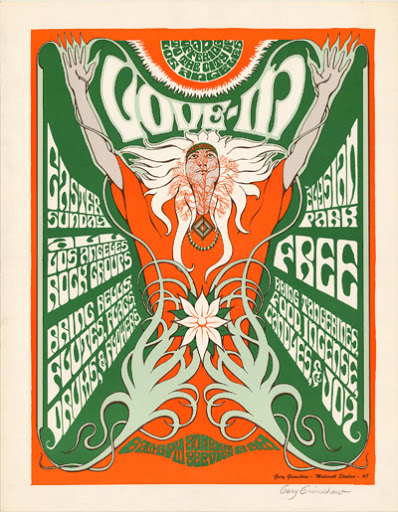
This is a film about Los Angeles Elysian Park Love-in that took place in March of 1967. There is no dialogue in the film, just images of people dancing, playing, discretely engaging in drug use or sex, blowing bubbles, and just having a great time. As always, Blank’s documentaries capture a culture, and this is among the best representations of the hippie culture.
Blank is interested in the people. You see dozens up close, maybe even hundreds of them, but for short amounts of time. He gives different sorts of profile shorts; some from up front, and some from the side where they are oblivious to the camera.
The score begins with a harpsichord tunes that does not seem to fit the vibe, but it eventually transforms into hippie psychadelia. People are playing music in the park, whether as individuals (horns, whistles, saxophones) or as a collective (rock bands), but no audio from the actual event is shown on screen.
I would wager that 99% of the people captured in this film were high as a kite. He captures some of that. There are some profile images where you can just tell that someone his high by the vacant, lips widely parted stare. There are other scenes that you can tell from their behavior. There is one person who is looking at the crowd through a kaleidoscope, and then Blank’s camera captures that same visual, showing a distorted view of the people.
He primarily wants to convey the images of love, dancing and enjoyment. The movie is bookended by a brunette dancing girl wearing a red shirt and carrying flowers. Perhaps Les thought she was attractive or just that she embodied the culture. He shows her at the beginning, during the middle, and at the end. He shows a lot of signage, most of which has words of love. He shows many shots of flowers and as much dancing as possible. Probably half the film is just people dancing. In some scenes they are dancing aggressively, wearing face and body paint with hippie imagery. At other times they are dancing playfully, like when groups of people are holding hands and running around, which maybe shouldn’t be considered dancing at all. Regardless of one’s opinion of the short-lived hippie movement, Les Blank captures its essence.
Film Rating: 8/10
Flower Power, 2014 – This is a short documentary about the hippie film. Harrod Blank, Les’ son, said he filmed flowers and women his whole life. This short was originally made for a PBS station. As Skip Gerson, producer, retells, it was shown once on TV and then re-cut to the movie we know today. He said that all historical documentaries about the 60s include a shot from the Les Blank short.
SPEND IT ALL, LES BLANK, 1970
Of the documentaries I’ve seen thus far from Les Blank, this is my favorite. It is about the Cajun culture of Southwest Louisiana. The film begins with title cards telling the history of how the Acadia people from Canada were exiled from their homes and re-settled in Louisiana. They were a peaceful bunch and preferred not to fight, and that tradition continues with much of their culture intact, even if some of it has been lost to modernity.
Just about every American knows about the delectable Cajun foods, but probably few understand its culture. I thought I did, having studied some in college, but seeing it from Les Blank’s perspective taught me more than any class I could ever take.
These are people that can live off the land. They are shown engaging in numerous activities involving food, from harvesting oysters, shrimp or fish from the waters, to butchering and cooking a pig. Food is a major part of their culture. In one scene a man talks about a homemade dish of venison sausage, rabbit meat that is cooked in a red sauce and later poured over Cajun rice. He said this is their version of spaghetti.
There are two major themes to be found in this documentary. The first is that the people are kind-hearted, peaceful, and brotherly. One of them proudly says that he has “yet to meet a stranger in my life.” They watch out for each other, and most importantly play and celebrate together, and those festivities usually involve music and food of some variety.
The other theme is about the trappings of modernity. These people are unique because their land is rich enough that they did not have to work, at least not in the modern sense. One of the subjects spends his time and money participating in local horse races. He says that he makes nothing out of it, because he has to invest so much in the horses, but he is not doing it for money. He is doing it because it is what he enjoys it. That is the Cajun way – to spend your money doing what you love.
The times are changing. The older people did not have to work or go to school. They lived off the land, but many have to work out of necessity. One subject drives a bus and sells life insurance, but he still engages in the culture and celebrations on the weekends. Another is a musician that has his own music shop, but this is something he enjoys Even if it is considered working, it is something he enjoys. What he likes about Cajun culture is that they are free. He had been in prison for one day and had distaste for losing that freedom. Working for someone else is also a way of losing that freedom. He cannot think of living in downtown New York City, wearing a suit and working in an office. That would be tantamount to being in a prison.
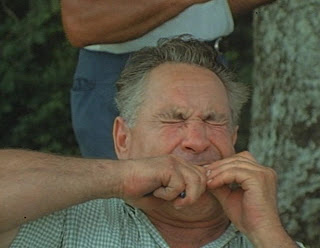
One of the most memorable and shocking scenes is when a group of Cajuns are sitting around, getting ready to enjoy a nice meal, when one of them takes a pair of pliers and pulls his own tooth out right on camera. He spits the blood out and says “I feel better already.” The tooth had been bothering him for days. “Now I have more room in my mouth,” he says joyfully, showing that he has other dental vacancies in his mouth. Even though a lot of people would see a lack of dental care and other facilities as a shortcoming to this lifestyle, they do not seem to mind.
Film Rating: 9/10
An Appreciation by Werner Herzog – Herzog was influenced by Les Blank, specifically the Spend it All film, and he borrowed the tooth-pulling scene from one of his narrative films. He likes that Blank filmed people on the fringes of society, not in the mainstream, and you can see that Herzog has carried that tradition to a certain degree in his own documentary filmmaking. He shares one example where they were filming in Antarctica, and someone wondered how to describe and explain this place to America and elsewhere. Borrowing again from Les Blank, he said nothing needs to be explained. It can just be shown.
Blank famously shot the documentary Burden of Dreams, which is about Herzog working with Klaus Kinski on the Amazonian epic, Fitzcarraldo. Blank would just quietly observe. At one time, Herzog told Les that they were about to have an eventful scene, and Blank responded that “I’m not here to film events.”
A WELL SPENT LIFE, LES BLANK, 1970

This time Les Blank looks at another Texas blues musician, Mance Lipscomb. Mance is an engaging and peaceful interview subject, and shares some of his story. He was 75 years old and had lived his life as a farmer and sharecropper. Some time passes before we learn what a fantastic musician he is, although his music is the soundtrack the entire time. He is a friend with someone named “Peg Leg” who, as you might guess, is missing a leg.
Mance talks less about his music and more about his feelings on life. He has two Greyhound dogs, which might be considered a rich breed, but they catch rabbits, which he can then sell for $1 apiece. He said that the hunt is the fun part, so if he catches six or seven, then he gets $6-7, but for $100 worth of enjoyment.
Just like with Lightnin’ Hopkins, Blank shows random scenes while the music plays. For example, one time he shows a lady just checking her mailbox. Again, he makes the ordinary look extraordinary. He shows another scene with a construction crew digging a hole to put in a telephone pole, while the lyrics from his music says “the bossman works me so hard, cannot even sleep.”
For the last 11 years Mance has been pretty free, enjoying life, able to play where he wants. It is not revealed in the documentary, but we find out from the supplements that this is due to him being discovered in 1960 and getting a record contract. Mance clearly does not see this as getting rich or successful. It is just a means to do what he enjoys.
Recalling a theme that came up in Spend it All, he talks about the trappings of modernity and the speed of life. “We living a fast life now.“ This is in the context of Mance talking about how they would play baseball in a field and make do with ordinary objects rather than using mitts and balls. This wouldn’t change how much fun they have. Today, in this fast life, the equipment is necessary and kids don’t play with it anymore. The only time we hear Blank speak is when he asks Mance to place a value on the speed of life. He responds without hesitation that the fast life is a negative thing.
Many of Mance’s musings are philosophical. He thinks and talks about his own mortality. In the final, unforgettable scene, he tells the, that “you won’t find another Mance.” He is in extreme close-up for this shot, and we see his eyes wander, ruminating on the gravity of what he just said. He then looks directly at the camera, and it freezes on him.
Film Rating: 7.5
No Man Like Mance, 2014 – This is another behind-the-scenes look at the documentary. Again, Blank captured the people and the environment as much as he did the musician. Skip Gerson said that they spent 4-5 weeks for the Cajun film and this one took 2 weeks with Mance. Mance was different than Lightnin’. He was a preserver of songs, whereas Lightnin’ made stuff up as he was going along. They did not have a plan for the documentary, but instead played it by ear. Gerson says that Blank shot a lot of film, and especially a lot of B roll, He tries to capture what resonated for him.
Meeting Mance – Chris Strachwitz, who was a friend of Blank’s and founded a Texan record label talks about meeting Mance in the 1960s. He drove out to country to find blues singers. “Do you know of guitar pickers in these parts?” They sent him to Navasota, TX. Was sent to look for “Peg Leg,” who introduced them to Mance. At first he was not crazy about Mance because he played traditional songs and not the guttural, mean blues like Lightnin’ Hopkins, but the musicality was there and he gave Mance a contract. That was in 1960 and was the beginning of the 11 years that Mance speaks fondly of in the movie.
Criterion: Bottle Rocket, Wes Anderson, 1996

It would be unfair to only talk about Bottle Rocket as Wes Anderson’s first film, and how it planted the template from which his future style would grow. It technically was his first film and certain stylistic and performance elements would reoccur, but it feels to be more substantial than a first feature. Wes Anderson and the Wilson brothers were learning, certainly, but the real first feature was the short film a few years earlier. That was their low-budget, independent way of figuring things out, and that’s what gave them the attention and confidence to be trusted with a larger production. Bottle Rocket cost nearly $8 million dollars and had some influential and experienced people involved, notably producers James L. Brooks, Polly Platt, and actor James Caan.
It is fair to compare this alongside Anderson’s other works, and in my opinion, it rates rather highly. Anderson says in the ‘making of’ documentary that people usually have one of two responses to the movie – they either love or hate it. There isn’t much in between. I’m in the love it camp, and have been since I first saw it many years ago. I’ve already talked about my respectful ambivalence toward’s Wes Anderson in my Fantastic Mr. Fox write-up (all of the rest which will eventually be revisited), but it is worth repeating that the style of all of his films can be divisive. Sure, he’s a critical darling, and deservedly so, but some people find his quirky indie style to be unappealing. That has been me to a certain degree, but not with Bottle Rocket.
I think it is among his best films, somewhere around Fantastic Mr Fox, Rushmore and Grand Budapest Hotel.. On some days I might call it my favorite Wes Anderson.
Why do I like it so much? First off, Anderson is a phenomenal filmmaker, and this is apparent from throughout the feature debut, and to a certain degree with the short film. Of all his films, I think Dignan is the best-drawn character, and I will delve into him further in a moment. Even though the film is eccentric, compared to many of Anderson’s other works, it is more realistic. Sometimes in his later films he will take the quirkiness too far, such as with The Royal Tenenbaums, The Life Aquatic and Darjeeling Limited, and they appear to be more of a fantasy world than reality. Bottle Rocket and also Rushmore are grounded in a lower class, youthful and naive reality, with two (three if you count Bob) lost souls trying to scrap together a place in this world.
Another strength of Bottle Rocket is the romantic element, which I think Anderson has only come close to replicating with Rushmore. The fact that Anthony falls for a hotel housekeeper speaks to his desperation and to his benevolence. Most housekeepers are invisible, even to the lower classes. It speaks for Anthony’s character that not only he recognizes her, but he pursues her in the kindest, gentlest way possible, yet is genuinely infatuated.
One of my favorite scenes in all of Anderson’s movies is the pool scene where the romance is effectuated. The scene is beautifully lit and the pool is a gorgeous shade of blue. The camera angles are not linear, but not disruptive either. The way the scene is shot lends to the awkwardness and uncertainty of the characters, and the satisfaction for both of them once they finally act on their feelings. The scene ends appropriately with Dignan interrupting them.
Dignan is the type of character that is easy to love and feel sorry for at the same time. He is ignorant, naïve, and not very self aware, but he is also charismatic and confident. He has qualities that everyone has to a certain degree, yet they are accentuated. He is like a more eccentric and less intelligent Max from Rushmore. He will say what he means and sometimes trample on others, but he will instantly back down when it comes to a confrontation. His most endearing characteristic is his optimism and glass half-full outlook on life. I will not spoil the ending, but the fact that he utters the line “We did it” triumphantly to Anthony and Bob, just sums up everything about him. He gives another great line while in the midst of a heist – “They’ll never catch me because I’m fucking innocent.” He gets the best lines in the movie, as he should, because he’s …. well, he’s just Dignan.
Film Rating: 9/10
Supplements:
Commentary with Wes Anderson and Owen Wilson – They can barely remember the movie because they made it so long ago, but they still share a number of good stories. They weren’t sure whether they would cast the Wilson brothers because they had little acting experience and wouldn’t give the project much panache. The producers were the ones who convinced them. Jim Brooks thought Luke had a Montgomery Clift feel.
It was interesting that they cut roughly 20-minutes of an action sequence. This was Bob’s pot plant being discovered by police and them running away, much of which is in the deleted scenes. The odd part is that the remainder of the movie has very little action save for the very end, yet they cut the scene that had a lot of action because it simply didn’t fit.
They talk about the disastrous test screenings, and how they thought their film was funny, but discovered later that “there was not a big laugh in the movie.” They remembered one incredibly positive comment card out of 500 from that first screening where most people walked out. Anderson coincidentally met the person who wrote the card later and he recognized her because he cherished that card and kept it.
The Making of Bottle Rocket – This is mostly a series of interviews from the participants, since not much footage exists from the actual shooting. Anderson and the Wilsons talk about how young they were and how little they knew, but others say they were more professional and confident on the set. Andrew Wilson, for instance, says that they play possum because they knew exactly what they were doing. Interestingly enough, they were making $700 a week and $100 per diem during the production. They were kids and had never earned this type of money before, so a lot of people accused them of milking the production time to keep getting paid. The jury is still out whether that was the case, but they at least established the slow pace at which they would develop films. Anderson has never been in a major hurry, and that has helped his films retain a sense of quality.
Bottle Rocket, 1994 – This is the short 13-minute film that was recognized at Sundance. There are many similarities to the movie, such as the stealing of the earrings, playing pinball, the book store heist, and many more. For a student film, they do a good job and I can understand why people saw enough promise to give them a feature. It also looks inexpensive. For instance, they don’t show the bookstore robbery. They just show the actors talking about it later.
Deleted scenes – You can see the amateurism of the filmmaking from the deleted scenes far more than anything else, and they were smart to delete them. They would have slowed the movie down with irrelevancy. The pot chase was a fun scene, but most others were just distractions.
Photos and Storyboards – The photos were from Laura Wilson and encompassed the feature and the short. These stills are more for the die hard fans.
Shafrazi Lectures, No. 1: Bottle Rocket – For a critical commentary, this one was disorganized and inarticulate. He says some things about the characters, but mostly looks at random scenes and comments on them. Most of his comments are not very insightful, such “I love that,” for one or “I don’t like that” for another.
Murita Cycles, 1978 – This is Barry Braverman’s documentary about his father Murray. Braverman was a collaborator and friend of the filmmakers and this early work inspired them. You can tell that they modeled some of their characters from Murray. He is quirky and soft-spoken, and reminds me of some of the Bill Murray characters in later films. He is sort of a hoarder entrepreneur, yet is unafraid of getting himself dirty. Like a lot of Anderson characters, he is endearing and refreshing despite his flaws.
Criterion Rating: 9/10
Criterion: Time Bandits, Terry Gilliam, 1981

Time Bandits came at a curious time in the career of Terry Gilliam. It could be considered a crossroads. He had cut his teeth animating for Monty Python, which eventually led to him co-directing Monty Python and the Holy Grail with Terry Jones. From there he moved towards imaginative fantasy worlds like Jabberwocky, where he was still finding his craft. Time Bandits was yet another step forward into exploring a fantastical world, while still clinging to his Python roots and trying to achieve a mass appeal. What resulted was a blending of the Python comedy, the Gilliam fantasy, and another stepping stone towards the career of a unique auteur.
Gilliam uses a child’s perspective to establish the fantasy, contrasted with the crass commercialism of the adults – Kevin’s parents – and a yearning toward the adventures of yesteryear. While he is dreaming of historical and fantasy worlds, his parents are dreaming of an appliance that prepares their food just a little quicker. Meanwhile, they sit on furniture that still has the plastic covering seemingly to keep it from becoming worn and old.
The mise-en-scene of Kevin’s bedroom is a template for the entire remainder of the film. The pictures represent locations where Kevin and his Time Bandits will later travel, while the toys will similarly reappear as objects in later scenes. This is a clever and creative way of planting a gun in the first act to have it reappear in the third. Gilliam places everything in the first act, which begs the question as to whether the events take place in reality or whether they are in the dreams of a child’s mind.
The fact that Kevin’s travel companions are dwarves help anchor the camera to a child’s perspective, so that virtually everything in the movie is shot from below. All of the adults (save for Napoleon) tower over the camera. This also suggests the mystery between this being a child’s imaginary world or whether the bandits and their perspective are real.
John Cleese and Michael Palin are the link with Gilliam’s Monty Python roots. While they are funny in Time Bandits and steal every scene they are in, they restrain Gilliam’s artistry and imagination. It is no coincidence that his best work would come when he was ultimately divorced from the Python aesthetic. We laugh when Cleese steals the rich bounty from the bandits only to give it away to the poor, or when he turns a blind eye to those poor being punched for no apparent reason. We also laugh when Michael Palin tries to hide an ailment from his beloved Shelley Duvall, whether it is in the forest or on the Titanic.
When the Python actors are not on the screen, the film becomes less of a comedy and more of a deeper examination of the spirituality of this world. In this sense, Time Bandits is two different movies. It is in part a Pythonesque comedy and in part an artistic examination of commercialism, the concept of good versus evil, and at it’s core, a coming of age story. Given that it is so many things and is partially effective at each, I feel that it falls short of its potential, yet remains wholly entertaining.
Film Rating: 6.5/10
Supplements:
Commentary: – Gilliam discusses his experiences with the film in a decent commentary. I did not realize that this began as a children’s film while he was struggling to make Brazil. I can see that ambition in Time Bandits, and for that reason I’m glad he used a mainstream canvas to stretch his creative legs, and that experience probably helped Brazil become a great film. It is interesting that he used Python actors and dwarf actors from Star Wars, yet was inspired by Visconti in terms of production value. This is readily apparent by the terrific historical set pieces, which stand on their own for any genre of film.
There are other participants in the commentary. Child actor Craig Warnock played Kevin and shares some of his fond memories of the experience, since he was young during the filming, he does not have the sharpest memory of how everything came together. He share some interesting stories, such as how he got the part, which of course would be difficult to forget.
Also participating in the commentary are Michael Palin, John Cleese, and David Warner. Palin helped write the movie. He was initially going to only write the dialogue, but he ended up contributing to the plot as well. And he casted and wrote his own part. It was a short shoot for John Cleese and he did not know entirely what the movie was about, but he enjoyed his scene. Warner enjoyed playing the evil genius, which was a sort of comic villain that he had not played before.
“Creating the Worlds of Time Bandits” – This piece is about the set and costume design. Like many good Criterion features, it points out things that are easy to miss when first viewing the film. One thing I missed was that the bandit characters had relics from history as part of their costumes. Talks about different locations – Ancient Greece was Southern Morocco. The Napoleon scenes were filmed in Wales. There were other scenes shot in Kent, and a lot on the studio. The Titanic was shot in a studio by just creating a deck, but it worked well. The sinking was from A Night to Remember.
Terry Gilliam and Peter von Baugh – This is a conversation between the director and film scholar from 1998. Gilliam talks about films he loves as a kid, like epic films (Ben Hur), which can be seen in his personal and Monty Python works. Talks about using movies as escapes, which makes sense since his major works – even the most artistic — really are about escaping into a sort of fantasy world. He did not know art cinema as a child, but adored people like Jerry Lewis. Of course he would eventually discover art films. At one point in the interview he references La Jetee, which of course he would remake into 12 Monkeys.
Shelley Duvall – Interview with Tom Snyder in 1981 on his Tomorrow show. He introduces her as a big star, which she really was at the time, but her film career derailed afterward and she worked more on children’s projects (Fairy Tale Theater). She talks about how smart Monty Python guys are, which is true as they are all Oxford scholars, and many of their post Python works have been academic. This was a short, promotional segment where they showed a clip.
Criterion Rating: 7.5/10
Criterion: The Complete Jacques Tati

It is both fortunate and tragic that we can package an innovative filmmaker’s life work into a 7-disc box set. The tragedy is that he was not able to share more of his artistic vision, either due to financial or creative issues. You would be hard pressed to find another auteur who matches the quality of the heart of his output from 1953 until 1967 with Monsieur Hulot’s Holiday, Mon Oncle, and PlayTime. The last film of the trilogy, which is arguably the best, essentially ended his creative freedom and harnessed his talents. His career ended with a whimper, and his final projects never made their way out of development.
On the other hand, despite the lack of production, it is quite a journey to wade through all of the creative works from someone of Tati’s caliber. The Jacques Demy box set that came out earlier this year similarly captured the essence of his career, but not the entire narrative. There were notable omissions, some of which would be a good fit for Criterion (Model Shop), while others wouldn’t (Parking). For Tati, even the lesser films are Criterion-worthy, as they highlight his talents and his style in various ways. He had financial problems after PlayTime, but that did not force him to compromise his artistic integrity in order to make a fast buck.
Tati began his career as a music hall performer and a mime, and in many ways, he remained as such throughout his career. The oddball characters of of François the Mailman or the popular Monsieur Hulot showcased his physical talents and comic ability. Since his characters were mostly mute, he was a mime without the makeup, a music hall performer without the music (at least not the same type of music). And he could always make us laugh.
People fascinated Tati. He used his films as a way of observing the habits of ordinary people, however odd and nonsensical, and how they transformed during the period of economic prosperity and American innovation following the war. He was always an observer, and his film style made us observers as well, rewarding us for our attention to details, with hidden gags buried layers below the surface or in the background of the frame. He challenged us to be curious like him.
Tati denied that he was critical of modern architecture. He constantly claimed to be impressed by it, but not always by the people who inhabited it. A large part of his work satires the preposterous lengths that people go in order to improve their lives, whereas deep down they are merely trying to impress others. Hulot as a character and Tati as a person were less than impressed by these displays. To them, having the latest gadget, or the most immaculately manicured landscaping, or an appliance that has an inexplicable additional feature were pointless. He wanted to get to the core of humanity, get people away from the hustle and bustle of the city. This sometimes meant meandering around a small town where garbage lies in the middle of the street, or transforming a ludicrously designed restaurant into a relaxing bistro where companionship and revelry were most important.
These little treasures from the old France were being lost, little by little, but there was beauty still to be found among all the chaos. Few scenes illustrate this point better than PlayTime when Barbara opens Hulot’s gift en route to Orly airport, to uncover a lovely flower arrangement, which not-so-coincidentally resembles the streetlights that guide their way back home.
The box set is a delight, and ranks at the top of the Criterion sets that I’ve explored to this date.
Criterion Rating: 10/10
Jour de Fete
Monsieur Hulot’s Holiday
Mon Oncle
PlayTime
Trafic
Parade
Tati Shorts
Criterion: Tati Shorts, Jacques Tati

When accepting the Honorary César award in 1977, Tati urged the film industry to support short filmmakers, even if they had to sacrifice a small percentage of their profits. It is through shorts that filmmakers are allowed to get creative and take risks. He points out that without shorts, the careers of people like Keaton, Chaplin, Fellini and Rene Clement would not have flourished. The same is true of himself, even if he humbly left his own name out. Through his short films, we see the evolution of his style that would materialize in his six feature films over fifty years, three of which are arguably masterpieces. This disc has all of the films shorts with his involvement, either as actor, writer, director or even father.
On Demande Une Brute, 1934 – This was written by and starred Tati, but written by Charles Barrois. It is pure slapstick comedy, that is not so much Tatiesque. He claims in one of the supplements that the first film was not very good, but he learned from it. I don’t agree with his assessment, as I think it works as a comedy, even if it doesn’t resemble what would become a Tati comedy. Tati played a naïve youngster, caught in a tough position having to accept a wrestling match with a menacing champion. Plenty of shenanigans ensure, including a major plot point that involved an umbrella, perhaps foreshadowing things to come. 7/10
Gai Dimanche, 1935 – Tati co-directed this short with Jacques Berr, co-starred and co-wrote with Enrico Sprocani (circus clown that went by name of Rhum). This is a better effort than his first film, even if the direction is amateurish and there is some poor framing. I’m a little more forgiving because I know the filmmakers were young and learning their craft. The results on screen are more in line with what Tati would later do, including using long-shots and creative sound effects in order to enhance the humor. There’s even a scene with a malfunctioning sign, which is nearly mimicked in Jour de Fete, and signs would be a recurring motif in all of his future work. 7.5/10
Soigne Ton Gaughe, 1936 – This was directed by René Clément, only his second credited project, and starred Tati. Even though Clément was not yet the accomplished director he would become, it is apparent in this early work that he had potential early on. Even though Tati did not write the story, it played to his tastes and his strengths. He starts out as a bicyclist that resembles Francois from Jour de Fete. He does a boxing routine when he thinks nobody is looking that is much like a performance he gave 40 years later in Parade. Tati again proves himself to be a capable comic actor, and the shot selection and framing are the best of these early works. 8/10
L’Ecole Des Facteurs, 1946 – This is the first sole directorial credit for Tati, and anyone who has seen Jour da Fete can tell. This is the first introduction to Francois the Postman, and is essentially a truncated version of what would become Tati’s feature length debut. Many of the shots look identical to the feature, and it they were not the same shots, then I have to give Tati kudos for recreating them so efficiently. The story begins with the bicycle school, where Francois and two other postmen learn the proper way to ride and hand for certain types of letters. There’s also the famous bike riding itself scene, which ends with it parked comfortable at the café. While it lacks the charm and character development of the feature film, it is quick to get to the point and highlights some of the better gags. 8/10
Cours du Soir, 1967 – This was made on the set of PlayTime, directed by Nicolas Ribowski, starring Tati who dresses in Hulot clothing. But this character is not Hulot! He is teaching an evening class about an unknown subject. If anything, the class is to become Hulot. He starts by doing impressions of different sorts of smokers, then segues to sports impersonations and other pantomimes. Finally they have to practice stumbling on a step and then running into a column, which of course Tati can do masterfully. The students cannot quite manage, and they perform nonsensical calculations (using shoe size?) to figure it out. Even though this is a showcase for Tati’s talents, the humor is not as effective. We’ve seen him do many of these same routines in other places without making up an absurd classroom scenario. 4.5/10
Degustation Maison, 1977 – This was Tati’s daughter, Sophie Tatischeff ‘s directorial debut. Tati was not directly involved, but most likely gave his daughter a great deal of assistance. The short film has some Tatiesque elements, and is filmed in Saint-Severe, the same location as Jour de Fete. The premise has locals frequenting a bakery and having an insatiable demand for tartlets. Most of the short just watches them interact, which is the type of observation that her father favored. The joke is that the café is like a bar. As they eat the tartlets, they get looser and eventually appear drunk and get cut off. While the short was one-note and the joke is not very funny, it was a decent debut. 5.5/10
Forza Bastia, 1978/2002. This is a film that Tati began and did not finish. His daughter Sophie wrapped it up over two decades later. This is very much unlike any other Tati film. It is a pure documentary, which I don’t believe he had previously attempted. This is about a football match between Eindhoven and home team Bastia. Not so surprisingly, Tati is more interested in the behavior of the participants rather than the actual match. He films the town as they represent and celebrate their team in the days leading up to the match, waving flags and honking horns through congested traffic. Even during the match, he captures more footage of the fans in the crowd and curiosities on the field, such as the groundskeepers creatively trying to make the soggy field playable. He shoots some of the match, but very little, and the results are anti-climactic. Instead he accomplishes what he most likely intended, which was to capture the culture surrounding the match. This is my favorite of his shorts. 8.5/10
Supplements:
Professor Goudet Lessons – Stéphane Goudet is all over this box-set as the preeminent Tati scholar, so it is only fitting that he conclude the disc with a half hour lecture that concludes the themes and methods of the filmmaker.
One of the more common recipients of Tati’s ridicule is the education system. He made fun of schools, which we see more in his short films rather than his features. He is primarily interested in leisure, especially sports and holidays, and these do become prominent themes of his features. Constant targets are those who take themselves too seriously at anything.
The basis of Tati’s cinema is observation. He likes to show us people looking, and subsequently, he challenges us to observe as well. It is curious as to why he made so few films in such a long timespan. At first it was because he needed time to observe humanity, to pick up on personal nuances and trends that he could ridicule. He says that PlayTime was the only film that the French didn’t like because they didn’t know how to watch it.
For someone that is consistently compared to silent filmmakers, sound is a major attribute of his films. He likes objects or people to have one sound to characterize their function, which he often manipulates in order to highlight ridiculousness or humor.
David Lynch, Olivier Assayas, Michel Gondry, Patrice Leconte and Wes Anderson all contribute snippets to this lecture.
Tati Story – This is a brief bio of the life of Tati through his works. Begins with his silent period, then feature films, and shows many examples from the short films on this disc. For someone with such a limited output of work, his reach and genius was limitless.
Criterion Rating: 8/10
Criterion: Parade, Jacques Tati, 1974

I wrapped up my discussion of Trafic by quoting Tati from an interview about why he made so few films. His answer was that he did not want to make something that failed to meet his standards. His quote was that, “in life, you only have so many ideas.” Parade is most certainly one of his big ideas. It is ultimately his lifelong idea, a culmination of all his years working in the entertainment industry, beginning in the music hall, continuing with his mime training, and to a lesser extent, his experience in films. This is Tati the showman, which was ultimately what he was all his life, even if that side of him was disguised in his most popular works because the real Tati was somewhere within the character of Hulot.
By that same token, ideas for a variety show on TV and a feature film are drastically different. Parade stands apart from all of Tati’s cinematic output because (and apologies to Jafar Panahi), this is not a film. This is a TV show that was later converted to film. As a TV, show it would be quality entertainment. As a stage show, it would be an experience one would never forget. As a film, it is a decent and fleeting experience. As a Tati film, it is the outlier, the movie that does not belong and cannot be measured or even categorized with all of his previous efforts. For that reason, Parade is a disappointment.
The show is a form of a circus with Tati as the host. There are acts of juggling, balloons, magic, animals, and musicians (especially during the latter third of the film). The acts that take place when Tati is not on the stage are at times enjoyable, at others trite and uninspired.
It is when Tati is on screen that the film shines. He does a few pantomimes. My favorite was his attempt at boxing. His act is coordinated with the drummer to register the punches and the end of the round. It is short, but absolutely hilarious. Other acts are also good. The soccer goalie is a joy, whereas the tennis match is a riot, especially when he performs his mime in slow motion and captures the anguish of the tennis player on every shot to comedic effect.
The audience participates in the escapades. During the tennis match, they look left and right using the sound effect of the ball as their cue. At times it is clear that they are plants, such as when an audience member does a magic act that upstages the amateur on stage who fails at his act. There is also a husband and wife couple in the audience during the mule sequence. The husband is tempted to walk onto the stage and try his hand at the mule, but his wife gets in the way. When he finally gets away from her and onto the stage, he manages to ride the mule. He follows it up with a couple pratfalls and we catch on that the joke is on us. He was part of the entertainment. There is another family with two small children who are given a great deal of reaction shots during the entirety of the film with no explanation as to why, but they come back into “play” at the end of the film. It was probably a blast for the children, but as a film finale, it was unsatisfying.
It begs to wonder why Tati brought this to screen in the first place. The simplest explanation is the lure of money. He had been critical of the idea of ‘selling out’ to get a paycheck, but after two failures in PlayTime and Traffic, he may have had no choice. He may have needed the cash. On the other hand, he is clearly proud of his background as a pantomime and entertainer, and what better way to exhibit such hidden talents than on a TV screen? Given that he shot it in video (and it shows), it also begs to wonder whether this is something he wanted to stand on the same footing as his artistic films. Whatever his reasoning, it is a disappointment that this is the final appearance on film for such a cinematic genius.
Film Rating: 3/10
Supplements:
In the Ring – This is Stéphane Goudet’s critical analysis. He has provided a lot of the better content on this box set. His commentary is useful here in pointing out some of the background of the production, such as the fact that this was the first French movie filmed on video that was shown in theaters. He points out that the cinematographer was Gunnar Fischer, the same DP who filmed many of Ingmar Bergman’s classics (The Seventh Seal, Wild Strawberries, Smiles of a Summer Night). The filming style is different than Tati’s other works, not just because it is filmed on video, but it also has close-ups and zooms, which capture the action of the performance. Of course Tati’s traditional long shots would not work with this type of production.
He provides some background on what Tati brought to his performance. Many of the acts were developed 40 years earlier as he was a developing pantomime and comedic actor. Goudet is fond of this work because it shows that side of Tati, and he dismisses the argument from a Tati biographer that this was a tragic mistake. Goudet feels like this is an extension of Tati’s earlier work. I disagree with Goudet, as is clear in my write-up above.
“In the Footsteps of Monsieur Hulot” – This documentary is one of the better special features of the set. It was directed by his daughter Sophie Tatischeff, and separated into two parts. The first part is about Tati’s early life, how he developed his comic sensibilities, and through the filming and exhibition of Mon Oncle. It shows a lot of 1930s footage of Tati doing his mime acts in the music hall as a young man, and these are a treasure to see. There are interviews of Tati, and he discusses his move into short films, the first of which he considers to be terrible, but he learned from it, and eventually made features. He wrote Jour de Fete while in the war, stationed at Saint-Severe, and promised to return to film there. He kept his promise and that launched his film career. The whole town participated. He based Hulot on someone he had met in the military, someone good natured and goofy. From there, as we know, he made Monsieur Hulot’s Holiday and Mon Oncle, the latter of which launched him to international stardom.
Part two follows the remainder of his career. He tours the world for Mon Oncle. He wins at Cannes and an Academy Award. He gets to meet the star of his choice after winning the Oscar, and chooses Buster Keaton, and eventually spends time with Keaton, Harold Lloyd, Mack Sennett, and Stan Laurel. From there they cover PlayTime, with the construction and destruction of “Tativille,” and the economic failure of Tati. Traffic is glossed over, but Parade is cherished by Tati. He made it in Sweden because he felt they had supported him in his career, even during the bad times. It ends with him giving a parting quote: “If I’ve managed to bring a little smile to people’s everyday lives, in the end [ … ] I think I did well in choosing this marvelous means of expression.” You did well, Jacques.
“An Homage to Jacques Tati” – This is a 1982 episode of the French TV show Magazine. Artist and set designer Jacques Lagrange pays tribute to his friend. He talks about how he created the Arpel house from a sketch, and they received letters of outrage from architects, all of which they cherished. He talks about the process by which they would write their gags, which was carefully thought out and visualized.
Even if the film itself is not up to the quality of the rest of Tati’s work, the disc is worth watching for the supplements, especially Tatischeff’s feature length documentary.
Criterion Rating: 6/10


 Criterion Close-Up