Category Archives: Film
Nearly Complete
My dream to complete the collection (on Blu-Ray at least), just became much closer to becoming a reality. Criterion usually has a February Flash Sale. I had held off on purchasing anything additional off my wish list until that happened. When the month of February passed, I was disappointed, but instead splurged on the Kino-Lorber Pioneer’s of African-American Cinema Kickstarter. Lo and behold, the Flash Sale happened later than usual. As much as it hurt after having committed money elsewhere, I could not sit by the sidelines.
I indulged and bought just about everything remaining off of my Wish List that is not out-of-print. The discs that I bought this time fall into two categories: 1) Movies I don’t like. 2) Criterions that I’ve already seen (often from the library).
These are the titles I purchased.
Black Moon
Certified Copy
Gray’s Anatomy
Insignificance
Investigation of a Citizen Above Suspicion
Judex
La Vie de Boheme
Le Havre
Like Someone in Love
Medium Cool
Pale Flower
Red Desert
Repo Man
Riot in Cell Block 11
The Big Chill
The Great Beauty
The Great Dictator
The Last Metro
The Long Day Closes
The Moment of Truth
The Spy Who Came in from the Cold
Things to Come
Tiny Furniture
Vanya on 42nd Street
Vivre Sa Vie
Weekend
Zazie Dans Le Metro
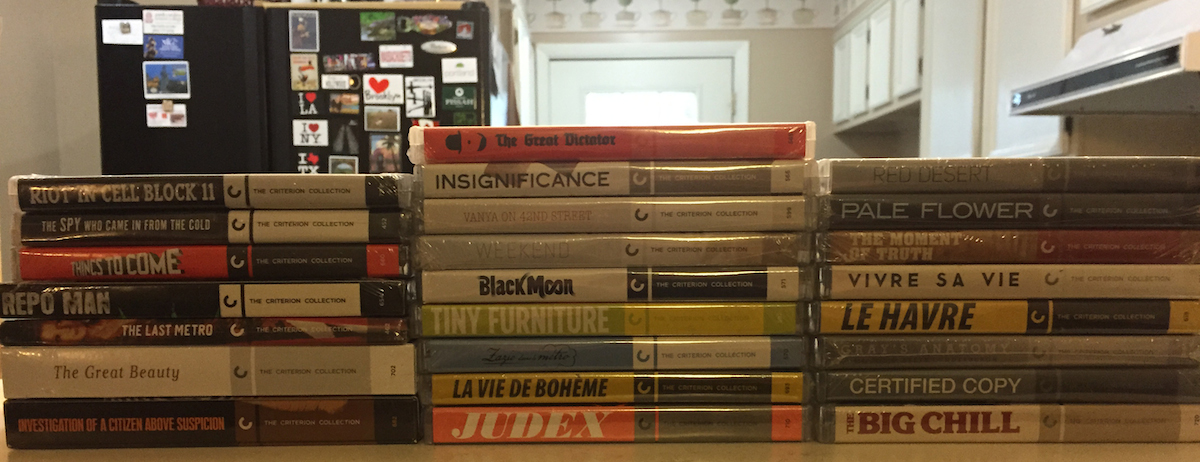
That leaves eight discs on my Wish List.
Blue is the Warmest Color – waiting for the rumored upgrade.
Chungking Express – Out of print.
The Curious Case of Benjamin Button – can be gotten easily and cheap.
Howard’s End – Out of print.
Leon Morin, Priest – Out of print and I already own DVD.
The Man Who Fell to Earth – Out of print.
Pierrot le fou – Out of print.
The Third Man – Out of print. The sacred cow.
Needless to say, completing these last few titles will take a little longer because of the exorbitant out-of-print titles. The Third Man would cost about as much as what I spent for the entire Flash Sale.
Another problem is shelving. We have plenty of shelves, but no single unit that can contain a collection of this magnitude. That will be our summer project. In the meantime, here are images of my current collection. You’ll see a lot of other titles sprinkled in. Criterion isn’t the only type of disc I collect.
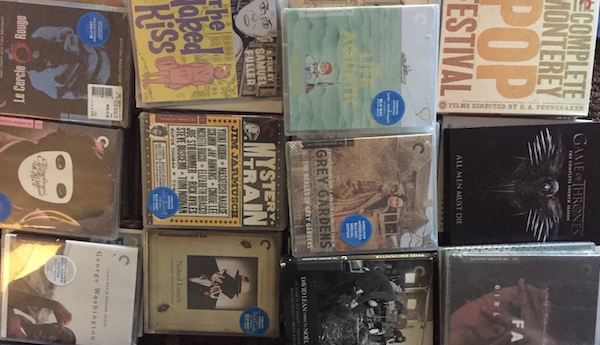
The stacks of unshelved discs. These are about 10 deep.
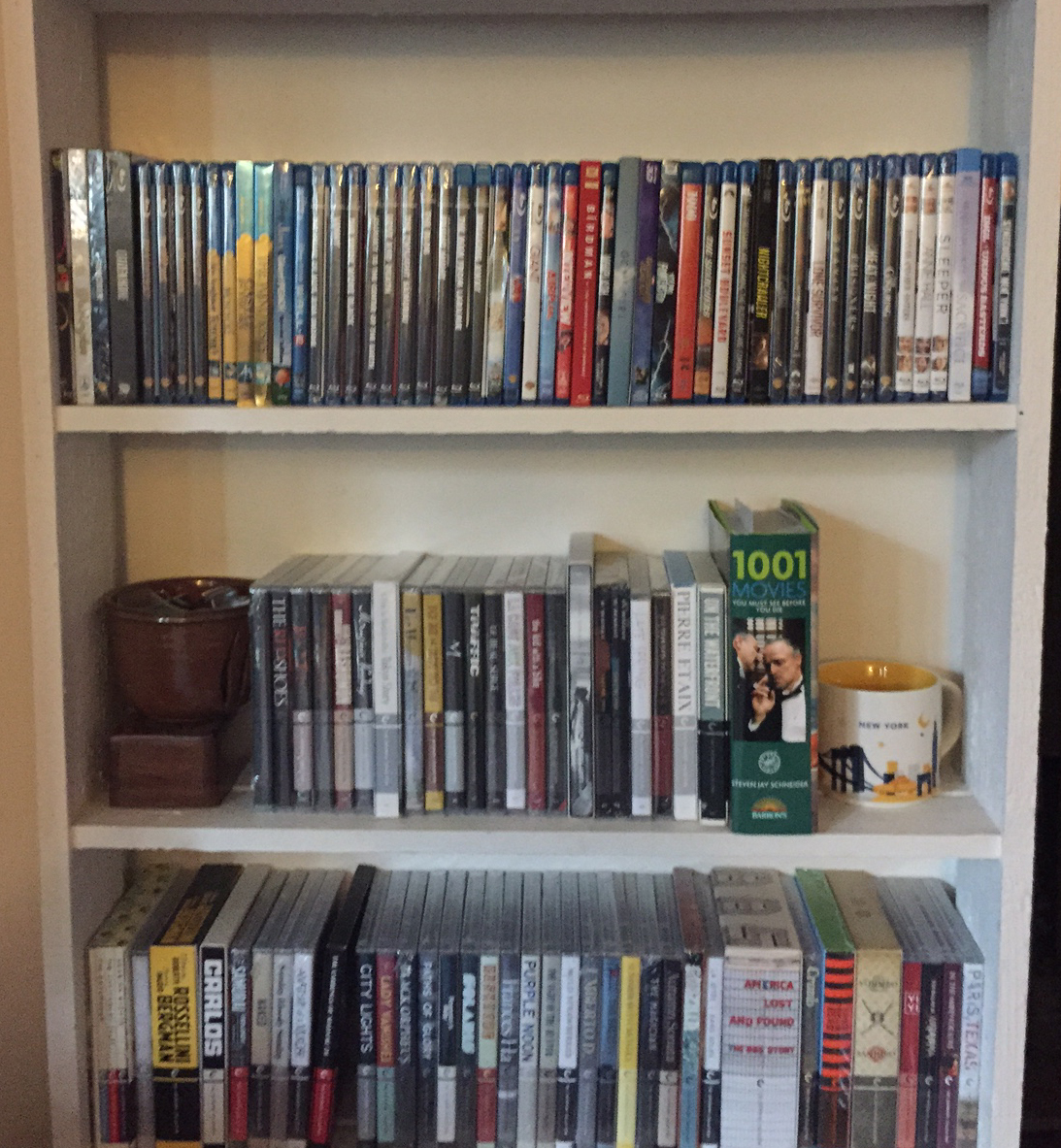
A mixture of Criterions on the two bottom rows.
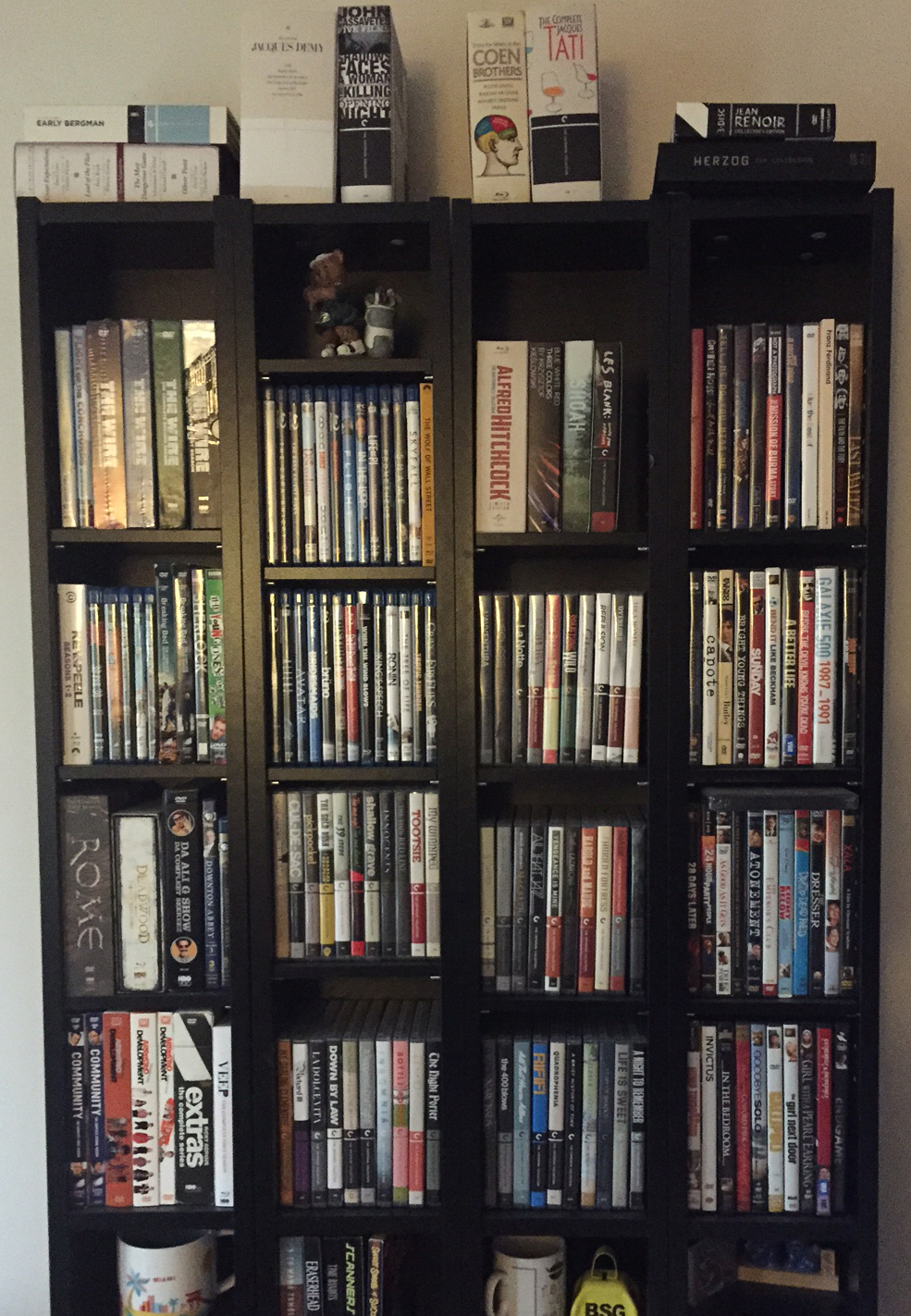
Criterions mixed in with TV (left shelf), wife’s discs (right shelf), and box sets on top.
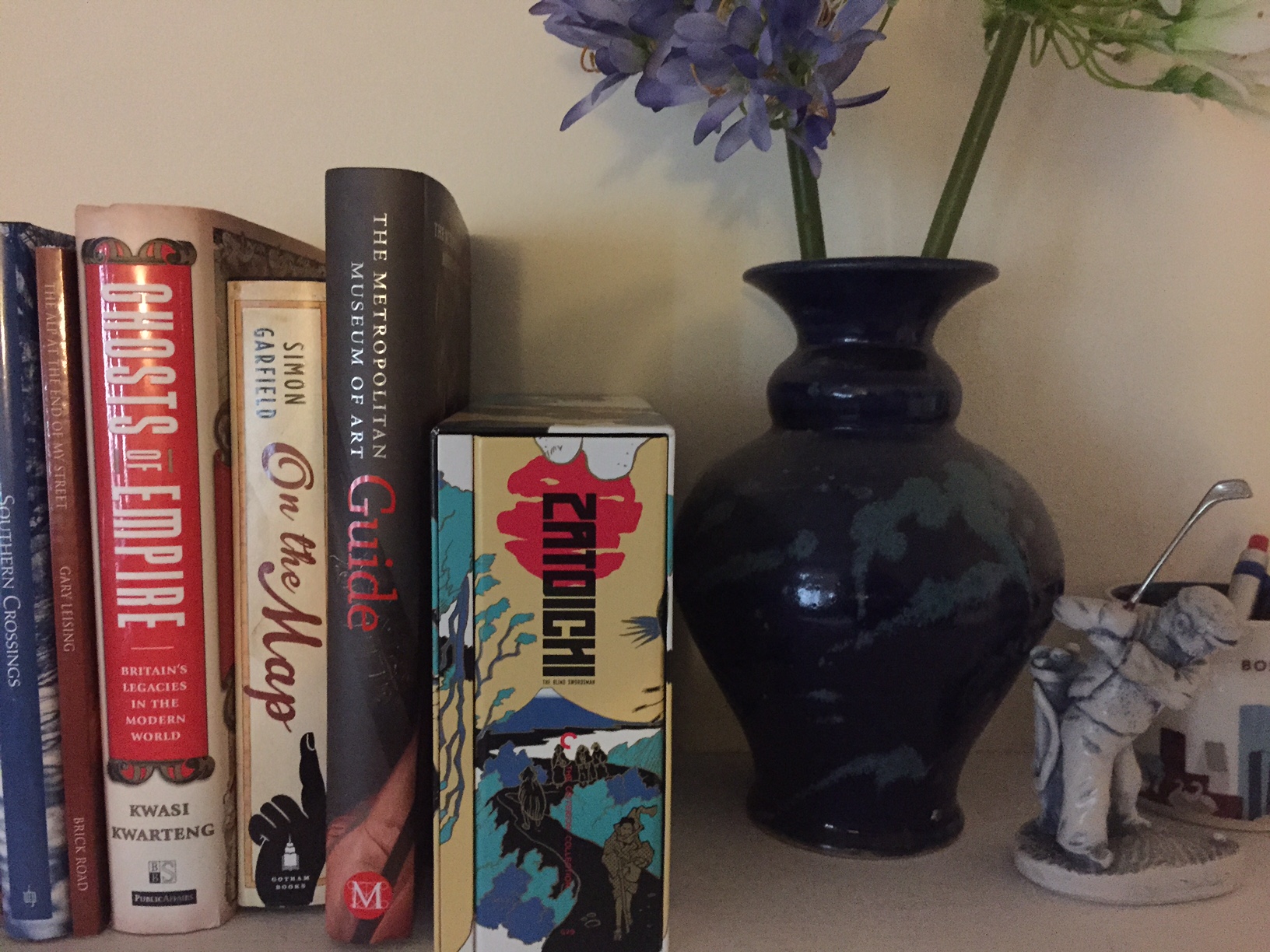
Can’t forget Zatoichi, which works very well as a bookend,
Don’t Look Now, Nicolas Roeg, 1973

I remember hearing about Don’t Look Now when I was a youngster. I probably even saw it, although it was at such a young age and was competing with a lot of schlocky horrors and thrillers, that I undoubtedly forgot it. Even though it was and is a highly regarded thriller, it was probably not my cup of tea. Now, many years later, it is interesting to revisit it as an art film and a thriller. It works effectively as both.
This film also deserves the requisite warning about spoilers. It cannot be discussed without mentioning pivotal scenes in the beginning and end. If you haven’t seen it, please do not read this review. It is an ending that has to be experienced without foreknowledge. It is also an ending that enhances further viewings and analysis.

Don’t Look Now could be seen as a story told backwards from the ending, as there is symbolism about what’s to come littered throughout the mise-en-scene. It could also be seen as a film with appropriate bookends. It begins and ends with a tragedy involving some (or all?) of the same characters. While there is plenty of room for exploration, what’s unquestionable is that this was crafted in a way that recalls the beginning and projects the future. Virtually every scene has some reference to either, and most nod to both.
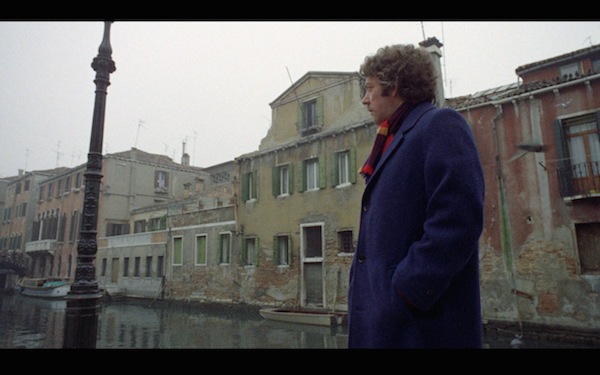
As for the symbolism, the most obvious is water. The majority of the movie takes place barely above water, from the tragedy in the beginning to the wanderings around Venice. They constantly tie water to death and, by extension, to the daughter. As he floats the canals, John sees murder victims extracted from the water. In one scene he notices a peach-colored, naked baby doll in the water, which is one of the most overt references to his daughter. Through John’s eyes especially, he is constantly searching the water for some meaning, whether it has to do with his daughter, his wife Laura when he believes she has not left, or even for his own spirituality.
The idea of belief is another major theme. John would not choose to visit Venice after the drowning of his daughter, but his profession as an architect brings him there. More specifically, a church brings him there. Does God lure him there? We can tell by his mannerisms and statements that he does not believe in a God. He actually feels some hostility towards the hypocrisy he sees within the church. Conversely, his wife takes on a more uncommon belief while she is in Venice, which is that of the paranormal. She believes that a blind lady could see her daughter Christine in between them at a restaurant. John tells her that “seeing is believing” and that he believes her, but he may be lying in the same way that he lies to his clerical associates. Because he does not believe in God and doubtfully believes in the paranormal, his lack of belief contrasts with the devout belief of the others in the film. Maybe God lured him to Venice, or maybe a paranormal intuition of his daughter lured him. Whatever power is at hand, he is naïve and dismissive of it.

There is also the matter of acceptance and overcoming the grieving process. The Baxters are wallowing in their misery when they are in Venice. Whether the premonition is true or not, the reason that Laura embraces the psychics is because she needs some sort of resolution. The blind psychic tells her that she has seen her daughter, who was sitting between them and laughing. “You don’t have to be sad,” she tells Laura. She clings to the psychics because of this assertion of comfort and resolution. She yearns to understand what happened with her daughter, and wants to believe Christine is happy and that their agony is misplaced. Again, this contrasts with religion, because the entire concept of Heaven is what the psychics claim to have seen in Christine – a happy and comfortable place. Once she has embraced belief of the psychics, she seems to accept the death of her daughter. She even interacts between the psychic and religious worlds by lighting candles in the church for Christine, which is out of happiness. What is ironic is that emotion is borne out of something far from the church, yet it is expressed within the church.
Regardless of how he acts around his wife and the clergy, John does not get relief from either psychic phenomena or religion. He instead is a practical man. Again, he believes in what he sees, and he is constantly looking for something in Venice even if he won’t admit what. He exclaims at one point that “Christine is dead!” and then repeats the word “dead” several times for good measure, as if he is trying to force himself and his wife to accept. He is not convinced, otherwise he would not have followed the red raincoat at the end of the film, the same one that results in his undoing. His belief that “seeing is believing” ends him. He was mistaken when he saw the red raincoat and chased after it, just like he was mistaken when he thought he saw Christine in Venice after her departure. The ladies think he has second sight, but it is his first sight and reliance on observation that deceives him.

What about the love scene? It is quite a brilliant bit of filmmaking despite all of the controversy and rumors about it. Many have argued that the scene is unnecessary, but I think it is a key component of the movie and expertly done. First off, the scene is a “love scene” and not a “sex scene.” They may be engaging in the act of intercourse, but they are expressing the love between them. In some ways this is a way of them taking solace in each other, and in another way it is another example of the relaxation after Laura believes that Christine is happy. The quick cuts between the actual sex, dressing and undressing make it less provocative, but they also show that it is a momentary reprieve. We are reminded during this lovely moment that it will end, and that they will have to go on about their lives. The scene also reinforces that they are unquestionably in love with each other, and it is a combination of the love for each other and that of their daughter that prompts this obsession. In Venice, they are looking for comfort with and for each other. The love scene is the only time where they truly accomplish it together.
Film Rating: 9/10
Supplements
Don’t Look Now, Looking Back: 2002 documentary by Blue Underground. Director Roeg and Director of Photography Anthony Richmond talk about reoccurring images that are not understood until the end. Using the color red and broken glass were not coincidences. They were deliberate. They share some stories from the set, such as when out-of-character Sutherland says “I don’t like this church” to Christie. They overheard and liked the line so much that they scrapped the script and used the real conversation.
They talk about the love scene in depth. They knew it would be controversial, which is why the decided not to cut it in a linear fashion. To film the scene, they took a small crew to a hotel and the entire shooting took place in an hour and a half.
Death in Venice: 2006 interview with composer Pino Donaggio discussing the music he created for the film. This was his first film. He didn’t initially understand why they called him for an important movie. Roeg gave him a trial to come up with a couple of themes, which worked. They were excited about the music. Producers liked it as well and decided to give him a shot. It was a lucky break as it began his career scoring films.
He talks about his decisions during crucial scenes. The soft piano playing at the beginning is deliberately not played perfectly, as if a learning child could have played it. He wanted an orchestral tune for the love scene, but he admits now that came from his own pride. He changed his mind after watching the scene.
He intentionally did not use typical horror type of music, which I think really enhances the film. He used single instruments like the flute because that expressed pathos and fear. That flute sound has been imitated in other movies.
Something Interesting: These were some assembled recent interviews with co-writer Allen Scott, DP Richmond, Sutherland and Christie. It was the best of the supplements in my opinion, mostly because it was a recent wide ranging discussion.
Roeg was not the first director attached, but he was the most thorough. Introduced the theme of “nothing is as it seems.” They had to change the short story, which had a couple with a dead child, but the actual death scene is not in the Du Maurier story. The story did not give John the motivation to be in Venice, whereas the movie added his profession as an architect.
There are more good stories from the set, like how Richmond was in the cold water for six hours in order to capture the scene where John finds his drowned child. Sutherland wasn’t going to do the church falling sequences, and then stunt man refused to do it. Sutherland decided to do it after all and he got more than he bargained for. They left him hung up there suspending and even pushed him into the shot.
In the script, the love scene was only described as: “They make love.” They had a camera, a couple lights, and went in with skeleton crew and shot it. Nobody saw the negative. The AD says they did it so well that people thought it was real. They address the unsimulated sex rumors and refute them absolutely. Donald talked about how un-sexual the mood was during that scene. They had short actions and cuts, with loud noises in between. Christie says that filming sex has changed since then. Now they display sexual skill, whereas with Don’t Look Now it went from shot to shot, and she says even though it was not real, it was directed like it was real making love.
Nicolas Roeg: The Enigma of Film: Danny Boyle and Steven Soderbergh discuss Roeg and how he influenced them. Boyle says you can spot a Roeg film in seconds. He used to think it was the zoom lenses, but it is not that now. They both say that the lack of writing his own work doesn’t bring him down. “He writes with the camera” – Soderbergh. They both acknowledge that Roeg was good at handling time, whether in a non-linear fashion or compressed. They both talk about how they were inspired by him to the level that they stole scenes from him. Soderbergh gives an example with Out of Sight, where they inter-cut the making love with getting dressed.
Graeme Clifford and Bobbie O’Steele: Film historian O’Steele talks to editor Clifford. Julie Christie actually got him the job after they worked on McCabe and Mrs. Miller. Roeg wanted subtlety and visually connective, so things could be pieced together later. A lot of it is about process, and they began after the shoot had finished and the director had rested. Having seen and loved Walkabout, he was confident of what Roeg would like.
Nicolas Roeg at Café Lumiére: This was a Q&A after a screening in London. Roeg has a slow and sincere cadence that makes him not the best interview subject although what he talks about his fascinating. He thinks that film writing is unlike any other writing, much closer to literary. He doesn’t like rehearsing because you miss “chance and chaos.” Studios and producers hated this strategy because they wanted their safety nets, wanted to evaluate talent. He says that everyone involved is “all nervous” because nobody knows if the film will work out.
He talks about how independent film is tough now. There were more independent producers back when he was in his heyday, but it was still not easy. He speaks in praise of Harvey Weinstein, despite his hostile reputation, and how he gave Tarantino a lot of room to work. Roeg has trouble reading screenplays that he is not working on because “they are rarely beautifully written.”
They were screening it for DuMaurier, but they would not allow Roeg to come because he had changed so much. Later he got a letter from her. She told him that his film reminded her of the couple she saw in Venice that prompted her to write the story. It was a pleasing letter.
He talks about how the BBC had the love scene cut out. People were outraged and demanded that it be put it back in.. The BBC put it back in, and most agree that the movie falls apart without it.
Criterion Rating: 8.5/10
2014: The Best of The Criterion Collection
I started blogging Criterions about midway through 2014, but previously bought and watched most, if not all of them. This is probably the first year where I saw the vast majority of all the year’s releases, including all of the supplements, although I didn’t blog the early ones.
It was tough to come up with a best list because there were truly some spectacular releases. I started with a list of 5, then expanded it to 10, and finally settled on 20. Rather than separate them by upgrade, reissues, and new titles, I just combined everything. Sure, a lot of these releases I have already seen before, but I still enjoyed revisiting. The only separation was for the three box sets, which naturally do not fit with the single-disc releases. You could argue that the Monte Hellman westerns are a box-set, but I kept them with the single releases because they are one spine number.
The criteria is the same for how I usually rate these. The quality of the film is a major factor, which is why The Big Chill probably had no shot at the list even with the best supplements ever. On the other hand, It’s a Mad, Mad, Mad, Mad World is not as strong a film as some of the releases that didn’t make the list, but the supplements were fantastic, especially the Roadshow version with commentary. As with everything, film is subjective and I’m sure other Criterion collectors would have different lists. That’s what makes the discussion fun.
STANDARD RELEASES

1. Persona
2. Pickpocket
3. All That Jazz
4. Fantastic Mr Fox
5. Breaking the Waves
6. Red River
7. The Innocents
8. Il sorpasso
9. Sundays and Cybele
10. It Happened One Night
11. The Freshman
12. L’avventura
13. All That Heaven Allows
14. Y tu mama tambien
15. Picnic at Hanging Rock
16. It’s a Mad, Mad, Mad, Mad World
17. My Darling Clementine
18. Macbeth
19. The Shooting / Ride in the Whirlwind
20. Safe
BOX SETS

This was the toughest decision, because all three of the box sets were fantastic. You could make a case that each one is up there with the best Criterion release ever, yet they also had their own character. The Tati films are the best of the bunch, especially the middle three. The Demy films were the least consistent, but the set benefited from having Agnes Varda and her documentaries. The Les Blank set was one of a kind and the type of set I hope Criterion continues to focus on. Even though they were all large sets and time consuming, they were a joy and not a labor to consume.
1. The Complete Jacques Tati
2. Les Blank: Always For Pleasure
3. The Essential Jacques Demy
A Day in the Country, Renoir, 1936

Even if Renoir’s A Day in the Country is barely over 40-minutes long, was unfinished and lost for 10 years before being edited for release, it is still one of the quintessential representations of 1930s French Poetic Realism. The setting out in the country and the focus on being in nature and how the characters react to their surroundings is the poetic element. This is particularly revealed through the eyes of Henri and Henriette, both hopeless romantics who are looking for something poetic to distract them. The realistic element is the way that the plot unfolds. Rather than give away the ending in this post, because I implore people to watch this accessible Renoir, I’ll just say that realism means things don’t always work out the way people want or hope for.
A Day in the Country is a joyous movie, although two different versions of joy are juxtaposed against one another. A Parisian family wants to escape from the stuffy Paris, get some oxygen, and enjoy the luscious and beautiful French countryside. The joy for Henri and Rudolphe, two scheming locals, is having a group of Parisians to take advantage, specifically the young women. They are enthralled as the youngest, Henrietta, swings gracefully on a swing.
Given the short film length, not much time is spent on character exposition, but aside from a few details, it isn’t necessary. The characters of Rudolphe and Henri are explored as they sit in the café. Rudolphe considers himself a player, and ridicules Henri for being a serious man that wants a serious relationship. “Whores bore me, society girls are even worse,” Henri says. He is a serious romantic. You can tell this not only from the words he says, but his demeanor as he says them. Romance is not a joyous topic for him, as he has yet to find someone who shares his ideals.

Much of the film’s comedy is related to the double meaning of catching fish. The patriarch, Monsieur Dufour and his future son-in-law Anatole are obsessed with bringing a fish back to Paris to fry. Meanwhile, Rudolphe and Henri hatch a plan to lure the two women away from their family for their own amusement. After the two men talk in the café about their plans to catch the ladies, the scene cuts to the other men talking about fish. These two conversations can be contrasted, even if they are on completely different subjects. Monsieur Dufour is explaining to Anatole, who isn’t the brightest bulb, about the nuances of the fish they plan to catch, specifically the difference between the chub and the pike. Anatole is lost when it comes to fishing, whereas Henri is lost with love. Rudolph and Monsieur Dufour are the self-proclaimed experts.

When the two women talk, it is a variation of the men’s conversation, only the subject isn’t about catching fish, men, or women. The younger Henriette reveals herself as a romantic and has a love of nature. She is enraptured by her surroundings, and enjoys herself, whether she is on a swing, a skiff, or just lying on the grass. As they explore the potential for riding in a boat, she leaves her hat to save their picnic spot. This gives the men their ‘bait.’ It works and the entire family warms to the two men instantly, setting their plans in motion.
The men get the attention of the women and find some common ground. They get along splendidly. Madame Dufour is outgoing, giggly, and easily plays into the charms of the men. Henriette is still an introvert, but she is excitable about having a good time in nature, especially if she has the opportunity to ride in a boat. To lure the men to agree to let go of their women, they bring fishing poles. The Dufours consider them kind gentlemen, and naively let them do as they please with their women.

Rudolphe was hoping for Henrietta, and had arranged as much with his buddy, but then Henri manipulates the situation and gets her into his skiff. He sees something in Henriette that he sees in himself, and he is not going to let his mischievous friend take advantage.
The character contrasts are distinct, but they make the film even more enjoyable down the stretch. Rudolphe and Madame Dufour are both outgoing, playful, and they have fun with the adventure of the chase. Henri and Henriette are also similar. They are demure and romantics. Henriette is swept up in excitement as they row along the Seine. Henri has his mind on something different altogether, and when she begins to figure this out, she is reticent to continue. If not for crossing paths with their counterparts, who are loudly and boisterously having a great time, things might not progress. They do, however, and if not for a chirping bird, they may not have gone further.

The last few minutes are abbreviated because the film wasn’t finished. They work as a conclusion to this short film, but if Renoir’s vision of three connected short films had come to fruition, this could have been among his masterpieces. Even at the abbreviated length, I consider this to be one of his strongest works, and the story behind the story is almost as captivating as the film itself.
This was a pivotal period in Renoir’s career. He had already become an established star director, and he had become more comfortable in his craft. In A Day in the Country , you can see him exploring techniques that would result in his finest films, like La Grande Illusion, La Bete Humaine, and Rules of the Game. He plays with deep focus photography for many scenes, such as when the men are talking in the café and a swinging Henriette is framed by the window. This technique would be mastered in later films, most notably Rules of the Game. He had become deft at exploring character contrasts, which he did so terrifically in La Grande Illusion.

Deep focus example
A Day in the Country stands on its own as one of Renoir’s greatest achievements, but it is also evidence of a master that was progressing in his craft.
Film Rating: 9.5/10
Supplements:
Renior Introduction: The initial idea was to shoot a 40-minute short film with the production value and acting talent as a feature. He wanted to shoot three shorts of that length, which in sum would become a feature. This sort of omnibus feature had not been done by then, but has since.
In a weird digression, Renoir argues for plagiarism. I don’t think he means it the way we understand the term. He means using stories as templates to embellish into a different story, and that has and is regularly done today. I can only speculate that back then, people thought it took nerve to alter a story by someone as heralded as de Maupassant.
The Road to A Day in the Country: This is a piece from Jean Renoir scholar Christopher Faulkner.
1935 he was very active with the popular front, militantly active. While he was leading the popular front and making films (like The Lower Depths) in the language of the movement, he made this one that seemed out of time politically.
Part of this was his coming to terms with his father, the famous painter, whose legacy likely continued to overshadow Renoir’s directorial career. Faulkner thinks this is a resolution with the past that he would return to frequently. The area that they filmed was an area that impressionist painters had worked in the 1880s. Many shots were homages to impressionist paintings.
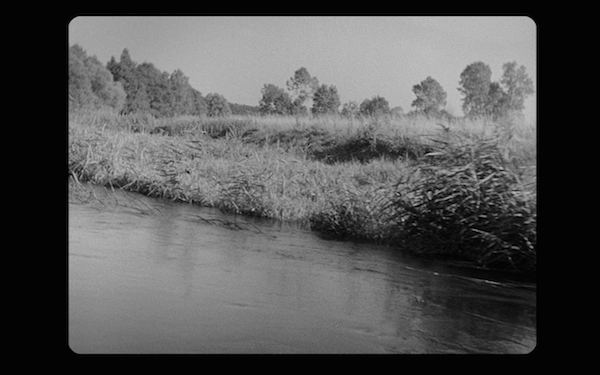
The riverbank could be an impressionist painting.
Rain interfered and slowed down production. It took seven weeks, only 22 days of which were dedicated to shooting. Faulkner disagrees with Renoir’s assertion that they changed script due to rain. There was evidence that they had written in rain. Nevertheless, the rain did shut down production and cost money. Jacques Becker shot some material later when Renoir was not available. 23 shots in the completed film were shot by Becker, but according to Renoir’s instructions.
Producer Pierre Braunberger was Jewish and had to leave the country when war broke out, and had to take all his belongings including the film. He edited it in his mind during his exile, but it could not be seen until 10 years later when the war ended.
Marinette Cadix and Marguerite Renoir later edited the film into what we see today.
By the time of the release, Renoir was in the USA and basically forgot the movie. He had nothing to do with the final editing of the film.
Pierre Braunberger on Jean Renoir: They had worked on a great number of Jean’s early works. He speaks reverentially of Renoir. He made A Day in the Country for Sylvia Battaille, who he was in love with.
He talks about the rain and production problems. Both Renoir and Battaille got sick of it, and they shut down the film. They had hoped to finish the film, but the war and exile changed those plans. When he was hiding on an island, he had a lot of time to think. In his solitude, he realized that he could finish the film with two titles cards. Voila.
Un Tournage a la Campagne: This is a long series (1:29) of scenes and outtakes from the production. Some of them add scenes or extend scenes included in the movie, but the majority are in sequence of what we see in the finished film. They show some of the filmmaking process, with the setting of the scene, calling action, and other background set details. They even show mistakes by the actors and/or crew. There are some sequences that are significantly longer, such as the swinging scene. What’s interesting is they had a lot more footage to make a longer film. Some of the footage is of poor quality. Some even has no sound, probably because it was going to be added in later.
One thing that is impressive about all of these outtakes is the skill of the actors. We can see take after take of them giving their all. I was mostly impressed by Battaille, who on a moment’s notice could turn on the childlike giddiness or enraptured romanticism.
Renoir appears prominently in these outtakes. You can always hear his voice in the background and he is encouraging. Even though I enjoyed the entire series (although many might find it long), I especially liked the tribute to Renoir in the end credits where they show outtakes of people saying “Here is the boss.”
Renoir at Work: Christopher Faulkner examines the outtakes of the film. This is the only set of outtakes for any Renoir film, so they are important to see how he worked.
We see how Renoir interacts with the actors, and starts the scene by using the first line of dialog and he praises the shot. This is how he became “an actor’s director.”
Some of the later scenes are after Renoir had left for The Lower Depths and Becker had taken over. We can tell that Becker followed Renoir’s instructions.
Screen Tests: These are a series of screen tests with all (or most) of the actors. The initial scenes of Henri and Henriette are mere impressions, as they quietly react to each other.
The mother, father, future son-in-law, grandmother (man in women’s clothing) are just looking at the camera and around. Even Renoir gets a screen test.
Some have expressed reservation about Criterion publishing what is essentially a film short, but there is so much extra material here that isn’t characteristic of classic film. We get spoiled by releases of recent films, such as the Wes Anderson collection, all of which have a ton of supplements. A Day in the Country has nearly the same volume of supplemental material, which is a rarity for a classic French film.
Even though this is an early release, it has such great supplements and import that it is an early contender for release of the year.
Criterion Rating: 10/10
Violence at Noon, Jesse & Celine, and more
Over the last few months, I’ve gradually dipped my toes outside of this humble abode and written some posts elsewhere. That will continue, so I’ve added a new section called Essays. This will include links to everything I write or collaborate with elsewhere on the internet. Just recently a few new posts were published, and soon there will be a few more.
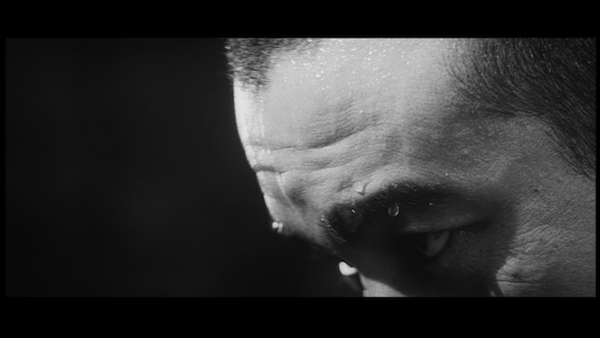
Violence at Noon
Journey Through the Eclipse Series, Violence at Noon
I’m a big fan of CriterionCast. As fate would have it, David Blakeslee, who writes and podcasts for CritrionCast and blogs at Criterion Reflections, and I were watching a Nagisha Oshima movie at the same time. David invited me to do a deep, collaborative review. This is an obscure film and I doubt many have seen it, but trust me that it is groundbreaking, visually stunning, and rich in thematic material. There was a lot to talk about, and I had just seen In the Realm of the Senses, so I had a footing to approach his older work. We started with me giving some broad impressions. David responded with larger thoughts, and I followed along with my own, more detailed analysis, and then we both chimed in with conclusions. It was a lot of fun writing and I think it came out well.
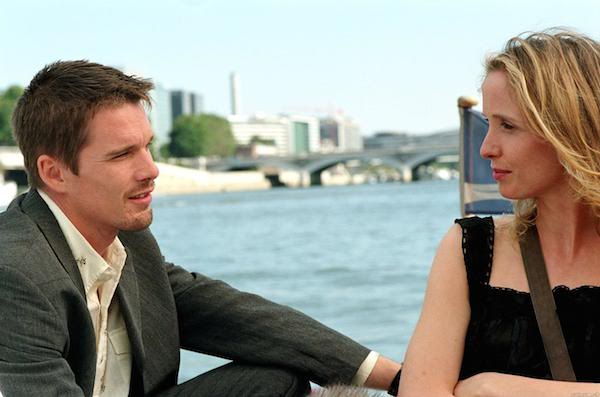
Jesse & Celine
I have just recently joined the Writer’s Team for FilmInquiry. My first assignment was an easy and also an enjoyable one — Favorite Couples discussion. This was a group topic for all writers about who was their favorite on screen couple. I touch on why Jesse & Celine have some sentimental value in the article, and I’ll elaborate a little more here as to why.
As a Honeymoon excursion, we followed the footsteps of Jesse & Celine’s journey through the locations of Paris from Before Sunset. This was back in 2006, just a couple years before the world of smartphones took over our lives. We pulled up a map on the internet of locations in the order they appeared in the movie, downloaded the actual movie to my iPod (yes, iPod, that itsy bitsy thing), and used it as our guide. We stopped and had some coffee at La Pure Cafe and hit the majority of the locations. We would have finished the entire movie, but, spoiler alert, you cannot visit all of these locations in 1:30. We were going about it for an entire day, and saw some wondrous, off the beaten path sites. When it started getting dark and we started getting lost, we decided to pack it in. You fooled us, movie magic! We had made it through about 3/4 of the movie, so that was enough for us. The last location was Celine’s apartment, and I doubt they’d want some foreigners hanging around anyway.
Last year my wife was chosen to be a contestant on the Jeopardy game show. The application process was lengthy, and she had to provide a long list of anecdotes that were interesting enough to discuss with Alex Trebek on the show. Long story short, because of the way the taping process went, I knew that the Before Sunset story was going to be her anecdote. Then, Andrea and I were both surprised when Alex asked her one of her other stories. She gave a good, funny answer, and the show continued. I was a little bummed, because that story was special to us and I was hoping it would be shared with the world. Fortunately, SHE WON! So she was able to come on for another day. Her second day anecdote was the Before Sunset story. That made it all the more special. Unfortunately she did not win the second game, coming in second, but we received a nice bonus last year and memories to cherish forever.
Besides, how can you choose anyone other than Jesse & Celine? Seriously, people!
Back to FilmInquiry, I decided to write for them because I could write some thoughtful, longer form essays. These are the types that won’t fit here and are not Criterion specific. The first one will be about the French film movement of Poetic Realism. The timing couldn’t be better, as the next Criterion I’ll be posting here is Jean Renoir’s A Day in the Country, which is the quintessential Poetic Realist film. The first post will be up to 1935, and then there will be a second post that covers until the war.
I’ve done a good bit of scholarship on French Film, so this could become a lengthy series about the entirety of French Film. Eventually I would like to cover the war years, and I have already worked extensively on Resistance Films. And being a Criterion fan, I’ve seen my share of French New Wave films.
This will not be the only topic, but it seems like a good first start. I’ll continue to talk about these postings here and will permanently archive them in the Essays Section.
I also have another something coming out soonish for Rupert Pupkin Speaks. Brian has been working on his 2014 Film Discoveries posts for quite some time, and will shortly be switching to a new series. He has shared his plans with me and I’ve already submitted my first piece. I won’t spoil the surprise, but I’ll say that his plans align very closely with the type of stuff I’m doing, so it is not terribly difficult to contribute for him. I expect to be involved in the entire upcoming series, and not just this next post, so expect more to come. What I like about his site is he simply celebrates film, and looks to highlight the stuff that’s not canonized (like, ahem, here). So I’m excited to see the direction Brian takes.
Tokyo Drifter, Seijun Suzuki, 1966

Of the films that Seijun Suzuki would make for the Nikkatsu studio, Tokyo Drifter was one of the wildest, audacious, and visually stunning, yet it was also one of the most incongruous for both Suzuki and Nikkatsu. It was a bold visual statement that happened to also be a complicated yet predictable action film.

Intro
The opening is in black and white, with thugs beating up Tetsu, the hero, who is trying to make a clean break from the yakuza. They leave him bloody and beaten in this depressing, black and white wasteland. Tetsu picks himself up, finds a toy gun between two rail cars that happens to be in color, and calmly says “Don’t get me mad.” From here we leave the old world, the black and white world, for a world that is full of vivid and at times overwhelming color.
The plot is almost unnecessary and at times it is nearly incomprehensible. Rather than bog us down in details, the plot is basically a way to transition from one action sequence to another. They skip ahead in time rather than wade in exposition. We know that there are rival gangs that are trying to get over on another, and Tetsu is caught between them. He becomes such a fearsome enemy that all the gangs target him, yet he is able to elude them. Always. He is the Tokyo Drifter, the ultimate badass, a killing machine that cannot be caught, contained, and of course, cannot be killed no matter how hard they try.

What separates Tokyo Drifter from all the other Nikkatsu teen films that were coming out during this period is the vivid visual style. Suzuki uses flamboyant colors whenever he can, usually loud and bright colors, the types that were being used in pop art –- purples, pinks, yellows, blood reds. Even though the sets are just as unrealistic as the plot, they make this for an aesthetically pleasing and thrilling ride. You can turn your mind off, get lost in the eye candy, and root for the hero to triumph over his enemies.
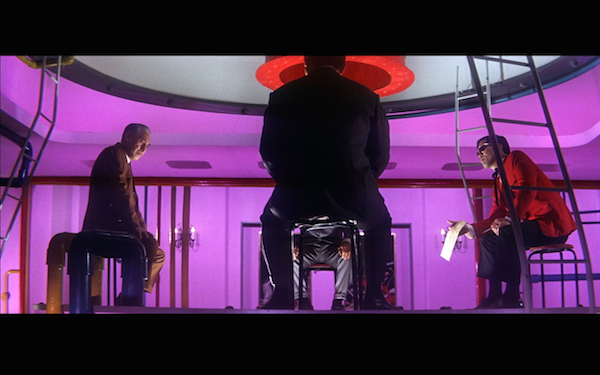
Enemies plotting to take down Tetsu
The rival gangs and their real estate shenanigans are the embodiment of evil. They claim that “money and power rule now. Honor means nothing.” They have no redeeming qualities whatsoever, and exist completely as flattened villains. This works as a way of hero worship. As bad and bumbling as his enemies look, Tetsu just looks cool, calm, and elevated by comparison. In one scene he takes on multiple opponents, which is odd given that this is a yakuza and not a samurai film, but the choreography is reminiscent of how Zatoichi dispatches several enemies at once. You have to suspend enough disbelief that these people wouldn’t be wise enough to just take a few steps back and fire their guns at Tetsu. This is not a realistic world.

In several instances the style resembles that of a Spaghetti Western. There are long shots showing Tetsu drifting at some location, and his coolness is shown in close-up wearing his sunglasses and dripping in sweat, just like Sergio Leone was shooting Clint Eastwood around the same time.

The pop song
Another similarity with the spaghetti western is that the hero has a theme song, but rather than it being scored by Morricone and played as background music when the hero enters the frame, it is actually sung or performed several times in the film. He is introduced as the Tokyo Drifter by an adoring female singer, and the song takes on several other forms throughout the running time. At one time he sings it himself, and another time he whistles what is by that time a familiar refrain.
Much of what takes place in Tokyo Drifter can be dismissed as style over substance with a brainless heroic plot, but there is a message to be had. It is no coincidence that American GIs are at the center of a bar fight near the end of the film. They are abused in this fight, and they react with a silliness that was probably stereotyped for Americans at the time. It may not be as explicit as other films, especially Gate of Flesh, but Suzuki appears to be lamenting the modern world that the Americans have created since the war, with their values of money over honor.
This is one movie that cannot be spoiled because it is completely predictable. It is difficult to criticize it for being ridiculous and over-the-top. Is that okay? Can we excuse this one for being silly, while we condemn other poorly written films? Yes, I think so, because this one has no intention of being anything other than pure fun. It is not aiming at literary high art. It attempts only to be escapist and bedazzling, and on that level it succeeds.
Film Rating: 7/10
Supplements:
Seijun Suzuki and Masami Kuzuu – This is a 2011 interview with the director and Assistant director. Suzuki saw this as a pop song movie, which it was. In some ways it could be considered a forebear to the music video. He said that they did not put as much thought into it as we might expect today. They were on a quick production schedule, so they discussed shot selections the night before. Their intent was to take the script and make the mundane seem interesting. Suzuki focused exclusively on style, and did not get much funding because his movies were not expected to be hits. He thinks that because they did not have money, they were able to get more creative. The vibrant colors were intended to highlight the pop song.
He denies being influenced by westerns, even though he did watch and admire them. This is one area where I think you have to take his denials with a grain of salt If he grew up watching westerns and this film ends up being full of similarities to the genre, then he was undeniably influenced by them, whether he realized it or not.
The film production revolved around star system. The studio intended to make Tetsuya Watari a star, and that is another reason why he was portrayed as heroically as possible and received flattering shots and poses. They even reshot scenes to heighten his presence.
The studio was against his films, especially this one because they too weird and surreal. The first version had a green moon in the final scene, which the studio made him reshoot, again making Watari more prominent, which he obliged. ‘What else could he do?’ he asks, laughing.
Seijun Suzuki – Here is was interviewed as part of a career retrospective in 1997. He started as a contract director doing B movies before being given the opportunity to make features, which is when he started making innovative genre films. He could not refuse too many scripts, and really why would he since they were all pulpy entertain films anyway? There were no perfect scripts, so he simply changed them as needed.
He tells some funny stories about Watari. He had orders to make him a star, but the actor was not experienced on the set. Many times he had trouble remembering his lines, and sometimes an AD would have to sit outside of the frame with a broom anf hit Watari in order to make him remember his lines.
Criterion Rating: 5.5/10
Top 20 of 1986

1986 was a good year. It gave us one of David Lynch’s finest, the best of the Alien franchise, and a lot of good smaller films. Some that flew under the radar back when they were released, like Manhunter and River’s Edge, have achieved cult status. The same happened with Demme’s Something Wild, and while I appreciate some things about it (especially Liotta!), it did not make my list.
I don’t consider the 1980s as one of the best decades for French films, but there are some good ones this year. I included Jean de Florette and Manon of the Spring together on the list because I think of them as one long movie, although the first is the best.
There are three Dennis Hopper movies on this list. I doubt that’ll happen again, ever.
1. Blue Velvet
2. Aliens
3. Stand By Me
4. Castle in the Sky
5. Jimi Plays Monterey
6. When the Wind Blows
7. Hannah and Her Sisters
8. Le Rayon Vert / Summer
9. Down by Law
10. Platoon
11. Jean de Florette
12. Manon of the Spring
13. The Sacrifice
14. Manhunter
15. River’s Edge
16. The Name of the Rose
17. The Fly
18. Hoosiers
19. Mona Lisa
20. Ferris Bueller’s Day Off
Some near misses were: The Mission, The Color of Money, Sid & Nancy, and Something Wild.
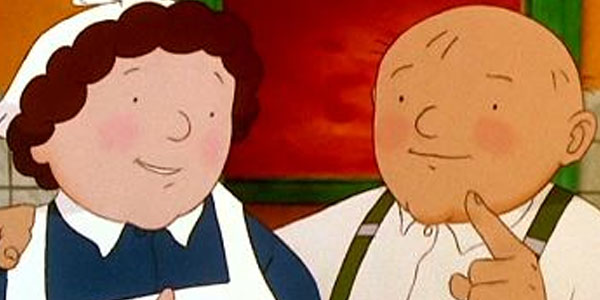
My Winnipeg, Guy Maddin, 2007

People can be extremely protective about the definition of a documentary. There are some purist that insist that the only real documentaries are cinema vérité, where the camera is a mere fly on the wall and the directors do absolutely nothing to obstruct real life from happening. Of course people have been testing that definition for nearly 100 years. Robert Flaherty is famous for casting actors and staging the action, yet his documentaries like Nanook of the North and Man of Aran are seen as revolutionary.
While many have stayed true to the essence of the documentary, the envelope has continually been pushed over the years. Errol Morris broke a major rule by actually reconstructing real events for The Thin Blue Line. Today the definition of a documentary has been stretched even further. With My Winnipeg, Guy Maddin did not so much as push the envelope, but tore it up into little pieces, ate it up, and regurgitated it. And it is magnificent.
First, let me get a disclaimer out of the way. Guy Maddin is not for everyone. I had seen two of his films previously, The Heart of the World and The Saddest Music in the World. In both I recognized the talented craft of a filmmaker who had studied his film history, especially black and white silent film. These films were a mixture of silent film with David Lynch. I preferred “Heart” over “Saddest”, respected both and loved neither. They were intriguing experiments and not much more. Despite the accolades, I skipped My Winnipeg until now.

Winnipeg!
Another disclaimer, I love documentary and could care less about the purity. I love Flaherty, especially Morris, Steve James, Berlinger & Sinofsky (R.I.P.), and everyone in between. If someone wants to experiment with form in order to make a point, whether for the purpose of art or revealing a truth, then I say go for it. One of my favorite documentaries of the last several years is Exit Through the Gift Shop, which may be a complete farce. It has some truths, because it talks about graffiti artists whose work exists, but we ultimately do not know what is truthful. We may be the subjects just as much as those on screen. The same could be said with Guy Maddin’s documentary.
My Winnipeg is both a love letter and hate letter to Maddin’s home town. Ultimately it is a little bit of both. He loves the uniqueness, the absurdity, yet hates the cold, the monotony, and how it reminds him of the symbolism of his childhood, such as the furs, the forks, and the lap. Don’t worry if that last sentence doesn’t make sense. It doesn’t make too much sense in the film either.
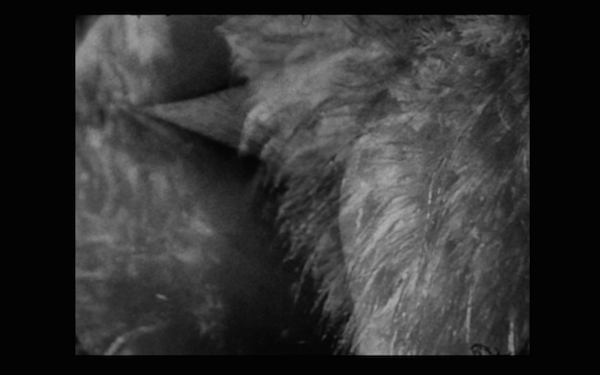
Fur dissolving into Lap
The film is rooted in Maddin’s own life. He recreates his childhood using actors to play his mother, his dead brother, and even his dog. They stage much of it at his recreated childhood home at 800 Ellis. Since his father died, they pretend that his body was exhumed and buried in the living room.
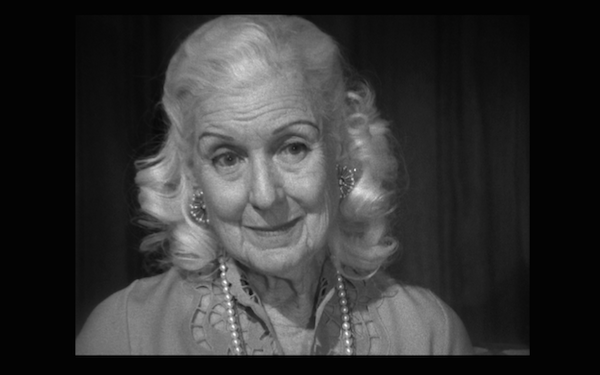
Mother
Maddin provides the narration, which begins with him riding a train through Winnipeg, and the voice is his own reflection of the city. As he narrates in his monotone voice, he intersperses archival footage, maps, quick shots of furs, laps and forks, with scenes of him trying to stay awake on the train. In this manner, the style is similar to the other Maddin films, with nods to silent films (weird title cards), quick dissolves between different types of footage, grainy film, shaky camera work, and the scenes cut back and forth from the train to his home, to the stories of his childhood and of the city. This is not like any other documentary.
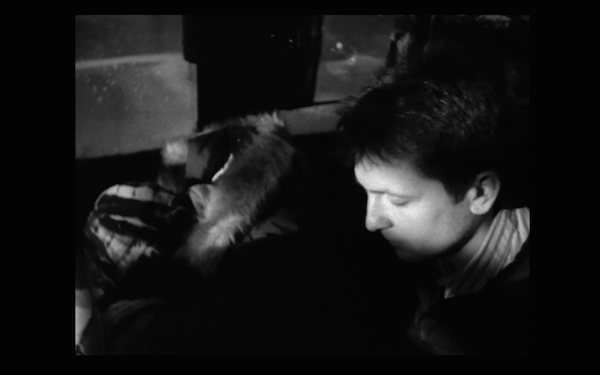
Sleepy on Train
It is immediately apparent that Maddin is playing with the truth, not just of his own life, but the entire city. He states some facts, one of which is that Winnipeg has 10x the sleepwalking rate of any other city. Of course that cannot be true. How is it even measurable? Yet this “fact” plays into his train-riding reflections of the city that in many respects resembles a dream world. He also claims that Winnipeg is the coldest city in North America. This is partially true depending on how you measure. It is the coldest large city. There are a few towns in Nunavut that would blow Winnipeg doors off. Maddin’s intention, however, it is not presenting an absolutely factual representation of the city. How much fun would that be anyway?
As he ventures away from his own history, he looks deeper into the city. “Winnipeg!” he says, as he introduces another absurdity, like not being allowed to keep any old signage. All the old signage is kept in the signage graveyard. He talks about a TV show called Ledgeman, where every episode has someone standing at the edge of a ledge, and every show ends with a suicide. Is that real? You can easily Google it to find out. If not real, then what is Maddin trying to say about his city? The TV show is not real, and I think this is part of the hate letter to his city, the fact that people would be entertained by people leaving their city in one of the most gruesome ways imaginable.

The partially demolished MTS Centre
There are other tidbits of “facts,” some more absurd than the last. He talks about the MTS Centre, or the MT Centre with the S flickering on and off so that it really says “empty center.” This was the hockey arena, but has become a betrayal because Winnipeg’s market could not sustain an NHL hockey team, so it was demolished yet stilled fielded a team called “The Black Tuesdays” that consisted of former players aged 70 or older, who played hockey amid the wreckage, sometimes with the wrecking ball actively destroying the arena. Maddin also claims that he was born and raised in the Centre. He was nursed in the wives room, and loaned out to visiting teams as a stick boy.
Some of the above paragraph is true, some embellished, and some outright lies.

Finally we get to the horses, the lovely and beautiful horses. I am not going to delve into this story because it is such a terrific scene and needs to be seen without description. This scene also has a little bit of truth, a little bit of embellishment, and of course, some lies.
Some events seem to be absurdist revisionist history, but are absolutely true. That’s part of what is gorgeous about this documentary. Not only is it engaging and fascinating, but it is a mystery. One could spend hours trying to fact check the documentary, and some probably have, and still could not tell the entire truth from the lies.
There is one telling line near the beginning of the film. “Everything that happens in Winnipeg is a euphemism.” Of course this is not literally true. Plenty of true things happen every day. Perhaps everything that happens in My Winnipeg is a euphemism.
Sometimes strange is truthier than fiction. I loved this movie.
Film Rating: 9/10
Supplements:
Cine-Essays: These are a series of short essays that Maddin refers to as little “points” that when finished point by point, will encompass Winnipeg. The topics are puberty, colours, elms, and cold. They are, very much like the film, indescribable and inexplicable, but just as much fun.
Guy Maddin and Robert Enright – This is a 52 minute conversation from 2014. He talks about the evolution of the project, and of course, about the factuality of the piece.
The documentary was commissions by Michael Burns for the Documentary Channel. Maddin was fascinated by trains and wanted to use this as the basis to show that Winnipeg is the “frozen hellhole” that we know it is.
He describes the mythologizing as “embedding the stories in emulsion.” It has been called Auto-Fantasia. The debate whether something is really documentary was mostly settled. He cites Herzog who presented “ecstatic truth.” Truth uninhibited is different than truth exaggerated, and that’s how he feels about My Winnipeg.
Even history is flawed because it is the victor’s viewpoint. If they look at the other side, it gets romanticized.
He cites influences, notably Chris Marker, although he does not want to compare himself to Marker. He was also inspired by Fellini’s I Vitelloni. He also references Detour because he cast leading lady Ann Savage as his mother. He does not make the connection, but one could connect the unreliable narrator of Detour with Maddin himself in My Winnipeg. He may be the least reliable narrator in any film.
Of course he does talk about which parts are real and fake, yet in a playful manner. He jokes that he would always get asked the same questions at festivals and screenings, so he challenged himself to always give a different answer. He does tell of some things that were real and embellished, but you can tell that he is answering carefully and could be giving different answers. Even as an interview subject, he is not the most reliable narrator.

If Day. Is it true?
”My Winnipeg:” Live in Toronto – This bit shows a screening at the Royal Cinema in Toronto with Maddin providing live narration. He felt nervous. He was told it is normal to feel terrible before and great during. He was surprised how he got big laughter during certain scenes.
Short Films:
Spanky: To the Pier and Back (2008)
This is a film about his dog Spanky, the same one he used as a replacement in the film for his childhood dog. Sadly, this turned out to be his last walk with the dog, as he died shortly afterword. What’s odd is that Maddin calls it an artless film, but I have to call him out on that statement. This is the most interesting dog walk to a pier and back that I’ve seen. Like his feature films, he uses a lot of quick cuts, and frenetic, sweeping camera motions. 8/10
Sinclair, 2010
This is a film that would be incomprehensible without the intro. Maddin was angry about some political, racist issues in Canada. Bryan Sinclair was an Indian, but had a treatable condition and was in the hospital, only to be found dead later. This film is the perspective of Sinclair in the waiting room. 5/10
Only Dream Things, 2012
This was developed for the Winnipeg Art Creative. He recreated the bedroom where he lived and used sounds that he remembers. The movie was dreamlike, with the typical Maddin style, only in color. The dreams themselves are more vivid, alternates between foggy dream state. In a way this film reminded me of someone who goes crazy with Photoshop filters or Instagram. 3/10
The Hall Runner, 2014 – This was one he was hoping to make into a feature but he did not get it off the ground. The film follows hall runner rugs with Maddin narrating. 5/10
Louis Riel for Dinner, 2014
Riel was a politician, and one of the founders of Manitoba. This was an animated short in which Louis Riel was a duck that could not be eaten. This one cannot be described and must be seen, and is probably my favorite short on the disc. 8/10
This was a treasure trove of riches and a nice, recent discovery for me. I expect this will be one of my favorite releases by the end of the year.
Criterion Rating: 9.5/10
In the Realm of the Senses, Nagisa Oshima, 1976

In the Realm of the Senses is shocking, vile, gruesome and absurd, all of which were intentional. It meant to provoke us (and Japan) away from our mundane social norms, like a lot of 1970s filmmakers were doing across the globe. With the Japanese fierce censorship code, this film is even more shocking, and it reveals something about their moral code given that it still has not been shown in its uncut entirety today.

Kichi and Sada
However disturbing, it is essentially a film about love. To most people, including myself, this type of love would be revolting and unfathomable. The woman has an unquenchable sexual thirst, while the man serves as a vehicle for her insatiable desire. As their relationship progresses, the ordinary becomes boring and she continues to ratchet up their activities. This makes for a more controversial and shocking film as it goes along, but it is fitting in how the plot develops and resolves.
When I first watched it, I found it shocking and amusing. That was also intended. Scenes such as when children throw snowballs at an older man’s genitalia add very little to the plot, and serve only to further provoke. The older man in question is only pertinent because he recognizes Sada, the lead character, as a former prostitute, although that could have been handled differently.
The sexual acts get more amusing, whereas the climax (no pun intended) and resolution are outlandish and way over the top. I was surprised to learn later that this was a true story. This one needed some time to settle and appreciate, and thanks to a good number of Criterion supplements, I received plenty of context and analysis.

Even though the description of the film would sound like pornography (and in a way, it is), the difference is that this was created and produced by professionals and has an artistry that lessens the stimulation. The set designs and photography are gorgeous, and even though the characters are doing unsettling things with their bodies, they are framed by an auteur. One such example is during the wedding scene. The man who had previously conducted the ceremony is doing some sort of celebratory dance. The camera pans upward so that he and his dance are the focus of the shot. It settles there for a time as he continues dancing, and then pans down to his feet where an orgy is taking place among the entire wedding party. Again, it is meant to shock and not titillate.
From here on out, I have to discuss the ending. Please stop reading here if you are spoiler averse.

Kichi Falling Asleep
As domestic, routine sexual activity becomes boring, Sada veers into sado-masochism territory. This is introduced through her earning her living as a prostitute, and encouraging her client to slap her repeatedly. She enjoys this so much that she brings it into her own bedroom. This leads even further, and she eventually gets fixated on choking. She likes the sensation when he is being choked during the sexual act. Even this eventually becomes mundane, and they have to go even further.
To understand Kichi’s behavior and final sacrifice, you have to understand a little bit about Japanese culture. They have a certain fascination with it, and they think of it as courageous to sacrifice one’s life for another. The most obvious examples of this ideology are the kamikazes in World War II. We also decorate our heroes, but in Japan it is different. It is truly honorable to die by one’s own desire.

The Final Sacrifice
When Kichi tells Sada that next time she should not stop with the choking, he is committing his final sacrifice. This is him letting go, giving everything he has in order to please who he loves, because there is nothing else within him that can satisfy her any longer. From a Japanese perspective, it is an honorable, if unconventional, way to die.
The ending is foreshadowed throughout the film. She has been characterized to have a violent streak, and had even threatened to cut off his manhood earlier in the film. There are scenes where she uses sharp objects, such as the time she holds a knife in her mouth, or the fantasy she has of cutting up Kichi’s ex-wife. Once she realizes that Kichi is gone, she simply takes what she feels belongs to her, his manhood. Again, this is shocking and grotesque, but in the context of their relationship, it is another act of love. She is taking her favorite part of his, and what’s left is her intense loneliness.
Film Rating: 8/10
Supplements:
Commentary: – This was a fantastic commentary from film scholar Tony Rayns, which was not expected. He begins by disclaiming that he will not be commenting on the sexual acts themselves, and he takes an academic approach to the film that was enlightening and refreshing.
He reveals that the popularity of artistic sex films in America prompted the project to start. Japanese had many sex films, but that’s not what they were going for. This was a true story, and the filmed version a lot more similar to the reveal events. Not every scene was true, of course, but the broad strokes of the plot were real.
They were a working class couple, not very educated, and they continue an erotic tradition that goes back centuries until Edo period. It stopped around Meiji period, where outside morals infringed on them. Because of this, In the Realm of the Senses is in part a political film, but that is difficult for Americans to tell unless they have a good sense of Japanese history.
Oshima drew on the trial transcript and the Sada story that was told after she was released from jail and published later. Oshima had made other provocative films, but this was his first from the female perspective. Of course it would not have made much sense to tell this story from a male point of view..
The sexual pleasure on film is all from Sada, and not from Kichi. He is never shown or heard actually in an orgasmic state. Even in the scene where his pleasure is shown in physical form, he does not moan or shudder. It is shown from her perspective and she takes the pleasure in his discharge, not him.
The true story is that after Kichi dies, the story becomes popular and people side with Sada. That is strange given what we’ve seen on film, but it is not too abnormal given Japanese culture. He gave his life for her.
Interviews:
Oshima and His Actors – This was a 1976 interview with the lead actors and Oshima for Belgian TV in 1976. Fuji does not actually speak in this interview, and Oshima does the majority of the talking, He says this was the first hard-core pornographic film in Japan. The other ‘pink’ films, as he calls them, were tame in comparison.
Eiko Matsuda, who plays Sada, speaks briefly and seems uncomfortable. She had an inferiority complex when she heard about the film. It helped her work through it, and so she feels it was her destiny.
Tatsuya Fuji – The lead actor was interviewed for Criterion in 2008.
French title was “Empire of the Senses” which is a better fit. He felt that his relationship was very much a dual, two-person empire, and their desires are their own. They should not be judged.
He said not many actresses could have taken such a role, not just because of the ability, but also the courage. Eiko had worked in underground theater and had a different perspective than most actresses.
Oshima created a relaxed and gentle atmosphere on set. He was very polite and let the actors be. Usually the set would be cleared for the sex scenes with just the actors and Oshima present.
He talks about how the sense of dying in Japan is different. They see life as a “a fleeting dream.”
Recalling the Dream – Even though this segment is under the Interview category, it is more of a documentary. It is a 40-minute segment that talks with a number of people who were involved with the film from behind the camera.
French distributor Dauman had imported Oshima’s Death by Hanging. He then moved from distribution to production, and it was Dauman that wanted an erotic film. Oshima was a leftist and it was thought that he would use sexual imagery as a political statement, but it turned out to be a conventional love story, albeit with political overtones.
They got around French legalities because they were technically French sets. All the film and negatives went to France. It was not developed in Japan during or after filming. It had been developed in Japan, the lab would be charged with indecency. It was unusual for the crew to not see dailies or any footage during the shoot. They just had to trust that Oshima was getting what he needed.
When the filmmakers and crew returned from France after the initial release, customs and police waiting for them. They had to screen the print to customs because it was a customs bond, which was the only time the film was ever screened uncensored in Japan. It was an audience of 50 people. For the Japanese release, they put a black bar on the entire lower part of the frame to censor the sexual activities.
Police wanted to go after Oshima for something and couldn’t. Instead they went after the script. The result was that Oshima apologized for stimulating the judge, police and authorities in the hearing. It sounds today like he was being sarcastic, but that was actually part of the deal.
Censorship is more liberal in Japan now, but they still cannot show the uncensored film. The biggest victory was being able to show the castrated penis uncensored.
Deleted Footage – Most of the scenes were simply extensions of existing scenes and were not too necessary. For instance, they extend a scene with her playing music at the inn to hide that they are having sex. The most notable deleted footage was that of the non-fatal choking scene and just after Kichi’s death. That scene is extended with Sada acting frantically and looking around, presumably to make sure nobody was around. They probably shortened that scene to make it seem more like love and less like a crime.
Criterion Rating: 8.5/10
Les Blank: Always For Pleasure. Final Thoughts.

Over the last month or so, I have tackled the terrific Criterion box set, Les Blank: Always for Pleasure. It consists of fourteen main features, countless supplements, and various other short films. It is a treasure of riches, as Blank takes us through Cajun country, up to Northern California, across the country to the Blue Ridge Mountains, up north to New England, back to California, Louisiana, and ending with a spiritual celebration in New York City. In the process we experience various different cultures, foods, music, and vibrant characters that are so far fetched that they cannot be made up. Les Blank’s world is about as far from the mainstream as possible, but it is about living life to the fullest, enjoying the simple things, and respecting traditions.
How can I summarize such a journey? I really cannot, as I’ve already written nearly 10,000 words as I rode along. You can read them here:
As a recap, I’ll look at the different types of topics that Les Blank explored, and how his vision was unique compared to so many others.
Music

Today it seems like most musicians and bands with a fan base have their own documentary. They are relatively easy to put together thanks to DIY independent film avenues and crowdfunding like Kickstarter. The larger the band, the larger the production, and the sales are nearly guaranteed. Most of these documentaries fall into one of two categories: the career narrative and the concert film. While some can be extremely good, such as somewhat recent documentaries on Rush, Metallica and Big Star, but they follow the same formula. They talk about the band’s origins, their success, breakup, and aftermath. They show concert footage and talking head interviews with anyone and everyone they can find. Many of these are inspired by VH1’s Behind the Music more than filmmakers like Les Blank or D.A. Pennebaker, and that’s a shame.
In many ways, Les Blank was a pioneer of the music documentary, and in other ways he was completely isolated from the genre, on his own island. He started with Dizzy Gillespie (which is not on the disc), and from there, he found some blues artists in Texas and Louisiana. He ventured further away from the Deep South, and covered artists that would not be found at the top of a music chart or featured on MTV. He wasn’t interested in only the musician, but also the way that they lived, the place and culture that molded them, and, perhaps most importantly, the affect they had on others. The one common thread among all of his musical documentaries is people could dance to the music. The people who experienced and enjoyed the music were just as essential to the documentary as the musician and the music.
Les Blank’s music work predated MTV, VH1, and Kickstarter, although it eventually caught up and he worked concurrently with the transformation of audio to video. He undoubtedly saw the musical documentaries from Pennebaker, Scorsese, Demme, and others, and you would think those would influence his style. Nope. From the first documentary on the disc, The Blues According to Lightnin’ Hopkins in 1968 to the final documentary, Sworn to the Drum, very little had changed. He had as much interest in how and where Hopkins grew up as he did Francisco Aguabella. He could not travel to Cuba to understand Aguabella, but if it were politically possible, he unquestionably would have. It is no coincidence that both of these documentaries are just about a half an hour long, feature the artist’s music as the soundtrack, show people dancing to the music, and explores the roots and ideologies that make them express themselves through sound.
Food

Again, Les Blank was a pioneer when it came to documentaries about food. Unlike with music documentaries, food via the mass media found a home almost exclusively on television. Blank probably had more influence than he gets credit for, since it was the Cajun cuisine that became a large part of cooking television. One of his subjects, Paul Prudhomme, even had his own short-lived series on Public TV during the nineties. Other personalities like Emeril Lagasse and Justin Wilson also became Cajun celebrity chefs. As Blank demonstrated, Cajun cuisine is delectable, and until the 1990s, was virtually unexplored as a mass consumer cuisine. Today you can get Cajun food everywhere, but not the type of food that Les Blank’s subjects cooked.
Food was such a central subject with his documentaries, that it comes as a surprise that only two of the films on the disc were specifically about cuisine. He explored garlic with Garlic Is as Good as Ten Mothers and Cajun in Yum, Yum, Yum! A Taste of Cajun and Creole Cooking. Despite it not being the sole subject, food is a large part of most of his documentaries. For musicians, he wants to know what they eat in addition to where they live. When he looks at cultures like Cajun or Polish-American, he spends a lot of time with their foods of choice. Even with Tommy Jarrell in Sprout Wings and Fly, he has a scene at the dinner table where they serve traditional southern food.
Les Blank loved food and it showed. In the supplements, we learned that he would run around movie theaters with aromatic dishes prior to a screening to add another layer of immersion to the experience. Can you imagine watching a movie about New Orleans while smelling red beans and rice? What about Ten Mothers while sniffing the strong scent of garlic? Even though I watched all of these movies without the hint of an aroma, I felt like I could taste and smell all of the food. And it was good …
Life

Even though each documentary had a subject, Les Blank’s films were just about the way people lived. Whether they were laborers in the middle of Texas, hippies in California, or country folk living in the mountains, we got to see what they did, how they behaved, and we heard their thoughts and ideas on life. As I reflect on this boxset, I think back to the early documentaries where he shows gorgeous landscapes, stunning sunsets, or just people wandering to and fro. People fascinated Blank, and that fascination was not restricted to his subject. He was enthralled by people running in a field just as much as he was a crazy actor arguing with a director (from Burden of Dreams about Herzog and Kinski, which was not on the set), or an old musician talking about playing baseball in the fields as a kid.
Food and music were just two examples of the many outlets people found to enjoy life. The Maestro dedicated his life to painting hundreds or perhaps thousands of pieces, not for economic benefit, but for his own passion. Blank loved to show people that were proud of something, whether it was a distinctive physical imperfection like a gap between two front teeth, or people who tried to compete with each other by wearing the best costumes at Mardi Gras. He showed people having a good time however they could. It doesn’t matter whether people were poor and lived in small Texan towns, or if they were doctors and lawyers that wanted to dance polka for a week, there was a smile on their face. If a nagging tooth gets in the way, then just pull it out and enjoy life.
Thanks Les Blank for showing us your world.
Box Set Rating: 9/10


 Criterion Close-Up