Category Archives: Film
The River, 1951, Jean Renoir

“The River had it’s own life, fishes and porpoise, turtles and birds, and people who were born and lived and died on it “ – Older Harriet
With The River, Jean Renoir is portraying two Indias. The native India is one of mystique and mystery to a westerner, but also one of serenity and a dedication to tradition. It is clear that he has fallen in love with that India (and he would later admit as much). The other India is the white upper class, post-colonial India, which Renoir may identify with as a westerner, but he seems to have mixed feelings about this India and portrays the characters as lost and confused.
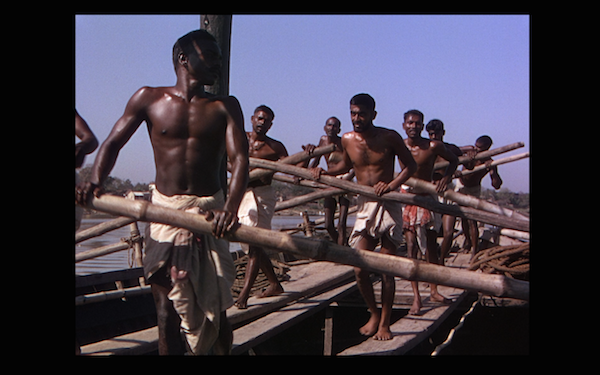
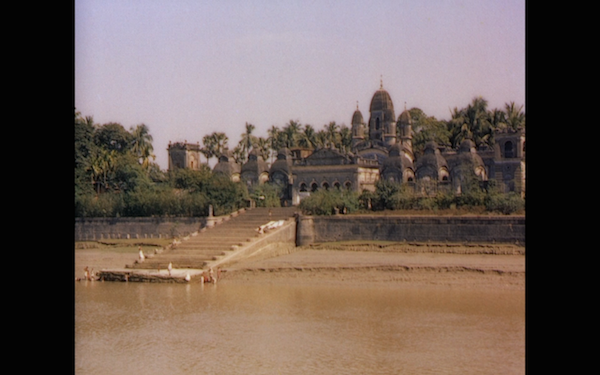
Renoir uses documentary footage to show the real India and how the people live around the Ganges. In narration, we are told about “the animals and the people who lived and died near it.” We see people working on the boats; we see playing children descending stairs that reach into the river; we see people relaxing along the banks. The river is not only a place for sustenance, but it is also a place for escapism. The river is integral to the lives of the locals.

The Snake Charmer
As for the English family that serves as the protagonists, they stay at arms length from the culture at which they are occupying, yet they are not disdainful. They respect and appreciate the traditions. The father prefers to walk through the bazaar on his way home and haggle over merchandise even though it is out of his way. The younger boy is fixated on snake charmers and wishes to learn their secrets. The English girls and Captain John are less attentive of their surroundings, and more concerned with their own distractions and affairs. They are “coming of age” in their own way while the river and the culture are relegated to the background.
The film has a great deal of voice-over narration, from Harriett, the English child protagonist, reflecting on her story of her first love presumably as an adult. It is her narration that we see both Indias, her insular version and the real one, yet she is educated and enamored by the true India and the magnetic lure of the river. This could mean that as part of her coming of age, she later came to an education and understanding of how special her surroundings really were, and how much the river influenced her life.

Harriet looking at John.
The primary white protagonists are Harriet, Valerie, and Captain John, and they form a sort of love triangle. Captain John has only one leg and is taking refuge in a foreign land as a way of escaping, a houseguest of their neighbor, Mr. John. He quickly befriends the family and the young girls. Harriet and Valerie both develop a crush on him, although they pursue it in different ways. Harriet is far too young for John, and hers is more of the fleeting girl crush. Valerie is older, who is not one of the family, but as an only child of a local businessman, she spends much of her days with Harriet’s family. She pursues John as a form of game, and she even toys with him and his affliction In one cruel scenario, she encourages John to play a game of catch and causes him to injure himself. Whether or not her heart is really into the affair is up in the air, but there is no doubt about Harriet. She is enamored by the visitor.


The white family has Indian connections. Dr. John has a mixed race daughter, Melanie, from a deceased Indian wife. Melanie serves as the mechanism for introducing Indian culture into the film, including a lovely fairy-tale diversion into the background of the God Krishna. Melanie also represents the contrast of both cultures. She has an English-centric upbringing, but as she gets older, she embraces her native culture. She even insists on wearing a Sari permanently. Bogey, Harriet’s younger brother, has a young Indian friend who encourages his foray into Indian culture and will be present for a later, game-changing scene.

The Girls
These younger characters are all lost in a foreign land. In this way Renoir seems to be contrasting the privileged white class against the comfortable locals. Harriet is lost in love, which is a fruitless pursuit given the age difference. Valerie is lost in herself, and is more capricious as a teenage, only child, yet that does not seem to be an aspect of her person that she is proud of. Captain John is completely lost. He is coming to terms with his loss of a leg and being less of a man after the war, and has wandered from place to place, unsuccessfully trying to find somewhere he belongs. The least lost is Melanie, although based on her multi-cultural upbringing, she could have been portrayed as being the most confused. Even though in one sequence, she says to her father “someday I shall find out where I belong,” but she appears to have found it. She is resolute in embracing her native culture, while still embracing the love for her father and friendship with Captain John. Even though she is not squarely placed within the love triangle, it seems most appropriate that she end up with the visitor.


The heart of the movie is when the Indian traditions are shown. Here Renoir slows down the pacing and backs away from the narrative. It shows the real India, while also fragmenting the movie. The foolish meanderings of the young girls and their rivaling affections for Captain John seem to be insignificant compared to the beauty of the culture around them, which has been around for thousands of years compared to the teenage years of Harriet and Valerie. The previously mentioned Krishna story and the Hindu Festival with 100,000 lamps are when the film is the most pleasant, relaxing, and the most beautiful. Even though the coming of age stories are interesting, they pale compared to the story of the real India that Renoir puts so much care and love into showing us.
It is worth mentioning that Satyajit Ray and Subatra Mitra worked as Assistant Directors on the film. They were undoubtedly influenced by the work, and even though their later work would be unquestionably Indian, you can see some of the pacing and the mixture of documentary footage with narrative in their narrative films. I can see a lot of similarities between The River and The Apu Trilogy. The Renoir film is worth praise in its own right, but it also deserves credit for influencing the career of the man who would be called “The Father of Indian Cinema.”
Film Rating: 8.5/10

Supplements
Jean Renoir Introduction:
The idea came to him when he was reading book reviews. He saw a glowing review of a book about India. He read the book and was convinced. All of the studios rejected him, thinking that a movie in India required tigers, Bengal lancers, or elephants. He then met an Indian florist that wanted to get into film. It was difficult at the time because Europeans and Americans did not understand Indian issues, so they had to film India through English eyes.
He heard about Rumer Godden, who was English but was born and lived in India. Renoir acquired the option before they met. They flew to India to make sure it was acceptable to shoot there, and Renoir was bowled over. He loved the country.
Martin Scorsese: 2004 Interview.
He went to movies with his father during his childhood and he describes this as one of “the most formative” experiences he had, and he compares it to The Red Shoes as the two best classic films in color. It was the first Renoir in color and the first Indian film in color.
India had a terrific canvas for color primarily because of the vegetation on the bank of the river. Many of the scenes he thought were reminiscent of a watercolor painting by Renoir’s father. Renoir apparently took a long time to arrange shots in a certain way, so possibly that was because of his father’s visual style.
Around the River: 2008 documentary about The River by Arnaud Mandagaran.
In a 1958 biography, Renoir called The River the favorite of his films. After Rules of the Game failed, he left France, made six films in the USA and then RKO dropped him after the failure of The Woman on the Beach. He left for India in 1949.
Kenneth McEldowney, producer, talks about his experience behind the film. He was first looking at one book, then that author recommended The River. He found that Renoir had the rights although he was not going to do anything with them. Renoir’s only condition was that he get a paid trip to India to make sure he wanted to shoot there, and he fell in love. Rumer Godden had also written Black Narcissus, and hated that it was shot entirely in a studio. She wanted Renoir to shoot in India.
Satyajit Ray worked up courage to ask for Renoir at hotel reception desk. He told the famous director that he was a great admirer of his, and Renoir was very nice. Ray “pestered him with questions, but he was very patient.” Asked him about French films, his father, and just about everything he could think of. Ray told him that he would like to make a film and described Pather Panchali.
Alain Renoir – His father had problems with the screenwriters. They would write something, and then he would film something completely different. Most became infuriated with him. Rumer Godden was the exception because she knew the country and the culture. This was one of the few occasions that Renoir and the writer collaborated well.
As for the Indian elements, they were unquestionably Renoir. He saw Rahda dance and wanted to meet her. The role of the mixed race Indian was not in the book, but was invented to bring more of India into the film and cast Rahda as Melanie. They found from the previews that Captain John was not sympathetic and the children acting was not as strong, so they over-emphasized the cultural moments and river sequences, which I think turned out to be a good move.
Jean Renoir: A Passage Through India: 2014 Criterion visual essay.
Water was a metaphor for life in Renoir’s work, and this was quite a good fit for him. He had been criticized for not returning to France after the war, but after The River, Renoir considered himself beyond nationalism.
The River was always his favorite because it finally made him an international director.
At one ceremony for Ray, it was said that Ray owed everything to Renoir. The elder director scoffed and said he owed nothing to him, and that he was the father of Indian cinema. Ray’s reaction was not recorded, but he later named Renoir as one of his major influences.
Criterion Rating: 9/10
Top 20 of 1946
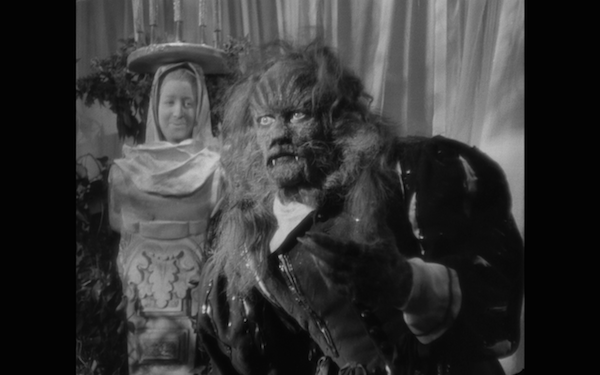
1946 is an important year for cinema as it was a post-war turning point both in America and internationally. With the war over, the tone of film changed. The propaganda pieces were mostly a thing of the past, but the pessimism and negatively lingered in the form of film noir, which really flourished in 1946. Even though I have a handful of noir titles on my list, there were a number near misses.
One could argue that 1946 was a watershed year for Italian Neorealism, and I have two benchmark films on my list from Vittorio de Sica and Roberto Rosselini. Things were returning back to normal in France, as Julien Duvivier and other filmmakers returned to their homeland. The top spot is occupied by one of the great French fantasy films, which was filmed during the tail end of the war — a remarkable achievement. Rene Clément worked as an assistant with Cocteau, but also released a landmark film of his own, Battle of the Rails, which could be seen as the first French resistance film. There would be more to come.
Finally, towards the tail end of the list, there are some familiar Japanese faces. No Regrets for Our Youth is significant because it showed the promise of a young filmmaker, Akira Kurosawa, and a lead actress, Setsuko Hara, both of whom would be prominent in the major Japanese post-war film explosion. Utamaro and His Five Women marked the return of a near middle-aged Kenji Mizoguchi, who would make some of his best films in the years to come.
One notable American film that is missing from this list is It’s a Wonderful Life, which a lot of people might consider blasphemy. It is a film I’ve seen numerous times and is a good film, albeit not a great film in my opinion. I realize that I am in the minority in that opinion, and it almost made the list anyway. This just happened to be a crowded year.
1. Beauty and the Beast
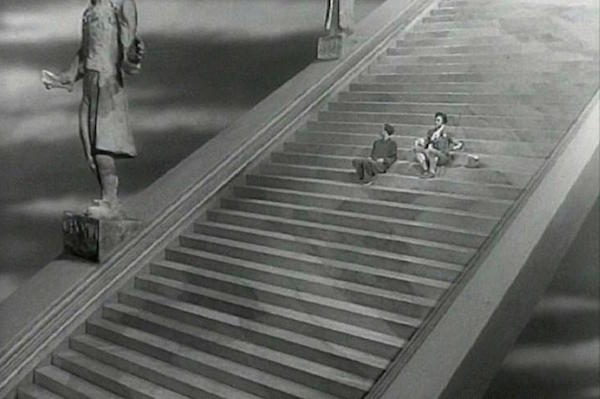
2. A Matter of Life and Death
3. The Best Years of Our Lives
4. Shoeshine
5. My Darling Clementine
6. The Big Sleep
7. Panique
8. The Stranger
9. Gates of the Night
10. Green for Danger
11. Notorious
12. Great Expectations
13. The Killers
14. Battle of the Rails
15. Paisan
16. Humoresque
17. Gilda
18. No Regrets for our Youth
19. Utamaro and His Five Women
20. The Postman Always Rings Twice
An Appreciation for Errol Morris

It was a strange coincidence that when I was reevaluating Errol Morris’ Gates of Heaven and Vernon, Florida, just a number of weeks after delving into The Thin Blue Line, that I caught wind of one of my favorite podcasts (WrongReel) dedicating half of an episode to Errol Morris. Rather than influence my own opinion, I proceeded with the write-ups and listened to the podcast afterward. Here is the cast in question, where they also talk about another film, The Seven Five that sounds up my alley.
It was an excellent episode, and just like I did with Salò (link), I am going to piggyback on their thoughts and add some of my own about his entire body of work.
First off, Morris is a master interviewer. This is particularly apparent in The Thin Blue Line and The Fog of War. Often in his documentaries (although not in his early ones), you can hear his voice in the background asking questions. He asks pointed, sharp, and sometimes difficult, penetrating questions. He basically put Robert McNamara on the spot to get him to admit to being wrong about his entire operation. One thing the WrongReel guys touched on was that Morris intentionally does not react to something a subject says. In that aspect, some of his subjects think he isn’t listening to them – quite the contrary. He just does not want to influence them one way or another, and by doing this, somehow they just talk aimlessly and in the process will reveal details they might not want be known. One example is a witness at one of the trials who basically incriminates herself. McNamara nearly does the same to himself, although he’s careful not to absolutely place blame on himself (he indicts the war machine).
The guys point out how Morris chose a couple of his subjects out of his own morbid curiosity. That hadn’t dawned on me before, but when you look at his filmography, it is absolutely and unequivocally true. Even Vernon, Florida, which is among his lighter and funnier documentaries, originated as a way of exploring people who blew up their own limbs as an insurance scam in “Nub City.” Those people wouldn’t talk to him without threatening or inflicting violence, so he talked to the town goofballs instead.
This morbid taste is more obvious with some topic choices, such as <emThe Thin Blue Line and Mr. Death. Other topics lean in a morbid direction. With the two politician films, he takes them down a path for them to revisit the atrocities committed during the war while they were in office. Even with A Brief History of Time, which is the least Morris-like documentary, he has to talk about the condition that put Stephen Hawking in a near vegetative state. Gates of Heaven is about people burying their pets. Errol Morris is without question into dark topics.
Philip Glass also plays a major part in the key works of Errol Morris — The Thin Blue Line, A Brief History of Time, and The Fog of War. It is difficult to imagine these films without Glass’ music. The documentary styles are a perfect marriage, and I have to give the editors credit for coupling these two styles for maximum affect. Glass also scores Godfrey Reggio’s The Quatsi Triogy and a number of other documentaries and fiction films, but at least for me, it is the Errol Morris documentaries where his music has the most presence.
Since I’ve seen just about all of them, here are my personal top five Errol Morris films.
4. A Brief History of Time
3. Mr. Death
2. The Fog of War
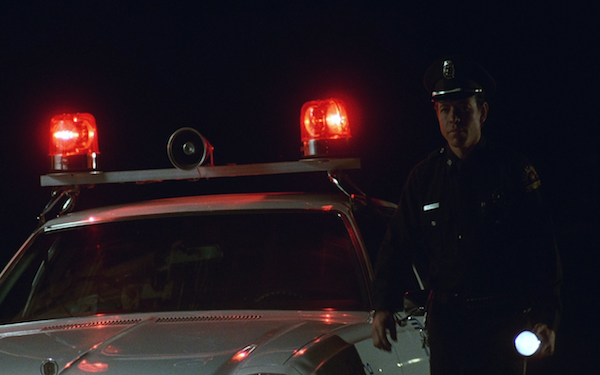
The top two are among my favorite documentaries of all time, so this was a close call.
I’ll end with a story. My father is a Vietnam veteran. If you’ve met many, you’ll know that they often don’t like to talk about their time in the war. My father and I have had some brief conversations about it over the years, but nothing substantial. My father also planted the seeds for my love of film. After being enamored by The Fog of War, I thought this might be a way of bonding with my father if we watched it together. I thought that maybe it would help him process some things, plus I know that he loves a good documentary.
My father watched it pensively. I could see him fidgeting as we watched. Afterward he conceded that it was well put together. When I asked if he liked it, he said it was okay. I pursued, and finally he said (without anger), “I just cannot believe the nerve of that asshole!” I learned later that the troops and protestors reviled McNamara back in the day, that he was the poster boy for what was wrong with the war. Even though I was decently educated about the war, I did not realize the venom towards this one figure. That was not a part of my generation. My father’s main reservation was that this was a mea culpa, only it was 30 years too late. His problems with the movie were the same as my praise, just from a completely different perspective. I respected my Dad’s opinion and have never brought the film or the war up again.
Fast forward a decade and I watch The Unknown Known, which is a similar format as the McNamara film only with Donald Rumsfeld as the subject talking about his time overseeing the Iraq war. Having lived through that debacle, I had a tough time taking anything Rummy said seriously. The fact that he was deliberately evasive and became semantic with the nature of the questions showed that he was the opposite of McNamara. This was no mea culpa, but more of a quagmire. It angered me more than anything because this was the same stuff the guy was doing in the White House. I respected the filmmaking, but I could not bring myself to “like” this film.
I found myself in a film discussion with someone who passionately loved the Rumsfeld doc. His argument was that this was the point. The circular logic that Rumsfeld expounded revealed his flaws as a human being, and that Morris was making light of that. That’s why he titled the movie The Unknown Known because, frankly, the phrase is illogical. This individual made a decent argument, but I was seeing none of it. Later I learned that my debate opponent was 20, so he was 10 during the high point of the war and in elementary school during its inception. He didn’t have the preconceived and impermeable perceptions of the individual. It dawned on me at that very moment that this kid was me ten years ago, and I was my father after seeing The Fog of War.
The way a message lands depends on the recipient.
Keep making movies, Errol.
Top 60 Adolescence and Childhood Films
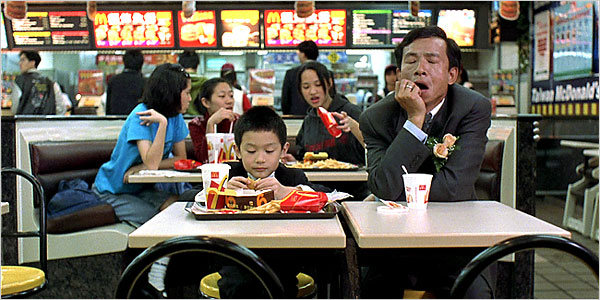
Sam over at Wonders in the Dark invited me to participate in a project to pick 60 of my favorite portrayals of adolescence and childhood. Sounds easy, right? Quite the opposite. I was happy to oblige as I live for lists like this, but it took some work to narrow down my favorites.
First off, what sort of criteria should I use? I was given freedom to formulate my list however I wished. Did I want to simply list the best films that have children in them? Did I want to list movies that are the best at capturing childhood and adolescence? Did I want to include movies only from a child’s perspective, or films where children are prominent yet not the protagonists? Or did I want to just list the best “coming of age” films?
None one of these options by itself would work for a lengthy list, so I went with a combination of all of the above criteria. In most of the list, you’ll find high quality films with children figured prominently. They are not all strictly “coming of age” films, but childhood and adolescence are at least key themes and they are integrated well into the film.
I tried to portray a mixture of genre and era as much as I could, but of course I ended up with a lot of classic and foreign films. I also found for some reason that both Louis Malle and Studio Ghibli figured prominently. I had no idea I was such a fan.
1. Yi Yi
2. The 400 Blows
3. Kes
4. Aparajito
5. Cria Cuervos
6. Lacombe Lucien
7. Mirror
8. Au Revoir Les Enfants
9. Mouchette
10. Zero for Conduct
11. The White Balloon
12. Amarcord
13. Dazed and Confused
14. Bicycle Thieves
15. Fanny and Alexander
16. Shoeshine
17. Tree of Life
18. Nobody Knows
19. Grave of the Fireflies
20. Twenty-Four Eyes
21. Closely Watched Trains
22. Breaking Away
23. Come and See
24. My Life as a Dog
25. Pather Panchali
26. The Last Picture Show
27. When Father Was Away on Business
28. To Kill a Mockingbird
29. My Neighbor Totoro
30. Cinema Paradiso
31. La Promesse
32. Life of Pi
33. King of the Hill
34. Sundays and Cybele
35. The Red Balloon
36. Au Hazard Balthazar
37. The Innocents
38. The Perks of Being a Wallflower
39. Alice in the Cities
40. Almost Famous
41. Y Tu Mama Tambien
42. Murmur of the Heart
43. A Tree Grows in Brooklyn
44. Let the Right One In
45. Night of the Hunter
46. We Are the Best
47. The River
48. Picnic at Hanging Rock
49. One Upon a Time in America
50. Beasts of the Southern Wild
51. Fish Tank
52. Spirited Away
53. Heavenly Creatures
54. Rebel Without a Cause
55. In America
56. The Children Are Watching Us
57. Daisies
58. Boyhood
59. Persepolis
60. Whale Rider

Redes, 1936, Emilio Gómez Muriel & Fred Zinnemann
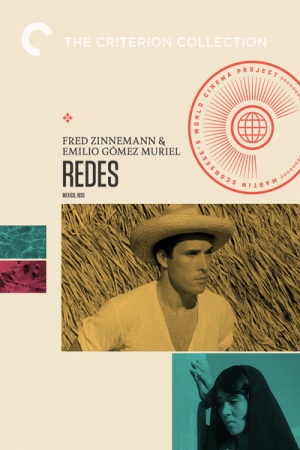
Sergei Eisenstein famously visited Mexico in 1930 to attempt a film project, ¡Que viva México! which fell through for a number of reasons. Despite his failure, he left an indelible mark on the film industry. Initiated by a strong left wing state, the film Redes was produced in the vein of Eisenstein. While it is unquestionably a work of propaganda, it resembles the Soviet montage, highlighting the strength and solidarity of the workers while using editing techniques to portray the upper classes in a poor light.

Miro
The film is set in a small fishing village and begins with tragedy. Miro’s young boy passes away because there was not enough work for him to feed him the child. We see a number of sullen and somber expressions from Miro as he deals with this loss, while a boiling anger towards the system lies close to the surface.

Flopping Fish.
The economic environment changes when the workers discover a bounty of fish, so many that there is enough work for everyone. The capitalist Don Anselmo makes sure to capitalize, and instructs his henchman to harvest as much as he can. “I just need people, boss,” he replies, establishing the reliance of labor in order for the prosperity to continue.
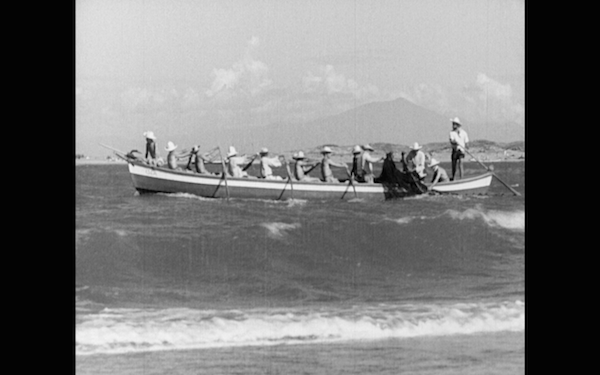

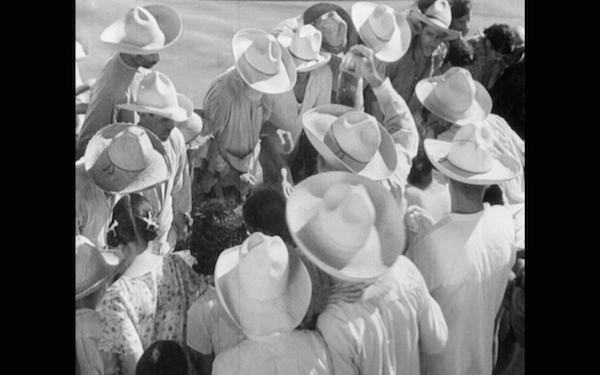
Miro works because he needs the money, but the memory of his child is not lost on him. He regrets that the work came too late. He along with others set forth into the water, and we see every stage of the process of fishing. Just like with Eisenstein, the film language celebrates the workers and shows their passion and ability. There are many shots that show the collaboration and cooperation it requires to mine these vast quantities of fish. The camera pauses on a muscular man pulling in the boats with the fish, highlighting the muscles that it requires. It is a well-done visual sequence that is shot documentary style and reminded me of Flaherty’s Man of Oran.
When the men are talking, one asks: “Who’s more stupid? Man or fish?” One response is a joke about women, but within the context of the movie, the question is valid. The men, at least the poor workers, are soon being exploited. When they return to the bosses with their massive fish haul, they are disappointed by the payment they are given. If this is the best they will get, then they will not be able to feed their families. They know the value of the fish, and some immediately figure out that they are being exploited to line the pockets of the rich.

One of the bosses reassures him that if they vote for him, he will clean everything up. Miro rejects him, knowing that he’ll say anything to get votes. “You know the big fish always win,” they say. From there, they decide to band together and unionize.
Even though the third act of the film is predictable, I’ll stop there. The last act is somewhat of a mixture between Salt of the Earth and an early Eisenstein movie. They use montage theory effectively. There is one scene where a significant incident takes place, which is followed by successive, quick cuts to stills of symbols, including currency, fish, and work, reinforcing the message that the workers needs to consolidate in order for their power to be felt.
The acting may not be spectacular, although the plot and message did not require them to emote. Just like, say, Alexander Nevsky, the ‘good guys’ acted and were portrayed as dignified, while the ‘bad guys’ were portrayed as greedy pigs.

Don Anselmo

Corrupt Bad Guy.
Just like with the Russian and Flaherty films that I’ve already referenced, the strengths were in the visuals. Paul Strand, a noted photographer, did a fantastic job at getting the most of the location shots, where Muriel and Zinneman choreographed the action with precision. The film’s visuals and location shooting look ahead of its time, especially for an international film.
Film Rating: 7.5/10
Supplements
Martin Scorsese Introduction:
This was a short introduction for a film that Scorsese had never seen before the project began. It had three fantastic, and it was a state sponsored and a progressive, leftist film. Paul Strand was a visual artist; Fred Zimmerman had worked with Robert Flaherty (and I noticed some similiarities in shooting style), and Emilio Gomez was comfortable working in the Mexican system.
Visual Essay on Redes: Kent Jones, 2013.
Redes was conceived Mexican and shot at fishing village of Alvarado. It was financed by the Ministry of Education and Carlos Chavez. It was conceived as a rigorous Marxist analysis of modern living.
There were conflicts between Paul Strand and Fred Zinneman. Strand wanted still images and was reluctant to shoot anything moving, but of course Zinneman wanted there to be some action. The result is somewhere in between.
Reviews were favorable, but the movie was not widely seen. The negative was subsequently lost. Zinneman said that the Nazi’s burned it, but that has not been substantiated. The WCF took it over in 2008.
Vernon, Florida, 1981, Errol Morris

I live in the southeast, so I’m used to southern culture. We have our share of “rednecks,” but aside from the accents and political leanings, much of the local flavor isn’t too different from any other medium-sized city. Because it is nearby, we visit Florida somewhat frequently as a getaway. It is often dubbed the “Redneck Riviera.” Sure, you get a lot of transplants, tourists, and there’s a large Latin American and Cuban population, but there are also plenty of homegrown locals. On every trip, we’ll encounter some weird local. Generally, the further south we go, it becomes less “redneck” and more multi-cultural.
The panhandle is a different breed entirely. I’ve only been there a handful of times, and it has more in common with Alabama and Mississippi than Tampa and Miami. Vernon, Florida, is just like any southern town out in the middle of nowhere. Having been to many of those, I can testify that there are some unique, backwoods characters, and many of them are not among the intellectual elite (although I do know some highly intelligent people living in small southern towns). Morris chose Vernon by accident, but many of the same type of people could be found in almost any southern town of the same size.

While Gates of Heaven had a narrative arc, it also had quirky and unique characters with stories to tell. Vernon, Florida sheds the narrative and focuses instead on the colorful characters in this small Florida panhandle town. To call the characters quirky is an understatement. They are sheltered, naïve, and passionate about their worldview, but it is far from metropolitan. The subjects that Morris interviews are far from the most intelligent bunch, and Morris seems to go out of his way to portray their ignorance. While at times these characters are humorous, at others their simple nuggets of wisdom are endearing.

Brain bowl guy.
“You ever seen a man’s brains?” asks one of the residents, randomly, and then goes into how they are contained within four bowls around the circumference of the skull (aside from “bowls,” these are my words, not his). “You are not a one track mind. You are a four track mind,” he says, and then he goes on to explain the thesis. Like many of the interviews, at first the reaction is ‘WTF?’ and as the diatribe continues, it keeps on getting more absurd. That’s the essence of Vernon, Florida. It is a lot of people saying strange, kooky, and dumb things.

Ray Cotton, the “therefore” preacher.
Even Ray Cotton, the preacher, is not immune to being taken to task. He is developed as a nice, honest guy, who decided to spread the word of the Lord for less money rather than take up a more lucrative profession. However, when he preaches, he is yet another source of humor. He begins by talking about the word “therefore,” and how Paul uses it quite a bit. He had to look up the definition of the word in Webster’s dictionary, and finds that it is a conjunction. He then has to look up “conjunction,” and that leads to him looking up other words. He does come around to a point, but he takes an extensive journey through the world of Webster in order to get there.

Henry Shipes, the Turkey Shooter guy.

Henry’s friends.
One of my criticisms, which is more of a minor quibble, is that Morris spends too much time with turkey hunter Henry Shipes and his friends. Henry has his quirks, such as when he gives a contradictory statement about whether to go after turkeys when there’s a hen present. He also has some more cinematic moments, such as when they go out on the boat to try to find a nest of turkeys. Compared to the remaining characters, he is the least interesting, and he does not say much for the town other than the fact that people hunt wild turkeys.

The Wiggler Guy.
There are plenty of other motley characters and they all share their own bit of warped wisdom. One of the most memorable quotes for me was a guy talking about Wigglers, who says, “I never studied no books about these wigglers. What I know ‘bout ‘em is just self experience. Uh, they’ve got books on ‘em. Them books is wrong.” There’s also a police officer, who frankly seems bored. There’s a guy who is boggled by the concept of jewelry, and another who pontificates on random things happening.
Errol Morris is, of course, an intelligent and well-educated individual. While he can be seen as exploiting these people for their simplicity, the joke is occasionally on him. In one scene, he interviews a couple about how they brought some sand back from vacation and put it in a jar. Over the years, the sand subsequently grew. “In a couple of years that jar will be full,” the man says. What? Sand doesn’t grow, so this initially looks to be another example of their Vernon stupidity. Morris found out later that there are certain types of sand that can absorb moisture and will gain in size, especially when moved to a different climate. There is another scene where a man calls a turtle a “gopher,” and initially we again think he is confused or just stupid. What’s not mentioned is that there is such a thing as a Gopher Tortoise. In his defense, Morris possibly knew about the tortoise and this may have just been a random comment that people picked up on. Despite the gopher comment, the gentleman’s speech about turtles is quite entertaining.
While it is enjoyable to meet these characters and hear their words of wisdom, as I noted, there is not a point of narrative. The film meanders and is basically a portrait of a small town with quaint, folksy people, who seem foreign to the art-house cinephiles who would see an Errol Morris documentary. It is an enjoyable way to spend an hour, but it does not compare with some of his best work.
Film Rating: 5.5/10
Supplements
Errol Morris: Interview from 2014.
Morris talks about the genesis of this project. At first he intended to film a documentary called “Nub City.” This was an area in Florida where they had the highest rate of insurance fraud, most of which were from people who blew off an arm or a leg in order to collect the insurance money – hence the “Nub” part of the nickname.
He was warned that “Nub City” at night because it was too dangerous. At first Morris found it not too dangerous, but fabulously weird. He interviewed some insurance fraudsters and for the first time in his life, he got beat up. In hindsight, “it was sort of unpleasant,” he says.
The real “Nub City” is Vernon, FL. Rather than risk life and limb, he instead just started talking to the locals and he found the characters engaging. This explains why the film lacks a subject, thesis or narrative. As Morris puts it: “I just love these guys. So I made this movie.”
This is the second film in the disc with Gates of Heaven, so the rating below is for both discs combined. Gates of Heaven is both the better film and has the better extras, especially because of the Les Blank documentary. While Vernon, Florida does not measure up, it is basically a second movie for the same price.
Criterion Rating: 8/10
Gates of Heaven, 1978, Errol Morris

Early on in Gates of Heaven, one of the interview subjects gives a quote that summarizes much of the film: “The love that people have for their pets is tremendous, something that is very, very difficult to explain.” As a pet owner for most of my life, I identify with this statement. When each pet has passed, it has been a difficult period –- almost to the level of losing a family member. For some people, losing a pet is worse than losing a family member.
At a recent film festival, we saw a short film about Cherry Pop, a Fort Lauderdale show cat with wealthy owners that lived during the 1980s. Her “parents” would buy her jewels, gave her a Rolls Royce, and spoiled her to high heaven. It was estimated that they spent $1 million on this cat. It was a neat little film with archived video footage from home movies, and I can think of fewer examples of someone loving a pet as much as this family. It was ridiculous that they spent all that money, but the feeling in their hearts was genuine. When they lost Cherry Pop, they were devastated.
The opposite is also true. There are many who see animals as packages of flesh with no real purpose. Since they are not human beings, they do not deserve to be memorialized or even treated humanely. These are the types who would raise no objection about rendering a deceased pet’s remains into a raw material.
Gates of Heaven is about this dichotomy. It explores the levels of which people love and care for their pets, in this world or the next, and those who think of them as garbage that needs to be processed somewhere. It is also about more than just the pets, but how people can turn these emotional connections into business enterprises, and whether they do so out of compassion or in order to line their own pockets.
The film begins with Floyd (or “Mac” as he goes by) talking about losing his Collie to an accident. Devastated, he wanted to find a piece of land to bury the remains of his loved one. When he found the land, he had a dream and eventually it led to the creation of a pet cemetery.

“Mac”
Mac is a man of compassion and his business interest is more about his love and respect for the deceased animals and the families who mourn them. He lambasts the rendering companies who have no respect for the deceased. There is another interviewee who talks about people being upset when a zoo animal’s remains went to rendering company. He admits that they lied and said that they buried them.
Mac realizes that there are more economic ways to maintain a pet cemetery, but he claims that his is “not a fast buck business.” He could have efficiently dumped a number of animals into the same burial plot and that would have likely brought him more profits, but it went against his moral code. Unfortunately, because he focused too little on the business aspect, he lost his shirt and his buried pets were forcefully evicted from the cemetery.
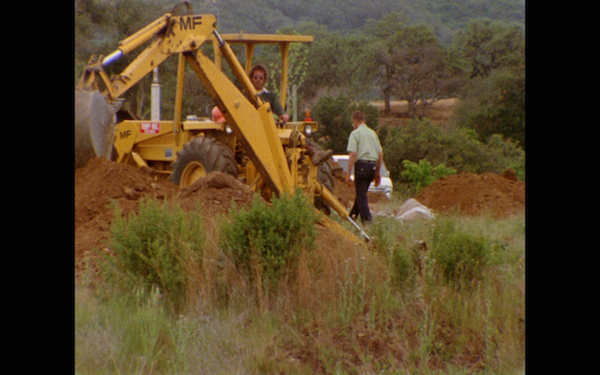
Pet relocation process.
Mac when talking about the failings of his business and any culpability: “The only thing I’m guilty of is compassion. And that’s all.”
These pets were transferred to Bubbling Well Pet Memorial Park. Contrary to Mac’s endeavor, Bubbling Well is a successful pet cemetery because it is built upon solid business practices.

Bubbling Well

Bubbling Well Memorial Service.
While the father and two suns that run Bubbling Well see it more as a business, does that mean it is exploitative? That is up to the viewer’s interpretation. There is one scene where a couple are putting to rest their loved dog Caesar. They are memorializing him with the patriarch of the business, Cal Harberts. He asks to see a picture of Caesar and compliments the dog for having such a gorgeous coat. He then talks about what great pets mixed breeds make. His tone is respectful and it comforts the mourning couple, but you have to wonder whether it is genuine. It could be superficial and a variation of what he says to every client, or he could have been playing to the cameras. Mac would share similar words, but we can imagine that he may emotionally empathize more with his clients.

Phil Harberts
Harberts leaves the operating of the business to his two kids, Phil and Dan. Dan dresses in 1970s, post-hippie fashion, and aspires to be a rock star. He admits that he partied during college, yet feels that he learned things and gives an odd explanation as to why, which shows that he basically did not learn. His brother Phil is his opposite. He has experience in the insurance industry and has good business sense. He compliments himself on his great memory and how it is necessary for the business that he uses it to keep up with all his veterinarian contacts. When he speaks, he is all either business or affirmation. He wants to even expand the business, and when talking about his father’s success, “he read the same textbooks as me.”
Phil is creative. He builds a “Garden of Honor,” which is a resting place for service dogs, whether they are police or seeing eye dogs, and they are buried for no price. Other owners can bury their pets in the same section, but at a higher price because of the prestigious land.
Bubbling Well still exists today. Here is a recent article the facility and its history.

Dan’s priority – music over Bubbling Wells.
Dan is neither Phil, Cal or Mac, and his appearance towards the end gives this documentary an extra quirk (although it has plenty, mostly from interviews of pet owners). He really is a slacker. We see him in his apartment listening to psychedelic music, presumably his own. He writes songs and longs to have them heard, but realizes that as time passes, that dream is fading.

Lady and dog singing,
The interviews with pet owners and snapshots of their interactions, like the memorable singing owner and dog, offer little to the narrative, but they are what gives the documentary its flavor. They recall the statement I began this write-up with, that people inexplicably love their pets. One lady says that she wants her pet buried because she believes they will be together again. In a sentiment that Mac would agree with, Mrs. Harberts says that the “at the Gates of Heaven, an all compassionate God is not going to say ‘Well, you’re walking in on two legs, you can go in. You’re walking in on four legs, we can’t take you.”
Film Rating: 7/10
Supplements
Werner Herzog Eats His Shoe, 1980, Les Blank

The bet was that Morris would not be able to complete Gates of Heaven or Werner Herzog would eat his shoe. This documentary is Herzog living up to his end of the bargain, with help from friends such as culinary goddess, Alice Waters, and of course the documentarian, Les Blank.
The documentary is in typical Les Blank style. It begins with upbeat music, photography that focuses on a weird object (Herzog’s walking shoe), and of course food.
After preparing the shoe Cajun style, and boiling it for 5 hours, he proclaims the shoe edible. Herzog says that he has survived Kentucky Fried Chicken so he can handle this. Does he eat the shoe? Sort of. They cleverly intercut the famous Chaplin shoe-eating scene from The Gold Rush. He does eat the shoe, but not the sole, comparing it to the bones of a chicken.
Back to the topic of this post. Herzog is proud of Morris for making the film. While eating the shoe is foolish, he is proud that it was a motivator.
Film Rating: 8/10
Herzog at Telluride: “You can make films with your guts alone.” This is a very short clip where he complements Gates of Heaven as a very fine film that was made with no money and only guts.
Errol Morris: October, 2014 interview.
Just like with The Thin Blue Line, Errol Morris proves to be an excellent interview subject.
He tells a funny story about how Douglas Sirk, a director that he respected tremendously, walked out of his movie. “This isn’t a movie. This is a slideshow.” And then he said, “There’s a danger that this film could be perceived as ironic.” What?
Morris doesn’t remember Herzog saying he would eat his shoe, and minimized the influence of that “bet.” He claims he was more inspired by Herzog’s films.
Wim Wenders saw a very rough cut, one that they were worried wouldn’t fit into the projector. He said it was a masterpiece. That was the first positive review. It was very encouraging of course. Siskel and Ebert followed suit and loved it. They were known to fight with each other, but in the case of Morris’ film, they fought about how good it was. They reviewed it three times and put it on best of year list. “Thank you, Roger. Thank you, Gene.”
This is a two-film disc with Vernon, FL, which will be discussed next.
The Friends of Eddie Coyle, 1973, Peter Yates

The Story of Eddie Coyle is a rough edged movie with stern and serious characters that are either acting out of desperation or opportunism, all the while taking advantage of everyone that gets in their way. Everyone has an agenda, and much of the movie is them taking slight steps to manipulate the situation to reach that agenda.
If there’s any doubt about how rough the movie is, it is quashed early when Robert Mitchum’s Eddie Coyle tells a story about putting his hand in a drawer so that nuns would smash his fingers. He has lived a tough life and circumstances have turned against him to where he’s looking at facing time. Meanwhile his “friends” are either running guns for him or robbing banks.


One thing that jumped out at me is the correlations between the uses of space. There are a few tense action sequences, but the remainder of the movie basically consists of people talking to each other at different locations. A great deal of it takes place in the outdoors in the stark daylight, with contrasts with the darkness within each character.

The colors are often vivid pastels, which are used effectively as a way to color the cars for each character. Even on an indoor set like the bowling alley, the bright colors give some vibrancy to what would otherwise be a dark location. They use a variety of locations for these conversations, such as near a riverbank, at a park, in the parking lot of a grocery store or train station, and various other locations. For all the underhanded activity, the template is bright and might otherwise be seen as cheery, but the characterizations and acting keep the film gritty.
Again, using spaces, they differentiate between public and private space. They show Mitchum disheveled at his home. This is a rare glimpse of his private life, but other than him having his shirt un-tucked, it isn’t altogether different that the public spaces we see. It is still brightly lit and he barely cracks a smile, even to his wife who he ushers out while he makes important phone calls.

There are a lot of dialogue scenes with people talking in restaurants, often with Coyle and Jackie Brown (Steven Keats) talking about setting up deals. The diner scene above is a rarity in that it takes place at night, but it still has the same bright lighting, and even adds color with the bright yellow menu reflected on the mirror. It almost appears to be an artificial sun that is hovering above them.

The outdoor night scenes are barely lit, showing emptiness and desolation. There are often long shots with cars driving at night where the only light source is the headlights. This emptiness correlates to the character’s struggles. Many of them are left out to try and are truly alone. They have no real “friends,” especially not Eddie Coyle despite the title. The stark night scenes are not used often and only in important, key situations (like the screenshot above that I will not spoil).

What separates The Friends of Eddie Coyle from many “heist” (if you can call it that) films is the pacing of the “action.” The scenes play out naturally and slowly. This begins with the bank robbery, with many quick cuts to show reactions, slight movements, and the mechanics of the scene. As the pace continues, an unsettling uncertainty sinks in. The slightest movement could make the whole thing go awry, and the viewers are essentially preparing themselves for something to happen. The same sort of pacing is used for the gun exchanges. There’s more action in these scenes, so there is a lot more cutting back and forth, occasionally broken up by characters interacting, and then cutting again as people move into position. Sometimes something climatic happens, while other times nothing happens. It keeps the viewers on their toes. These scenes are wonderfully composed and edited.
Here is where I’ll dip into spoiler territory, so if you have not seen this, you might want to check out now.
The title is meant to be ironic. Eddie Coyle has no friends. Dillon is the guy who seems to be his closest friend and confidant during the movie turns out to have the same motivation as Coyle and double crosses him. Coyle double crosses his other friends, beginning with Jackie Brown, and then he offers up the bank robbers as well – anything that will get him out of hot water. The cops, like Dave Foley, sometimes seem to be looking out for their subject’s best interests, but they are merely playing them. Despite the sacrifice that Coyle makes, it isn’t enough to get him his relief. Dillon makes a greater sacrifice and appears to get his relief, but we will never really know.

Hey Buddy, let’s go to a hockey game?
Often I try to read deeper into films like this to see what they say about society. The core of The Friends of Eddie Coyle is distrust. Everybody is out for themselves and you cannot trust them, whether you’re in a diner or at a hockey game. Could this be a statement on the Vietnam war that was going on at the time? Could it be related to the Watergate scandal that had just occurred (although to be fair, I’m not sure if that was resolved during the movie)? In this instance, I think there are no deep messages about early 1970s society. It is merely a slick, well-done and somewhat unique crime film, and there’s nothing wrong with that.
Film Rating: 7.5
Supplements
Commentary: 2009, Director Peter Yates.
He considers it among his three favorite films that he directed along with The Dresser and Breaking Away.
Yates talks quite a lot about the actors, which is not uncommon with Director commentaries. One of my pet peeves is that they rarely say anything negative. It’s not that I want them to dish on their stars, but I think there could be more substance to a commentary than just gushing about actors. Nonetheless, it was interesting to hear him talk about his cast, especially Mitchum.
Mitchum was the type of guy who didn’t like to discuss his performance in advance, but listens when shooting. He would then adapt accordingly. He wanted to conceive his own ideas first and go from there. Yates said that he was the consummate professional and very impressive. He worked on his Boston accent, and concentrated on holding himself steady to capture the downbeat aura of Coyle.
He said that Boston was very cooperative, letting them shoot in public places and shutting traffic down. Since there were so many public spots, this really made the film.
He considers the film to be the opposite of The Godfather. It was not glamorous or romantic, nor was it about mobsters. It was about morally bankrupt common criminals just scraping along.
This disc is particularly light on features for an upgrade. Other than the commentary, there are image stills. Those are nice, but not as substantial. I would have liked to have seen interviews or a visual essay. Still, because of the quality of the film and the transfer, it is a worthwhile addition.
Criterion Rating: 5.5
On the Waterfront, 1954, Elia Kazan

Waterfront Week was quite an experiment. This is not something I’ve done before but I’ll most likely do it again for important films as they come along.
Here are the posts from the week:
Kazan Naming Names – This is about Elia Kazan’s experiences with the HUAC and how the film is partly autobiographical.
The Great Performances – The film had arguably the best ensemble, and many (including me) would say had the greatest performance of all time. This piece talks about all of the major actors.
My Favorite Classic Movie – After a week of analysis, this is my summary as to whether this stands up as one of the greats of classic cinema.
Film Rating: 10/10
Supplements
Commentary: This is one of the rare occasions where I did not listen to the commentary for this release. The reason? I’ve already heard it. This is the same one from the older DVD. Of course it has probably been 15-20 years since I heard Richard Schickel and Jeff Young talking about the movie. I remember good things and it most likely enhanced my appreciation.
Martin Scorsese and Kent Jones: 2012 interview with the pair who had together made the documentary A Letter to Elia.
Scorsese had a connection with this period of American cinema because it reflected the world in which he lived and grew up. Other movies were still just generally correct. On the Waterfront and Kazan films captured the realism.
They talk about the how the performances moved them and, of course, the HUAC. The part that relates to Kazan’s testimony is the least convincing to Scorsese. He was not aware of the political situation when he first saw it, although he knew the paranoia and controversy from growing up during the time.
Elia Kazan: An Outsider: 1982 documentary directed by Annie Tresgot.
This documentary has Kazan primarily telling his own story. It starts with a house in CT that he acquired in 1939 through his acting. He then got another role, another piece of property, and became a director. He joked that his Greek background had taught him to buy land for security, and once he had that, he could take risks.
He talks about his origins in theater with the Strasberg school, calling it essentially human, rooted in psychoanalysis where people train themselves to be in control of their emotions. Objects are essential.
He reflects on his life as a Communist and the HUAC. He recalls the specifics of how he was voted out of the party (22-2). Afterward he had still been enamored with Soviet Union until the truth of what they had been doing came out, especially the German pact.
He says he was not pressured to testify, but instead had conviction. Solzhenitsyn’s and Kruschev’s books had a major effect on him. The experience changed his life and toughened him. Even though he was in pain from the alienation, his films got better after he testified.
”I’m Standin’ Over Here Now”: 2012 Criterion documentary that has interviews with a number of Kazan scholars and film historians.
He began his theater career with Thornton Wilder’s “The Skin of My Teeth,” yet later directed Arthur Miller and Tennessee Williams. One difference between he and other theater directors is that he would engage with the playwright’s on the creation of the play.
The first draft of anything resembling Waterfront was Arthur Miller’s “The Hook” about gangsters in Red Hook, Brooklyn. The studios got cold feet because of Miller’s communism. Miller left project.
Boris Kaufman was chosen as cinematographer. He had worked with Jean Vigo and others, and was chosen because they wanted images of realism. Kaufman and Kazan had a great rapport and cohesion with each other.
As for the allegory of the HUAC controversy and Kazan’s testimony, most people at the time did not make the connection. They say most people today do not make the connection because the time is past (Of course I disagree). Kazan said belligerently that it was about his testimony because he was proud. Budd Schulberg, the screenwriter, argued that it had nothing to do with either testimony, that it was based on a true story.
Eva Marie Saint: 2012 Criterion Interview.
Her routine during the film was that of a housewife. She would go home, make dinner, go to work, come back home, etc. Previously to the film, she and Brando had done improvisations before, but had not acted together before. She was shy about doing the love scene while wearing a slip on camera, but Brando took her aside and whispered “Jeff” – her husband’s name. It worked and she was relaxed.
Elia Kazan: 2001 Interview with Richard Schickel.
Kazan humbly calls it a wonderful screenplay with a wonderful actor, and that’s why it worked. It was a great experience for him and the closest he came to making a film exactly as he wanted.
He talks about the cab scene and how it has become so popular. He takes no credit. All he did was take the two characters in the backseat of a barely assembled set. They knew the characters and they made the scene.
Thomas Hanley 2012 Criterion interview with child actor from the pigeons. His story was interesting because he retired from acting and became a longshoreman. He was the real deal.
His father was killed and was no saint, but he was never sure why. During the emotional scene, Kazan irked him by suggesting his father was killed for squealing. This was before he did the “pigeon for a pigeon” scene, otherwise he would have tried to portray his character with more toughness.
His career choice was to go on the waterfront or enter a life of crime. He forged his documents, got his coast guard pass, and passed through the waterfront boards.
The reality on the docks were as portrayed in the movie. People didn’t squeal. People got killed. Mobster activity existed, but eventually they would rat on each other. Because of this double standard, now Hanley has no qualms with informing to police.
Who is Mr. Big? 2012 Criterion interview with James T. Fisher, author of On the Irish Waterfront, about the historical basis for the film.
Irish immigrants that came over in the 1820-30s had limited opportunities. Many worked on the docks out of necessity because of danger and it wasn’t a job in demand. They made it their own and achieved political power. Bill McKormick and his family controlled all the ports by early 20th century. McCormick came to be known as “Mr. Big.” People were taken care of as long as they accepted the system, which was not beneficial to them. They had low wages, danger, just as it was portrayed in the movie.
Father Phil Carey tried to achieve social justice for these employees. He received intimidating calls immediately and was warned to stay away. He was even intimidated by the monsignor.
John Corridan was an assistant to Carey who held similar convictions. He spent two years studying the waterfront. He understood the system, bosses, etc. There was a journalist at that time named Malcolm Johnson doing some investigative reporting. Corridan spilled everything to the journalist and blew up the waterfront. Johnson won the Pulitzer and Corridan became a celebrity.
Contender: Mastering the Method: 2001 documentary about the famous scene.

Rod Steiger, James Lipton and others were interviewed.
They really had a makeshift set, which half a taxi, a steering wheel and a seat for a driver. This was a way of cost-cutting. Brando was upset because there was no rear projection, so the instead used blinds because they had seen that in other taxis.
There were three shots. One was straight on both actors together, and then they shot from each actor’s perspective. Brando left for an analyst appointment while Steiger was shooting his part. This bothered Steiger and he wanted to prove himself. That’s part of the reason why he feels he brought such a goof performance.
Strangely enough, Brando did not think he was good in the film. Although a brilliant actor, personally the man was an enigma.
Leonard Bernstein’s Score: 2012 video essay for Criterion featuring Jon Burlingame.
They wanted Bernstein for his star power, not for what he could bring to the movie. He had never scored a film before.
It was rare for the time to start with a single instrument, which was a lone French horn with a few other quiet instruments gradually joining in. Bernstein called it “a quiet representation of the element of tragic mobility that underlies the surface of the main character.”
He composed numerous themes, including ones for Terry Malloy, violent scenes, and the love (or “glove”) scene. He also was able to add music for the cab scene, which was initially going to be played without music. Bernstein’s score begins when gun is pushed away. It is similar to the earlier, sad dirge used at the cargo scene.
Was there too much music? Schulberg said that at times it seemed loud, but he loved the score. The critics loved the score as well, although it lost to The High and Mighty, possibly because Bernstein was not part of the Hollywood industry. The music for On the Waterfront is remembered now far more than any of the nominees.
On the Aspect Ratio: Initially it was projected at 1:85. This was during the origins of the transformation from 1:33, so camera operators framed for both aspect ratios as a way to protect and make sure the film could be seen somewhat correctly in all theaters.
There has been a debate as to which should be the correct aspect ratio. 1:66 is the most common and is on the primary disc. The movie changes at 1:85, with some things being cropped. During the cab scene, the zoom is even more intense and sometimes the faces fall out of the frame during close-ups.
The Criterion disc has all aspect ratios available to watch. Needless to say I did not watch the movie three times for each ratio, but next time I may try a different one.
Even without watching the commentary, this disc has the most supplements that I’ve seen (yet) on a release. It is a worthwhile package that does justice to an historical film.
Criterion Rating: 10/10
My Favorite Classic Movie Blogathon: On the Waterfront
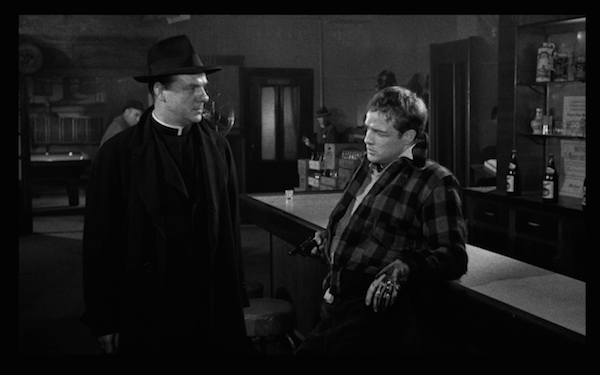
Over the last week, I’ve dedicated myself to re-evaluating a single film for Classic Film and TV Cafe’s “My Favorite Classic Movie” Blogathon. This is the official post for my choice of film, but I’ve already written about the film at length. I began the week introducing this adventure that I dubbed “Waterfront Week.” I then explored the history of the HUAC and how Elia Kazan’s testimony materializes in the plot in Kazan Naming Names. Finally, and most importantly, I looked at The Great Performances in On the Waterfront. Since the acting is the most groundbreaking aspect of the film, the latter was the post that I dedicated the most time and energy towards. If I were to recommend reading one post on the topic, that would be the one.

One thing I wondered at the start of this revisitation was whether the film would resonate as well upon yet another viewing and deeper exploration. The answer is an enthusiastic and emphatic YES. Even though I had already seen the movie a few times before, including seeing the Contender scene probably a dozen times, I still found myself as engaged as every other time, perhaps even more so thanks to the wealth of extra materials on the Criterion release.
On the Waterfront is among my favorite movies of all time. If I had to cobble together a list, my guess is it would be in my top ten or top five. It is in the conversation for my favorite American film of all time. At the moment I cannot think of many American films that comes close. Of course Citizen Kane, Sunset Blvd, The Third Man and others are in the conversation. On the Waterfront belongs right with them, but it is also different. You cannot compare it with Kane, which was more groundbreaking with cinematography and artistic narrative. Kane has a realism and humanism that so many films lack.

It stands on its own because it is an investigation of the human spirit. We can identify with Terry Malloy because we are him. I don’t care who or how successful you are, you’ve had your low points, regrets, and someone in your life has let you down. There are several occasions in my own life where I can relate to Malloy’s predicament. Part of the reason it works so well is because it is such a realistic portrayal of someone who has come to terms with his life’s disappointment, and decided to take action against those who kept him and others like him down. T

Malloy showing off his boxing moves.
We adore Terry not just because he is one of us, but because through Marlon Brando, he is both charismatic and naive. He is an everyman that has walked the tightrope when it comes to his own morality. He has participated, directly or indirectly, in a corrupt system for most of his life, unaware or perhaps in denial how monstrous the system actually was. His slap in the face is the murder of his friend, the effect that had on the family, including a love interest, and the fact that his brother has some involvement with the criminals. His brother is the major obstacle between him doing the right thing or continuing to live his life of blissful ignorance.
The taxi cab scene is so effective because it is the pivotal moment of realization for both characters. Terry realizes that if the system prompted his Charley to threaten him with a gun, then that system isn’t worth saving. His brother understands that it was, in fact, him that let Terry down. He did compromise long-term success for short-term gains for his cronies. During those few minutes, they reconcile a lingering issue that had transformed both of their lives.
When Rod Steiger exhales and looks away after putting the gun away, you know the situation has forever changed. The ending, however spectacular, is inevitable. Again, we like Terry for being relatable, but we admire him for being brave and going against the criminals. I’ve had some brave moments, but I cannot say that I’d do the same thing in his shoes.
On the Waterfront is one of my favorite classic movies of all time. Thanks again to Rick at Classic Film & TV Cafe for planting this seed.
There will be one more post where I evaluate the Criterion release, and next week I’ll move on to other films.


 Criterion Close-Up