Category Archives: Film
On the Waterfront: The Great Performances

“When you weighed one hundred and sixty-eight pounds you were beautiful.” – Charley Malloy.
“It was you, Charley.” – Terry Mallow.
We’ll get to Terry (Marlon Brando) and Charley (Rod Steiger) soon enough, especially the famous scene from the image above. Even though that sequence is iconic and has one of the most memorable lines ever delivered in film, there is far more to the acting in On the Waterfront than any particular scene.
Kazan has often been described as an “Actor’s Director.” There’s more truth to that statement than many might realize. He began his directorial career in theater, but rather than stick to the traditional acting styles, he searched for something new and vibrant. He wanted something realistic that people could identify with. He drew from the Stanislavski System, worked with Lee Strasberg, and founded the Actor’s Studio in 1947. Many of the actors from this studio would become regulars in Kazan films, and many would subsequently become Hollywood Stars. The most notable, Marlon Brando, is considered by many to be the best actor that ever lived.
By 1954, Kazan had successfully implemented his acting system to the big screen. His greatest success was in adapting Tennessee Williams’ A Streetcar Named Desire, which won three out of the four acting categories (Brando lost). That and other of his films were revolutionary when it came to the acting, but even Streetcar had a theatricality about it. Even though the acting was superb, it did not have the intense realism that was being imported from overseas, specifically Italy. On the Waterfront would change that, and Kazan considers it the one film where the final product was closest to his original vision.
In addition to Brando and Steiger, who were established method actors, there were other Actor’s Studio alums, including Lee J. Cobb, Eva Marie Saint, and Karl Malden. These performances all stand out, and all were nominated for Academy Awards, with Brando and Saint winning. The strength of the acting extends all the way down to amateurs and extras. Just about every human being in the film is convincingly real, whether they deliver one line of dialogue or several.
Johnny Friendly, portrayed by Lee J. Cobb

Cobb had worked with Kazan as Willy Loman on stage in Arthur Miller’s Death of a Salesman. He was no stranger to the method and could play a variety of characters. He would have quite a career. He is often overlooked for his work as Johnny Friendly, but that is mostly based on the strength of his co-stars. He is the ideal villain. While he does not show the same humanity that Terry and Charley show, we understand that his fiery, combative motivation comes from a sense of self preservation.
Johnny probably did not always come off as the villain. We get a sense in the early scenes that he was a mentor for the Malloys when they were kids. That may have been based on his own self-interest of indoctrinating them into the system, casting favor onto them so they would remain loyal and not “squeal,” but all the same, the hostility Terry would feel toward him was likely a new development. Johnny would remind them where they came from, but he also expected them to do his bidding without question. If someone crosses him, they were gone. It could be something as small as getting a money count wrong (which implies stealing) or worse, talking about their operation to the commission.
Cobb’s performance is nuanced to a degree, in that we see him calmly giving out orders, maintaining his composure under some pressure, while we also see him in a state of fury and rage when the situation calls for it. The ending confrontation between Johnny and Terry is legendary, with an amazing, explosive exchange between both actors.
Father Barry, portrayed by Karl Malden

Terry Malloy might be the protagonist of the film, but Father Barry is unquestionably the “good guy.” He is a local Catholic priest who exhibits real concern and passion for the people who are being taken advantage of down at the docks. Rather than play the priest in stereotypical, solemn fashion, he strikes a balance between Barry’s obsession toward righting the wrong, and even his toughness by standing up to the organized local that he knows has been guilty of terrible crimes including murder.
When he is talking to the dockworkers, especially Terry Mallow, he is understanding of their fears and concerns, while also taking upon himself to get them to take action. He uses religion when needed to prove his point that acting against those in power is not only in the people’s interest, but is in God’s interest as well. When Terry Malloy tells him, “If I spill, my life ain’t worth a nickel,” he quickly retorts, “How much is your soul worth if you don’t?” Most importantly, he is not afraid for his own well being, and in this respect he is one-sided, but Malden adds as much dimension and tenacity as he can.
Edie Doyle, portrayed by Eva Marie Saint

Brando tends to get credit for the great performance in the film, but his work was enhanced by the great work of the people he acted with. Saint was a newcomer to acting, but she had also been educated via the Actor’s Studio. She was also personally similar to her character. She was a scared, inhibited, naive 19-year-old.
Edie is a fragile character, still dealing with the loss of her brother, while being pursued aggressively by Terry. She is reluctant to open up, partly due to her sensitivity with the loss fresh in her mind, but also because of her reservations with Terry’s favored position by the locals in power. She becomes embroiled in the quest of Father Barry and the confidence of Terry Malloy, who is torn as to what he should do. Through her performance, we understand Saint’s manic reaction to what is going on around her. During the wedding scene, she is literally crying at one point, and tentatively dancing with Malloy moments later. Her performance is magnificent, and she helps endear us to both characters, making them more sympathetic.
Charley Malloy, portrayed by Rod Steiger

Rod Steiger has been accused often of over-acting and being hammy. I touched on that to an extent when reflecting on Jubal. He does the same thing on occasion in On the Waterfront. He plays Terry’s brother Charley, who is a ranking member of the union mob.
Most of the time Steiger stays in the character of the henchman and trusted man of Johnny Friendly, fighting his battles, even if those are against his own brother. At times he is quietly obedient to his boss, while at others he would raise his voice and thunderously bash someone who either does not conform to the system or rejects it. He is a company man, through and through. Steiger is excellent in the role, one of the few times I think he has shown his true potential as an actor (the other is The Pawnbroker, which should have landed Steiger an Oscar).
While Steiger has many bright moments, he was at his best during the cab scene. I’ll come back to that momentarily.
Terry Malloy, portrayed by Marlon Brando

I consider Marlon Brando’s performance in On the Waterfront to be the greatest of all time. Some have dismissed him of basically playing a mumbling, gum-chewing buffoon, but that’s part of the strength of the performance. He is a buffoon, but so is Terry Malloy, a former prizefighter with barely any education. Brando is completely realistic in the role, using the vernacular of the waterfront and fitting in with the locals, many of whom were extras that actually were Longshoremen.
Brando is not only engaging and entertaining to watch, but he also carries the personal nuance and sensitivity that his character needs. We need to believe that he would be respected by the mob, yet also they could be afraid of him and what he knows. We need to believe that he is charming enough to lure Edie to his side, while also sensitive enough to not scare her away. We need to believe that this is a man who used to knock people out for a living, who now works at the docks, yet spends his spare time caring for pigeons on a rooftop. The audience has to like the character as much as Edie and Father Barry do, and we have to rally behind him in order to make the plot and ending work. He has to become the underdog.
Brando puts on a clinic with method acting. Yes, he does chew gum. He fidgets and plays with his hair, but these are all things that normal people do. That’s what Kazan was going for. He did not want someone like Ralph Richardson or Laurence Olivier (both fantastic actors, just different). He wanted someone who could act naturalistic at and around the docks. Using props, gestures and body mannerisms was one of the ways Brando would keep himself on his toes. He needed to be distracted enough in the scene that he could be convincing at being the person, and not just enunciating some previously written lines. His performance has the feeling of an improvisation, and some of the best moments come from material that he and his co-stars previously improvised.
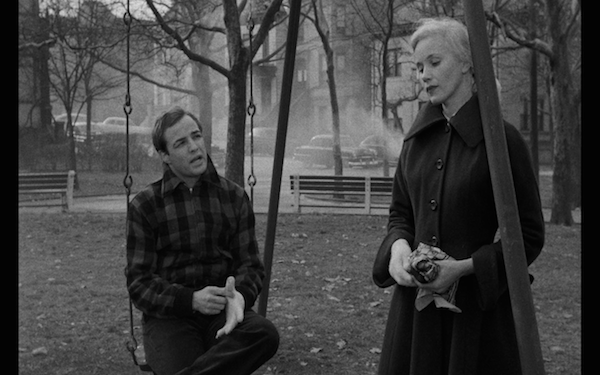
The glove scene with Eva Marie Saint
The courting scene between Terry and Edie is a classic, and is notable for the use of the glove. She drops her glove while he is trying to talk to her. He picks it up, plays with it, and eventually puts the glove on, hinting at some sexuality. By this action, with her personal belonging invaded, she gets a little more comfortable and closer to him. They are connected with that glove. When she takes it back at the end of the scene and puts it back on her hand, she is a changed woman and the relationship has made progress.
The glove scene came out of an improvisation during rehearsal. She dropped the glove and Kazan let them keep going. Many directors would have stifled this creativity, but the actors made it work and Kazan used it in the completed film. It is one of the most memorable scenes in the film.
The Contender

If you haven’t seen On the Waterfront, you’ve probably heard of or seen the infamous cab scene and the “Contender” line somewhere before. I’ve seen the movie about 3-4 times, but I’ve seen the cab scene easily a dozen times, maybe two dozen, and it gets to me every time. Even though it stands alone as an exceptional scene, it is the culmination of the performances up to that point that really makes it special.
We learn through dialogue and exposition that Terry used to be a boxer, but that his career ended because he had to take a dive. We do not learn the caliber a fighter he was, or the perspective of Charley until the cab scene.
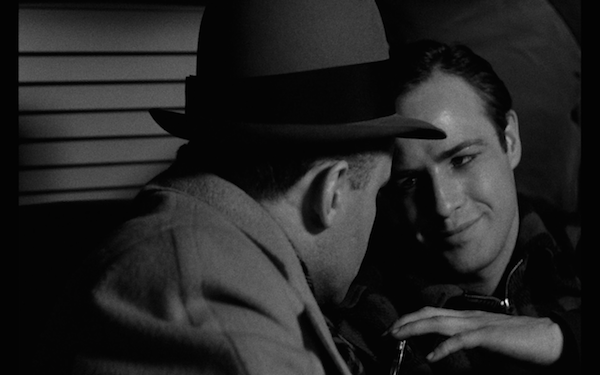
Terry gently pushing the gun down.
The scene begins with Charley trying to talk some sense into his brother. He doesn’t want him to testify at the commission. When he makes little progress, he uses violent manipulation, probably the same way he has used it many times before. He pulls a gun on his brother and demands that he take a comfortable job in exchange for his silence. This is where Steiger’s propensity for big acting really works. When Terry refuses and Charley realizes that he might testify, things get heated. The performance reaches an unexpected point of tension when the gun comes out. The way Brando reacts is touching. Rather than cowering in fear or getting defensive, he just shakes his head, says his brothers name, and slowly pushes the gun away. He is not angry, just disappointed.
From there, the situation completely changes and the brothers are on even footing. There’s no way that Charley could kill his brother, and him pulling the gun was as empty a threat as he could muster. The scene picks up in this YouTube and this is where the magic really begins.
Even though the “Contender” line is the famous one (#3 on AFI’s Greatest Quotes list), there are another four words that really cut to the heart of the matter and are the most affecting. “It was you, Charley.” They reminisce about old times. He talks of Terry when he was 168 pounds and beautiful, how he could have been “another Billy Conn.” Charley blames it on a manager. No, “it wasn’t him Charley, it was you,” Terry says.
From there the speech happens.
I coulda had class. I coulda been a contender. I could’ve been somebody, instead of a bum, which is what I am. Let’s face it. It was you, Charley.

Brando delivers the speech with gusto, with passion, with precision. Terry has been waiting ever since that fateful night where he took the dive and lost his shot, feeling resentful towards his brother the whole time. He does not overact here. He does not scream with rage. His words are those of disappointment, of dejection. His dreams were shattered, and finally he can express himself to the man who crushed them, all to make a quick buck.
The rush of passion is gone when he says “It was you, Charley.” The line is delivered with just a feeling of shame for his brother, that he was so short-sided that he ended a dream.
Steiger does not get the credit he deserves for this scene, but the way he reacts is just as important to the scene as the way Brando delivers the dialogue. The way Steiger is silent and expressionless as the words hit him enhances the scene. He is clearly affected by the remarks his brother has made, and immediately changes direction, which seals his fate. He loves his brother and realizes that it was him. There is no overacting here, just acceptance. “Okay, okay,” he says. That’s it.
Through these few minutes, we have someone pulling a gun on his brother, and then just moments later, giving the gun up and sacrificing himself out of love. We see a brief glimpse of Charley, the authoritarian figure, when he barks at the driver, “You, you pull over.” The rest plays out as it has to.
Having seen the scene so many times, it is difficult to put into words how meaningful and memorable it is. The only way I can describe it is beautifully tragic. It is pure power. Brando and Steiger, through Kazan and a makeshift set, made one of the highest points of American cinema in a matter of minutes. It is still remembered vividly 60 years later, and will continue to be remembered as a key part of cinema history.
Waterfront Week

Some films require more attention than just the standard “review” format to cover properly. On the Waterfront has been “reviewed” thousands of times from amateurs and professionals alike. It is the caliber of film that, in my opinion, requires a little more attention than just a few scribblings and moving on to the next one. There are many variables in play, and the film reflects film history, and would change the nature of film (especially acting!) for years to come. For that reason, I am going to expand upon my usual format to cover this tentpole film. I’m going to spend the entire week dedicating myself to the film and discussing various elements.

What prompted this was another Blogathon. I caught wind of Classic Film and TV Café’s “My Favorite Classic Movie Blogathon” and had to make a quick decision. I wanted something American, so I scanned my shelves for an unwatched master. My eyes settled in this lovely turquoise and white digipack for On the Waterfront. I had seen the movie a couple of times and considered it among my favorites of all time, even though it ranked behind Sansho the Bailiff in my 1954 list. Picking a favorite film would be like a father of ten picking a favorite child. I just cannot do it, but in terms of importance and the influence of a film on my own tastes, On the Waterfront qualifies.
Excuse the increased activity, but this week there will be a few posts about the film. The first will be within the next day or two and will discuss the history behind the film, specifically the HUAC and how Elia Kazan named names. This film was in a lot of ways a justification of his actions. The next post will be about the acting styles. This was arguably one of the greatest ensembles of method actors ever assembled for a film. It cemented Brando as a star and changed acting permanently. On Saturday, I will post the reason I consider this among my favorite films. Who knows? By the end of the week, I may be willing to boldly proclaim it AS my favorite film. We’ll see how it holds up. Either way, it certainly belongs in the conversation and I will discuss why. Finally I will wrap up the postings, talk about the Criterion supplements (of which there are many) and then I can move onto the next one.
I hope you’ll enjoy taking this journey with me. If you haven’t seen it, I implore you to rush out and rent it, or better yet buy the Criterion. It is a must have for any serious cinephile.
Odd Man Out, 1947, Carol Reed

Odd Man Out was the first of a series of three films that essentially put Carol Reed into the conversation as a major auteur of the post-war period. The other two are The Fallen Idol and The Third Man, the latter of which is considered his masterpiece. It currently is #73 on BFI’s Sight and Sound poll and is consider the #1 British film of all time. Reed’s later work had some success, even if not quite as celebrated on a historical scale. He is appropriately remembered for these three, all of which have some similarities in style, yet are thematically different.
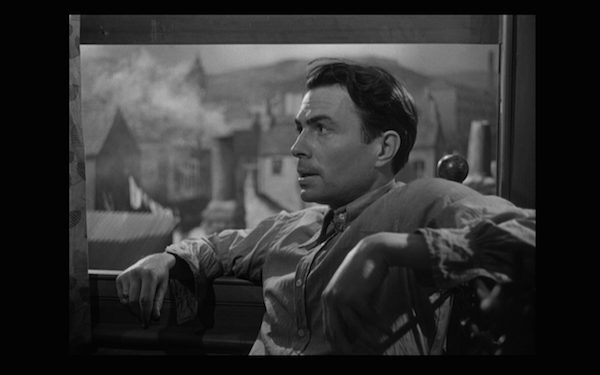
Johnny as leader at the beginning of the film.
Odd Man Out is also remembered as one of the few films to feature Northern Ireland politics as a major setting. Another is John Ford’s The Informer, which would be a major influence on the Reed film. The politics of the IRA at the time were complicated, as they were in subsequent decades, and I don’t believe that Reed was trying to make a political statement of any sort. He simply adapted a novel with an Irish setting and used the political landscape as the backdrop to explore some major themes about humanity.
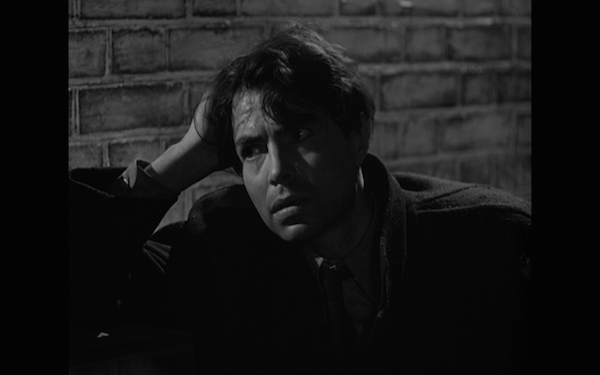
James Mason as Johnny, acting with his face.
This was also James Mason’s breakthrough role, and I consider it to be one of the best performances of his career. His character Johnny is the leader of the local IRA group, and they rob a mill in order to acquire funds. Things go wrong when a renegade employee pursues the group with a gun. After a struggle, he shoots Johnny, who returns fire and kills the man. Johnny is wounded and tries to escape with his gang, but falls from the getaway car into no man’s land. From here, he is the title character as he literally is the odd man out of the group, although not by design.
Johnny is gravely wounded, yet because of the crime and fatality, the police are after the local rebel. The relations between the armed police and the citizens are the scenes where the political situation is addressed. Many of the locals seem to be on Johnny’s side whereas the police desperately want him captured and order restored. People assist Johnny in eluding his captors, sometimes by accident, but they do not immediately report his location. A household takes him in at one point, not realizing who he is, and they try to help with his injuries. Once they realize who he is, they let him go to wander the streets, but they do not turn him in. They simply want no part of the situation, probably because even though they support Johnny and his people, they do not want trouble from the authorities. Others assist him as well, and later when someone attempts to turn him in, it is to a local priest and only for some sort of reward.
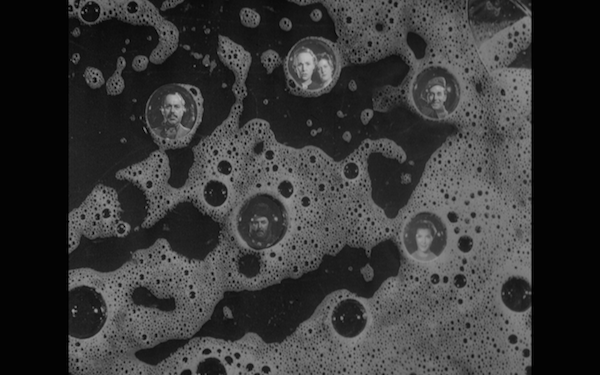
One of Johnny’s hallucinations materializes out of guilt.
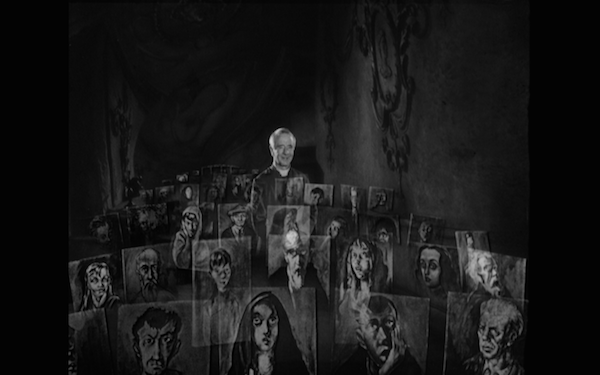
Another hallucination ties into redemption and religion.
As Johnny’s physical state deteriorates, his mental state follows. He fades in and out of consciousness, at times reaching a delusional state where he sees hallucinations. This is where Mason’s performance stands out. He often has very little dialog to say, and instead spends a lot of his screen time looking weathered and emaciated. When he does speak, it is often murmuring and sometimes rambling. Often his performance is merely physical, and he does as much with his movements, mannerisms and expressions as he does with words.
Even though Johnny is technically a rebel, murderer and criminal, he is portrayed as a benevolent person. When he is lucid, he wonders whether he accidentally killed the man at the mill. It pains him when he learns that the man is dead, not just for his own fate as a criminal, but because of his guilty conscience. He is expressly non-violent. At one point he hallucinates a policeman who he treats of as a confessionary, a plot point that will come back into play later.
The church is continually involved in the film, both from a thematic sense and directly within the plot. Religion is at the forefront of the film, and becomes expressed through the character. When “Shell” gets wind of Johnny’s location, he uses an analogy of Johnny being one of his birds, and essentially tries to get a reward for this message from the church. Rather than giving any monetary reward, which they could not offer anyway, they instead give him the promise of spiritual rewards. By delivering Johnny to the church (and by extension, to God) “Shell” is one step closer to salvation.
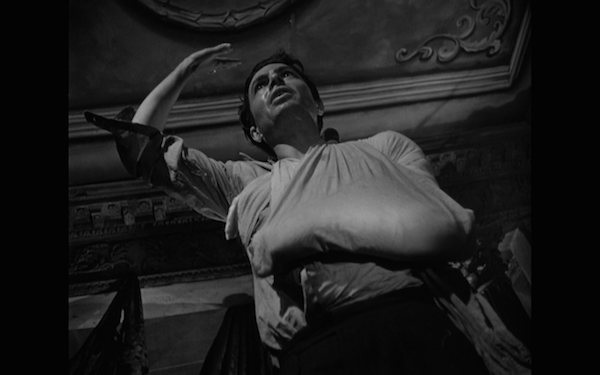
Johnny preaching his sermon from Corinthians.
As a product of the thick religious theme, Johnny becomes a messianic character. As he is being bandaged up by a local group, his physical health deteriorating and visions increasing, he quotes the bible. He says ““I remember when I was a child, I spoke as a child; I thought as a child; I understood as a child. But when I became a man, I put away childish things.” This bit of scripture is from Corinthians chapter 13, which is coincidentally enough, the chapter on “Love,” and is often quoted in positive and selfless context. Is Johnny becoming an instrument of God? Through his delusion, is he preaching for people to become more passive, loving, and accepting of God so that they will reach salvation? Is Johnny merely trying to achieve his own salvation out of guilt for his actions and the potential sacrifice to come? The film does not answer any of these questions definitively and it shouldn’t. That is one of its strengths, as it cannot give the answers, but it promotes spiritual and ethical exploration.
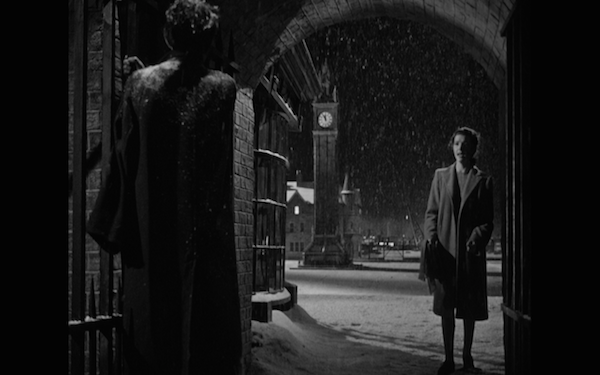
Kathleen is instrumental in Johnny’s journey.
One of the constant motifs is about death. Tying into the religious theme, at one point the priest says, “This life is nothing but a trial for the life to come.” It is perhaps Johnny’s trial. In another scene, a character is asked what faith means. “Only one man had it,” he responds, probably referring to Jesus, although possibly in the context of the film, to Johnny. He continues by saying that “It is life.” Much of the film is concerned with whether Johnny will live or die, and it is through his love, Kathleen, that this answer is revealed at the end of the film. I will not give that answer here and spoil the film, but I will say that the ending punctuates much of what I have discussed here. It creates more questions than it answers, and that sort of ambiguity (along with a number of filmic strengths that I have not discussed) is what makes this a classic.
Film Rating: 8.5/10
Supplements
Template for the Troubles: John Hill on Odd Man Out: 2014 interview with a scholar on Northern Ireland.
He calls this the first film to portray the urban Northern Island situation since the partition in 1921. IRA activity had not been significant before the film. During WW2, the members were interned. The film is sympathetic to the organization and Johnny.
The city in Odd Man Out is not named, but is implied to be Belfast. There are some overhead establishing shots of Belfast, but most of the film was shot around Shoreditch, London or in Denham Studio in London. They created a model of the large clock, which would play a major part in the visuals, and they recreated the Crown Bar from Belfast in Denham studio.
Postwar Poetry: Carol Reed and Odd Man Out: This is a short documentary made for Criterion Collection in 2014.
They discuss the film in detail, from its origins when Reed read the book in 1945 and began shooting in 1946, to its legacy. One contributor calls it the British High Noon because you are so aware of the time throughout the film.
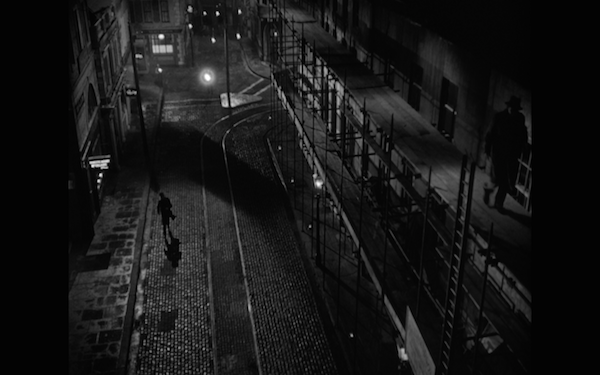
An example of some of the great night shots.
They speak about this film in the context of the other Reed films, including his prior and later films. One element that sets apart the three films is that they are shot at night and they exhibit an excellent use of darkness. Previously filming at night was not an option for Reed because he did not have the budget. There were other characteristics of a Reed film, such as that it had a cluttered frame and was shot documentary style.
Home, James: This 1972 documentary is a personal look through Mason’s eyes at his hometown of Huddersfield.
Mason narrates and they show scenes of people living, working, walking and going about his town. Much of the movie is about the economy, population, and industry. He spends a lot of time looking at the various local companies that operate in Huddersfield, and he speaks gushingly of the respectable type of person that lives in the town, whether they are a lower class worker or an upper class business owner. You could call it a fluff piece, as a critical words is hardly uttered.
Mason has a familiar slow and relaxed manner of speaking, which works well in film and his dialog benefits from this manner of speaking. I once joked that Mason’s voice would be enjoyable reading a phone book. After seeing this documentary, my opinion has changed. This film appears to have been created for local educational TV as a way of glorifying the city. Mason indubitably had plenty of hometown pride, but from an outsider, this is not exactly gripping subject material. It actually took me away from the film. A supplement about Mason would have been terrific, but this seemed like it did not belong. Film Rating: 3/10
Collaborative Composition: Scoring Odd Man Out: This is a piece about William Alwyn’s score with Jeff Smith.
I did not discuss many of the exemplary technical elements in my review, but the score is absolutely brilliant. Johnny’s theme is especially memorable and really fits well with his plight. As a result, this was my favorite supplement on the disc and it brought me back after seeing the dull documentary.
In a way, the score was experimental. Alwyn did not believe in “wall-to-wall” score with endless silence. He believed that there should be musical silence in plaes. He worked with sound editor to determine when to use score and when to use sound effects.
Smith plays all of the themes on the piano, which are for the characters of Johnny, Kathleen, Shell. Alwyn only deviated slightly from these themes. For instance he would play a delirium sound when Johnny hallucinates or loses his mind.
Alwyn was a major influence on the merits of pre-scoring a film and working with a collaborative team. Many famous conductors would write the score after the first rough cut of the film was completed. Alwyn pre-scored Odd Man Out based on the script. Others have followed, with the most notable example being Ennio Morricone with Once Upon a Time in the West where he played the theme for the actors.
Even though he had a highly successful career, Alwyn considered Odd Man Out his crowning achievement.
Suspense, Episode 460: February 1952 broadcast with primary cast.
This was another radio broadcast with cast members from the film. Since it is relatively short, it is an easy listen, even if the film language does not translate well to radio. Mason’s voice work is key in this version, beginning with him using his character to establish the heist debacle. “I’m hurt!!!” he yells loudly.
Criterion Rating: 8.5/10
Top 20 of 1956
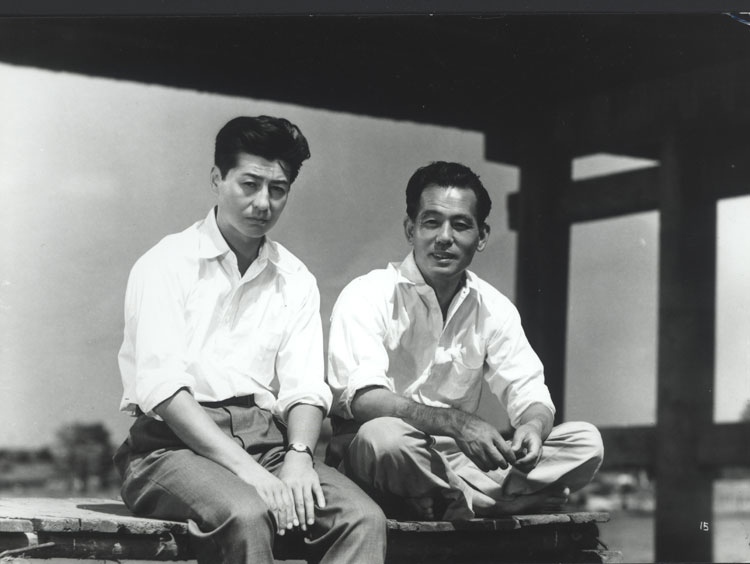
Both 1954 and 1955 were dominated by international films, so it caught me by surprise when compiling my 1956 list that there were so many English language films to choose from. The majority of the list is in English, including 5 out of the top 10. It comes as no surprise when looking at the filmmakers. There are two Hitchcocks, plus selections from Ford, Kubrick, Ray, Aldrich, Stevens, Sirk, Siegel — all heavyweights in American cinema. There are others that barely missed the list, such as Wyler’s Friendly Persuasion, Kazan’s Baby Doll and Daves’ Jubal.
It was a solid year for American cinema, much of which I attribute to the end of the studio system and the competition from television. Auteurs were finally given some artistic and creative independence. On top of that, film became a way of portraying the subversion of the American dream, contrasted with the banality and morality of suburban life as portrayed on television. It is no surprise that the American entries are dark and seedy. There were two worthwhile boxing movies, but the portrayal of fighter that takes dives was more enduring and fit with the times than the rags to riches story (Somebody Up There Likes Me).
Of course there is plenty of international representation, including Ozu, Melville, Clément, Bresson, Ichikawa, and the debut film from Louis Malle (with Jacques Cousteau), which would begin two diverging careers. There were two international films that hurt to cut from the list, Mizoguchi’s Street of Shame and the last edition of Inagaki’s Samurai Trilogy, Duel at Ganryu Island. Alas, there are only 20 slots and too many contenders.
The one film that stands apart is Cecil B. DeMille’s 1956, The Ten Commandments. Yes, it is as campy as any DeMille film goes, but it is so much fun to watch. The production value and special effects are awe inspiring, not just by 1956 standards. The parting of the red sea is still impressive. Of all the selections on this list, none were as fun as the DeMille epic.
1956 was a strong year for film, but I would not rank it up there with the previous two years, nor the year to come. Spoiler alert: 1957 is amazing.
1. Early Spring
2. The Killing
3. The Searchers
4. Gervaise
5. Bob Le Flambeur
6. The Burmese Harp
7. A Man Escaped
8. The Harder They Fall
9. The Ten Commandments
10. Attack!
11. Monde du Silence
12. The Red Balloon
13. The Bad Seed
14. Bigger than Life
15. Giant
16. Lust for Life
17. Written on the Wind
18. The Wrong Man
19. Invasion of the Body Snatchers
20. The Man Who Knew Too Much
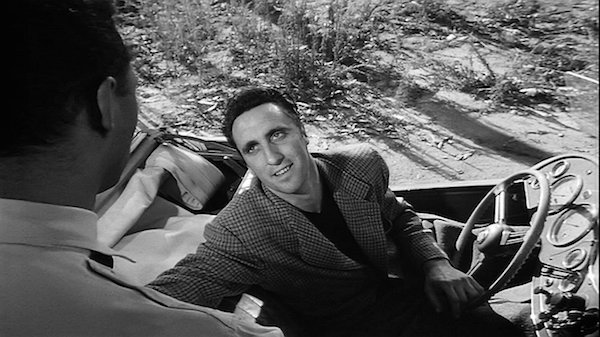
An Autumn Afternoon, 1962, Yasujiro Ozu

An Autumn Afternoon ended up being Ozu’s last film. While it is a shame we don’t have a few more Ozu films in color, this was a solid ending to a legendary and masterful career.
For those who have seen Ozu films, the style is completely familiar. It focuses on domestic issues, is shot from a low angle with a camera that never moves, has a somewhat slower pace, and speaks solemnly on the intricacies of life and relationships.

This transition shows an interior with signage in the exterior.
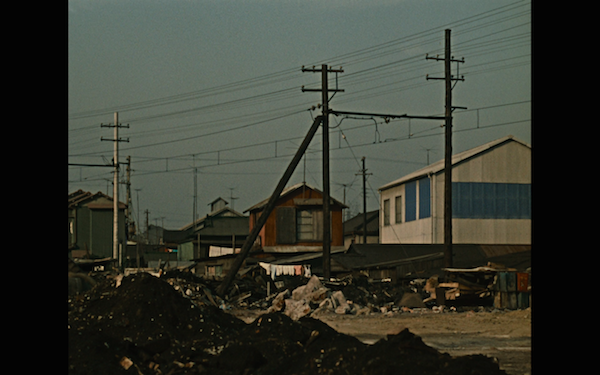

Ozu has plenty to say about the contrast between modernity, technology, commercialism, and a nostalgic fondness for the way things were. This is mostly established by his clever use of transition shots. The character scenes take place almost exclusively on interior sets. The transitions between these scenes show both a commercially vibrant Tokyo with elaborate signage, and also a worn down Tokyo by the seedier side of industry. These images are juxtaposed by characters that are concerned with baseball, refrigerators and golf clubs. Materialism is a vital part of their life, but is not portrayed as an entirely positive thing.
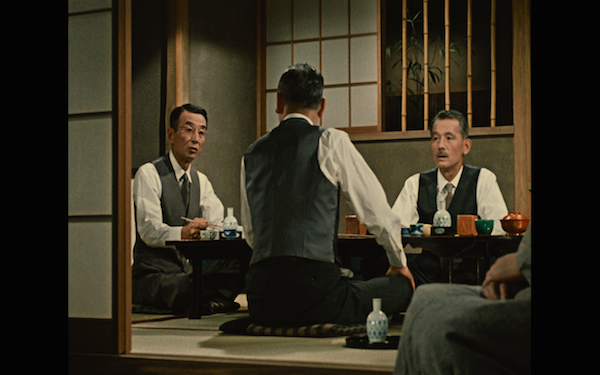
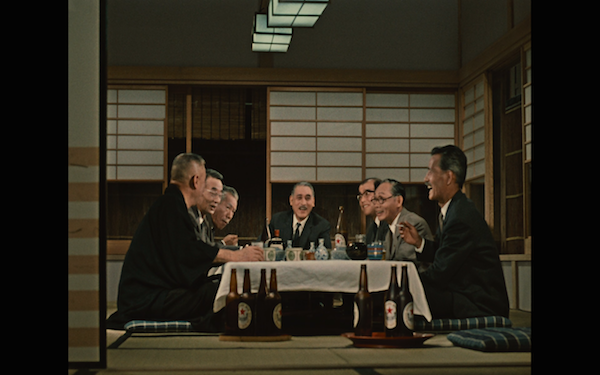
Ozu portrays men drinking together as pleasant experiences. This is where the men relax and enjoy each other’s company. Whether this happens as a large class reunion, or just two fellow Navy officers flippantly discussing the ramifications of the war, the mood is positive. This is punctuated by the score, which like most Ozu films, is always effective at setting a mood. Most trivialities are forgotten as men drink sake in the bar, reliving and enjoying the younger days while playfully tweaking each other. Age and virility are constant topics in these exchanges, and they talk often of marriage. Over time, these exchanges re-direct back to the family and the primary theme of the film. The tragic character of ‘The Gourd’ joins the classmates at their reunion and he is the picture of a fractured life, one that they do not want to repeat.

Notice the foreground red and white matching the background girls dressed in red and white.
With Ozu there is always juxtaposition, and that is with family and married life. The family life is often portrayed as structured, formal and with a balance between commercial indulgences and domestic responsibilities. There is a subplot with Shuhei’s married son who wants an expensive set of golf clubs, which his wife stubbornly resists out of economic necessity. Even though marriage is discussed often in the film, this give-and-take exchange (which happens to be among my favorite sequences) shows a marriage in action. The golf clubs provide for a mild conflict between husband and wife, but also a way of expressing how aging men yearn for a leisurely outlet, which the wives must accommodate. This is juxtaposed with the Shuhei’s daughter taking care of her father, while being defiant when it comes to being the caretaker, knowing all along that her father and brother need a strong female in their lives.

This train scene divides the film.

It then reboots by repeating the industry shot from earlier.
Near the mid-point of the movie, after the marital dispute is resolved, the movie is basically rebooted. We see an image of a train, common in Ozu films, and then we see the same images and sets that began the film. We see the candy striped tanks of industry, followed by another exchange between Shuhei and his secretary. This is what started the film, and will propel it to the final act, which is that of Shuhei coming to terms with his aging and accepting the loneliness.
The ‘Gourd’ shows back up and is the catalyst for the remainder of the film. He is pitied, as he has degraded into a drunken restaurateur that caters to the lower classes. As he gets drunk, he laments on his life. “You gentlemen are so fortunate. I’m so lonely,” he says, and then later gives the fateful, tragic line of dialog that finally shakes up Shuhei: “In the end we spend our lives alone.” The former teacher has clung to his daughter, not letting her marry, yet he is still lonely. Shuhei has hitherto been in denial about his daughter’s readiness for marriage, which probably has to do with his reliance on her as a widower. He decides to let her go and let her marry.
The second half is heavier on plot, and as the pursuit of a suitable marriage candidate is explored, we lose sight of where Shuhei is headed. He is kind, thoughtful and considerate of his daughter, who we learn really does want to marry. She does not get her first choice, but she finds a satisfactory match. Her father just wants the her to be pleased with the best possible match.
Shuhei is left alone. After marrying off his daughter, he says: “Boy or girl, they all leave the aged behind.” His solace is working, drinking in bars and re-living the past with friends, whether they are his old classmates or war buddies. At the end he says that, “I’m all alone,” and subsequently sings the war song.
The ending is bittersweet. His family is happy and he is left forgotten. Even though he did the opposite of ‘The Gourd,’ both by finding a lucrative career and letting his daughter go, his fate is the same. Ultimately he has done the right thing, even if it leaves him with the inevitability of aging alone. At least he has solace in his war songs and the knowledge that, contrasted with ‘The Gourd,’ his family is his legacy and they have a bright future.
The same could be said for Ozu. He passed away the year after this was released, and western audiences did not discover him immediately, at least not like counterparts Kurosawa and Mizoguchi. He had a long and illustrious career, but one that was not compromised by intervention or commerciality. He did right by his films, and left a body of work that would stand the test of time.
Film Rating: 9/10
Supplements
Commentary: I was pleased to see David Bordwell. He is among the most reputable and admired film scholars out there. I have read him many times in film studies classes, and one class used his work as a textbook. Among his many books is Ozu and the Politics of Cinema, which is available as a downloadable PDF. He is one of the foremost Ozu and academic film scholars.
This is one of the better commentaries I’ve heard on a Criterion disc. Bordwell provides a wealth of information, not just on the background of Ozu and the film, but also about the shot selections, filming style, and how they were to used to convey Ozu’s thematic messages. One example is during the golf sequence with the brothers and sister-in-law, which Bordwell demonstrates with precision all the different cuts and camera changes, and how these interact with the relationships.
I’ll share a handful of factoids that I found interesting:
- Ozu establishes the premise early on during the office scene with his secretary. Women have two options in life. They can stay at home with their parents (father) or get married.
- In this era, working class men often had a rhythm of going to work, spending the evening out drinking, and return home drunk.
- It is a misnomer that American culture began penetrating Japan in the 50s. It actually started in the 20-30s. Ozu brought that into his earlier films. Kids in his 1930s films, for instance, want baseball gloves.
- The reunion of characters is also a reunion of actors. Many of those at the reunion were regular Shochiku players.
- Film was in decline during the final years of Ozu’s life. There had been a billion annual movie viewers in 1959, which declined to 500 million in 1963. That mirrored the decline of the prior decade in America. Part of the reason was TV, while foreign imports (especially American) also contributed to a decline in Japanese cinema.
- Sometimes Ozu mismatched the music. He would show a somber scene with cheerful music. Ozu was quoted as wanting “good weather music always.”
- Ozu filmed from a variety of different character ages, genders and perspectives. Most directors rely on autobiographical experience when portraying characters, but Ozu lived at home with his mother for most of his life, so it is impressive that he was able to relate to so many people different than himself.
- Ozu’s camera is almost always lower and rarely moves, but it is not on the floor. It is just lower than the characters in the frame, so the viewer is barely looking up.
- Ozu checked every shot through Viewfinder. Shohei Imamura was AD and got annoyed by him playing with continuity. Ozu uses it in this film with a soy sauce bottle, which Bordwell compares to a subtle Jacques Tati gag.
- Ozu’s mother died during production of film. Bordwell reads his diary entry where writes a poem beginning with: “Under the sky spring is blossoming ….” His grief materializes in the movie, with the film about a father also possibly being a film about a son.

The Soy Sauce scene.
Yasujiro Ozy and the Taste of Sake: 1978 excerpts of French TV show.
Ozu was “mysterious in his simplicity.” They talk about how he was a bachelor that lived with his mother for 60 years. He was usually later than his contemporaries when adopting technologies, including sound and color. He was unknown in the west until 15 years after his death.
A number of French critics discuss the filmmaker and his films. Georges Perec says Ozu searches for reality and does not find it. Instead he questions reality.
They show sequences of archery, Zen Buddhism, philosophy and even martial arts, which are prerequisites for Ozu’s work.
This release is an example that quantity does not always equate to quality. Usually a movie with a commentary and a single supplement would not be considered a major release, but the quality of the commentary and the gorgeous 4k restoration make this a must for any Ozu fan.
Criterion Rating: 9/10
Beauty and the Beast, 1946, Jean Cocteau

When Beauty and the Beast was in production, the Second World War was in its final throes. The entire European landscape was ravaged and devastated by the war machine, and France had been under German occupation. Even though many filmmakers fled or were exiled, the industry continued in a limited capacity. To say that it had been a difficult time for the French would be a gross understatement. It had been horrific. When the film industry slowly began finding its legs, it would be expected that some escapism would be necessary. A bit of that can be found in Children of Paradise (my #1 of 1945). Few, however, would expect such a vast departure from reality as Beauty and the Beast.
Previous to 1946, Fairy Tales had primarily been almost exclusive to Disney animated films. In France, they were even less prominent, as many American films had not been shown during the war. Most people didn’t have a chance to see Pinnochio, Fantasia, Dumbo or Bambi until after the war. I’m a believer that time and context is a major consideration when evaluating film. This makes Cocteau’s project that much more special. For France, it was revolutionary filmmaking, unparalleled in time and space. One could argue that there never has been a live action film like it, and it has influenced many future films, such as the Disney remake and Demy’s Donkey Skin.
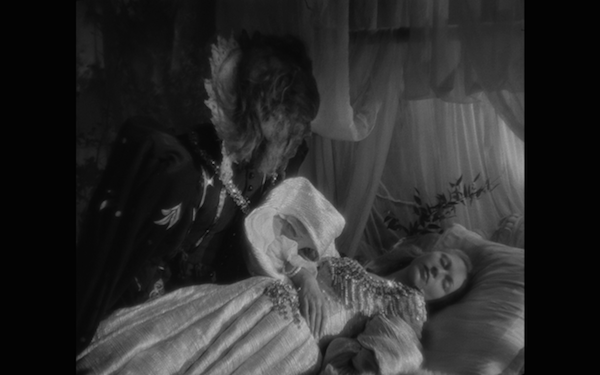
The story is familiar to probably every reader. Whether they have seen the Cocteau, they have undoubtedly seen the 1991 Disney version, which takes more from Cocteau than it does the original work from Beaumont. A princess ends up in an animated castle with a beastly creature. At first she loathes him, but grows to like and respect him, and eventually, well, you know the rest. This is a fairy tale after all.

Cocteau liked using smoke.
What is also impressive is that Cocteau does not rely on state-of-the-art special effects to achieve is fantasy. He uses set design, musical score, costumes, make-up, cinematography, and mise-en-scene to create the fantasy. There are special effects, but they are only slightly more technical than the effects that Georges Méliès was creating during the early days of films. What’s more impressive is that we hardly notice that the effects are not technical spectacles. Everything else is so well done that it keeps us enthralled with what’s on screen. Cocteau uses artistry and not trickery to immerse us in this world.

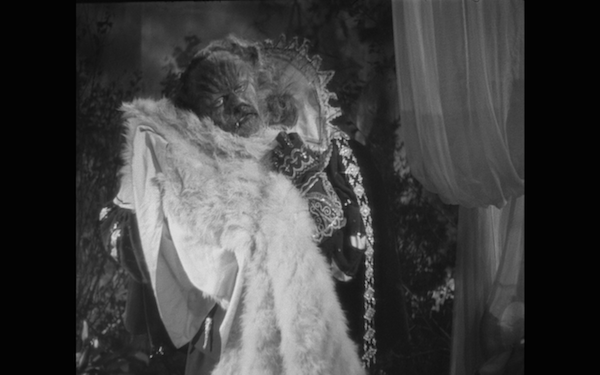
I’ve already gushed plenty about this movie, but I have to gush just a little more. Jean Marais deserves credit for playing a number of parts in the film, but most importantly for his work as the Beast. One amazing aspect of the supplements was learning all that went into creating the character. Marais basically had to live in an uncomfortable layer of fur for hours, after spending up to five-hours being prepared in costume. Despite having no face to emote, he manages to perform enough with his eyes and his mannerisms that we understand the character’s feelings and motivations. On different occasions, we see the Beast as fierce, menacing, somber, mournful and jubilant.
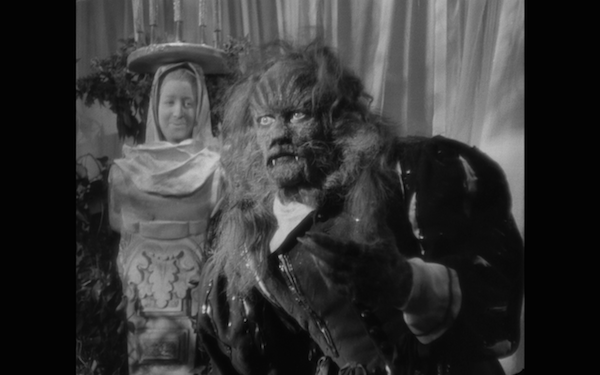
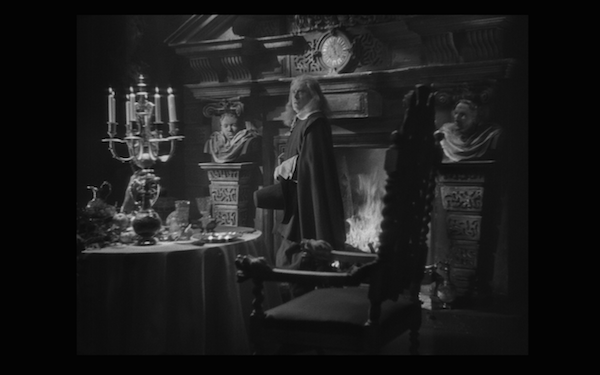
Unlike a number of directors, past and present, Cocteau was a true artist. Rather than create a faithful adaptation, he made it his own by adding to the fantasy. The fantastical elements of the house are all Cocteau. He has human hands holding candles, pouring liquids, and human faces lining the walls, watching every move of the living. The fact that the house is alive adds to the mood and mystique. It is both unnerving and enticing to see a ashen face breathing smoke alongside the fireplace.
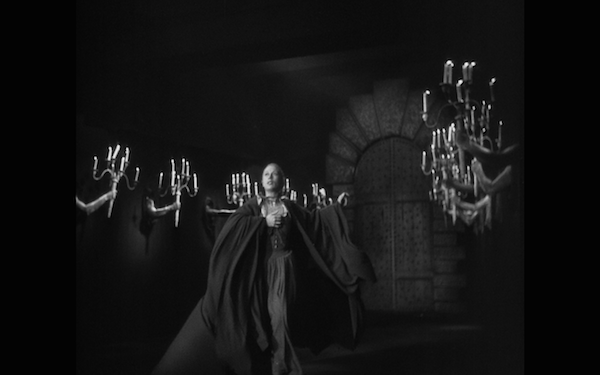
Arms are holding the candelabras.
Beauty and the Beast was not without social commentary. The fact that the other living characters, especially Belle’s sisters, are untrustworthy, manipulative, and only looking out for their own gain speaks to the times. Belle utters a particularly scathing line of dialog that speaks more to modern society, specifically German occupiers and French collaborators: “There are men far more monstrous than you, but they conceal it well.” Cocteau is unequivocally comparing the monstrous nature of the peripheral characters with the real monsters who had governed France for the previous several years. Even if these monsters could sometimes be polite and smile, that does not change the fact that they are monsters. Beauty’s first paramour, Avenant, is very much like these two-faced fiends. He even has Belle fooled during the early portion of the film, but he is revealed to be just as cunning and dangerous as the outwardly evil characters. The Beast may not look like much and acts outside of social norms, but he is genuine. Belle knows what she will get with the Beast, and the more she gets to know him, the more she likes what he is.
I’m careful not to use the word “masterpiece” because it is a term that is too easily thrown about. I’ve used it on a few occasions, which is probably too often because it lessens the magnitude of the word. When I consider something is a masterpiece, I believe it is a truly original, creative and artistic piece of work that is unparalleled. Beauty and the Beast meets my definition, as I consider it the most important and the greatest live action fairy tale that has ever been made. It is the standard for which all tales should be measured, animated or otherwise.
Film Rating: 10/10
Supplements
Commentaries:
Arthur Knight – Film historian, recorded in 1991.
- Germans enjoyed the film. They took to the Aryan looks of the leads and ignored the subtext, although it was obvious in the minds of the French.
- Cocteau added a number of elements to the story. Avenant is an example of a character that was not in the original.
- It was a frustrating shoot because of continued problems. Airplanes would fly over the set, the weather was bad, and passing children would gawk at Marais in costume. There were many delays.
- Cocteau was critical of Alekant’s cinematography, especially the pacing of him setting up, thinking that imperfections would show in the final product. The opposite was true as the photography was celebrated.
- Knight speaks in detail about Cocteau’s homosexuality, contrasted with Noel Coward’s. He speaks about the relationship with Jean Marais, which lasted until 1947, where Cocteau met Edouard Dermit.
Sir Christopher Frayling – Writer and cultural historian, recorded in 2001.
- He gives more of a direct commentary to the scenes as they are shown whereas King provides more background details. Frayling mentions more instances where Cocteau takes poetic license or when the dialog is lifted from the book.
- Critics had attacked Cocteau for not being political. The prologue text is directed more toward them than the viewer.
- Cocteau had been poet, playwright, graphic artist, and a novelist. He was quite the artist, but hadn’t made a film since 1930 and this was his first mainstream film.
- Many of the castle props, including the living sculptures and supernatural elements were inventions of Cocteau. This is more surreal whereas the book was opulent. Disney used the Cocteau ideas for their version.
- Frayling contrasts between Beauty in this version and Disney. She is a post-feminist, intelligent woman in the Disney film, whereas Cocteau portrays her more as an object.
- In original story, Belle stays with Beast for three months while sisters get married to flawed individuals. Cocteau compresses the scenes.
- The fairy tale dates to 2nd century AD and wasn’t written until 1756. Passed down via word of mouth – “mother goose tale.”
- New Wave filmmakers loved Cocteau and Truffaut actually donated money for him to complete a film. He was not embraced in 1946-47.
Philip Glass’s Opera: 1994 opera created for the movie. It functions as another audio track that replaces the dialog. The Glass music is distinctive for those watching Errol Morris films (link to Thin Blue Line). It is a nice option for fans of opera and highlights some of the emotionality of the film. For many it may be the preferred score. It is extremely well put-together and inspired, but I prefer the original.
Screening at the Majestic: A short documentary about the filming with interviews.
During filming in 1946 in Rochecorbon, Tours, Cocteau watched the “rushes” in the Majestic Theater, which no longer exists. They found from the rushes that the film had a poetic and beautiful quality.
Jean Marais (Beast) and Mila Parély (Félicie) are interviewed. Marais respects Beaumont, the original author, but thinks that the magnificence of the film is due to Cocteau. I agree.
René Clément showed up and assisted, just after finishing Battle of the Rails, a prominent movie about the French Resistance. Clément was an AD, but was vitally important. They did not know then how talented he was.
Marais’ makeup took 5 hours to put on and was difficult to take on. The glue cut off his circulation.
Studied the art of Vermeer and others to get the lighting and set design. This is apparent in the scenes of Belle’s family’s house, as the interiors look very much like Vermeer paintings.

Vermeer’s “The Kitchen Maid.”

Interior shot inspired by Vermeer and others.
Interview with Henri Alekan: This 1995 TV interview with Director of Photography coincided with restoration.
It was a highlight of his life, in part because he was a beginner. It was difficult to make because the war was still going on.
Tricky to film in the dark, but he took on the challenge. Flemish painters like Vermeer, De Hooch, inspired him. Cocteau mentioned them repeatedly and encouraged him to go to museums to study the masters. This was just as important for his future as a cinematographer as making the film.
Secrets Professionnels: Tête à Tête: 1964 episode from French TV.
This short feature is about Hagop Arakelian, makeup artist. He worked for 33 years in the profession, learned from an actor in stage and silent movies in Russia and France.
As he has an actor in the make-up chair, he talks about his methods for applying makeup, how to make eyes look natural and other practices.
The list of directors he has worked with is staggering. They are basically the masters of French cinema. He demonstrates a number of different looks he can create, such as a black/white painted male face or a vagabond looking character with fake facial hair
This piece does not mention Beauty and the Beast, but he refers to it as his best work.
Film Restoration: The movie was not in jeopardy of being lost because all the negatives exist, but had degraded over the years. They replaced 150 frames with those before or after to fill in black frames, while computer procedures were used to correct sound.
Criterion Rating: 10/10
Jean-Pierre Melville’s Resistance

“This film has no pretension of solving the problem of Franco-German relations, for they cannot be solved while the barbarous Nazi crimes, committed with the complicity of the German people, remain fresh in men’s minds.” – Le silence de la mer
The above words are the opening statement from Jean-Pierre Melville before his first film about the German occupation of France during World War II, Le Silence de la mer. The words represent his anger, and would color his other two films about the resistance. His take on the occupation is pointed, caustic, tragic, and in many instances he does not pull his punches, accusing both French and German alike of misdeeds.
Jean Pierre Melville came from Jewish ancestry, and grew up “in a cultured, bourgeois-Bohemian environment” (Vincendeau). He was fond of American culture, and even changed his surname from Grumbach to Melville in honor of American author, Herman Melville. He served in the military and participated in the French resistance, but details are scant as to what specifically he did. He has revealed little about his activities, and we can only speculate as to the level of autobiography in his later films, although it is clear they are based on his own experiences.
Melville became a cinephile at a young age, and during the 1930s he consumed cinema from morning to night. He claimed to go to the cinema at 9am and leave at 3am, immersing himself completely in the world of cinema. Classical Hollywood and American culture influenced him to the point that “for most of his adult life he wore a Stetson hat and dark glasses, and smoked large cigars” (Williams). Despite his obvious appreciation for all things American, he was also entrenched in the French film culture, among others.
Politically, Melville was an enigma, but he has admitted to being a communist from 1930 to 1939. Afterward, he became a “right wing anarchist” according to his own words. His films show some of these political images, albeit still with some ambiguity. His resistance films are similar in fashion as many of the left-wing films of the 1930s. His gangster or noir films are less political, but you can see a hint of his anarchic philosophy.
His career began in rebellious and anarchic style, with him filming without permission from the unions. He used unconventional methods, such as small crews shooting entirely on location. This would begin his career as a filmmaker in radical fashion. He would produce his films independently and eventually from his own studio, establishing himself as an outsider in the post-war French cinema scene.
La Silence de la mer
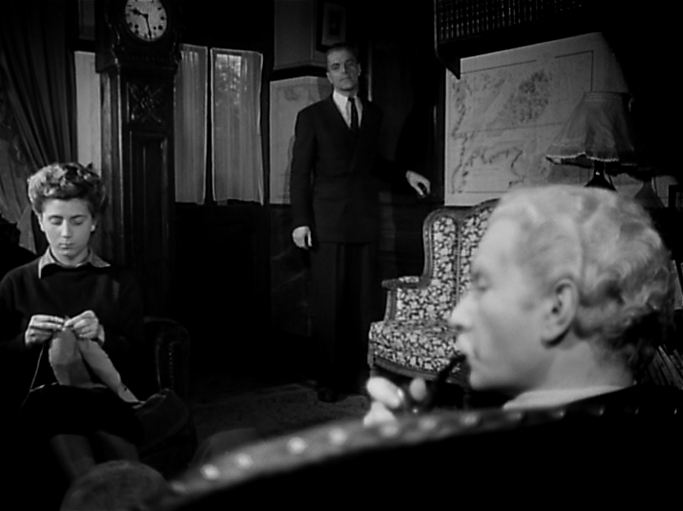
Melville’s first film shows resistance in a subtle and quiet form. During the war, a German occupying officer imposes on an uncle and niece’s house for lodging. As they live together, he tries to engage the pair in friendship and conversation. He loves France and its culture, and is blinded by the atrocities committed by his side during the war. They resist by not speaking to him, barely even acknowledging his presence. That he turns out to be a likeable and benevolent person is irrelevant to their resistance, and despite his efforts, they do not break their silence throughout the entirety of the film.
Unlike many of Melville’s later American-style gangster films, this one was in familiar, French film language. Even though having two main characters hardly speak during the film was uncommon for the time, the tone is similar to the later 1930s darker poetic realism. At first it appears the guest is a foreboding, evil German and his hosts are unflinching and condemning. They have an arc that reveals that they are not as unflinching as they intend. The German has some admirable qualities, and charms his hosts to a certain degree. They emote differently during their later, friendlier encounters. Despite their change in expressions, the French pair do not ever speak.
These multifaceted characters are not dissimilar to Marcel Carné’s characters in Hotel Du Nord and Port of Shadows, who are endearing despite their flaws. Another example is how officers from opposing sides find common ground in Renoir’s Grand Illusion. If Melville’s characters would not have parted, they may have eventually broken their silence and found mutual, common ground.
What is striking about the film is that Melville is glorifying the German character, and in a sense, indicting the French. By ignoring his overtures, they do themselves and their cause a disservice. They make no progress and live in discomfort for the entirety of the officer’s stay. The resistance in this case is fruitless and unnecessary. The same could be said with the actual resistance, which would in many cases prove divisive and counterproductive. Melville likely saw this lack of progress in person during his own experiences, and his shift away from communism to the right during the war was probably rooted in what he saw and observed as a member of the army and resistance.
Léon Morin, Priest
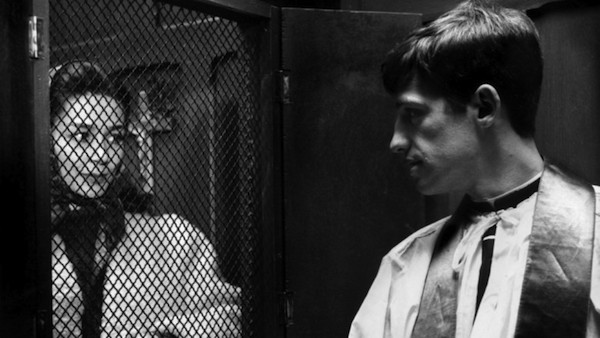
Of Melville’s resistance pieces, Léon Morin, Priest is the least aggressive and political. The resistance itself is more in the backdrop, as the plot is about a moral, sexual and spiritual exploration between a single mother named Barny and Léon Morin, a Catholic priest. He directs her towards Catholic teachings without directly trying to convert her, yet eventually and surprisingly, she converts on her own, perhaps to protect her daughter who is in hiding, and because of her romantic attraction to Morin.
Even though it does not make an overt statement about the resistance, there are a few subtle hints. One example is that her daughter is Jewish and named France, and she is sent away to avoid persecution during the occupation, only to return when the Germans leave. Other examples are in the dialog. When arguing with a co-worker about collaborating versus resisting, she says, “Better that France die than live in mortal sin.” Resistance efforts are often mentioned in passing. In one instance Morin mentions the bombing of a building, which Barny walked by without noticing. There are several areas where it could be argued that Melville is making statements about the resistance, such as Barny’s conversion – possibly she is converting to the resistance and away from collaboration.
Again, the film language here resembles 1930s poetic realism cinema. The quiet emphasis on character under the cloud of resistance recalls some of the gloomy late 1930s darker pictures. The story is dialog driven with little action, unlike other mainstream resistance pictures. The relationship between the two leads is high on drama, romanticism, poetry, and reality. Léon Morin, Priest was released in the midst of the French New Wave period, and the leads were both famous from New Wave films, yet the film had less in common with the films of its time and more in common with pre-war films.
It is also worth noting that Barny is communist, which Melville decidedly was not at the time, although there may (or may not) have been some lingering sympathies from the time that this was set. Since he had reformed, there is a chance that Barny’s transformation and conversion was a mirror of Melville’s change in political beliefs.
At first glance, the film is not as anti-French as Le silence de la mer, but there are some mixed messages. Melville is clearly pro-resistance, as expressed in Barny’s argument and by Morin’s actions and sympathies towards the Jewish, yet he is not as clearly pro-French. By Barny sending her daughter away, he could be implying that the real France is absent during the resistance, influencing Barny’s spiritual crisis. There is also the matter of Barny’s workplace and the contrast between resisting and collaborating. The fact that prominent characters are collaborators reopens some old wounds.
The biggest indictment and most surprising given Melville’s American influences is near the end of the movie after the Germans have left. The Americans have taken over, and two of them try to sleep with Barny. While they may be the French saviors, they are hardly morally superior to the Germans. After they leave, Barny’s daughter France asks “Are they Germans too?” Melville might have loved American films, but that did not mean he loved American soldiers in his homeland after the war had ended.
Army of Shadows
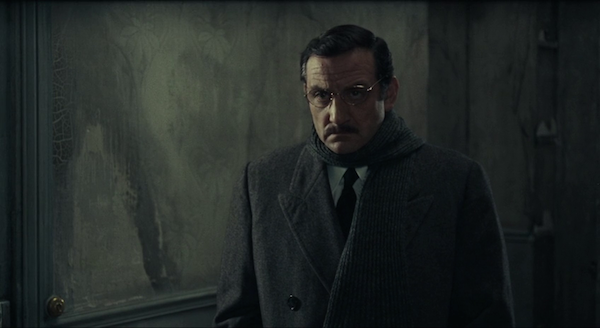
Of the three Melville resistance films, Army of Shadows is by far the most ambitious, the most personal, and the most highly regarded. It is the story of a resistance cell, mostly from the perspective of Philippe Gerbier, one of the upper level members. The character is allegedly a composite of people Melville actually knew. The story begins with his jailing and escape, and follows along his further adventures as an active member of a resistance group. It ends with the death of virtually everyone in the upper echelon of the organization. The film is both an adventure and a tragedy.
This was one of Melville’s final films, and was an outlier compared to his productions in this late era. Aside from Army of Shadows, his films were exclusively highly masculine gangster film. Like his previous two resistance pieces, this film had some dark minimalism, which was also present in some of his gangster films. The remnants of poetic realism and most other French influences were for the most part discarded in favor of American and English (primarily Hitchcock) crime films. The realism within the movie has less to do with the 1930s, and more to do with Melville’s personal experiences, including his hero worship from the time. His earlier, realism films countered the idea of resister as hero, whereas this film embraces and perpetuates it.
The message in this film is not subtle — the major players in the resistance were courageous, undeniable heroes, but that it was ultimately a waste of efforts, as it cost more lives than were saved. The fates of his main characters punctuates that the resistance was an unspeakable tragedy. While he does not place blame for the futility of the movement, it is hinted that the lack of organization among movements and the hesitation of the French populace to take sides doomed their efforts. Much of the time spent by the resisters in both the film and history, was in rooting out and executing traitors.
The evidence of Melville’s goal with this film is in what he changed from the source material. Ginette Vincendeau notes that Melville “changed the novel to a different vision of resistance characterized by misery and destruction.” She also notes that unlike the previous two resistance films, the Germans in Army of Shadows are unequivocally evil. There are no redeeming values or morality within any of them. Like with Melville’s gangster films, they are portrayed as the bad guys and are flat characters.
Even though more than 25 years had passed since the war ended and this film was produced, Melville’s personal experience screams at the viewer. His anger had not subsided. It is mostly directed towards the Germans, although the French are not unscathed. They are held accountable for incompetence, and they are often shown as collaborators who thwart the heroes. The key example is when Gerbier commands Mathilde to not carry a picture of her daughter with her. Mathilde disobeys and this is the one action that results in the undoing of the entire operation.
Conclusion
Melville spoke from experience when he made his three resistance films. His first resistance film was close enough to the war that the memories and emotions were still raw. This was both a cathartic and a career breakthrough for him. His second resistance film was a way for him to passively process the spiritual and moral dilemma that encompassed not just him personally, but the entire French people during the time. His final piece on the subject was by far the most autobiographical, the most personal and the most damning of the cause as a whole. Enough time had passed that he was able to tell the tale from a distance, using the American film style that he had become accustomed with. Even with the years in between, his anger towards the entire experience is palpable.
There were many filmmakers that addressed the resistance, including Louis Malle, Claude Chabrol, René Clément, Francois Truffaut, among others. While all of these filmmakers lived during the war and had personal experiences and emotions, they were not as deeply involved in the activities as Jean-Pierre Melville. Like many of them, he became a highly skilled director and had a way of expressing his experiences and ideals through film. As a result, his resistance films, particularly the first and last, are among the most profound and memorable on the subject.
Works Cited
Hayward, Susan. French National Cinema.
Phillips, Richard. World Socialist Web Site.
Vincendeau, Ginette. Jean-Pierre Melville: An American in Paris.
Williams, Alan. Republic of Images: A History of French Filmmaking.
Jubal, 1956, Delmer Daves

Western films are templates to tell a wide variety of stories, whether melodrama, action, or even an acid western like The Shooting. Many of them were adaptations of previously written material, some of which thinly veiled, and some not (like The Magnificent Seven adapted from Seven Samurai.)
Jubal is a more straightforward adaptation of Shakespeare’s Othello, a play that has been adapted several times in film. The Moor of Venice may not seem like a fit for the Western frontier, but the basic love triangle and betrayal fits perfectly. The film strays from the play, mostly to adhere to the Western formula, but the core characters of Othello (Ernest Borgnine’s Shep), Iago (Rod Steiger’s Pinky), Desdemona (Valerie French’s Mae) and finally, Cassio (Glenn Ford’s Jubal) are the same. Just like Iago and Cassio, Pinky is envious of Jubal’s unqualified rise to being promoted to foreman, and he plans a scheme to accuse Jubal of having an affair with Mae, thereby turning Shep against him. The rest is no surprise to people familiar with the play. The broad strokes are mostly the same until the final act.

Jackson Hole on display.
Jubal was shot in the shadow of Jackson Hole, Wyoming. It may not be as distinctive or common as Ford’s Monument Valley, and that adds to its charm of a location. The Upper Midwest is seldom used in Hollywood films, probably due to the distance from Hollywood. The Southwest frontier, whether in California or Arizona, has been used so many times that it is nearly a cliché of Western films. The towering monoliths of Jackson Hole provide for a welcome backdrop. They are aesthetically gorgeous and give the film a unique flavor. It may not be Venice from the original Othello, but it is comparatively exotic for a Western film. Some of the best shots are when they are on location, even if they are brief transitions from scene to scene.
The acting is the true spark, particularly Borgnine and Steiger, whose contrasting acting styles play off of each other well. Steiger was one of the definitive method actors, and this worked with his fiery, volatile way of reciting -– no, barking — his lines. Borgnine was not a method actor, and instead tried to reach into the emotion of his character. He had just done so successfully the year prior, bringing home his only Oscar for Marty, playing a similar character as Shep. Steiger was only a couple years removed from his notable portrayal of Charlie Malloy, opposite Brando’s Terry Malloy in On the Waterfront.

Ernest Borgnine as Shep
Like Marty, Shep is a gregarious and pleasant guy, but self-conscious and not as self-assured. He has a big laugh and is pleasant company for the guys, if not for the woman (Mae). He has a sense of morality, looking for people he can trust, which he finds in Jubal and appropriately rewards him. He sees through Pinky’s pomposity and finds he would be a good worker, but a poor leader. This decision, however logical, sets off the dispute that will lead to strife later. He just wants to live comfortably on his land, working productively and having a good time. While these are all admirable character traits, they also result in some naivety. He has a rosier picture of life than reality and is blind as to what happens under his nose.
Mae is a philanderer. Her character represents the loneliness of the push west. She married Shep because she knew he had a vast tract of land, only to find that the land is mostly empty. She is bored, not only of her life, but also of her husband. To be fair, Shep’s naivety extends to his own home. He misses the signs of his wife’s world-weariness and has some habits that annoy her. She chooses to live by carousing behind Shep’s back. We can tell early on that Pinky used to be her paramour. She shuns him for the new arrival of Jubal.

Shep, Jubal and Mae.
Compared to the rest of the cast, Glenn Ford is more of the straight man. This could be said for a lot of his roles. He was a good actor, but did not chew scenery like Steiger or delve deep into his character’s inner self like Borgnine. Instead he plays his character stoically. He is stuck in the middle and has the most integrity and the best of intentions. He resists Mae as much as he can, and while he eventually wears down, he does not take the relationship beyond the breaking point. He respects Shep and does not want to double cross him however tempting Mae’s pursuits. He flirts with her early on, showing her a brand and joking that she “better stay away from this or you might get burned,” a line that foreshadows future events.
The tension between Pinky and Jubal is palpable and played to great affect. Steiger’s outbursts, however inarticulate at times, speaks to the pernicious nature of his character. He continually pushes his rival, provoking him with dialog or more aggressively by firing a gun near him, pretending to aim for a nearby wild cat. There is an energy when Steiger is on screen, whether he is whittling away at Jubal, or manipulating the situation to come out on top. As he notices Mae and Jubal ride off during a poker game, he asks, “think your luck has changed, Shep?” He curiously looks at the pair take off, his mind at work, and for a change speaks softly with, “we’ll see.” Steiger is a terrific Iago, wearing both the emotion, the capriciousness, and the deviousness on his shirt sleeve.
I have not mentioned the religious group that takes refuge in Shep’s land. Pinky wants them to be on their way, but Jubal overrides him. In an act of kindness, he agrees to let them stay, to rest and regain some health before pushing further west. This group is used to develop Jubal as a benevolent character. He finds a love interest in a young girl, the daughter of one of the elders, who is promised to marry another member of their worshippers.
These scenes are useful for developing Glenn Ford’s inner conflict as a leading man, but because Ford does not have the same acting chops as Steiger or Borgnine, this is the least interesting part of the movie. Anytime the film veers away from the brewing conflict, it becomes tedious. The third act diverges from the play and relies more on Ford and the religious group to bring the story home. That makes it end with a whimper rather than a bang. If they had stuck to the play, even without the traditional Hollywood ending, the movie could have been much better.
Film Rating: 6.5/10
Supplements:
None.
This is the first of several discs I’ve reviewed that has no supplements. For these I’m deducting 2 points from the film rating to get my Criterion rating.
Criterion Rating: 4.5
The Thin Blue Line, 1988, Errol Morris

Before there was Paradise Lost, Serial or The Jinx, there was The Thin Blue Line. Even if it was not the first true crime in media (America’s Most Wanted’s debut was the same year of its release), it feels like it. A good argument could be made that it is the most influential crime documentary of all time, and it has influenced countless other crime stories, not to mention documentaries in general. In addition to being revolutionary from a filmmaking perspective, it also set the pace for criminal advocacy filmmaking, which has successfully brought attention and scrutiny to victims of the justice system. In many cases, including all of the ones I’ve cited in this paragraph, it has contributed to revelations in the case.
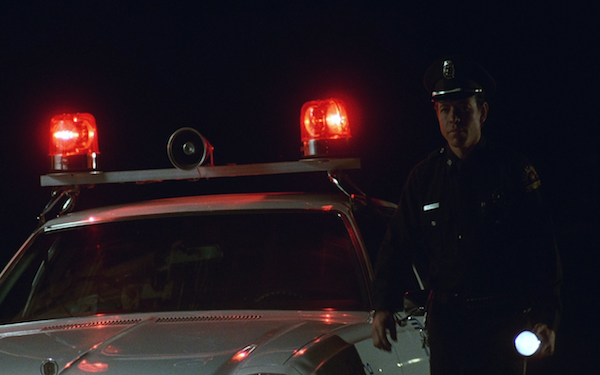
Reenactment of the crime.
That’s not to say that The Thin Blue Line is not without controversy. It broke a cardinal rule of documentary filmmaking by actually reenacting the crime and other situations. Of course the idea of cinematic purity is a silly one, and I’ve debated it already when discussing My Winnipeg. Plenty of celebrated filmmakers have played with their subjects and shown things that are not true. Whether they are the staged actors of Robert Flaherty or the deliberate interaction between the filmmakers and subjects in Harlan County, USA, that line has been blurred many times in the past.
Errol Morris played with the truth by re-staging the murder, hiring actors to portray the key participants, including the two police on the scene, and the one (or two) alleged killers. This may not be “true” cinema or “vérité,” but in the case of this film, it enhances the understanding of the crime. If we just had talking head interviews or court transcripts to describe the events, the film would be bland and the crime difficult to visualize. Morris is getting the most out of the visual nature of film. Plenty of documentaries have done the same thing, including the Serial podcast, which tried to reproduce of the events of their subject to see if they fit the alleged timeline. Together with one of several great Philip Glass scores to Morris movies, the restaging makes for a more watchable documentary, while still having enough interviews and testimonials for credibility.

David Harris
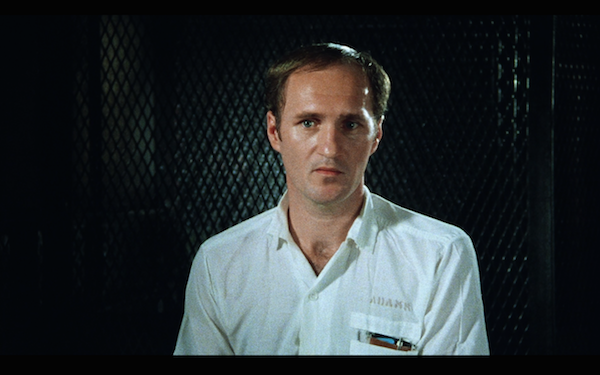
Randall Adams
What happened on the night of November 27th, 1976? That’s what Errol Morris endeavors to uncover. He tackles the case with vigor and sheds light on the political and judicial process that allowed for a man to be convicted when he claimed he was innocent. When the film begins, we learn that a car was pulled over by the police, and officer Robert Wood was shot dead when he approached the driver. He had a partner in the car, but her view and memory of the incident would not conclusively lead to the killer. Instead the police relied on the testimony of David Harris, a 16-year old kid, against Randall Adams, a 28-year old that had recently moved to Texas.
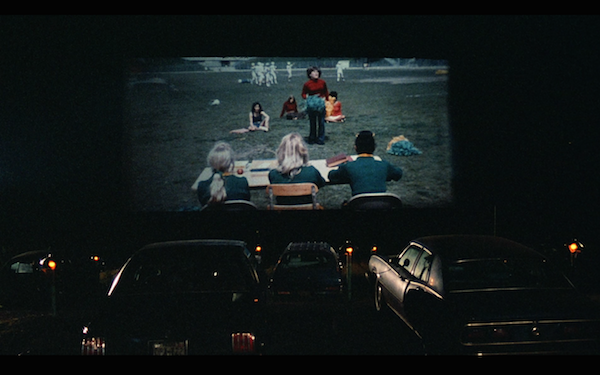
Reenactment of the drive-in.
Morris spends a great deal of time talking to Harris and Adams, both of whom are in jail. They tell their version of events on the day, but their interviews, like David’s testimony and Randall’s statement, do not match up. Adams insists that he was innocent. He says his car ran out of gas earlier that day. Harris picked him up in a stolen car, and they spent the day together drinking, drugging and later going to a drive-in movie. Adams says that he went home afterward, whereas Harris says that they were still together and Adams was driving when the incident occurred.
Morris does not stop at just the victims. He explores the entirety of the Texas judicial system, particularly how they are obsessed with the death penalty. That is why Adams thinks he was ultimately convicted because, as he put it, the D.A. “wanted to kill me.” Since he was older, he could be given the death penalty, whereas Harris was a minor so the chances were slim. With this being a cop-killing and a frustratingly unsuccessful and prolonged investigation, the D.A. put together a flimsy case and achieved a conviction. According to Adams, the system was more interested in clearing the case than finding the truth.
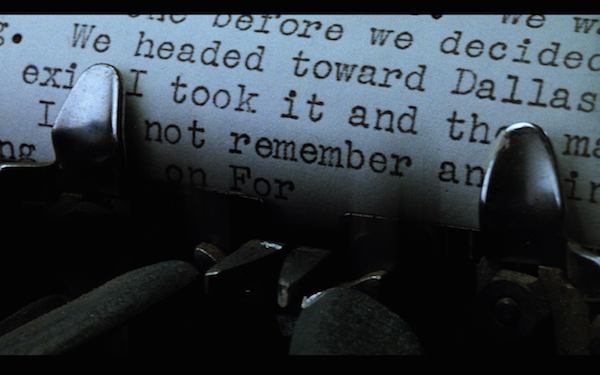
Reenactment of the Adams statement.
One man’s word against another is not usually enough to get a conviction. Adams was a suspect and gave a statement, which was transcribed on a typewriter. Morris again reenacted this for the screen. It is one of many examples of him using a visual, filmic element to reveal part of the story. Adams’ statement only said that he and Harris were together, but did not touch on the events later in the evening. Adams signed it, and it was considered to be close to a confession. The newspapers even reported it as such.
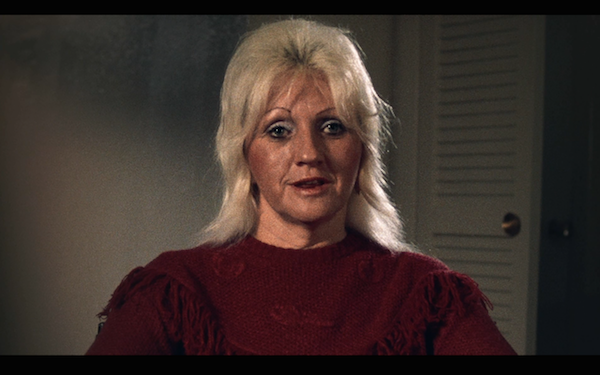
Witness 1
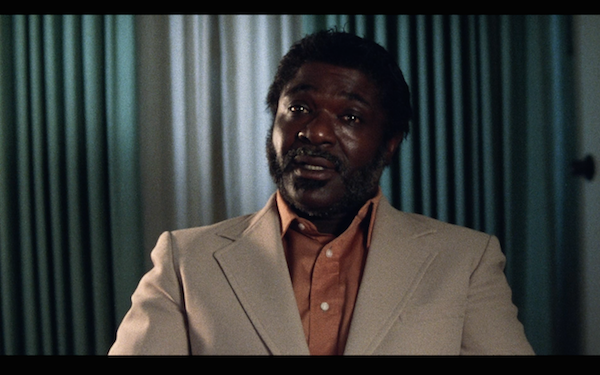
Witness 2
During the trial, eyewitnesses came forward. Morris had unfettered access to most people in the case, including the attorneys, the judge, and some of the witnesses. When Morris puts the eyewitnesses them in front of the camera and asks frank questions, he gets surprising answers. Even if Adams was guilty, it is clear that this was not a open and shut case. There were issues at every stage of the process, from the investigation to the prosecution.
Why would people go to such lengths to obtain a conviction? Why would people compromise their integrity to put someone away? Unlike his later films, we don’t see or hear Morris on camera, but we can tell that he asks tough questions and gets revealing answers. We get an idea why the witnesses testify. Was it because they had some self-interest or because they legitimately witnessed the crime? That depends on who you believe. As to why the police were invested in a conviction, well that is answered with the D.A.’s opening statement. He says that there is a “Thin Blue Line” that protects the people from anarchy. That line has to be protected. Adams would say that they were doing the opposite by turning away from the truth.

The pivotal moment.
The great thing about this movie is not only that it asks the questions, but it also provides answers. Yes, it provides THE answer. It is not a clear “so and so killed him in such and such way.” It is a veiled and carefully worded statement, captured on an audio recording. The image of the tape recorder playing back that interview is the most memorable and shocking of the entire movie. By the end of the movie, we know who killed Officer Wood. I will not reveal it here because the movie is a must see, but I will say that people’s lives were changed as a direct result of that tape recording and this film.
Film Rating: 9.5/10
Supplements
Errol Morris Interview: When I first read about the supplements on this disc, I was disappointed that there was not a commentary. When I got to the 2014 Errol Morris interview, that disappointment vanished.
Of course he would do an interview. That’s his thing! And he made for a fascinating subject, and probably provided a great deal of information that would have been on the commentary, but through the interview format, he is able to retell it as stories. The 40-minutes went by like lightning. It was fascinating hearing his experiences. I actually took about 600-700 words of notes while watching, which is far too much to write here. Plus I don’t want to spoil what he says. Instead, below is a list of the topics he delves into:
- The reenactment. He explains why he chose this method and what he hoped to accomplish.
- He talks about his background as a Private Detective and how this influenced his work on the film.
- He talks about his exposure to the Texas justice system through meeting another subject.
- He discusses his first impressions of the trial transcripts and the case when he first began considering this as a topic.
- The most fascinating part is when he talks about how he interviewed the person that would later be revealed as the killer. He immediately knew the truth when meeting this person and tells a story of how he feared for his life.
- He talks about the witnesses, especially Emily Miller.
- He delves into the film’s ending and his feelings about his findings.
- He talks about the aftermath of the movie and his relationship with the subjects.
Joshua Oppenheimer: Director of The Act of Killing.
Oppenheimer is a young documentarian, but he earned a lot of credibility with his first feature film. Like many documentaries (or one might say almost all), it owes a great debt to Errol Morris. He says that to call The Thin Blue Line great is to diminish it. The movie redefined the idea of a documentary.
Oppenheimer talks about the idea of using reenactment as a way to “excavate layer upon layer” of the story. In the film, we never see what really happened. Frankly, we never really know. We see incorrect versions based on whoever is telling the story. This shows that the participants are telling lies, but they believe their lies.
He also addresses direct cinema, the filmmaking style of the reenactments and his overall impressions. This is a shorter interview, but it is enlightening
Today Show: This is a 5-minute segment with Randall Adams, Randy Schaffer and Errol Morris. They talk about the aftermath of what happened and how the experience impacted all of their lives.
Criterion Rating: 8.5/10
Ride the Pink Horse, 1947, Robert Montgomery

I’ve talked before about “regulated differences” before when discussing La Promesse (link) by the Dardennes. When looking at a film noir, the theory still holds weight, or if anything is more relevant. By 1947, noir was starting to be thought of as a genre (would more accurately be called a “cycle”) thanks to the French critics like André Bazin. 1946 had been a watershed year for noir with The Big Sleep and The Killers pushing the boundaries, but there were still a great deal of constants. The protagonists were almost always confident to the point of cockiness, and aside from angst, frustration and confusion, would rarely show emotion. Their characterizations were often stoic and rugged, with a heavy dose of masculinity. Even they often were fallible, naïve, and subject to being bamboozled by femme fatales, they still rarely showed softness or humanity.
We appreciate the two noir films I just mentioned because they are inventive with plot structure and narrative, but they still hold true to the conventions. Ride the Pink Horse begins by staying within these conventions, yet at some point things start to crack. The façade fades, and we see weakness. The protagonist ends up losing control, becoming a shell of himself. He is so weak and incoherent that he is helpless to resolve his plotline, much less even comprehend how far he has fallen. That is Robert Mongtomery’s take on noir. While it does not measure up to the best of the genre, it is worthy of respect and admiration for showing a different and unique facet. This weakness and humanity is one of several regulated differences within the film, but it is the cornerstone of the structure. It is existential in this regard. Some things are just out of our control, yet we try to persist.

San Pablo, Mexico
Robert Montgomery acts and directs, and through both he brings a distinct sense of style. He uses lengthy takes, gives the scene some breathing room for events to unravel. As an actor, he begins with the custom, stoic characterization found in noir films. He is emotionally and personally impenetrable, working only towards the goal of avenging his lost friend Shorty. He believes Shorty was taken down by the suave and charismatic war profiteer, Frank Hugo, who is in a class amongst himself and lords over the poor town of San Pablo, Mexico.
When Gagin arrives in San Pablo off of the bus, he is stern and forthright. He walks into the train station and walks out, sizing the place up without an expression on his face. He means business. Later he encounters two women that welcome him with a certain wanting. They are more attracted to the fact that he is a well-dressed American, but he picks up on their ruse and rejects them. Instead a younger, shy Indian girl catches his attention. He asks for her to direct him around town not because of any attraction, but because she is non-threatening.
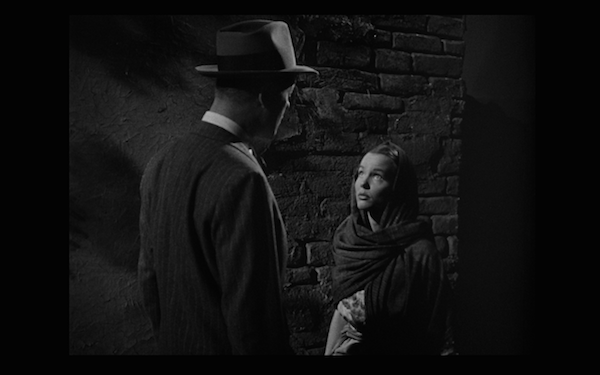
Gagin and Pila
Later he befriends a local Mexican, Pancho, who becomes his caretaker and friend. Pancho calls Gagin “The Man With No Place,” and opens up his house to the stranger. They become fast friends, and creaks start to show in Gagin’s impenetrable resolve.

Gagin and the exuberant Pancho.
“The Man With No Place,” is an appropriate label for a lot of noir lead characters. Many noir films feature private detectives as the protagonists, but deep exposition is not usually necessary. They are almost always hard-boiled, and revealing why would shatter the mystique. The assumption is they have become so tough because they’ve seen so much trouble that they are now jaded towards the world. We learn very little of their origins or backstory. Can you imagine Sam Spade talking about daddy issues when he was growing up? It just doesn’t happen. We learn about the characters and their motivation as they interact with other characters.
That’s why I love the label of “The Man With No Place” for Gagin. We know next to nothing about where he came from. We know he arrived in a bus and that his motivation is revenge for the loss of his friend, Shorty, but that is it. As a character, he has no place. If he makes it through this mess, we have no idea where he’ll return to or whether things will improve. We do learn about his feelings toward the world based on his interactions. For Gagin, we learn that he favors the lower classes and even a government investigator over the upper classes. Based on his dress, this is an unusual mindset since he has an upper class appearance. That is why the girls took notice of him early on. We do not know why or how he became to despise the rich. A good bet would be whatever happened to Shorty, but since he is “The Man With No Place,” this does not need to be explained.
Frank Hugo and Pancho have a couple things in common. First of all, they are both charismatic and personable. Even though Hugo is not trustworthy, he does lure you in and at times is a likeable character. Pancho is a delight, and Thomas Gomez was rightfully nominated for an Oscar for the portrayal. He is as benevolent as they come, and just lives to enjoy life. The key difference between him and Hugo are not just the class they occupy, but their feelings towards money and consumerism. Hugo cannot get enough money and power, whereas Pancho has little care for money or material things. Gagin identifies and appreciates Pancho’s values, but he is squarely in the middle. While his resentment of the upper class machine is palpable, money is part of his motivation, probably as a means of self preservation. In one scene he even tries to cut Pancho in for $5,000, which he sees as a gesture of friendship, but turns out to be one of ignorance. Pancho could care less about $5,000.

Marjorie is the femme fatale.
Another way this diverges from the traditional noir is in how it handles the femme fatale. In many noir films, the femme fatale has a bit of irresistibility and the hero cannot help but fall for her charms. This time, Marjorie Lundeen fills that role and appeals to Gagin, trying to lure him with both her looks and the potential for money. Her motivation is the same as most noir females. She is not on Gagin’s side and will double cross him anyway. He rejects her categorically. A significant scene where this is demonstrated is when he takes Pila to dinner. At first she seems out of place, even remarking on how unusual it is to eat a fruit cocktail. Marjorie approaches during the meal and asks Pila to step aside so the grown ups can talk. Pila, obedient as ever, obliges. Gagin hears out Marjorie’s offer, but inevitably sends her away for the lower class and more demure Pila.
Things do not go as they planned, and violence ensues. One location that I have not mentioned, yet is important to the plot, is the titular Pink Horse. This horse is part of a carousel, which is where the lower classes and especially children take pleasure. Pancho identifies more with this group, and young Pila belongs to both of them. This carousel is also important because it is where Gagin first shows humanity, where he cracks a smile while watching a girl ride.
The Pink Horse corrupted.
There is a fantastic scene where a violent action is taking place in front of the children in the carousel. We see very little of the violence, but instead see the anguished reaction on the children’s faces, and this includes Pila. This object of base pleasure becomes desecrated with violence by the powerful, which is just another example of how unfair and unequal life is in this small Mexican town.

Montgomery gives a fantastic performance, especially in this scene of Gagin’s weakness.
I will spare details from the ending of the plot because it is quite an experience to watch on your own. I will say again that things work out differently than most noirs. The lead character becomes impotent in his fight, and must rely on the help of his friends. By this point his character has transformed from the hard-boiled and stereotypical noir hero to a needful victim.
Tonally and thematically, the film is all over the place. At times it is pure noir, with dark shadows and shady characters. At others it is rosy and uplifting where the sun is shining brightly. The lengthy opening scene has both attributes. The sun is shining, but Gagin has his own personal shadows. Over time, his personality changes and the landscape varies from the confrontational Hugo apartment to a festival. These tonal changes are a welcome change from the noir template, as they develop not only the characters, but they give the film an identity that separates it from dozens of other noir pictures.
Film Rating: 7.5/10
Supplements
Commentary with Alain Silver and James Ursini: These are Film Noir historians.
Robert Montgomery was instrumental in breaking the barriers between actors and directors. He was one of the first who had gone from acting to directing and achieved success.
He had a unique style. For instance he uses long takes, notably with the intro shot, which give an added level of suspense and more of a sense of place. Montgomery learned a lot of technical tools from John Ford, who was his mentor. With this film he was parodying noir stereotypes. He does not cut unless he has to. There are not many point of view or reaction shots unless they are absolutely necessary to say something.
Pila is surrounded by some mysticism, most of which comes from Native American stereotypes. She sees him dead and makes a comment about him being knifed. She also is a major factor in getting Gagin to change. One of the commentators says this is a “movie is about reformation, redemption in many respects.”
The restaurant scene is important for many reasons. For one, there are elements of romantic comedy between Gagin and Pila, and then it is interrupted by Marjorie and it switches back to noir. Gagin’s reaction to her, as well as all the other people ijn the restaurant that give him looks, is a reference to his hatred of the snobbishness amid the upper crust of society.
In Lonely Places: Interview with Imogen Sara Smith, author of In Lonely Places: Film Noir Beyond the City.
Noir is not a genre. It is about mood and themes, interiority, psychology and motivations. There are many classic noirs set outside of the city, which is Smith’s study topic. Detour is one example of many in America, while Touch of Evil is an example of Mexico.
Mexico is important for noir because it is a place people escape to. It is used often and is portrayed as transient, lawless. Unlike other Mexican noirs, Ride the Pink Horse pays a lot more attention to local people and their culture rather than just on other Americans.
Dorothy B Hughes, the author of the book that Montgomery adapted, was interested in characters, environments, class, and how these influence development. We see a fiesta in the movie, but the novel has a lot more detail about fiestas and Mexican rituals.
Smith calls it an anti-noir. She concludes that is opposed to most noirs. It can still be categorized as a noir, but is more optimistic.
Radio Adaptation – More of a novelty. I’ve said this before, but this is the type of thing that I wish they would let you take with you. I listened to the first 20 minutes or so, and found it enjoyable as they recreate the action of the movie, but of course it pales in comparison.
Criterion Rating: 8/10


 Criterion Close-Up