Category Archives: Criterions
The Thin Blue Line, 1988, Errol Morris

Before there was Paradise Lost, Serial or The Jinx, there was The Thin Blue Line. Even if it was not the first true crime in media (America’s Most Wanted’s debut was the same year of its release), it feels like it. A good argument could be made that it is the most influential crime documentary of all time, and it has influenced countless other crime stories, not to mention documentaries in general. In addition to being revolutionary from a filmmaking perspective, it also set the pace for criminal advocacy filmmaking, which has successfully brought attention and scrutiny to victims of the justice system. In many cases, including all of the ones I’ve cited in this paragraph, it has contributed to revelations in the case.
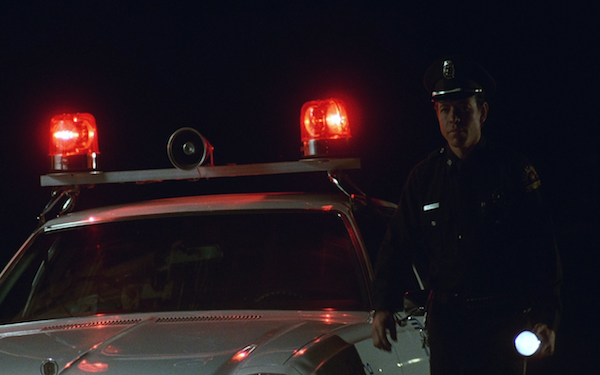
Reenactment of the crime.
That’s not to say that The Thin Blue Line is not without controversy. It broke a cardinal rule of documentary filmmaking by actually reenacting the crime and other situations. Of course the idea of cinematic purity is a silly one, and I’ve debated it already when discussing My Winnipeg. Plenty of celebrated filmmakers have played with their subjects and shown things that are not true. Whether they are the staged actors of Robert Flaherty or the deliberate interaction between the filmmakers and subjects in Harlan County, USA, that line has been blurred many times in the past.
Errol Morris played with the truth by re-staging the murder, hiring actors to portray the key participants, including the two police on the scene, and the one (or two) alleged killers. This may not be “true” cinema or “vérité,” but in the case of this film, it enhances the understanding of the crime. If we just had talking head interviews or court transcripts to describe the events, the film would be bland and the crime difficult to visualize. Morris is getting the most out of the visual nature of film. Plenty of documentaries have done the same thing, including the Serial podcast, which tried to reproduce of the events of their subject to see if they fit the alleged timeline. Together with one of several great Philip Glass scores to Morris movies, the restaging makes for a more watchable documentary, while still having enough interviews and testimonials for credibility.

David Harris
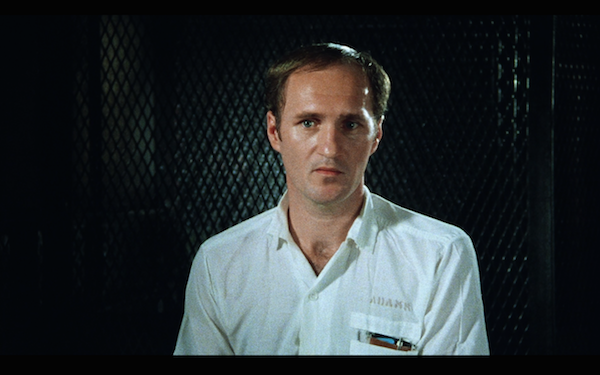
Randall Adams
What happened on the night of November 27th, 1976? That’s what Errol Morris endeavors to uncover. He tackles the case with vigor and sheds light on the political and judicial process that allowed for a man to be convicted when he claimed he was innocent. When the film begins, we learn that a car was pulled over by the police, and officer Robert Wood was shot dead when he approached the driver. He had a partner in the car, but her view and memory of the incident would not conclusively lead to the killer. Instead the police relied on the testimony of David Harris, a 16-year old kid, against Randall Adams, a 28-year old that had recently moved to Texas.
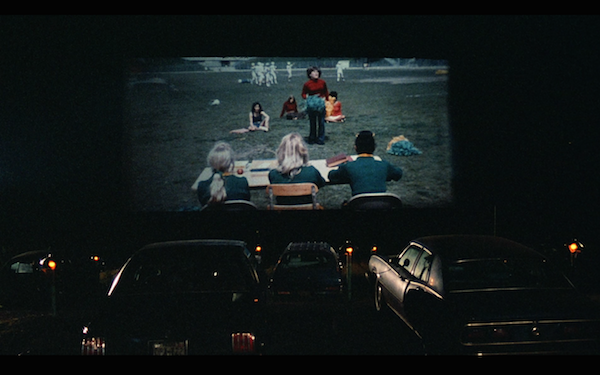
Reenactment of the drive-in.
Morris spends a great deal of time talking to Harris and Adams, both of whom are in jail. They tell their version of events on the day, but their interviews, like David’s testimony and Randall’s statement, do not match up. Adams insists that he was innocent. He says his car ran out of gas earlier that day. Harris picked him up in a stolen car, and they spent the day together drinking, drugging and later going to a drive-in movie. Adams says that he went home afterward, whereas Harris says that they were still together and Adams was driving when the incident occurred.
Morris does not stop at just the victims. He explores the entirety of the Texas judicial system, particularly how they are obsessed with the death penalty. That is why Adams thinks he was ultimately convicted because, as he put it, the D.A. “wanted to kill me.” Since he was older, he could be given the death penalty, whereas Harris was a minor so the chances were slim. With this being a cop-killing and a frustratingly unsuccessful and prolonged investigation, the D.A. put together a flimsy case and achieved a conviction. According to Adams, the system was more interested in clearing the case than finding the truth.
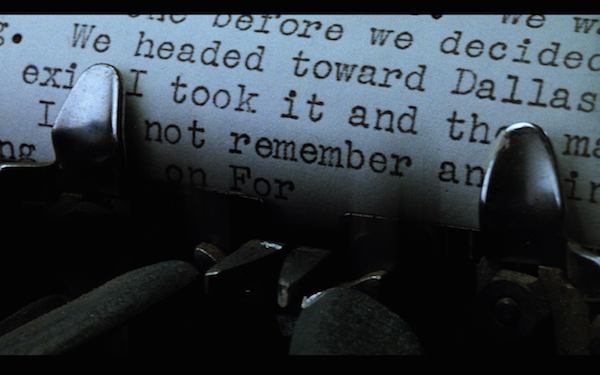
Reenactment of the Adams statement.
One man’s word against another is not usually enough to get a conviction. Adams was a suspect and gave a statement, which was transcribed on a typewriter. Morris again reenacted this for the screen. It is one of many examples of him using a visual, filmic element to reveal part of the story. Adams’ statement only said that he and Harris were together, but did not touch on the events later in the evening. Adams signed it, and it was considered to be close to a confession. The newspapers even reported it as such.
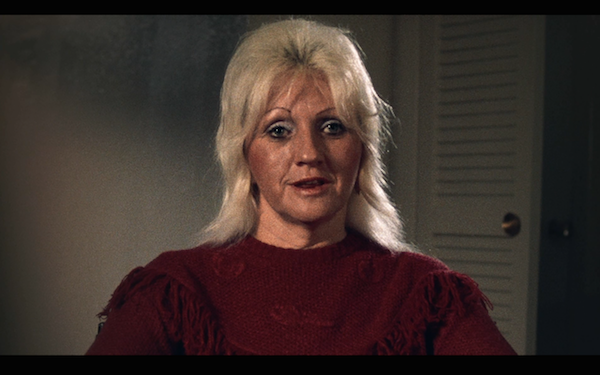
Witness 1
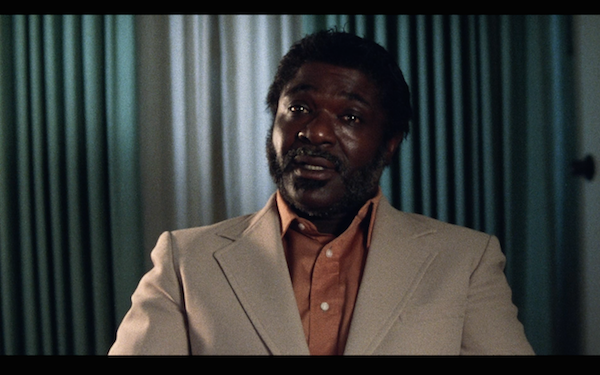
Witness 2
During the trial, eyewitnesses came forward. Morris had unfettered access to most people in the case, including the attorneys, the judge, and some of the witnesses. When Morris puts the eyewitnesses them in front of the camera and asks frank questions, he gets surprising answers. Even if Adams was guilty, it is clear that this was not a open and shut case. There were issues at every stage of the process, from the investigation to the prosecution.
Why would people go to such lengths to obtain a conviction? Why would people compromise their integrity to put someone away? Unlike his later films, we don’t see or hear Morris on camera, but we can tell that he asks tough questions and gets revealing answers. We get an idea why the witnesses testify. Was it because they had some self-interest or because they legitimately witnessed the crime? That depends on who you believe. As to why the police were invested in a conviction, well that is answered with the D.A.’s opening statement. He says that there is a “Thin Blue Line” that protects the people from anarchy. That line has to be protected. Adams would say that they were doing the opposite by turning away from the truth.

The pivotal moment.
The great thing about this movie is not only that it asks the questions, but it also provides answers. Yes, it provides THE answer. It is not a clear “so and so killed him in such and such way.” It is a veiled and carefully worded statement, captured on an audio recording. The image of the tape recorder playing back that interview is the most memorable and shocking of the entire movie. By the end of the movie, we know who killed Officer Wood. I will not reveal it here because the movie is a must see, but I will say that people’s lives were changed as a direct result of that tape recording and this film.
Film Rating: 9.5/10
Supplements
Errol Morris Interview: When I first read about the supplements on this disc, I was disappointed that there was not a commentary. When I got to the 2014 Errol Morris interview, that disappointment vanished.
Of course he would do an interview. That’s his thing! And he made for a fascinating subject, and probably provided a great deal of information that would have been on the commentary, but through the interview format, he is able to retell it as stories. The 40-minutes went by like lightning. It was fascinating hearing his experiences. I actually took about 600-700 words of notes while watching, which is far too much to write here. Plus I don’t want to spoil what he says. Instead, below is a list of the topics he delves into:
- The reenactment. He explains why he chose this method and what he hoped to accomplish.
- He talks about his background as a Private Detective and how this influenced his work on the film.
- He talks about his exposure to the Texas justice system through meeting another subject.
- He discusses his first impressions of the trial transcripts and the case when he first began considering this as a topic.
- The most fascinating part is when he talks about how he interviewed the person that would later be revealed as the killer. He immediately knew the truth when meeting this person and tells a story of how he feared for his life.
- He talks about the witnesses, especially Emily Miller.
- He delves into the film’s ending and his feelings about his findings.
- He talks about the aftermath of the movie and his relationship with the subjects.
Joshua Oppenheimer: Director of The Act of Killing.
Oppenheimer is a young documentarian, but he earned a lot of credibility with his first feature film. Like many documentaries (or one might say almost all), it owes a great debt to Errol Morris. He says that to call The Thin Blue Line great is to diminish it. The movie redefined the idea of a documentary.
Oppenheimer talks about the idea of using reenactment as a way to “excavate layer upon layer” of the story. In the film, we never see what really happened. Frankly, we never really know. We see incorrect versions based on whoever is telling the story. This shows that the participants are telling lies, but they believe their lies.
He also addresses direct cinema, the filmmaking style of the reenactments and his overall impressions. This is a shorter interview, but it is enlightening
Today Show: This is a 5-minute segment with Randall Adams, Randy Schaffer and Errol Morris. They talk about the aftermath of what happened and how the experience impacted all of their lives.
Criterion Rating: 8.5/10
Ride the Pink Horse, 1947, Robert Montgomery

I’ve talked before about “regulated differences” before when discussing La Promesse (link) by the Dardennes. When looking at a film noir, the theory still holds weight, or if anything is more relevant. By 1947, noir was starting to be thought of as a genre (would more accurately be called a “cycle”) thanks to the French critics like André Bazin. 1946 had been a watershed year for noir with The Big Sleep and The Killers pushing the boundaries, but there were still a great deal of constants. The protagonists were almost always confident to the point of cockiness, and aside from angst, frustration and confusion, would rarely show emotion. Their characterizations were often stoic and rugged, with a heavy dose of masculinity. Even they often were fallible, naïve, and subject to being bamboozled by femme fatales, they still rarely showed softness or humanity.
We appreciate the two noir films I just mentioned because they are inventive with plot structure and narrative, but they still hold true to the conventions. Ride the Pink Horse begins by staying within these conventions, yet at some point things start to crack. The façade fades, and we see weakness. The protagonist ends up losing control, becoming a shell of himself. He is so weak and incoherent that he is helpless to resolve his plotline, much less even comprehend how far he has fallen. That is Robert Mongtomery’s take on noir. While it does not measure up to the best of the genre, it is worthy of respect and admiration for showing a different and unique facet. This weakness and humanity is one of several regulated differences within the film, but it is the cornerstone of the structure. It is existential in this regard. Some things are just out of our control, yet we try to persist.

San Pablo, Mexico
Robert Montgomery acts and directs, and through both he brings a distinct sense of style. He uses lengthy takes, gives the scene some breathing room for events to unravel. As an actor, he begins with the custom, stoic characterization found in noir films. He is emotionally and personally impenetrable, working only towards the goal of avenging his lost friend Shorty. He believes Shorty was taken down by the suave and charismatic war profiteer, Frank Hugo, who is in a class amongst himself and lords over the poor town of San Pablo, Mexico.
When Gagin arrives in San Pablo off of the bus, he is stern and forthright. He walks into the train station and walks out, sizing the place up without an expression on his face. He means business. Later he encounters two women that welcome him with a certain wanting. They are more attracted to the fact that he is a well-dressed American, but he picks up on their ruse and rejects them. Instead a younger, shy Indian girl catches his attention. He asks for her to direct him around town not because of any attraction, but because she is non-threatening.
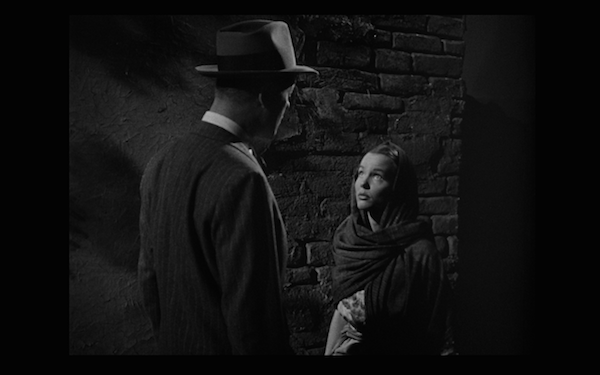
Gagin and Pila
Later he befriends a local Mexican, Pancho, who becomes his caretaker and friend. Pancho calls Gagin “The Man With No Place,” and opens up his house to the stranger. They become fast friends, and creaks start to show in Gagin’s impenetrable resolve.

Gagin and the exuberant Pancho.
“The Man With No Place,” is an appropriate label for a lot of noir lead characters. Many noir films feature private detectives as the protagonists, but deep exposition is not usually necessary. They are almost always hard-boiled, and revealing why would shatter the mystique. The assumption is they have become so tough because they’ve seen so much trouble that they are now jaded towards the world. We learn very little of their origins or backstory. Can you imagine Sam Spade talking about daddy issues when he was growing up? It just doesn’t happen. We learn about the characters and their motivation as they interact with other characters.
That’s why I love the label of “The Man With No Place” for Gagin. We know next to nothing about where he came from. We know he arrived in a bus and that his motivation is revenge for the loss of his friend, Shorty, but that is it. As a character, he has no place. If he makes it through this mess, we have no idea where he’ll return to or whether things will improve. We do learn about his feelings toward the world based on his interactions. For Gagin, we learn that he favors the lower classes and even a government investigator over the upper classes. Based on his dress, this is an unusual mindset since he has an upper class appearance. That is why the girls took notice of him early on. We do not know why or how he became to despise the rich. A good bet would be whatever happened to Shorty, but since he is “The Man With No Place,” this does not need to be explained.
Frank Hugo and Pancho have a couple things in common. First of all, they are both charismatic and personable. Even though Hugo is not trustworthy, he does lure you in and at times is a likeable character. Pancho is a delight, and Thomas Gomez was rightfully nominated for an Oscar for the portrayal. He is as benevolent as they come, and just lives to enjoy life. The key difference between him and Hugo are not just the class they occupy, but their feelings towards money and consumerism. Hugo cannot get enough money and power, whereas Pancho has little care for money or material things. Gagin identifies and appreciates Pancho’s values, but he is squarely in the middle. While his resentment of the upper class machine is palpable, money is part of his motivation, probably as a means of self preservation. In one scene he even tries to cut Pancho in for $5,000, which he sees as a gesture of friendship, but turns out to be one of ignorance. Pancho could care less about $5,000.

Marjorie is the femme fatale.
Another way this diverges from the traditional noir is in how it handles the femme fatale. In many noir films, the femme fatale has a bit of irresistibility and the hero cannot help but fall for her charms. This time, Marjorie Lundeen fills that role and appeals to Gagin, trying to lure him with both her looks and the potential for money. Her motivation is the same as most noir females. She is not on Gagin’s side and will double cross him anyway. He rejects her categorically. A significant scene where this is demonstrated is when he takes Pila to dinner. At first she seems out of place, even remarking on how unusual it is to eat a fruit cocktail. Marjorie approaches during the meal and asks Pila to step aside so the grown ups can talk. Pila, obedient as ever, obliges. Gagin hears out Marjorie’s offer, but inevitably sends her away for the lower class and more demure Pila.
Things do not go as they planned, and violence ensues. One location that I have not mentioned, yet is important to the plot, is the titular Pink Horse. This horse is part of a carousel, which is where the lower classes and especially children take pleasure. Pancho identifies more with this group, and young Pila belongs to both of them. This carousel is also important because it is where Gagin first shows humanity, where he cracks a smile while watching a girl ride.
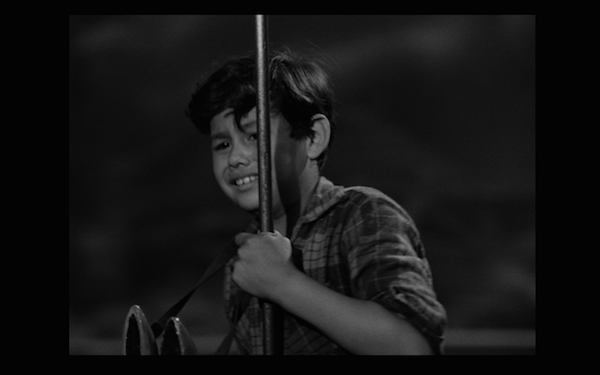
The Pink Horse corrupted.
There is a fantastic scene where a violent action is taking place in front of the children in the carousel. We see very little of the violence, but instead see the anguished reaction on the children’s faces, and this includes Pila. This object of base pleasure becomes desecrated with violence by the powerful, which is just another example of how unfair and unequal life is in this small Mexican town.

Montgomery gives a fantastic performance, especially in this scene of Gagin’s weakness.
I will spare details from the ending of the plot because it is quite an experience to watch on your own. I will say again that things work out differently than most noirs. The lead character becomes impotent in his fight, and must rely on the help of his friends. By this point his character has transformed from the hard-boiled and stereotypical noir hero to a needful victim.
Tonally and thematically, the film is all over the place. At times it is pure noir, with dark shadows and shady characters. At others it is rosy and uplifting where the sun is shining brightly. The lengthy opening scene has both attributes. The sun is shining, but Gagin has his own personal shadows. Over time, his personality changes and the landscape varies from the confrontational Hugo apartment to a festival. These tonal changes are a welcome change from the noir template, as they develop not only the characters, but they give the film an identity that separates it from dozens of other noir pictures.
Film Rating: 7.5/10
Supplements
Commentary with Alain Silver and James Ursini: These are Film Noir historians.
Robert Montgomery was instrumental in breaking the barriers between actors and directors. He was one of the first who had gone from acting to directing and achieved success.
He had a unique style. For instance he uses long takes, notably with the intro shot, which give an added level of suspense and more of a sense of place. Montgomery learned a lot of technical tools from John Ford, who was his mentor. With this film he was parodying noir stereotypes. He does not cut unless he has to. There are not many point of view or reaction shots unless they are absolutely necessary to say something.
Pila is surrounded by some mysticism, most of which comes from Native American stereotypes. She sees him dead and makes a comment about him being knifed. She also is a major factor in getting Gagin to change. One of the commentators says this is a “movie is about reformation, redemption in many respects.”
The restaurant scene is important for many reasons. For one, there are elements of romantic comedy between Gagin and Pila, and then it is interrupted by Marjorie and it switches back to noir. Gagin’s reaction to her, as well as all the other people ijn the restaurant that give him looks, is a reference to his hatred of the snobbishness amid the upper crust of society.
In Lonely Places: Interview with Imogen Sara Smith, author of In Lonely Places: Film Noir Beyond the City.
Noir is not a genre. It is about mood and themes, interiority, psychology and motivations. There are many classic noirs set outside of the city, which is Smith’s study topic. Detour is one example of many in America, while Touch of Evil is an example of Mexico.
Mexico is important for noir because it is a place people escape to. It is used often and is portrayed as transient, lawless. Unlike other Mexican noirs, Ride the Pink Horse pays a lot more attention to local people and their culture rather than just on other Americans.
Dorothy B Hughes, the author of the book that Montgomery adapted, was interested in characters, environments, class, and how these influence development. We see a fiesta in the movie, but the novel has a lot more detail about fiestas and Mexican rituals.
Smith calls it an anti-noir. She concludes that is opposed to most noirs. It can still be categorized as a noir, but is more optimistic.
Radio Adaptation – More of a novelty. I’ve said this before, but this is the type of thing that I wish they would let you take with you. I listened to the first 20 minutes or so, and found it enjoyable as they recreate the action of the movie, but of course it pales in comparison.
Criterion Rating: 8/10
A Tale of Two Blobs
The best way to establish the nature of The Blob is with a song. This little ditty by a young Burt Bacharach is the first impression of the franchise, playing over the opening credits. Unlike the chilling horror scores for filmmakers like Hitchcock, Argento, or Carpenter, The Blob has a theme song that you can dance to, something more in the neighborhood of The Monster Mash. If someone had never been exposed to The Blob before, they might expect a cartoon after hearing the song.
I recommend that while reading this blog entry, you play the above song to get the full media experience. If you read faster than 2 minutes and 41 seconds, then you may want to scroll back up and play it again. The song is catchy and I’d be lying if I said I didn’t listen to it a dozen times or more during this Blogathon process.
This post is part of THE GREAT VILLAIN BLOGATHON, hosted by Speakeasy, Shadows & Satin and Silver Screenings. Click HERE for a list of all entries.
Beware of the blob, it creeps, and leaps and glides and slides across the floor, right through the door, and all around the wall, a splotch, a blotch. Be careful of the blob
The song is a riot, but even the name is on the silly side. What is a Blob anyway? According to the dictionary, it is “a globule of liquid; bubble.” It is far from menacing, and instead is a playful, ridiculous villain, the type that would be right at home with the popcorn sci-fi double features of the 1950s. The reason the film was so successful and the song a hit has less to do with the scares, and more to do with the pop culture phenomenon of a funny little monster that resembles Play-Doh or a well-chewed piece of gum.
I’ve already talked about the 1958 version of The Blob, but the 1988 remake is also worth recognizing as a significant part of the franchise, even if it has a slightly different tone as the original. It has plenty of teenage inadequacy and angst, but is expressed more in the palette of the 1980s. Brian Flagg (Kevin Dillon) is a renegade outsider, wears a leather jacket, has a mullet, and rides a motorcycle. Meg Penny (Shawnee Smith) is a pretty cheerleader who at first wants to date the star of the football team, yet later is thrown into the Blob hysteria with Dillon. Just by the way the characters are drawn, they fit the typical 80s theme of how children fit (or don’t fit) into different social cliques.
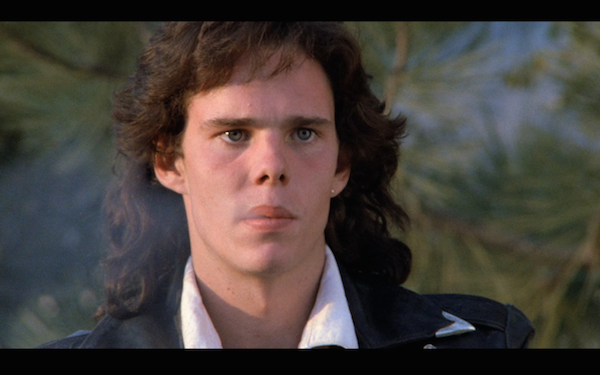
Don’t mess with Kevin Dillon, aka “Johnny Drama” or his mullet.
The remake takes itself more seriously than the original, but it is not without having a little fun at its own expense. For starters, it has the star football player buying condoms at the pharmacy for his hot date with Meg, and later discovers that his date’s dad is the same pharmacist. Doh! Most of the rest of its humor fits with the state of the horror genre in the 1980s. Some of the Blob’s attacks and kills are outlandish and you cannot help but laugh, which is a distinctively different atmosphere as the original, which celebrates and has fun with teenage life.
So let’s talk about the monster itself.
In both movies, it came from outer space. In both movies, it is discovered by a homeless person, who tries to touch the meteorite with a stick, only to get a piece of The Blob on his arm.

1958 Meteorite and Stick
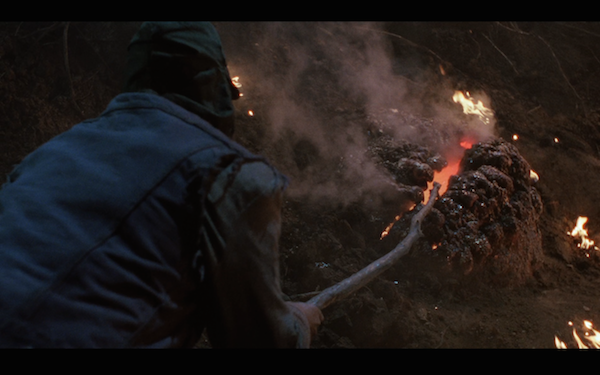
1988 Meteorite and Stick
In the original, he tries to shake it off like one would shake a stuck piece of rubber or glue. It’s just something disgusting that he wants off. This is when The Blob first gets its exposure to human flesh, and immediately wants more. It latches onto his arm and doesn’t let go. In the remake, they don’t waste time with having the homeless guy dance around trying to get a sticky mess off his arm. They instead go right for the gusto. Once The Blob gets a whiff of humanity, it strikes and latches on with lethal precision. Again being playful, the remake cuts to kids eating jell-o.

1958 Homeless Arm

1988 Homeless Arm
The colors of each film are worth discussing. One of the reasons that the original caught on was that it featured an extremely good use of color for the time. You can even tell from the screenshots that the color palette holds up reasonably well today. Of course by the time the 1988 version came along, color was not exactly groundbreaking, so they instead played around with the mise-en-scene. The school colors use pink, so cheerleaders at the football game have pink pom-poms. In one scene the use of color is addressed directly with Meg messing up the laundry and accidentally turning a sweater pink. Maybe that was an epidemic because there are many pink sweaters seen throughout the film. The remake had more flexibility with special effects to highlight the colors of the monster, and sometimes used that to color the frame. A good example of this is the phone booth scene where The Blob and one if it’s captives envelop the booth.
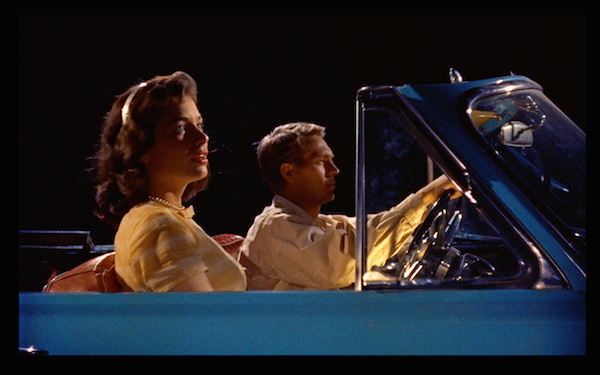
1958. Crisp Colors

1988. A pink re-imagining of The Scream?
The way they kill may not necessarily be different. The special effects limitations for the 1958 version don’t allow us to see the all the deaths. Besides, for the time frame, anything remotely close to the graphic images in the 1988 version would be shocking and revolting. The old homeless man is found dead in both movies, although far too graphic in the second film for me to even post a screenshot.
Steve and Nancy see the doctor dying, and presumably other people die as well, but most deaths are not on screen. In both films, The Blob can kill by enveloping their victims and we’d assume they suffocate. In the remake, The Blob also has the ability to dissolve their body as if they had been dipped in a vat of acid. That’s interesting because in the 1958 version, the nurse unsuccessfully tries to throw acid on The Blob, which has no effect.
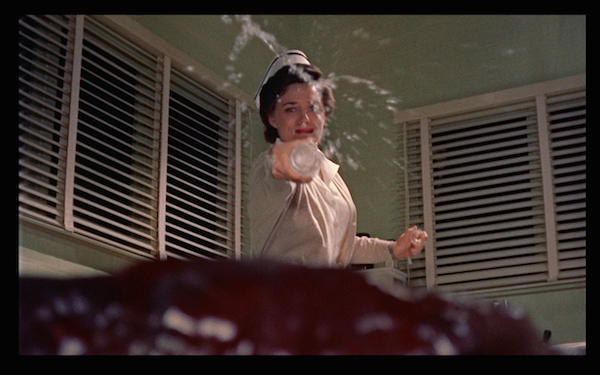
1958. The nurse throwing acid.

1988. This guy is either about to suffocate or is addicted to Big League Chew.
As for how The Blob gets around, Burt Bacharach mostly had it right, at least for the 1958 version. It creeps, leaps, glides, and slides. Where does it go? Across the floor, through the door, and around the wall.
There are some movement similarities during the early portion of both movies. The Blob grasps at the homeless guy’s arm and gradually spreads to the rest of the body. From there, the 1988 Blob moves at a far more rapid pace. This could be another special effect limitation because we do not see the 1958 Blob move as much. After all, he was basically just a bag of silicone. There are some fun movement parallels between both movies. For instance when Steve and Nancy are in the closet, The Blob oozes under the door. When Brian and Meg are in the walk-in freezer, The Blob oozes similarly toward them.
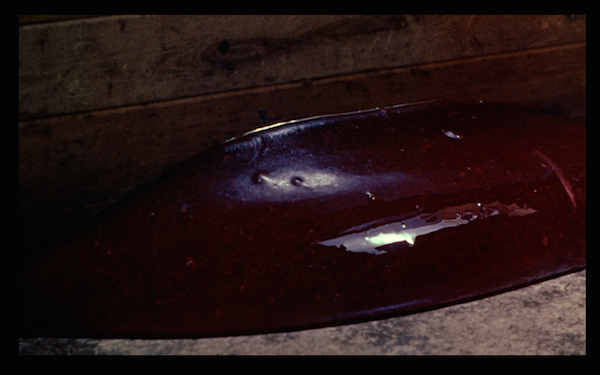
1958. Oozing under the door.
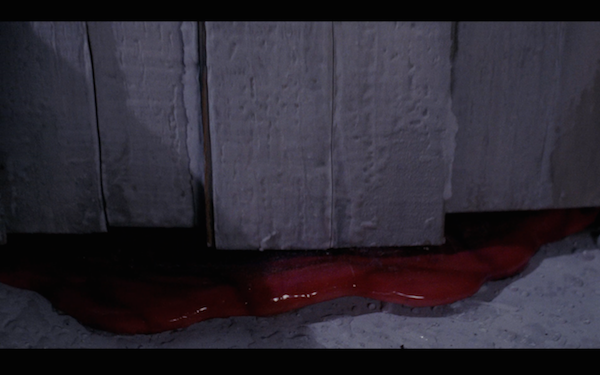
1988. Oozing under the door.
Another fun sequence in both movies is the theater. For 1958, the theater was groundbreaking in a sense. The late movie aspect of 50s teenage culture had not become a presence on film until The Blob, which used it as an exceptional plot device and a way to creatively show off the special effects at their disposal. The remake borrowed the movie theater plot, injecting some children who are seeing a movie that they shouldn’t. Again, it is a comic scenario, with an annoying guy who keeps talking loudly during the movie being the first to get Blobbed. What’s even funnier is that they show the scream in the movie as a reaction to this loudmouth’s quick demise.
The Blob starts in the projection room of both theaters, coming in through the ventilation system, and then makes it into the theater itself, causing mass havoc. The 1988 screen is darker and the visual may not show up well.
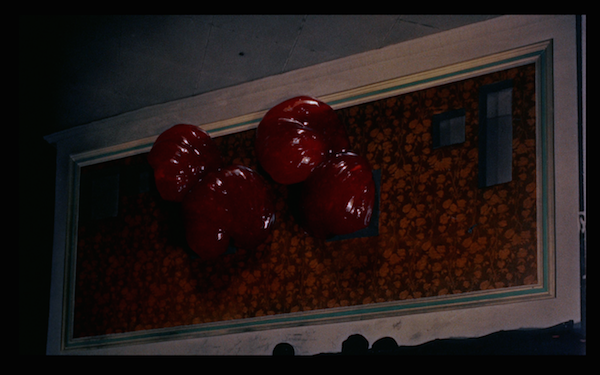
1958. Oozing out of the projection.
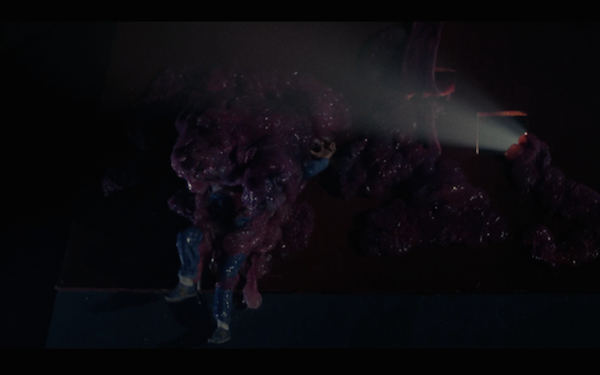
1988. Oozing out of the projection.
You can almost count on your fingers the number of times that The Blob appears in the 1958 version, and the screens that I’ve posted here represent a high percentage of the monster’s appearance. In the 1988 version, he is everywhere. When he appears, they make it a point to have him encompasses a large portion of the screen.

1958 Blob at doctor.
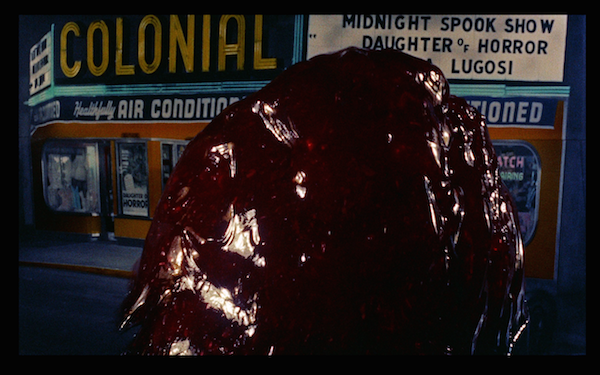
1958. The Blob even goes to the movies.
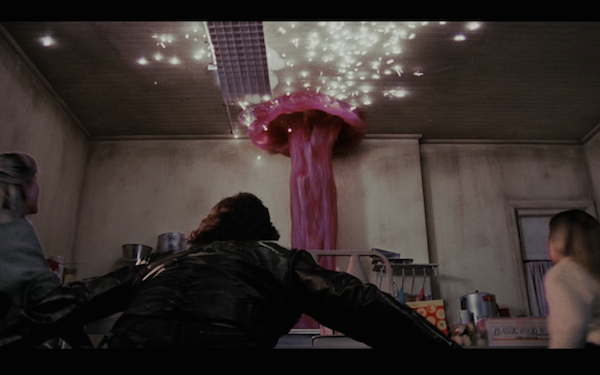
1988. Mushroom Cloud Blob.

1988. Christmas Tree Blob.
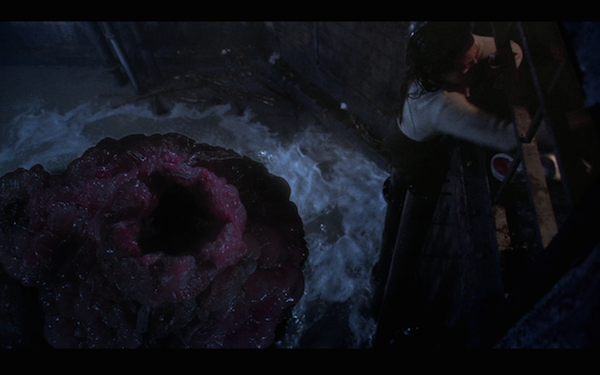
1988. Sewer Blob.
The conclusion is where the versions diverge. They have a similar ending in that The Blob is allergic to coldness. You could argue that the original was poorly written with a convenient deus ex machina ending as they discover this type of “Kryptonite” in the final act. The latter takes a more sophisticated approach, planting the seed of the aversion to coldness about midway in the aforementioned frozen locker scene. When The Blob oozes under the door, it oozes right back when it is exposed to the cool air.
The latter version also has an origin story, scientists that implement a biological containment as if it is a virus, and some far-fetched explanations that I won’t spoil. I’ll be honest that I much prefer the earlier ending, ‘deus ex machina’ or not. It has that same element of teenage innocence that makes the rest of the film so effective, while the latter version suffers from “Summer Movie Syndrome.” If something is expensive, that does not necessarily mean it is better.
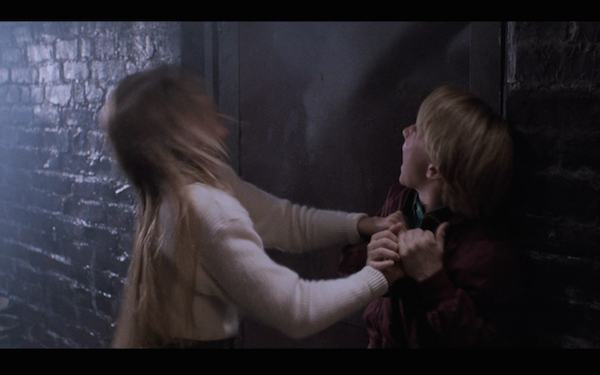
The Blob is so scary that this kid accidentally Birdman’d himself to the door.
So what can we say about The Blob as a villain?
In both versions, he’s a ferocious monster that basically eats people. I’d say that qualifies as a villain. The one thing I’ve purposely omitted from both write-ups until now is the representation of the red scare. In the 1950s, the symbolism of this nondescript menace that nobody understands is almost too obviously a nod toward the Cold War. That was the real fear, and The Blob is one way that allowed people, particularly teenagers, to process the fear. The 1988 version was still in the midst of the Cold War, but the cultural sensitivity was not as pronounced. Instead they use the additional backstory plot as a way of referencing weaponization. Perhaps they wrote this as an homage to the original, to fit it into the Cold War theme that clearly existed. Or maybe it was a product of the times, way of processing Reaganomic escalation. Either way, any text that uses a being to portray a political or societal evil qualifies as a villain in my opinion.
The Blob, 1958, Irwin S. Yeaworth

As I watched the original version of The Blob, I was surprised to find that it is just as much a teenpic as a monster movie. In some respects, the teenage themes were even more integral to the story. The monster was as much a vehicle to showcase adolescent insecurity, conflicts with authority, and the frustration of not being heard.
The teenpic nature of the film actually fits wonderfully for the way I want to structure this blog post. Since I’m about to get going on my Blobathon, it seems fitting to have a serious post today about the teenage issues, with a fun and light post on Wednesday about the monster itself. The Wednesday post will also contrast with the monster of the 1988 version of The Blob.
The one hurdle is that you have to buy Steve McQueen, in his debut feature role at the age of 27, as a teenager. That’s the biggest sell because even then he had a grizzled, experienced face, which would serve him well in his later stardom. While it takes a little while to get used to him as a teenager, he does show signs of the acting chops and screen presence that he’ll become famous for later.
What’s interesting about the teenage protagonists in The Blob as opposed to say, Rebel Without a Cause or even Blackboard Jungle, is that the kids are relatively benign with their misbehavior. As the plot progresses into a monster mystery, the actions that would usually be associated with young hooliganism, like sneaking out with a girl or driving cars fast, are actually heroic actions in an attempt to save their town.
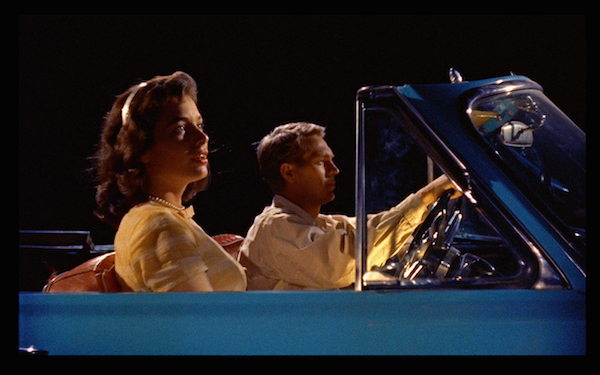
Teenagers cruising in a car.
The film begins with Steve (Steve McQueen) and Jane (Aneta Corsaut) up in his convertible at a lookout, gazing at the stars and enjoying each other’s company. This is a stereotypical scene of the 1950s, and usually would be seen as a place where a man would bring a girl, or a series of girls, in the hopes of one day getting lucky. Jane questions Steve on this very possibility, but he assures her that she is the first, and that he will not pressure her for romance. Even if he’s a teenager with normal hormones, he is established immediately as upstanding.

Kids being kids.
The next major scene between the teenagers is also typical juvenile behavior – a car race. A group of kids at first seem antagonistic, and they even tease Steve by dubbing him king of the road and placing a hubcap crown on his head. The tension eases quickly. They become more congenial, and even though they race, they do so in a playful spirit and the sequence ends with them friendly towards each other.
The relationship with the teenagers and the policeman are quite different from the norm. This being a small town, they know each other, and Steve addresses the ‘good’ cop as Dave rather than officer or any other title of respect. The ‘bad’ cop, Jim Bert, is nicknamed ‘Bert the Schmert’ because he is not sympathetic. Instead he is hostile and antagonistic. He refuses to believe in the monster, and blames juvenile delinquency for the strange events happening in the town.
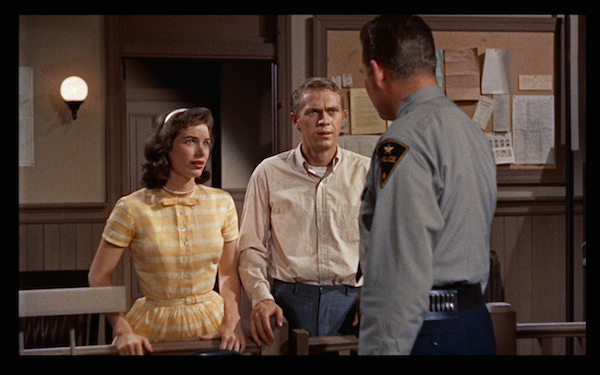
How do you convince police that a monster is on the loose?
The monster places the kids in a hopeless situation where they are the only living witnesses, but absolutely nobody will believe them. There are a few scenes where they try to convince the police. Dave is more inclined to believe then, whereas Bert plays intermediary and sways attention back onto the kids. Bert is alone in this manner of thinking, but this still contributes to confusion. The police and everybody else don’t know what to believe. There is another scene where a kid tries to warn a group of adult partiers, but they dismiss him entirely, even making fun of him by calling him Paul Revere. After several futile attempts to make people aware, Steve frustratingly wonders “How do you protect people from something they don’t believe in?”
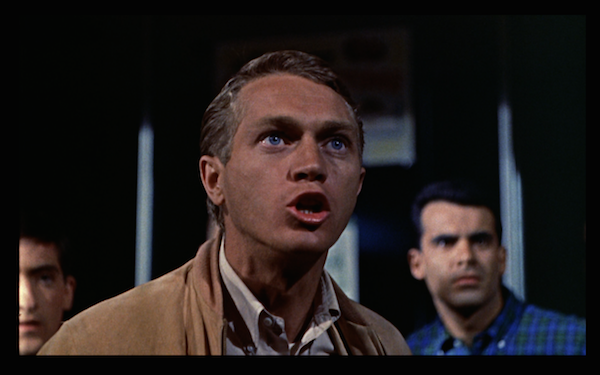
McQueen is appealing yet again to the police.
They don’t get results until Steve and the other teenagers make enough of a ruckus to get the entire town out of bed and gathered in one area. They do this via another method of teenage misbehavior — honking their horns and making noise. Steve then appeals yet again to the police. This time Dave is a willing listener. He takes a leadership role that leads to the final outcome. The tables are turned and the adults actually save the children.
Given that this was a B-level science fiction escapist flick, with a director who had never made a fiction feature, and a lot of amateur or first time actors, The Blob overachieves. The shots may not be framed well and the editing has some issues, but the story is told effectively. The teenage themes help the audience get more invested in their fight against the red menace, and it makes for an enjoyable resolution.
Film Rating: 6/10
Supplements
Commentaries: This release has two commentaries, one with Producer Jack Harris and Historian Bruce Eder, and the other with Director Irwin S. Yeaworth Jr. and Actor Robert Fields. All of the commentaries are recorded separately with no interaction, so I’m just going to list some of the highlights from each. One of the interesting highlights was how each one talked about the late Steve McQueen. They all spent quite a bit of time talking of their experiences with him, whether positive or negative. He was certainly a character, both on and off camera.
Jack Harris – Harris of course wanted to make a commercially successful film, so he intentionally combined science fiction with a teenpics. Both were playing well at the time, so he figured it would be a winning formula.
He thought McQueen had potential to be a big star, but he was too much of a “bad boy” and trying to impress people. Harris admitted that he didn’t like Steve McQueen on The Blob and would not cast him in the sequel. By the time he changed his mind, McQueen was too big for them to afford him. They became cordial later and McQueen tried to rent Harris’ house once. That was the last time Harris saw him.
He is the only one on the commentary to address the 1988 remake. He was not complimentary. The remake went in a lot of directions that the original didn’t, was too expensive and not as good.
Bruce Eder – Eder did not get as much voice time as Harris, but he did get a chance to make some Illuminating points.
He discusses some of the teenage themes. The children are the only ones who see the Blob until the end, and the police think the teenagers are the invaders. Eder thinks that McQueen’s performance came across as real on the film because he had genuine problems and irritation with the script. Those negative feelings were expressed through his performance as he tried to get heard.
Irwin S. Yeaworth Jr. –
McQueen and Yeaworth were both about the same age, and one review called them “the world’s oldest teenagers.” He had previously worked on a number of religious and educational films. They had created about a hundred 16mm films before trying their first feature.
He says that McQueen had a mercurial personality and was very “willful.” He hints at some problems on the set, although they did see each other several times later in California until Yeaworth stopped working there. McQueen seemed displeased with several aspects of The Blob, especially his salary because he made the short-sighted decision to take a smaller up-front payment rather than a cut of the profits. Yeaworth was surprised to learn that when McQueen died, the only thing found on his wall was a poster of The Blob. Surprising because he had disparaged the film because it was a B picture and he didn’t get paid what he could.
At first the movie was titled The Molten Meteor. They then changed it to The Glob, but that was taken. The next option was The Blob, which stuck. They wanted a title that people would make fun of, and they got free publicity from it.
Robert Fields – He played Tony, the apparent leader of the clique of boys that first encounters Steve.
He makes some interesting points about what he calls “Dying on Film.” He does not mean it as dark as it sounds, just that it is an expression that is used in acting fields. Actors see the aging process in their lives because they can see themselves at various points of their career. He compares this with a shoe salesman, who doesn’t see himself doing the same job at a younger age. Even though this is a dark point, he appreciates being able to see his younger, better looking self.
He shares a number of Steve McQueen stories, but they have a different angle than the rest since he was younger. He has vivid memories of riding in McQueen’s two-seater sports care, racing through winding roads at 100 mph. Robert thought of him like an older brother or a mentor of sorts. McQueen had a lot of charisma and impacted Fields’ life.
Blobabilia Wes Shank is an avid collector of memorabilia from The Blob. He has several still photos, posters, and the actual Blob that was used as a prop. The disc has a lengthy slideshow with the highlights of his collection.
Criterion Rating: 6.5
Watership Down, 1978, Martin Rosen

Watership Down has so many thematic textures that I felt this was a good opportunity to mix things up. Rather than review the film based on quality (spoiler alert: I loved it), I have instead isolated a few major themes that I’ll flesh out in detail.
Keep in mind that this is not a children’s film, and even if the images resemble the hand-drawn animation of old Disney, the subject matter is far darker.
I will be spoiling the entirety of the film both in the text below and the screenshots. I would recommend that anyone reading this piece have already seen the film or at least read the book.
There are several themes that are pertinent to the film that I chose not to cover. One of the major ones is environmentalism and man’s impact on the plan. This message is crystal clear and hard to miss. There are others that I studied and decided to cut, such as Leadership (Hazel) and the sense of Community. These also are easy to pick up on. Instead I chose to focus on political oppression, the use of violence, spirituality and religion, and of course, mortality.
Politics and Oppression

This innocent looking rabbit is oppressed.
“There is something oppressive in the air, like thunder,” Fiver says near the beginning of the film.
There are three major political groups in the film. The first Owsla is where the main characters originate. The Watership Down group is the protagonists and their quest for a homeland. The Efrafa is the group that they meet in the third act of the film.
It is clear early that while the protagonists are under the rule of the Owsla that they are oppressed. There is some sort of class or caste system that is not defined in detail, but it dictates access to materials (food, does, etc.). Only those in the upper echelon are privileged, whereas those in the lower class, like Fiver and Hazel, are oppressed. Another major character, Bigwig, is an officer for the Owsla, but he is sympathetic to those who are being subjugated. The form of government closely resembles fascism or any totalitarian rule where the leaders have unfettered control.
Oppression breeds dissension. Fiver has a psychic premonition that doom is upon them, and he and Hazel plead for audience with the chief. Bigwig facilitates their meeting and is later reprimanded for it. Fiver’s pleas fall on deaf ears, but he and Hazel are believers. After being rebuffed, they decide to flee the warren. When word gets around, others want to leave with them. The reasoning does not seem to be due to Fiver’s premonition. As we will see later, they don’t always believe him. The primary motivation for leaving is because they are being oppressed and lack basic freedoms.
When they try to leave, one officer tries to arrest all of them for “spreading dissension, inciting to mutiny.” This is again similar to fascism or totalitarian rule because those in power want to shut down any opposition. We know that Fiver’s vision is apolitical, but that is irrelevant to those in power. They require subjects in order to maintain their privileged status.
After they escape, the crew of Hazel, Fiver, Bigwig and others becomes a leftist and nearly communist role. They are interested in free living, community and collective harmony, which I will touch on in more detail later.

Captain Holly tells of the Owsla’s downfall.
After they escape and reach Watership Down, they learn of the Owsla’s downfall from Captain Holly. Most importantly for the final act, through Captain Holly, we learn of the third group, the Efrafan. It is clear from Holly’s condition that this is not a pleasant bunch. They capture him, rough him up, and rip his ear in order to mark him. We then see inside their burrow. They look evil and menacing. Through this portrayal, it is clear that they are the antagonists that will threaten the harmony of Watership Down.
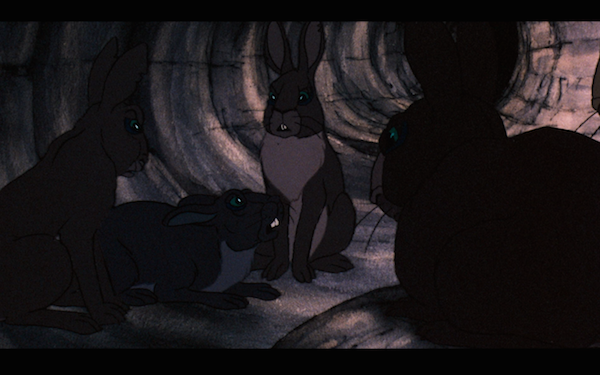
Inside the Efrafa burrow.
While doing some reading about this film, I’ve found some comparisons to Nazy Germany. Whether this is intended or not, there are several similarities. We first learn that they are overcrowded and cannot produce more litters. This reminds us of the tragic overcrowding of Jews in the ghettos and later the Holocaust. They mark their victims, just like they marked Captain Holly, and just like the Nazis marked the Jews.
Chief Woundwort is the leader and he is a beast. He is large of stature and for that reason he is not identical to Hitler, but he is unquestionably a dictator that rules with an iron fist. He sends out patrols that take stray rabbits to a council to mete out punishment, most of which is of a violent nature.
The Efrafans say that “everything out of the ordinary is to be reported.” Their methods are to annihilate opposition, and follow anyone under suspicion, as they do with Bigwig. Parallels could be made with virtually every totalitarian government, again including Nazi Germany, but also Stalin’s Russia, or any of the African, Asian or Arab despots.
When Hazel tries to negotiate terms with the Efrafa during their war, he suggests having independent, autonomous and free warrens. It is categorically rejected by the Efrafa. This proposal is close to communism, which of course is fundamentally opposed to fascism. Rather than negotiation, they rely on crushing, absolute destruction and refuse to stop or negotiate. In this manner, they are like Nazi Germany focused on total war to subjugate the opposition.
Violence
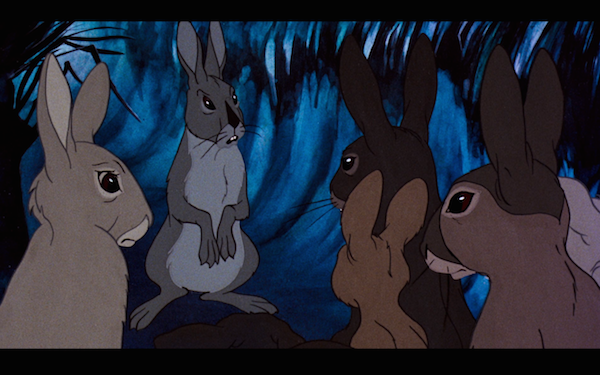
The initial violent confrontation.
Violence is a major theme of Watership Down. The characters may be cute and cuddly rabbits, but they are ruthless and vicious. Even the “good guys” resort to violence in order to achieve their escape. In fact, the film’s violence begins with the Watership group threatening to kill a Captain of the Owsla if he stands in their way. That is the first fight scene, where Bigwig joins the group by standing up for the rebels, tethering himself to their cause and isolating himself from the Owsla in the process.
There are several instances of violence scattered throughout the film. There is the brutal sequence where the Owlans meet their end, or when the farmers shoot Hazel, and of course when Bigwig gets caught in a rabbit trap and nearly meets his end. The ultra-violence is near the end when they are at war with the Efrafans.
“You don’t know the Efrafans. They’ll never give up!”
The ending is war, total war — the same type of ferocity and bloodlust that drove World War Two to staggering levels of destruction. Even prior to the war, the Efrafa are bent on obliterating their opponents, as they prepare to murderously charge at the Watership group when cornered at river’s edge. If not for the crafty rescue, the Watership group would have likely all been killed.
As the Efrafans try to penetrate the burrows at Watership Down, they do so with a bloodlust. This is not about strategy, but about death. They want to destroy those who harmed them and, in their minds, stole their property.
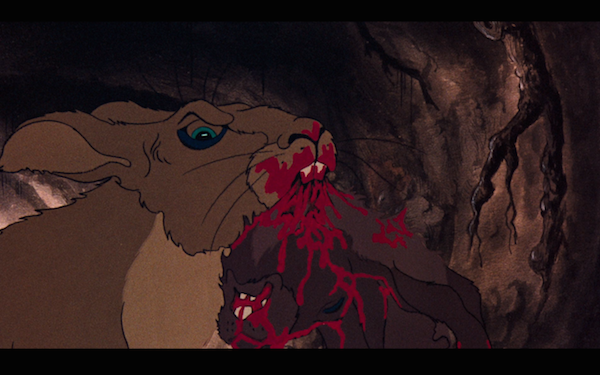
Total war is bloody.
The most violent scene is the fight to the death between Woundwort and Bigwig. At least it is intended to be a fight to the death, and neither side would have given up if not for other circumstances.
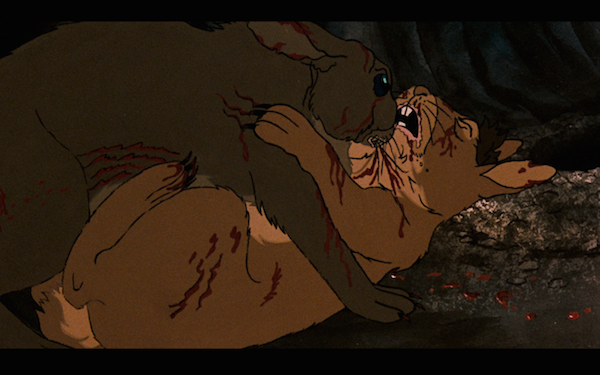
The final fight between Bigwig and Woundwort.
The freedom fighters use a secret weapon, a dog, in order to achieve victory. This could be seen as a deus ex machine plot device, or it could be seen as a weapon of mass destruction. An analogy could be made that the dog’s onslaught and end to the Efrafans is tantamount to the US dropping the atomic bomb in order to win the war. Both could be seen as atrocities depending on your perspective, but they both achieved the same result. They both saved lives for the winning side.
Spirituality/Religion

The Great Frith, God of the Rabbits.
Spirituality, religion and even mythology play a central role in Watership Down. The introduction tells the creation story of how The Great Frith made the world and all the stars. The Prince of Rabbits had many friends that ate grass together. Just like the Hebrew creation story, the rabbit makes a hubristic misstep and loses his honored status. The rabbits (or Children of El-Haraira) are hunted by other creatures and have to meet the “Black Rabbit of Death.” As a way to offset against these grave threats, Frith gives his rabbits a white tail and makes them faster than any creature in the world.

Fiver has a second sight that shows doom is coming.
Addition to the religious elements, there are also psychic phenomena that go unexplained. This is specifically the case with Fiver, who has a sort of precognition and foresight of things to come. He sees fields of blood that foresee the destruction of Owsla, the dangers inside the burrow of men, where Bigwig ends up snagged, and finally he senses the lurking evil of the Efrafa before they attack Watership Down. While he is not always believed, he turn out to be correct.
Fiver also has connections to the religious world. He can see the Black Rabbit, and during the memorable playing of Art Garfunkel’s “Bright Eyes,” he sees and perhaps participates in an adventure with the otherworldly being. Religion, mythology and the supernatural are all connected with death, as is the case with most human religions and a lot of supernatural phenomena. Christians believe in a Heaven, whereas mediums believe they can speak with the dead.
The rabbits are providential as opposed to secular. They refer to their religious world often, by saying “thank Frith,” “for Frith’s sake” or other phrases that humans would replace with the name of their God.

Their arrival at Watership Down.
Their departure from Owsla is similar to the Hebrew’s Exodus from Egypt, and Hazel in many ways resembles a Moses type of savior character. He does not perform any miracles. Access to the supernatural is solely Fiver’s territory. Hazel, through his leadership, does encourage those who would otherwise be lower class, or even worse, slaves, to follow him to the Promised Land. He does call upon Frith once, offering his life for the safety of his people. Frith does not take this offer, responding “There is no bargain. What is must be.” With or without Frith’s intervention, Hazel (or Hazel-Ra as they call him when he becomes chief) leads his people to salvation.
When the film ends, they have achieved the harmony that Hazel, Fiver and the rest hoped for. They have reached their holy land. They are the chosen ones and are at peace in their version of paradise.
Mortality

Death.
“Whenever they catch you, they will kill you.”
Death is ubiquitous in Watership Down, beginning with the Creation and origin story at the very beginning, where the rabbit is warned to “be cunning and full of tricks, and your people will never be destroyed.”
The first actual death on screen happens during the departure from the Owsla before they reach Watership Down. Their way is full of obstacles, and they learn of the danger when a vulture swoops down and snatches a rabbit named Violet right in front of Fiver. In an instant she is living and free, and then the next, she is gone, facing imminent death.

Bigwig choked in snare.
Death rears its ugly head again when Bigwig is caught in a snare near the suspicious place with the “man smell.” Bigwig struggles as they try to figure out how to free him from the wire. He bleeds incessantly, and the process is slow for the rabbits to figure out how to remove him from the trap. He is slowly choking. After he is freed, he is close to death. He gags and the camera changes to his perspective, where his fading eyes look up and only sees the dark silhouettes of his companions. At this point, his friends and the audience assume he is dead. Fiver says, “Please don’t die. We got you out.” The group collectively utters, “My heart has joined The Thousand, for my friend has stopped running today.” They think he is dead, but in a refreshing moment, he comes to. This is one of the most disturbing scenes in the film. Not only is it the first time we see a graphic wound, but we fear we have lost a main character. This will not be the last time.
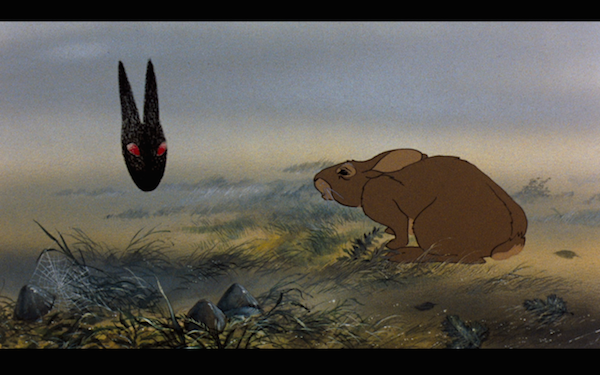
Hazel meets the Black Rabbit.
“We go by the way of the black rabbit. When he calls, we must go.”
The ending is foreshadowed with Fiver’s exposure to death during the “Bright Eyes” montage. This scene celebrates death, allows a major character to come to terms with it as an inevitable reality, and it prepares the audience for the final scene.
”Bright Eyes, How can you close and fail?
How can the light that burns so brightly, suddenly burn so pale? Bright Eyes.”
At the end, after years have passed and his people have long since settled, the Black Rabbit calls Hazel. His work on this earth has been done. He has delivered his people. His end is presented as a peaceful journey
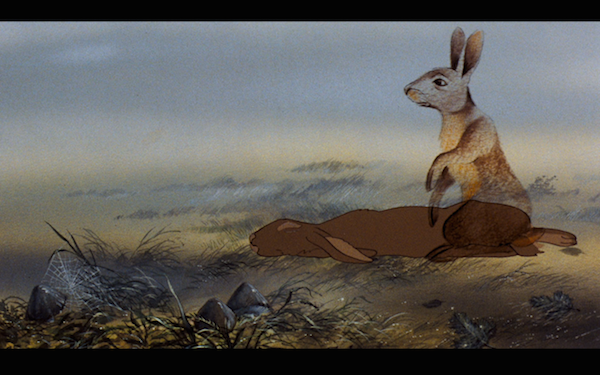
Hazel reborn.
The Black Rabbit says “I have come to ask if you would like to join my Owsla. We would love to have you. You’ve been feeling tired. If you’re ready, you can come now.” The Rabbit assures Hazel that his people will be fine. Hazel briefly hesitates and looks upon his people, at peace. They are fine and he has been tired. Hazel falls to the ground at that very moment, at first slumping and taking a couple of deep breaths before resting for good. The spirit leaves his body and he follows the Black Rabbit to a new Owsla.
The ending is a challenge. It is both somber and uplifting, and people react to it differently. We see death as tragic, but it is intended to be happy ending. Hazel’s life goals were achieved and he is ready to move on to the next phase, to join Frith. To me, the ending is extremely touching, affecting, and not manipulative. Death is a part of life, and a beautiful thing when a life has been fulfilled. Hopefully after death there is another promised land waiting. For Hazel, he has somewhere to go. He follows the Rabbit to what appears as the sun, and he joins his creator. However heartbreaking for many, it is a beautiful ending.

Hazel and the Black Rabbit. Truly free.
Film Rating: 9/10
Supplements
Passion Project: 2014 interview with Martin Rosen. He loved the book without thinking how difficult it would be. It was tough to get the rights. Richard Adams wanted nothing to do with the project simply because he was not a film lover.
The process was painstaking. All of the locations in the book were based on real locations that Adams knew. Rosen scouted these places and had them drawn as close as possible. He discusses at length the animation process, the voice casting and acting. He was fortunate to have a talented stable of actors, none of whom said no to the role, and they put their stamp on the performances.
The song is a key piece of the finished film. It was a financial requirement to have three songs in the film, yet Rosen was initially reluctant. “Bright Eyes” just fit with the theme.
A Movie Miracle: Guillermo Del Toro: People mistakenly think of animation as a genre and not a medium. Del Toro realized this from seeing this film. It created a world with socio-political and adult concerns. Watership Down is not an animation marvel, but people put the work in as best as they can while preserving narrative. It has a handmade feel that contributes to its quality.
Defining a Style: This is a series of interviews with a number of the animators that worked on the film. They all had positive experiences. They discuss the different styles they had an how they came together to form the final film. They also respect the film and how it broke ground.
Storyboards: The film can be watched with storyboards that appear in the upper right hand corner. This is partly a novelty, as it is difficult to seriously watch the movie with them on. However intrusive, they are interesting to see in small doses.
Criterion Rating: 8/10
Fellini Satyricon, 1969, Federico Fellini

Over the last couple months, there have been an inordinate number of art films with graphic sex scenes. Most recently was Godard’s Every Man for Himself, and not long before that was Don’t Look Now with the infamous “love” scene. The crème de la crème were Salò and In the Realm of the Senses. I haven’t intentionally looked for explicit films. That’s just the way it has worked out recently. Fellini Satyricon is more in the category of the latter two, yet does not quite reach the same depths of perversion. It is a depiction of pre-Christian Roman times and does not hold back showing the debauchery and depravity, which results in a lot of sexual activity.

Some of the extravagant characters.
I first saw Satyricon ages ago. I honestly cannot remember whether I saw it on video or cable, although I’m pretty sure it was one of the two. I watched it expecting humorous scandal, and ended up wondering what in the world I was watching. I may not have even finished it. Since that viewing, I have obviously studied film, and maybe not so obviously studies history, including a lot of ancient history. I never read Petronius’ Satyricon, which the Fellini version was “freely adapted,” from, as they point out in the opening credits. I did read a few of the peripheral sources from that time, including some Tacitus. Today, compared with my younger days, I have a firmer grip on Roman history and culture. In these two respects, this viewing was far more informed.
I usually do not get into transfers when writing about these films. Part of that is because Criterion has the reputation of putting out the best transfers available. At times there will be controversy that needs to be addressed, like with Lola, but rarely do I feel it is important to point how good a transfer is. That changes with Fellini Satyricon because this 4k restoration and Blu-Ray display might as well be another character. It is hard to imagine this movie looking any better. Every second is a visual spectacle. Even if some scenes are difficult to watch or incomprehensible, they look amazing.

Roman Baths with fake skyline.
On the other hand, sometimes the clarity of the transfer reveals the façade. Examples of this are when they are on a large set that is intended to masquerade as the outdoors, with a matte painting in the background. The above screenshot of the Roman Baths is an example of how this type of scene looks glorious with the format, as the upper half is a painting. On their way to the Baths, the structure of the set is more visible and it looks artificial. That is not really a gripe because it probably looked more realistic on other formats, not to mention it came out in 1969 and looked far better than most anything else from the time period. I enjoy being able to see these “flaws” in the production, even if it reveals more behind the curtain.
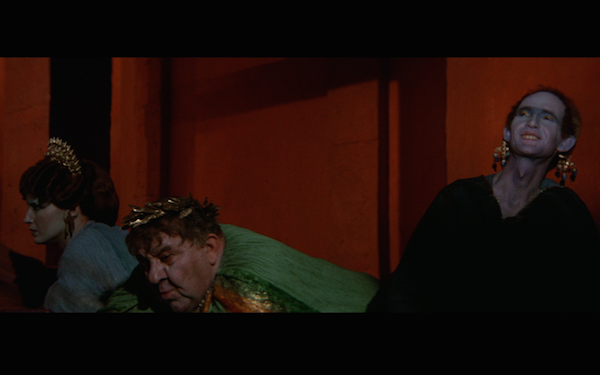
Participants of Trimalchio’s Dinner.

Trimalchio at his dinner.
To say that Fellini Satyricon is ostentatious and brazen would be an understatement. Every shot has a mind-bogglingly large set, with costumes so decorous that they look partly authentic and also like a freak show. We can tell that Fellini is in love with these little worlds he has created as much as we are, as he has extended tracking shots that reveal the entire set with carefully choreographed acting. The make-up and costumes are so brilliantly exorbitant that it is a festival of riches and completely immersive. It is a blast to be hypnotized by the visual marvels. Trimalchio’s Dinner is the most notable of these, even if the sets are intentionally less decorative than the brothels or art museum. They are the best portrayal of the hedonism and excess that these wealthy Romans indulge upon. At times they are disgusting, while at others they are wild and upbeat, such as the many energetic dancing sequences. They are always entertaining.

Encolpio emerges from the maze.
After viewing the spectacle, the plot seems less important, but it is worth touching on. Encolpio (Martin Potter) is the central figure and we see most everything from his point of view. He is involved with Ascilto (Hiram Keller), Gitone (Max Born) and Eumolpo (Salvo Randone). Their escapades begin at the heart of Roman culture in the city of Rome. They are later taken prisoner via boat to the outer provinces where Encolpio has to overcome a number of challenges, including fights with mercenaries, Minotaurs, and a merchant named Lichas with a lazy eye (Alain Cuny). While there is a beginning and ending, and the characters are on a journey of sorts, this is more of a slice of Roman life rather than a narrative with a central plot. In other words, you cannot compare this with the three-act Hollywood formula. It breaks virtually all the rules.

Long shot from above of the fight,
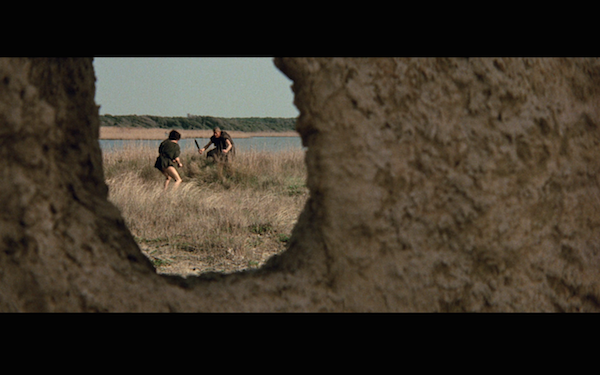
A fight is framed through a hole.
There is abundance of lascivious content. The three younger male characters have androgynous looks, and there are hints of homosexual activity even if they are not shown on screen until Encolpio meets Lichas, and that shows just a kiss. We are given the impression that a great deal of homosexual activity takes place behind the scenes. There is plenty of female nudity and heterosexual scenes, beginning with the brothel, and culminating in Encolpio’s sexual rendezvous with a tied-up nymphomaniac. I’ve already compared it to some later movies where graphic intercourse was shown, but it holds back from becoming anything resembling pornography.

Overhead shot of the Minotaur maze.
Fellini took a great deal of license with adapting Petronius’ work, filling up much of the film with his own research and, frankly, his wild imagination. Despite his embellishments, it still stands up as being much closer to authentic compared to other Roman depictions. This is not the Rome from your ordinary Cecil B. DeMille epic or even an HBO miniseries. This was the underbelly of Rome from during Nero’s reign, which Petronius was a witness to, and Fellini translated for a modern audience. It is carnivalesque mostly because this 2000 year-old culture is so foreign and distant to the one in which we live in. The reality is there was quite a bit of debauchery in pre-Christian Rome. Fellini Satyricon is not going to stand up as a historical document, but it is a better representation than a casual viewer (including the younger me) might realize. It portrays animal sacrifices, the brutality and abuse of power, pagan worship, and wild, erotic celebration.

Example of the locations and photography.

One of the many great location shots.
I cannot say enough about how visually splendid this film is. This post has a lot more screen shots than most, and I could have included even more. Every frame has something interesting to the eye, whether it is the flamboyant and eccentric character, the fantastic make-up, costumes, set designs, gorgeous landscapes and last but not least, the photography. The use of locations and color are not only unparalleled for the time, but they hold their own against some of the more artistic projects created today with modern technology. I will not spoil the beautiful final shot because it has to be seen, but it punctuates the film both visually and thematically. It is up there with the best shots in Fellini’s career.
My expectations for Fellini Satyricon could not have been lower. In fact, I wondered why it was getting the Criterion treatment at all. Instead, I fell in love with Fellini all over again. He was a genius and versatile filmmaker, and this is yet another dimension of his fine career.
Film Rating: 8.5/10
Supplements
Commentary: This is a dramatic reading of Eileen Lanouette Hughe’s 1971 memoir On the Set of “Fellini Satyricon”: A Behind-the-Scenes Diary. This is a new type of commentary for me, and it is tough to keep up with while re-watching the movie. It usually does not correspond to what is on the screen, although it is usually relatively close. It also gives a wealth of information about every aspect of the production, so much that it’s impossible digest it all. I am listing a few tidbits that I found interesting.
- It came to be known as Fellinicon and was the most expensive of his films and the first with foreign financing.
- All 3 of the leads were young, unknown actors. Two were British and one was American. They represented hippie culture, which is a good fit for the Petronius’ style.
- There was a rival Satyricon in the works with a much lower budget. That is why this was named Fellini Satyricon. It was a way to distinguish between the two.
- Many of the sets and props had to be made quickly with short notice. A Venus statue was made overnight. Parts of the brothel set were built in a couple hours and shot in a way that makes them look larger. There are many other examples of this throughout the commentary.
- The Trimalchio dinner scene took three weeks to shoot. It was intended to show the residence as not being ornamented aside from the food, because Trimalchio was a poor landowner and former slave who worshipped food.
- The actor that played Trimalchio ran a restaurant that Fellini used to frequent until he started getting too fat. The actor was reluctant to appear in film and leave his restaurant alone.
- Fellini intended to capture the essence of a pre-Christian world, which he likened to capturing Martians. That is why this pagan world seems so foreign to us.
- The ship is designed with modern methods and is a bridge between the ancient and modern world. This was intentional.
- Petronius had Encolpio marrying a young girl, but Italian censors would not allow a marriage with a child. Instead he marries Lichas (Cuny), a male, but acceptable to censors.
- The suicide scene may have been a nod to Petronius, because he killed himself rather than be killed by Nero.
- The set was constantly crowded with four people writing books, a documentarian, photographers, and guests. It also required an enormously large cast and crew.
Ciao, Federico! – Hour-long documentary by Gideon Bachmann. It starts with Fellini directing a love scene, calling out orders as the camera tracks around a threesome. One of the great parts of him shooting without sound is you hear him talk loudly to the actors while the camera is rolling. They show many shots from behind the scenes, which they alternate with interviews and slices of life with Fellini. We see him totally in element, including him on a cussing diatribe railing against someone who is working on the production. We also see him angry, happy, content, serene, and focused. It was a good documentary, both intrusive and revealing, but they had a lot of access.
Fellini: A series of interviews. Fellini despised giving interviews, but he had trouble saying no. That was noted in Bachmann’s documentary as well. We’re lucky he said yes so often because he had a lot to say and was highly quotable.
Gideon Bachmann (audio), 1969 – 10 minutes. Starts with a good quote: “The ideal film is the one you are making.” Obstacles are stimulating, because they cause you to create. He calls Saytricon his most difficult film because he had to create a world and portray situations that are considered forbidden. It was a stressful film for him to make.
French Television, 1969 – This was a short interview of just over a minute. He talks about the morality, or lack thereof in Satyricon, and instead showed decadence and vitality.
Gene Shalit, 1975 – This was another short interview. It begins with a title card that reads “Perfection.” Shalit repeats a previous Fellini quote “A good picture has defects.” They have to be complete, vital, and cannot reach perfection. He makes fun of Shalit’s appearance because it is imperfect and outlandish, yet he likes him for those flaws. The same is truth with film.
Giuseppe Rotunno, Cinematographer: 2011 interview for the Criterion Collection where he discusses the challenges in filming this iconic film. They worked on a number of films together and became like school buddies. Fellini allowed a great deal of freedom, yet was precise as far as what he wanted. Rotunno set up lights for 360-degree views because Fellini also liked to be free and wanted to shoot from all angles. Fellini’s common question when discussing a shot: “But will it look real?”
Fellini and Petronius: New 2014 Criterion documentary with classicists Joanna Paul and Luca Canali. Tacitus describes Petronius as someone who played in the leisurely, seedy side of Roman culture. He was known as a scandalous figure. We are missing most of the books of the Satyricon today, with only having bits of three of them. Fellini makes the film fragmented to honor what we have of the original text. The book is very realistic, and the film contains elements of that realism. Trimalchio’s dinner is the only extended portion of the Petronius text that survives, yet Fellini exaggerates it. A lot of the content and characters come from Petronius, while others come from elsewhere, partly Fellini’s imagination and also other sources. Fellini does not reveal sources except for Horace and Ovid, because he was not trying to be academic, but he clearly did his research to prepare for the film.
Mary Ellen Mark: She was 28 when she was assigned the task of photographing production for Look magazine. This is a 2014 interview with her. She shot the sequences he did in the Roman Baths, which was a smaller set and then grew larger. She had total access, partly because people weren’t paranoid about leaks like they are now. She loved photographing Fellini. He was larger than life and seemed to enjoy being photographed. She called him a showman. He was so busy making the film that he was oblivious to being shot, but still allowed himself to be seen.
Felliniana: These are items from Don Young’s memorabilia collection. It is a series posters, books, programs, and so forth. It is interesting to see such various depictions of this highly visual film from different cultures.
This was quite a release. While the film cannot be considered a masterpiece, the amount of supporting materials that were created and used on this Criterion disc are staggering. With a heavy and detailed commentary, a terrific behind the scenes documentary, and several other odds and ends, this is one of the most complete releases I’ve seen in a long time.
Criterion Rating: 10/10
Every Man for Himself, Jean-Luc Godard, 1980

Back in my early days of cinephilia, I remember taking a survey film class. I had watched a couple of Godard titles by that point and was less than impressed. When we reached the French New Wave section and were asked to discuss Godard, I said, halfway embarrassed that “I kind of hate Godard.” The professor laughed hysterically. “Hating Godard,” he said, “is the first step in understanding Godard.” It is a typical reaction. Of all the New Wave filmmakers, Godard is among the least accessible, and that’s probably the way he wants it.
I have since changed my opinion of Godard, at least to a certain degree. Of course I realize that he is a highly accomplished and influential filmmaker. I have adored many films I’ve seen since, notably Band of Outsiders, Contempt, and Pierrot le Fou. Despite warming up to him, I still have not completely drank the Kool-Aid. I think he gets carried away on occasion with trying to be different, and many of his films are structurally unsound and more about having “cool” looking characters. Sometimes that contributes to his appeal, as those ingredients are found in my favorite films of his. Sometimes his work feels gimmicky and less substantive.
That opinion was based on 1960s Godard. Until now, I had yet to delve into his later filmography. Every Man for Himself is marketed as his “second first film,” yet it is unmistakably a Godard film and has many of the same attributes as his earlier work. In many films he gets carried away with using a filmic device, such as the jump cut in Breathless. In that case, it was jarring, yet influential. In the case of this resurgent work, the technique is slow motion. He uses it well, but there’s a reason why the jump cut is popular today while slow motion is relegated to sports clips.

Paul in his apartment with opera singing in the background.
What he does exceptionally well is still the case here. He is great at using sound and image. That begins with the opening shot of Paul Godard (Jacques Dutronc) sitting on a couch, framed by the hallway, while the sound of a loud opera singer is heard from an unexplained location. Later we discover it is a neighbor practicing his vocals.
His best use of sound and image is during the slow motion sequences. While the character’s actions will slow down, their dialog and the diegetic sounds are played at the normal pace. By using this method, sound jumps ahead of the image. It is never particularly revealing, but it is clever and creative, and makes many of the slow shots more interesting than they would be otherwise.

Jacques Dutronc and Nathalie Baye
A distinct difference between this and earlier Godard is in how the characters are portrayed. I mentioned above that Godard likes to make his characters seem “cool.” This is far less true in Every Man For Himself. The men come off as despicable. The two female leads were played by exception actresses that would become major stars, Isabelle Huppert and Nathalie Baye, but they are portrayed as humble and downtrodden, but with a profound inner strength compared to the men. They may be victims of the men, but the powerful characterizations make them more relatable and sympathetic.

Paul’s daughter in slow motion after being the subject of a disgusting line.
Godard has always enjoyed being jarring, and that is why young cinephiles like myself don’t always take to him. In Every Man to Himself he uses a new device, sexual perversion and nudity to unsettle the viewer. It is not entirely pornographic. Like Salò, the sexual situations are not erotic or titillating, but instead uncomfortable. Huppert plays a prostitute, and in one scene she is in the act with an older man. She is looking out the window, distracting herself from the sexual act by telling herself a story that we hear through voiceover. There is another scene where she is joined with another prostitute, who stands naked, casually facing the camera for several minutes.

Isabelle looks pensive, but is a strong character.
The men are universally disgusting, either physically or mentally, and usually both. Paul is more interested in demeaning women than in finding a way to relate to them. He is a divorcee father, and is failing at a relationship with Denise (Nathalie Baye). The men that interact with Huppert’s character, also named Isabelle, are often preoccupied with monotony while using the women for sex. In the window scene, the man is on the phone conducting business. Men are self-important and care little for the women aside from the being objects of their indulgence. When they do interact with the women, it is often to insult or denigrate them, sometimes during a sexual act.

Isabelle Huppert appears about 40 minutes into the movie.
Even though the slow motion is used well from a technical standpoint, it does get tired and often fractures the narrative rather than enhances it. For instance, when Isabelle first meets Paul in a movie theater line, slow motion is used to highlight her reactions, but we lose an important character moment in the process. The best use of slow motion is when Paul attacks Denise, as shown in the cover image. He launches himself at her, flying across the air towards her shoulders and knocking her down. The camera slows down and as they roll around on the floor, the violence appears to transition to romance. We honestly cannot tell if they are fighting or engaging in an act of love, which sums up the ambiguous character relationship.
Every Man for Himself shows that Godard still has a confident handle on the camera and he has drawn some excellent characters, but the eccentricities of his direction are more on display and not as useful, unlike his better, earlier films. The grand sum is an intriguing piece of work with moments of brilliance, but overall stops short of being satisfying.
Film Rating: 5.5/10
Supplements:
Scénario de “Sauve qui peut (la vie)” This was the short film used to get financing for the feature. Godard had not written a script, so he used filmed the broad strokes of his ideas. He showed who he wanted to cast, what the character’s motivations would be, and how it would be filmed. The final product turned out to be mostly as he imagined, although Huppert and Dutronc were the only actors mentioned in the short that appeared in the film.
Sound, Image and Every Man For Himself: This is a critical video essay with Colin MacCabe. He gives much of the background details of Godard since his last major film, Weekend and how he faded into the background after the turmoil of 1968. Godard had been making experimental films, most of which were not watchable as movies.
Godard dislikes scripts because they remove the reality. He thinks they ignore the changing relation between “self and world.” He never used them for his films, which I think is one of the reasons why the narrative of some of his films seems improvised.
As for the use of slow motion, McCabe says, “slowed time down to let unseen realities appear.” The best example is the attack, which has the sound of glass breaking even if the unseen reality is the question between whether it is an action of romance or violence.
Godard on the Dick Cavett Show: These two episodes were shown back-to-back in October, 1980. Cavett may seem to be a strange choice to interview Godard. At times he seems out of his element with the filmmaker, but he was a good interviewer and makes both segments interesting
It felt like they had a better rapport during the first episode. They discuss the movie, which Godard is quick to refute as being a comeback. He claims he never left. He talks about how he sees the movie as a strong character piece. Cavett mentioned some poor reviews, which Godard thinks were most likely written by men. He thinks that men do not like the film because they try to identify with the male characters, and are disappointed to find them full of despair. The men are stagnant while the women are moving and growing.
At times Cavett and Godard seem to be on different wavelengths. Cavett asks Godard about how many people come out of his films having appreciated the work, but not enjoyed the film. This is much like my experience that I discussed in film class years ago. Godard thinks that people have to do a little work to get his work. They have a “responsibility in the making of movies,” and he weirdly compares it to eating hamburgers. Ultimately he is saying that people need to challenge themselves when approaching his films, and I agree.
The second episode is stilted. This could be partly because of Godard’s demeanor. He often takes pauses between answers, most likely to think about the way to craft an answer, but these take the form of awkward pauses during the interview. They talk about American movies, such as Hitchcock, and why Godard takes to them when they make such different films than he does. At times it seems like Cavett runs out of good questions. He starts asking about people, including Coppola, Truffaut, and in an odd back-and-forth, asks about another controversy involving Vanessa Redgrave. The interview falls off the rails, but Godard is still gracious and does what he can to stick with Cavett.
Godard 1980: This is a short film that is primarily another interview with Godard with montages of his work thrown in. Godard has his back to the camera, which is not altogether surprising for those who have seen his work. There is a lot of smoking, both by the interviewers and Godard. While they do get into some interesting topics, such as the ideas of his films reflecting a certain truth, but the short is ultimately disappointing. For one thing, the interviewers are difficult to hear and sometimes we miss the questions. Some of the answers have no context as a result. The same Godard pauses that we see in the Cavett interviews happen here, but they seem more out of place in a short film.
Interviews:
These are the best supplements on the disc. In total, they are over an hour of screen time, so I will just touch on the parts that jumped out at me.
Marin Karmitz, Producer – Karmitz knew Godard during his filmmaking peak in the 1960s, but they had not worked on a project together. He agreed to produce Every Man For Himself and tells many of the stories of the production in this interview, which in my opinion is the most insightful of the group.
One fun story he shares is about critics at Cannes. The reaction was poor when it screened. People booed and yelled “pornographers!” to the filmmakers. Godard was not fazed, but Karmitz was worried. He waited a few months and called the journalists who had panned film. He said that Godard had taken their critiques into account and had re-cut the film accordingly. He asked them to screen the newly edited version based on their critiques. They all agreed that it was magnificent, but the joke was on them. Godard had not edited a frame.
Isabelle Huppert, Actress – She talks a lot about the technique during the project. There was no script, but nothing was ever improvised. It was the opposite, as Godard was very direct in what he wanted. He had actors almost talk like him because of his Swiss accent. The lines were abstract, not like a traditional script. She was being led by Godard and did not question much what he asked. Even though there were some spicy scenes, she was not scared or embarrassed.
Nathalie Baye, Actress – She was the first to arrive and waited a lot of time to begin filming. She thinks he was stalling so that they would film on his own time at his pace. He was intimidating to her, and the shoots would often be a small crew with just Godard, the actors, and a camera. She is glowing in her praise of the man. She gushes about how she felt tenderness and gratitude towards him, and you can tell by her speaking that she genuinely respects him.
Renato Berta and William Lubtchansky, Cinematograpers – This was an interview from an episode of 1981 German TV. Why were there two cinematographers? At first Godard wanted three but settled on two so they could discuss lighting, camera placement. They have different tastes in light, so they would setup differently. They were more involved with the production, even writing occasional dialog.
Gabriel Yared – He met Godard and Karmitz at a diner in 1968. Godard was very intense, while very disparaging and distant. Yared got a little upset and ended the exchange with an outburst. They ended the discussion on a sour note. Godard later called Yared later and took the criticism to heart. It was as if he respected Yared for speaking out because he saw honesty and passion.
Even though this is not my favorite Godard film, it is loaded with extras and shows the filmmaker at a more mature and wiser age. Some, like the Cavett and cast/crew interviews are fascinating, while others, like the short film are not as good, but there’s a lot of material.
Criterion Rating: 8/10
Salò, or the 120 Days of Sodom, Pier Paolo Pasolini, 1974

My first viewing of Salò is one of those memorable experiences that I’ll never forget. It was shocking, disgusting, disturbing, and at times even humorous. I did not go in expecting an artistic statement on politics or society. I expected something so shocking that it would be difficult to watch. It was a test of my stomach rather than my intellect. While I could not say that I “liked” the film, I did find myself impressed with it. Having seen it once, I never expected or wanted to revisit, much less write about it.
As I embarked on this project, Salò lurked in the back of my mind. I purchased it when working to complete my collection, and promptly stuffed it under a number of other discs. Even though the Criterion arrived in a nice Digipak case, this was not one I wanted to explain to visitors.
The decision to revisit it came when I saw that The Wrong Reel (link) did a live commentary track. These are guys that I’ve vibed with on Twitter, partly because of their sense of humor, and partly because of their film taste and knowledge. Since I knew I was going to revisit someday, I figured I would take the plunge with some company, so to speak. We made a few jokes after I decided to try it, yet I still dreaded revisiting and was not expecting to change my opinion. That said, I approached this with an open mind and a willingness to reconsider it as a work of art.
In case you are not in the know, Salò is a fictional story of some Italian fascists who, toward the end of the Second World War incarcerate a group of young men and women. They play sadistic games with the children, some sexual, some violent, and some flat out cruel. They exhibit absolute power over their prisoners and this gave them pleasure. In case you have not seen it, be warned that there is nudity, violence, torture, homosexuality, sadism, etc. If you can think of something terrible, there’s a good chance it is in this film. Salò is not for the faint of heart or stomach.
The Wrong Reel commentary was exactly what I needed to take the edge off. They approached it with humor, yet they also took it seriously in many instances and brought up some thought provoking questions. I’m going to springboard off of some of their points before delving into my own analysis.
Early on in the movie, just when the children are being rounded up and we introduce their captors, The Wrong Reel guys have a discussion about how these Fascists arrived at such a place of depravity. The answer is in the question. These people had been through the war, seen and probably already done terrible, inexplicable things, far worse than they would force on their subjects over these 120 days. One of these sick individuals references his “frustrated desire.” He has been through so much that it takes atrocities in order for him to get aroused. He is just as much a product of the war as his victims. While he and his cohorts may appear to take pleasure in these acts, there are moments of weakness where they show hints of incredulity and shame at what is taking place.
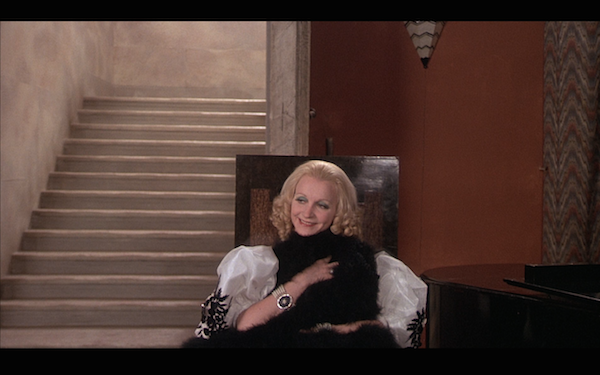
The prostitute and her stories divides the decadence.
Another point that impressed me was that many of the jokes (which included references to Woody Allen, South Park, and many others) were either sexual or toilet humor. They were funny, and that made it easier to endure the film again, but the guys pontificated as they were joking as to what that says about our culture. The fact that we can laugh at something this provocative and gruesome through infantile jokes speaks to our own immaturity and the puritanical nature of America. I’m not indicting the Wrong Reel guys because I laughed right along with them. They were more than aware of this double standard and wondered whether their reaction is a product of their own culture and upbringing, acknowledging that they cannot take consciously distance themselves from their background. Since sexual topics are taboo, a graphic film from the 1970s still allows us to get the giggles in a playful, embarrassing way. While the film was seen as graphic across the globe, it is telling that it was banned in Italy for the political themes, whereas it was banned in NYC for the adult content. They and I were not offended, but instead looked for humor within the taboo.
Another interesting topic was the contrast of James and Mikhail. James is close to my age, so we grew up at a time when nude magazines were rare and taboo. Mikhail is the “token millennial,” as they called him, so he has grown up with access to pornography throughout most of his life. This was his first time viewing the movie, and a recurring question was whether growing up in the Internet age would desensitize him to the sexual decadence. Surprisingly, he was not as fazed by some of the content that James and the others were. Sure, there were some scenes that got to him. There was a certain “circle” where they all pretty much lost it and the ending is hard for anyone to watch. In other scenes, the desensitization was apparent. During some of the sex scenes, he was the one to point out when things were obviously fake, like with prosthetics and sexual positioning. The illusion was shattered for him, whereas even with the second viewing, I was still disturbed and not as discerning.
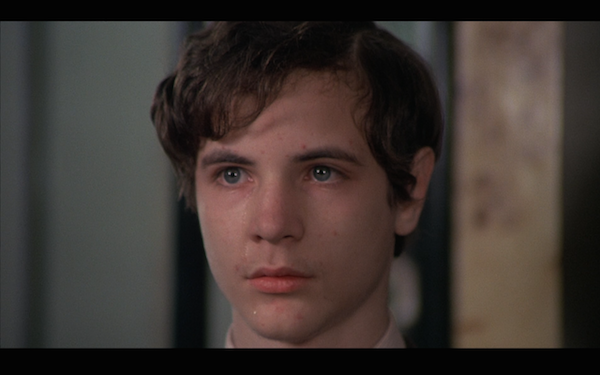
One of the many tragic faces within Salo.
The overarching theme of Salò is the mad, damning influence of abject power. The class in power has the ability to subject a lower class to whatever behavior they desire, and they derive pleasure from their supremacy. The response of their subjects is of mostly that of submission. There is some rebellion, some collaboration, and even some romanticism, but they are for the most part mortified as they are subjected to horrific acts against their will. The same is true of a tyrannical government and their subjects. A repressed population has no human rights and has scant options. In the case of Salò, it was basically to submit or die.
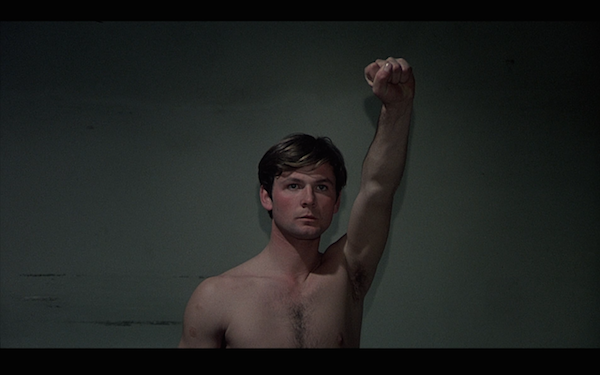
The face and fist of rebellion.
The most powerful scene is unquestionably that of absolute rebellion. Someone is caught breaking one of the rules, and rather than protest or plead for his life, he uses his final moments on this earth to make a statement. His oppressors have humiliated him, but he still has his honor. His final action against them, however futile, is powerful, tense, and one of the few optimistic moments of the movie. His captors even react to it, hesitating before they take his life away.
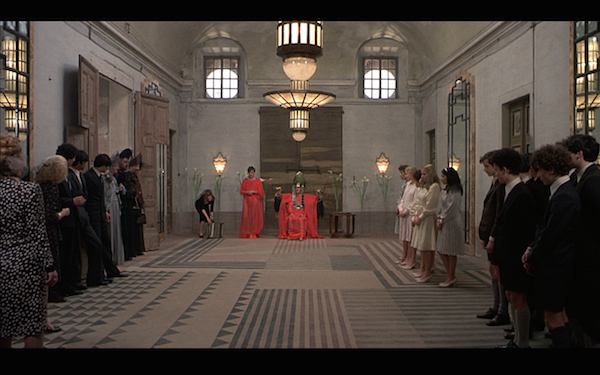
The use of a long shot with a lot of space.
One technique that Pasolini uses frequently is the use of space and long shots. In many respects, this puts the audience in the perspective of the captors, on board with those in power. He turns the tables on us and makes us the voyeurs that are visually engaged with the terrible things happening onscreen. The most notable example is in one of the final scenes, when the Fascists are outside torturing their prisoners, but the view is from upstairs and inside the house. We even see it through binoculars within the camera. While this is the most overt example, there are other similar vantage points throughout the film. We are often placed inside the eyes of the Fascists. During the long shots of large rooms, we see what they see, and by extension, are party to it.
From a filmmaking perspective, Salò is a masterwork. The shot selections, cinematography, performances, and locations are all top-notch. The Wrong Reel guys notice this as well, and they are correct when they say that if this were an amateurish film, then it would be dismissed as yet another 1970s porno. Pasolino, having already completed many well-done movies, like The Gospel According to St. Matthew, which made my top 10 of 1964.
On a second viewing, with or without the commentary, Salò is an easier film to stomach. With the shock value minimized, it is easier to understand the message and appreciate the film, even if it is not something that can be easily “enjoyed.” I came into this film expecting to be disgusted yet again. When it ended, I was impressed by such a provocative and startling political allegory. I still cannot rank it among films I like, yet I now have a greater understanding and respect for it as a piece of art.
Film Rating: 6.5/10
Supplements:
Salo: Yesterday and Today: This is a short documentary that shows some behind the scenes interviews intercut with interviews, including some with Pasolini.
In a grainy black and white, they show the overhead shooting of the final torture scenes with Pasolini interacting with the actors. One of the fascists asks: “do you have anything nasty for me to do?” Pasolini responds to “wait until next scene,” which we later find out is the candle burning scene.
Pasolini talks about the genesis of the project. He gave it a Dante-esque structure when working on the screenplay for another director, Sergio Citti. This was the division of the story into circles. Citti became lost interest while Pasolini became more engaged with the project, and wanted to use to to bring Marquis de Sade to 1944-45.
Pasolini says that the sado-masochism “reduces the human body to a commodity.” It is about the anarchy of power and the nonexistence of history. All of the schools of thought do not exist in the world of Salo. It is a metaphor of power to the people subjected to it, while also is a statement about capitalism. Man is a conformist, and we see that Pasolini indicts people who join forces in the subjugation of others. They do this out of self preservation, but it is not noble or right.
Pasolini was murdered right before setting up the French dubbing of the film. This of course was a shock and frightened everyone. It is still very much a mystery, with some believing that he was murdered because of Salo.
Fade to Black: This is a 2001 Nigel Algar documentary that disputes that Salo is pornography. By the time it was released, nobody had ever seen a film like Salo. Bertolucci saw it just after Pasolini was murdered, and couldn’t bear the film because of the tragedy. He hated the film initially, but it came to him that “there was something sublime in the nightmare.” It was considered by many to be pornography because there was no other way it could be categorized. The key difference is there is nothing pleasurable or sexually stimulating when watching the movie. In many ways it is an “anti-pornographic” and political film, which continues the traditions of Rome Open City, The Night Porter, and The Conformist.
The End of Salò: This is a 40-minute documentary, mostly interviews with people involved with the project. It begins with them talking about the “Circle of Shit” scenes. The substance was made of chocolate, and the actors ate it with gusto. “The greater the gusto, the more shocking the scene,” says one of the actors playing Fascist royalty.
They had long meetings with the script, de Sade’s text, and Baudelaire, so there was quite a bit of sadistic material to work with. They pitched terrible ideas to each other and they formulated the film. One shot that was cut was a dance sequence with an ensemble that was to be the ending. Personally, I think the true ending is far more appropriate.
Dante Ferretti: – This is a 12-minute interview with the Production designer about Pasolini’s films and their relationship. Talks about his origins in film and how he met Pasolini, worked with him first on The Gospel According to Saint Matthew., which was Ferretti’s second film. He really respected Pasolini after Accatone. With Salo they were going for minimalism. He said it should not be pursued as a painting, but as a graphical way of highlighting symbols. He intentionally did not move the camera much.
Jean-Pierre Gorin: Interview with film scholar. He talks about how the film is not realist, but an adaptation of Sade to the Italian republic. Pasolini was using the past to reflect his present, the end of the 1960s.
The story, while grotesque, is deliberately meant to incite laughter. He does not mean this in an infantile sense, or out of fear or terror, but someone who sees these “elements of the machine so exposed, and see that it is never going to stop.”
Gorin compares it to In the Realm of the Senses because they both reflected the ideals of the 1960s. Both can be considered pornographic films that question society, yet they both have a historical perspective.
Lastly, he says that there is a lot of love in Pasolini’s films. They are tougher to find in Salo, but there are moments of tenderness, especially the ending.
Even though Salo is a polarizing and difficult film, the story behind it is fascinating. Criterion did a fantastic job with the project, with a wealth of supplements and a booklet with several essays. Even though the film is disturbing, the release is recommended.
Criterion Rating: 8.5/10
Bigger than Life, Nicholas Ray, 1956

Nicholas Ray had an uncanny ability at capturing the social isolation and detachment of certain groups during the 1950s, that contrasted with the pristine, manufactured image of the obedient nuclear family as seen on TV. He played around in a variety of genres, such as the western (Johnny Guitar), the teenpic (Rebel Without a Cause) and family drama with Bigger than Life. Even if the setting and plot are different, the primary message is the same — moral decay and hypocrisy that is taking place with the changing times.
The first shot is fired by showing Ed Avery’s (James Mason) poor financial condition. He is a well-spoken, intelligent school teacher, yet he is required to moonlight as a cab dispatcher in order to supplement his income. Embarrassed, he lies to his wife, saying that he has to stay late in order to meet members of the school board. At one point of the film, he decries that “I’m a school teacher, not a plumber,” when someone asks him about money. By making a direct comparison between a learned educator and a tradesman, Ray is making a commentary on the inadequate income of teachers, a disparity that sadly still exists today.
When we meet his family, we are surprised to see that he lives in a traditional, suburban neighborhood, reminiscent of the types seen on TV shows like Leave it to Beaver (coincidence: Jerry Mathers who later played the Beaver appears in this film). This type of living would be considered middle class in the 1950s. He has a wife that stays at home and a child that enjoys watching television, just like most other suburban families. He has to work both jobs in order to maintain this status of living. We can tell from the paintings and posters in the house that his true passion is not at home, but instead exploring the great tourist cities of the world. Circumstances will not allow him that luxury.
It is sickness that changes him. He has a rare condition that inflames his arteries, with a dire prognosis of one year to live without trying an experimental drug – cortisone. It is unfortunate that they named the drug, which back then probably was more in the experimental category, but today is commonplace for treating a variety of injuries and has documented side effects. What happens in the movie is not what would happen in reality with this medicine, but that is beside the point. He is really sick of modern, American society, and the side effects that materialize motivate him to reject and criticize his world.
The medicine works at first. In fact, he is happier than ever at home and he participates and seems to belong in the stereotypical nuclear family environment.
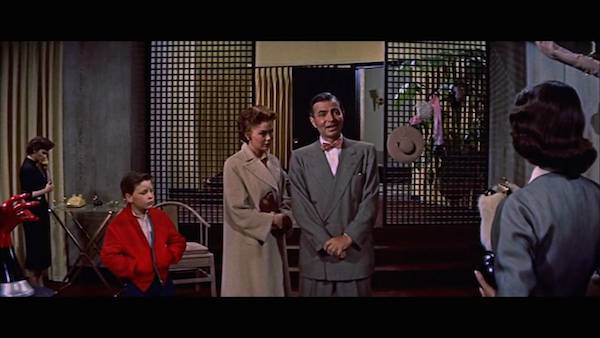
The new Ed embraces materialism and consumption. In order to please his wife, he takes her to an expensive dress shop and encourages her to pick one out that she likes. They cannot afford such a dress, and this expense will come back to haunt them later in the film. What is important is that, or specifically he, feels the need to purchase a dress because that will make his wife happy and give him the appearance of being a good husband. They do not need the dress, just like they do not need most material objects found in their home, but they are helpless not to participate in the capitalistic craze.
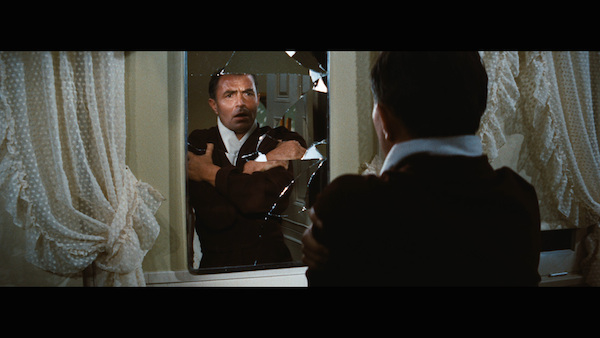
It is about midway through the film when the change in Ed begins. His wife abruptly acts out by breaking the bathroom glass mirror in a sudden rage. “You’re not in the hospital now!” she yells. He looks at his reflection in mirror and sees himself in shambles. This action is unprovoked and his wife quickly apologizes, but it sets his downfall in motion. Is the mirror fragments in two, so does his personality. What emerges is an unpleasant, unkind human being who thinks he has all of the answers for society’s ills.
One of the better scenes of the movie is when Ed is at an evening parent-teacher conference. This is the new Ed, and he says what he really thinks without a care of how it is received. He compares his students to gorillas that are victims of the deterioration of poor educational values. The fact that teachers are paid so poorly probably sparks this manner of thinking. Without economic incentive, why should they bother shaping and molding their students into bright and productive members of society? When he says that they are teaching an inferior class of students, one person suggests that he should be the Principal. In reality he is saying what the other teachers will not say, that things are not quite right.

This new Ed has a new world vision and challenges himself to make a difference. Meanwhile, his home life falls apart because he expects too much of his wife and child. He becomes a bad husband and a bad father, and things get worse as he becomes addicted to the medicine that is supposedly healing him. He takes more than his prescribed dosage, even forging prescriptions, and eventually loses his mind. The latter portion of the movie is Ed settling into his psychosis and nearly committing a terrible act.
The movie ends by him coming to after being off the medicine. He remembers his behavior and immediately feels ashamed. You could call it a happy ending, and for the Avery household, it probably is for the short-term. In the long-term, there is no way that life will be happy and pleasant for them. These issues still linger and will not resolve anytime soon. If Ed gets sick again, the cycle could repeat itself or he may die. In a way, this ending is an embracement of the status quo. There are no quick solutions for the Avery family, just as there are not for suburban society at large.
Film Rating: 8/10
Supplements:
Commentary: with Geoff Andrew, film scholar and author of The Films of Nicholas Ray. This was a disappointing commentary. I’m sure Dr. Andrew has plenty of credibility as an academic, but I think he left a lot to be desired. His voice is dry and not exactly exciting, although that’s not exactly uncommon in academia. Many excellent commentaries come from scholars with dry and monotone voices. It is the material that makes the difference. Maybe it was the level of preparation, but Dr. Andrew did not provide as much insight into the film as most Criterion commentaries. He makes many interesting comments, but does not elaborate on them with much detail. For instance, he mentions that Ray thought teachers were underpaid, and then moves onto another point, often making an observation that the viewer can make.
One of the more interesting insights was that Ray had interest in architecture, specifically Frank Lloyd Wright. This can be seen in a great many of his films, and especially Rebel Without a Cause. Ray used buildings very well in his films, and this was no different. Andrew makes some observations about the posters in the house. Downstairs has the public type of décor, like the Grand Canyon. Upstairs is private and exotic, with posters of faraway, cultured cities.
This period of Ray’s life was a period of depression and many of his themes were formed by the red scare, HUAC politics of the time.
Profile of Nicholas Ray: This was a 1977 TV interview with the late critic, Cliff Jahr. Not too much of the interview was about Bigger than Life. This may be the only Ray film to come to Criterion, so this can certainly be excused. One of the first questions is whether Ray gets tired of questions about Rebel Without a Cause. The answer was an emphatic no, because the subject is still relevant today and people connect. He only likes to talk about films that remain relevant. Most of the follow-up questions have to do with Rebel, including the obligatory James Dean question. I’d wager he was tired of those.
He talks on a few occasions about his mentality back during his peak filmmaking years. He says that a lot of his working back then was insanity and that “I work better now. I like myself better now.”
Jonathan Lethem: This is one of the novelists favorite films and he does a great job with his analysis.
What’s interesting about the movie is what it excludes. There is no teenage rebellion, rock and roll, or any deviancy. Things are too perfect. I thought the same thing when I saw how well behaved the students were in class. This was definitely deliberate.
There are numerous class issues. The house may look very suburban, but it has several blemishes. With a closer look, Lethem says it “barely qualifies” as a representation of suburban life. The fiction is that they can afford what they want, which is of course not the case. That’s why the dress scene is so important.
Susan Ray: Ray’s ex-wife reflects on her husband.
His process was “creative chaos” and “responsiveness.” He was keenly aware of what was going on around him, and he was best at observing people’s natures. He “had passion in finding deepest possible truth in a human being.”
A real hero is a “poor slob” like you and me, as he would put it. Even though he had a sense of masculine bravado, he also had a humble and sensitive side.
Ray’s choice of suburban life was because he saw the deadening and sterility. He had a jaundiced view of his own generation, calling them “betrayers.”
Criterion Rating: 8.5
Three from Jean Vigo
À PROPOS DE NICE, 1930

Jean Vigo’s debut film falls very much into his idea of “social cinema.” He was a leftist (specifically an anarchist with communistic leanings), which I’ll talk about in more detail later. He was driven to film as a means of expressing his political world view.
À Propos de Nice is a silent documentary short, but it is unlike most of the ones you’ve likely seen. There are no title cards and little actual narrative. It is more of a slice of life documentary about the coastal town of Nice, France. It shows the flow of rich vacationers contrasted with the locals that put on a show for them, and reaches a crescendo that makes a thinly veiled political statement.
The beginning shows a number of upper class, upper crust people lazily enjoying the sun-drenched city. Some are simply walking and looking distinguished; others are enjoying a book on a beach chair; while others are taking sun naps. Occasionally Vigo will show a lower class citizen just to keep the viewer’s attention. For instance, between shots of opulence in action, there is a shot with a garbage collector. There is another shot with a clearly wealthy individual sitting in a chair, and a homeless person sits next to him. Vigo holds that shot, accentuating their differences, yet they are still both sitting idly near a gorgeous beach.
Vigo gets a little more adventurous with some daring, staged shots, which get crazier as the film goes on. There is one such scene with a lady sitting quietly in a chair. The scene cuts and we see the same lady in the same position, with a different wardrobe. It cuts again to yet another wardrobe, and continues to cut a couple more times. The last cut reveals her sitting completely nude in the same chair position. In this manner, the documentary is both jarring and humorous, which would be a constant.
Shots become more abstract as Vigo shows buildings from unusual camera angles, often sideways. He shows poor men wearing big hats, and we discover they are serving pies to their rich visitors. Finally we are shown a parade, including some large, comical figurine faces that were also shown out-of-context in the very beginning of the film. This is the real city of Nice. These are the workers that entertain the rich tourists, that depend on their livelihood and choose to look silly in order to facilitate the pleasure of the class above them.
The film ends with militarism and radical dancing. We see ladies doing the cancan, raising their legs higher in the air with each kick, threatening to reveal their hidden mysteries. These are again lower class, possibly prostitutes or at the very least loose women. Unlike the idle rich vacationers, they are partying wildly without a care in the world. They even dance over a pothole, with the camera covertly positioned inside, shooting them from below in a voyeuristic manner, even though it is obviously a staged shot.
We end with workers, soldiers, and fire. The message is clear when analyzed closely. It is at the hands of the workers that the future lies. Vigo shows them up to the task, upbeat and engaged, but the ending is not resolved.
Film Rating: 8.5/10
TARIS, 1931

Taris stands apart from the remainder of Vigo’s work. It was a commission to profile the famous French swimming champion, Jean Taris. While it was not a vehicle for his “social cinema,” it gave him the opportunity for some technical experimentation and expression that would be used again in his two final films.
The 9-minute short is a vanity film, with Taris showing off with his diving ability and his mastery of various swimming strokes. Vigo’s film language helps portray the swimmer in the most positive light possible. He shows close-ups of him while he is working hard, the respected yet agonized face of an endurance athlete. He reverses some of the diving scenes to make it appear that he dives, and then floats back to the diving platform.
The best footage is when Taris is underwater. There is no sound, which is appropriate for underwater footage. Taris is alone in his element. We see him in close-up, holding his breath, yet still enjoying himself and preening for the camera. If there’s any doubt as to his stature, it is quashed when the diving scene and a trick dissolve makes him appear that he is walking on water. Some may have seen that sacrilege, whereas his fans probably found it appropriate. He was an athletic celebrity.
Even though this is a technically accomplished film, it exists for the sole purpose of making someone look good. That makes it the outlier of the four films that Vigo would complete in his lifetime.
Film Rating: 5/10
ZÉRO DE CONDUITE, 1933

Zéro de conduite – or Zero for Conduct, as I will refer to it – is the most fully revealed of Vigo’s “social cinema.” I mentioned above that he was an anarchist. Even though his politics were complicated, Zero for Conduct helps clear them up. In some respects it is a blueprint for exactly the type of anarchic revolution that Vigo longed for, yet it takes place in the unlikely setting of a young boy’s school.
The children in the boy’s home are characters that many can relate to. They push the boundaries of authority, and try to get away with whatever they can. They are into hijinx, practical jokes, and overall misbehavior. They are not a peaceful bunch, and they give it to their teachers at every opportunity, whether to their face or behind their backs. The only exception is Monsieur Huguet, who they find as an allay and a character that understands them.
The other teachers are impatient for any mischievousness, and they rule with an iron fist. “Zero for Conduct” is the punishment for any transgression. It means that they are not given their freedom on Sundays to visit family or friends, and instead are required to stay in school at detention. Furthermore, the teachers dole out the punishment arbitrarily and unfairly. Vigo is intending to portray this as a totalitarian state where the lower class’ (or children’s) rights are being impeded.
The children may be the goats, but they also get to be the heroes. With some assistance from the friendly teacher, they lay out plans for rebellion. The planning is carefully orchestrated and is not put into action until the authority tries to compromise one of the oppressed. It begins with an expletive, continues with a rowdy food fight, and the revolt is in progress. The children hoist their flag and march with exaltation. The sense of freedom and liberation is palpable, just as Vigo expects that it would be in reality. Even though the film is of revolution, it is combined with the exuberance of childhood merrymaking.
Zero for Conduct was banned for a number of reasons. First and foremost, there is clear male nudity during the march scene. There is also the acknowledgement of a homosexual relationship between two males, one of which looks effeminate to easily be confused as a girl (full disclosure: I thought he was a she during the first viewing). Not only is it apparent on screen, but even the school officials take notice. In one scene when the pair are walking arm in arm, the headmaster tells another teacher that “we need to keep an eye on these two.” This was 1933, where the subject of homosexuality was barely even believed in common society, much less presented in the media arts. Finally, there was religious consecration as the children place one teacher in a crucifixion pose during the rebellion. This was too much for the censors.
While Zero for Conduct is an understandably controversial film that was a product of the post-Bolshevik era and Vigo’s politics, it is also far ahead of it’s time in film language. During the early years of French Poetic Realism, there had been plenty of radical images, but none that came close to Vigo’s penultimate film.
Film Rating: 9/10
Supplements:
Since this entry is about only three short films from The Complete Jean Vigo disc, I am only going to cover the commentaries in this post. There will be another post about L’Atalante and a wrap-up post to come, which will cover more supplements.
Commentaries – Michael Temple, author of French Film Directors: Jean Vigo contributed commentaries for all four of Vigo’s films.
All four films were producted with Boris Kaufman, brother of the filmmakers that created the legendary Man With a Movie Camera, and he had significant success after the Vigo years. He already had a great deal of film background when the collaboration began, whereas Vigo was young and inexperienced. The partnership may not have happened if Vigo had not financed À Propos de Nice with his marriage dowry. The collaboration was beneficial to both, and they grew as filmmakers, which is more than evident from the quality of their work.
Temple claims that Vigo is considered one of the more celebrated filmmakers in French film history. This is amazing given that he made a mere four films, and only one of which was a full length feature. Vigo’s work was not appreciated during his lifetime and would be rediscovered by filmmakers such as Truffaut and Godard during the French New Wave.
I’ve already referred to the term “social cinema,” which is a phrase I received another source (Republic of Images, Alan Williams.) Temple says that Vigo called À Propos de Nice a “social documentary.” It is divided into three parts: 1) Wealth. 2) Contrasts 3) Revolution. Vigo himself appeared in the cancan dance sequence, kicking his legs up with glee with both women around his arms.
Taris was the exact opposite of Apropos because it was commission. Vigo received it because of his name recognition after À Propos de Nice. He used the commission to learn more about film technique, which he would use in his two final films. The most notable items he recycled were the underwater scenes, which he shot by using portholes underneath.
The producers did not like his version and hired someone else to finish. We do not know for certain whether it is all Vigo’s work in the final film. Vigo rejected the film, but said he like underwater scenes.
Zero for Conduct was Vigo’s signature film. It was both based on his personal experience in a children’s home, and it expressed his anarchist ideology throughout the film.
Merde is a magical word in anarchist culture. It is a difficult translation from French (literally translates as “shit”), but the word is not always profane. Sometimes it is just a desire to shock or go against conventions. It is a word used within revolt.
Vigo sees anarchism and revolution as joyful, and that is eloquently presented in the film. The kids are having an absolute blast, while it is also a call to freedom.
The final confetti slow motion rebellion scene is one that Vigo borrowed from his underwater scene. If you watch it carefully, it is reminiscent of how Taris was shot with it’s subject swimming under the water.


 Criterion Close-Up